
Finding the next high-growth neighborhood before prices increase represents the ultimate advantage in real estate investing. Savvy investors in 2026 use AI-powered tools that analyze hundreds of market signals simultaneously, uncovering emerging areas that traditional research methods miss completely. 
The difference between lower returns and exceptional profits often comes down to timing and location intelligence.
Traditional neighborhood research relies on lagging indicators, such as recent sales prices and demographic reports. By the time these trends become apparent, early investors already captured the appreciation.
AI transforms this equation by monitoring leading indicators, including permit activity, infrastructure development, business openings, and employment growth, to identify transformation before it reaches mainstream awareness.
Platforms like Homesage.ai Investment Potential combine predictive analytics with real-time market data to help investors discover tomorrow’s hotspots today.
This guide explores proven AI-powered investment strategies for identifying upcoming areas in 2026, from predictive market modeling to automated opportunity scanning.
Understanding AI-Powered Market Intelligence
How AI Identifies Emerging Neighborhoods
AI systems monitor dozens of signals that human researchers typically overlook or cannot process at scale.
These platforms track new construction permits, signaling developer confidence; retail and restaurant openings, indicating economic vitality; school rating improvements, attracting families; public transit expansions, increasing accessibility; employment growth, driving housing demand; and crime trend reductions, enhancing neighborhood appeal.
Natural language processing algorithms scan city planning documents, zoning change proposals, and infrastructure announcements to detect early signals of transformation.
Machine learning models trained on historical appreciation patterns identify which combination of factors precedes significant value increases.
Homesage.ai Property Information incorporates location-based analytics that continuously process these signals, alerting investors to opportunities 12-24 months before mainstream recognition.
Predictive Analytics vs. Traditional Research
Traditional neighborhood research examines what already happened, recent sales, current listings, and historical price trends. Predictive analytics forecasts what will happen by analyzing leading economic indicators, demographic migration patterns, infrastructure investment timelines, and development pipeline data.
This forward-looking approach identifies neighborhoods positioned for growth rather than those already appreciating in value. For investors seeking maximum returns, buying before appreciation begins delivers significantly better outcomes than chasing established trends. 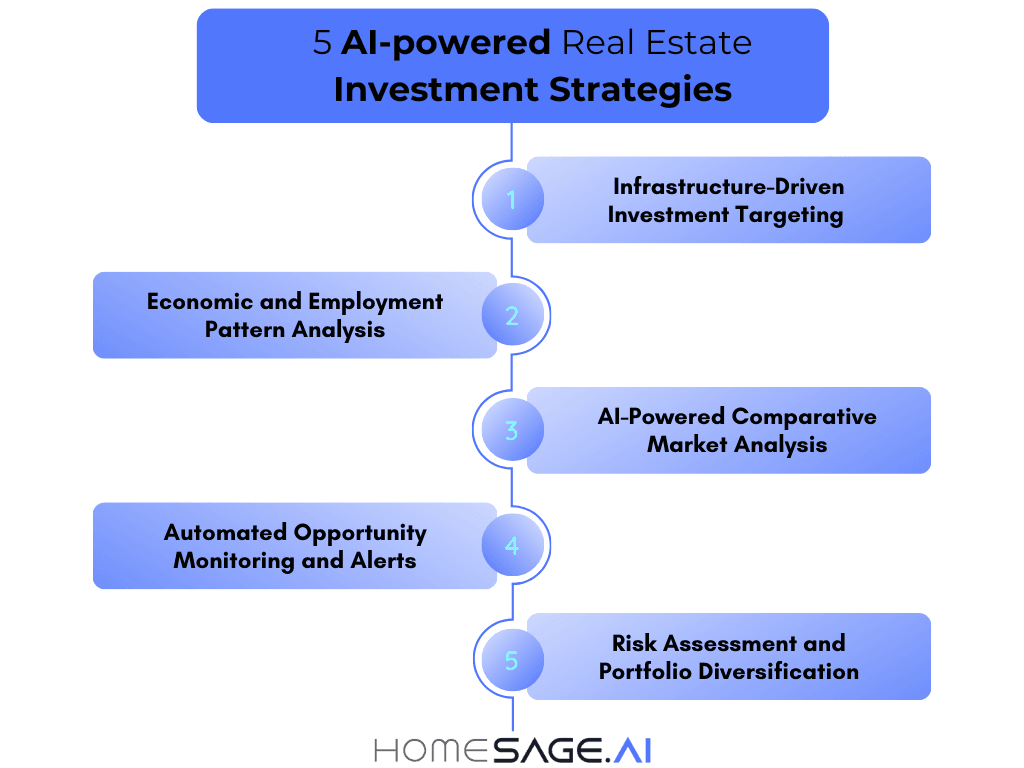
Strategy 1: Infrastructure-Driven Investment Targeting
Transit and Transportation Development
Major transportation projects create predictable appreciation patterns. AI tools track announced transit expansions, highway improvements, airport development, and bike infrastructure to identify properties positioned to benefit.
Properties within walking distance of new transit stations typically appreciate faster than market averages. Investors using AI to map these zones before construction begins secure acquisition prices reflecting current access rather than future connectivity.
Key indicators AI monitors include:
- Transit station announcements with projected completion dates.
- Highway expansion projects are reducing commute times.
- Bike lane networks are increasing neighborhood walkability scores.
- Parking facility development supporting commercial growth.
Homesage.ai Home Value Graph displays historical value trends in neighborhoods that experienced similar infrastructure improvements, providing data-driven forecasts for current opportunities.
School District Quality Trajectories
School quality improvements drive family migration and housing demand. AI platforms track standardized test score trends, changes in teacher-to-student ratios, facility improvement investments, and new school construction to identify districts on upward trajectories.
Neighborhoods with improving schools attract buyers willing to pay premium prices for access to quality education. Investors who purchase before school improvements are recognized for benefiting from both increased rental demand and property appreciation.
5 AI-Powered Strategies to Find Upcoming Areas
Strategy | What It Tracks | Why It Works |
Infrastructure Development | Transit projects, highway expansions, school improvements | Buy before connectivity increases property values |
Employment & Migration Trends | Job growth, corporate moves, and remote worker inflows | Identify demand surges before prices rise |
Neighborhoods with similar appreciation signals | Replicate past successful investments in new markets | |
Automated Opportunity Alerts | New listings, price drops, off-market deals | Act faster than competitors with real-time intelligence |
Risk & Diversification Analysis | Market cycles, portfolio concentration | Time purchases and spreads risk across markets |
Strategy 2: Economic and Employment Pattern Analysis
Job Growth and Corporate Relocations
Employment growth creates housing demand. AI systems monitor corporate expansion announcements, increases in job posting volume, declines in the unemployment rate, and wage growth patterns to identify markets experiencing economic acceleration.
When major employers announce relocations or expansions, housing prices near employment centers typically rise as workers seek convenient commutes. AI tools that track these announcements in real-time enable investors to acquire properties before widespread market recognition drives prices higher.
Platforms using natural language processing scan business news, press releases, and economic development announcements to identify opportunities as soon as they become public. This speed advantage is measured in weeks or months compared to traditional research methods that rely on quarterly economic reports.
Remote Work Migration Patterns
The shift toward hybrid and remote work continues to reshape real estate demand in 2026. AI analytics identify secondary and tertiary markets attracting remote workers seeking affordability, quality of life, and lifestyle amenities.
These tools analyze internet search trends for specific cities, migration pattern data, cost-of-living comparisons, and quality-of-life metrics to predict which markets will experience sustained inbound migration. Investors targeting these markets before demand peaks secure better acquisition prices and cash flow.
Strategy 3: AI-Powered Comparative Market Analysis
Cross-Market Pattern Recognition
AI excels at identifying patterns across different markets and time periods. Machine learning models analyze neighborhoods that experienced significant appreciation, extract common characteristics, and scan current markets for properties exhibiting similar patterns. 
This pattern recognition approach effectively clones successful investments. If an investor profited from gentrifying neighborhoods driven by specific demographic shifts and retail development patterns, AI can identify other markets exhibiting identical early-stage signals.
Homesage.ai AI Investment Property Search uses this methodology to surface opportunities matching your historical success criteria, scaling your best strategies across multiple markets.
Neighborhood Lifecycle Positioning
Different investment strategies suit different stages of the neighborhood lifecycle. AI tools categorize neighborhoods as pre-gentrification high-risk, high-reward; early gentrification moderate risk, strong returns; established growth, stable appreciation; and mature premium neighborhoods, stable, lower returns.
Understanding where a neighborhood sits in this lifecycle helps investors align strategy with risk tolerance and return requirements. AI platforms that automatically categorize neighborhoods based on multiple indicators significantly simplify this analysis.
Strategy 4: Automated Opportunity Monitoring and Alerts
Real-Time Market Scanning
AI platforms monitor markets continuously, alerting investors within minutes when properties matching specific criteria appear. These systems track new listings that meet location requirements, price reductions indicating seller motivation, increases in days-on-market suggesting negotiation opportunities, and off-market leads from public records.
For competitive markets where desirable properties sell within days, this speed advantage proves critical. Investors receive alerts, analyze deals using automated financial models, and make offers while competitors conduct preliminary research.
Homesage.ai Price Flexibility Score API determines negotiation potential by analyzing listing history and seller motivation, helping investors make competitive yet profitable offers.
Lead Scoring and Prioritization
Not all opportunities deserve equal attention. AI lead scoring ranks properties based on investment criteria, including ROI potential, condition versus asking price, neighborhood trajectory, and comparable sales analysis.
This prioritization ensures investors focus energy on the highest-potential deals rather than evaluating every listing manually. Machine learning models that learn from your past acquisitions improve scoring accuracy over time, effectively automating your investment thesis.
Strategy 5: Risk Assessment and Portfolio Diversification
Market Cycle Timing
AI algorithms analyze market cycles to predict optimal transaction windows. These systems analyze seasonal demand patterns, interest rate trends, inventory level changes, and correlations among economic indicators to forecast when markets favor buyers versus sellers.
For investors building positions across multiple markets, understanding where each market sits in its cycle helps prevent overconcentration in overpriced areas. AI tools that provide market-timing intelligence help investors deploy capital when conditions offer the most significant advantage.
Geographic and Strategy Diversification
Sophisticated investors diversify across markets and strategies. AI portfolio analytics evaluate risk concentration by geography, property type, investment strategy, and tenant demographics.
These platforms recommend optimal diversification based on historical performance data and risk modeling. For investors managing multiple properties, this intelligence prevents overexposure to market-specific risks that could impact the entire portfolio.
Homesage.ai Long-Term and Short-Term (Airbnb) Rental API compares cash flow potential across different monetization strategies, enabling data-driven diversification decisions.
Emerging Technologies Reshaping Market Intelligence
Computer Vision for Neighborhood Assessment
Advanced AI platforms now use satellite imagery and street-level photography to assess neighborhood condition and development activity. Computer vision algorithms detect new construction, property maintenance levels, retail vacancy rates, and public space quality by analyzing visual data.
This capability enables remote neighborhood evaluation without site visits. Investors researching multiple markets simultaneously gain unprecedented scale advantages through automated visual assessment.
Homesage.ai Property Condition API applies computer vision to individual properties, categorizing conditions as Excellent, Good, Average, Outdated, Poor, and Very Poor based on photo analysis.
Natural Language Processing for News Intelligence
AI systems using natural language processing scan thousands of news sources, social media feeds, and business announcements to identify market-moving events. These platforms detect sentiment shifts, development announcements, policy changes, and economic news that impact specific neighborhoods or markets.
This real-time news intelligence provides investors with information advantages measured in days or weeks compared to waiting for industry reports or economic data releases.
Watch this short walkthrough showing how Homesage.ai turns any US property address into a complete investment report in seconds.
The video covers after-repair value, flip and rental ROI, price flexibility, and neighborhood context—giving you a concrete example of how to apply the strategies in this guide to real deals.
Key Takeaways
- AI-powered market intelligence identifies emerging neighborhoods 12-24 months before mainstream recognition by monitoring leading indicators, including permits, business openings, infrastructure projects, and employment growth that traditional research misses.
- Infrastructure-driven strategies target neighborhoods near announced transit developments, highway improvements, and school enhancements, allowing investors to acquire properties at current-access prices before future connectivity drives appreciation.
- Employment and migration analytics reveal markets experiencing job growth and inflows of remote workers, helping investors position ahead of demand surges that elevate both rental rates and property values.
- Automated monitoring and lead scoring provide speed advantages in competitive markets, alerting investors to opportunities within minutes while AI scoring prioritizes the highest-potential deals based on ROI probability and market positioning.
- Risk management through diversification becomes data-driven when AI portfolio analytics evaluate concentration across geographies and strategies, recommending optimal allocations based on market-cycle positioning and historical performance patterns.
- Platforms like Homesage.ai integrate these capabilities through specialized APIs, including Investment Potential scoring, Property Condition assessment, Price Flexibility analysis, and dual Rental Income projections, transforming raw data into actionable investment intelligence.
Conclusion
The investors achieving exceptional returns in 2026 leverage AI to discover opportunities before markets recognize their potential. These tools process market intelligence at scales that are impossible for individuals to access, identifying emerging neighborhoods through signals that traditional research overlooks.
AI-powered investment strategies represent a fundamental shift from reactive analysis to predictive intelligence. Platforms that combine infrastructure tracking, employment analytics, automated monitoring, and computer vision assessment provide investors with institutional-grade capabilities previously unavailable to individuals.
Whether you’re building a fix-and-flip portfolio, acquiring long-term rentals, or targeting short-term (Airbnb) rental markets, integrating AI-powered market intelligence into your investment process isn’t optional; it’s how serious investors maintain competitive advantages in rapidly evolving markets.
Ready to discover tomorrow’s high-growth neighborhoods today? Explore Homesage.ai AI Investment Property Search to access predictive market intelligence that helps you find, analyze, and acquire properties in upcoming areas before appreciation begins.
Frequently Asked Questions
Q: How accurate are AI predictions for neighborhood appreciation?
A: AI models analyzing infrastructure, employment, and demographic patterns achieve significantly higher accuracy than traditional methods for predicting neighborhood appreciation 12-24 months in advance.
These systems excel at identifying leading indicators that precede price increases, though accuracy varies based on data quality, market liquidity, and unforeseen economic events. Combining AI insights with local market knowledge produces optimal results.
Q: Can individual investors access the same AI tools that institutions use?
A: Yes. Modern AI platforms offer flexible pricing, including API-based models and subscriptions, making institutional-grade market intelligence accessible to individual investors.
Platforms like Homesage.ai Real Estate APIs provide the same predictive analytics, property intelligence, and market monitoring capabilities previously available only to large investment firms, democratizing access to sophisticated investment tools.
Q: What’s the difference between AI property search and traditional market research?
A: Traditional market research analyzes what already happened using historical sales data and current listings. AI property search predicts what will happen by processing leading indicators, including permits, employment trends, infrastructure announcements, and migration patterns.
Q: How does Homesage.ai help investors find upcoming areas differently from other platforms?
A: Homesage.ai combines multiple specialized AI capabilities, including Investment Potential scoring that rates neighborhoods for appreciation probability, Property Condition assessment through computer vision, Price Flexibility analysis for negotiation strategy, and dual Rental Income projections comparing long-term versus short-term strategies.
In this guide
- AI agents for real estate
- custom AI solutions for real estate
- becoming a better investor with AI
- AI tools for estimating ARV
- the real estate affiliate program
- how AI is changing real estate data
- how AI agents help real estate pros
- long-term vs short-term rental
- how lenders speed up due diligence
- best SaaS affiliate programs
- finding rental properties with AI
- flip or rental
- AI market prediction indicators
- best browser extensions for investors
- AI for house flipping
- how investors analyze properties with AI
- how AI levels the playing field
- how to flip homes with AI
- how to select the best AI provider
- attracting real estate investors
- best real estate analytics tools
- finding distressed properties with AI
- AI-powered real estate data use cases
- AI from deal sourcing to closing
- AI investment property search strategies
- must-have AI real estate products
- AI metrics for spotting good deals
- top MCPs transforming real estate
- finding properties with equity potential
- AI for real estate investors
- predicting listing price flexibility
- calculating ARV with AI
- AI investing growth tactics
- a data-driven investment strategy
- maximizing profits with AI
- predicting real estate bubbles
- whether AI can help you find investments
- how hard money lenders use AI
- streamlining due diligence with AI
- AI tools for house flippers
- finding undervalued properties
- real-time property market insights
- AI property analysis platforms
- tech tools for agents
- the 2026 foreclosure guide
- 4 ways AI helps investors
- automating deal-analysis pipelines
- 8 best real estate tech companies
- the DealFinder Chrome extension
- off-market finder strategies
- the neighborhood evaluation guide
- 7 platforms to find off-market properties
- predictive vs traditional deal analysis
Put these strategies to work with AI Investment Property Search.





Nourhan December 22, 2025
Insightful!
Peter December 25, 2025
Good read