

House flipping has always been about finding the right property, estimating costs accurately, and maximizing returns. In 2026, artificial intelligence is changing how investors approach every step of that process.
AI-powered tools now read property conditions through photos, predict renovation costs, and identify undervalued properties before they hit the mainstream market.
Using AI for house flipping isn’t optional anymore; it’s essential.
Homesage.ai has developed a suite of AI-driven APIs covering 155M+ US properties that turn traditional flipping workflows into data powered decision engines, helping investors analyze properties faster and more accurately than ever before.
“Quick answer To flip homes with AI, investors run five tools in sequence: automated deal sourcing, computer vision condition checks, renovation cost estimates, ARV prediction and flip return analysis. Homesage.ai delivers all five as APIs covering 155M+ US properties and with Fannie Mae forecasting 6% mortgage rates for 2026, the investors who analyze fastest will win the recovering market.
Why 2026 Favors AI-Equipped Flippers
The market is entering a promising phase after the tight margins of 2025. Fannie Mae’s forecast has the 30 year fixed rate averaging around 6% in 2026, down from the 7% rates that dominated early 2025. Analysis of NAR’s housing data puts the effect at roughly 5.5 million additional households able to qualify for a mortgage, stronger demand for renovated homes.
At the same time, rising material costs and heavier competition mean thinner room for error. Traditional evaluation driving neighborhoods, comparing listings by hand, trusting gut instinct can’t match algorithms trained on millions of property transactions. That combination is exactly where AI for house flipping pays for itself.
Five Ways AI Transforms the House Flipping Process
1. Automated Property Discovery and Deal Sourcing
AI-powered search tools monitor listings continuously, flagging properties that meet your criteria: below market pricing, distressed conditions, emerging neighborhoods.
The algorithms also weigh factors manual searches for miss price history, days on market, seller motivation indicators and development patterns delivering early alerts and a first mover advantage.
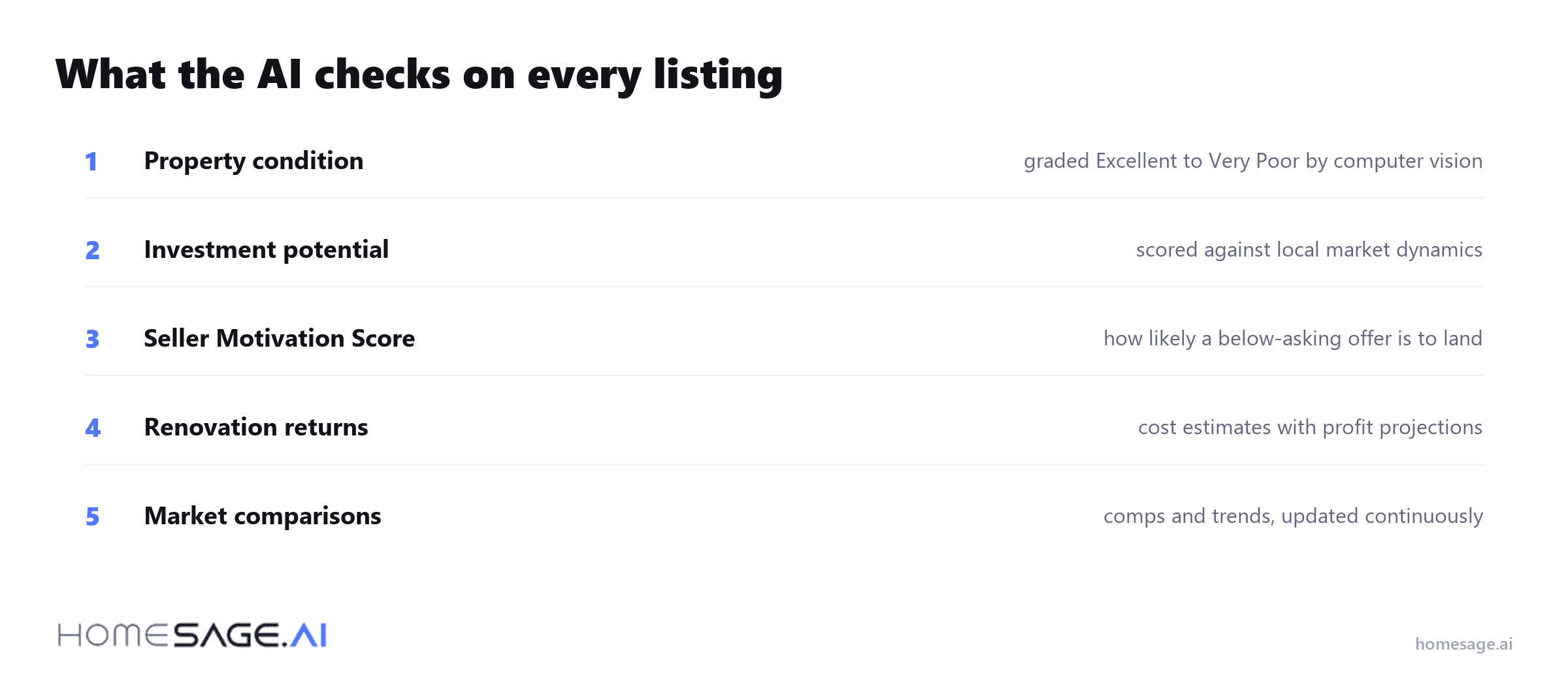
On the platform, every listing is checked for five signals:
- Property condition: Graded from Excellent to Very Poor by computer vision.
- Investment potential: Scored against market dynamics.
- Seller Motivation Score: Estimate how likely a seller is to accept the below request.
- Renovation returns: With profit projections.
- Market comparisons and trends: Are updated continuously.
2. Computer Vision for Property Condition Assessment
Walking through dozens of properties wastes time and still relies on judgment. Computer vision analyzes the property photos instead, detecting roof damage, foundation problems, outdated fixtures, and cosmetic issues by comparing the images against massive databases of similar homes.
The Property Condition API returns condition assessments across five levels, so you know before scheduling a visit whether a house needs cosmetic updates or major repairs.
3. Renovation Costs and Where to Stop Spending
Accurate budgets separate profitable flips from financial disasters. AI powered renovation cost estimators Analyze property characteristics, regional labor rates, and current material prices to generate line-item budgets in seconds. The Renovation Cost API covers kitchens, bathrooms, flooring, roofing and other common categories.
Over improving a property for its neighborhood is one of the most common mistakes in house flipping.
AI prevents it in two ways. It analyzes comparable sales and local trends so renovation style and finish match what the neighborhood pays for no luxury kitchens in mid-market areas. And the Maximum Recommended Renovation Cost metric draws a hard threshold beyond which extra spending won’t generate the returns to justify it, based on current condition, local buyer expectations, comparable price points and expected time to sell.
4. After Repair Value (ARV) Prediction
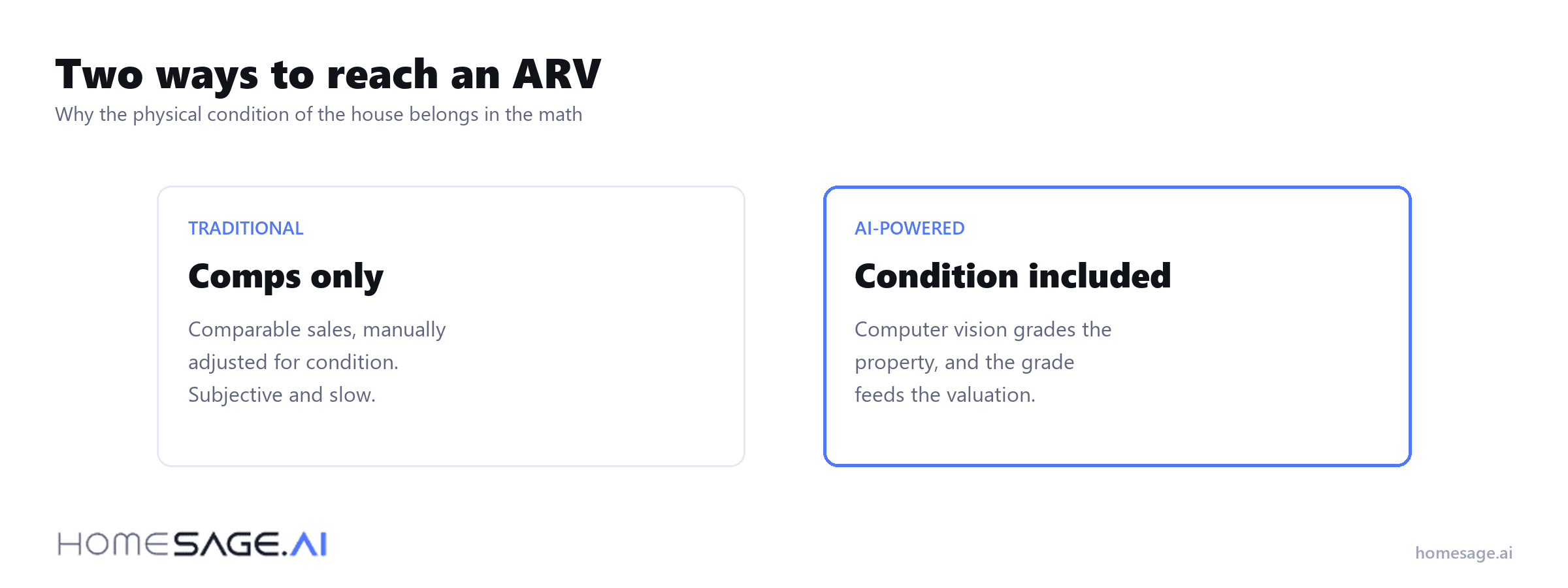
Traditional ARV estimation relies on manually chosen comparables and subjective adjustments as a process prone to bias. Machine learning models analyze hundreds of similar transactions at once and update continuously as new sales land.
The platform goes a step further: it is among the few that factor the physical condition of the house into ARV. The computer vision grade feeds the valuation, so a dated interior or damaged roof is priced in from the start more accurate than comps only estimates.
5. Investment Return Analysis and Risk Assessment
Confident purchases require understanding return on investment and risk. AI analysis tools calculate expected profit and holding costs across multiple scenarios of different renovation scopes, holding periods, and exit strategies so you can compare properties objectively.
The Flip Return API aggregates it all into one report: purchase costs, renovation expenses, carrying costs, selling expenses and projected profit documentation lenders increasingly expect. When the flip is done, the same data recommends a listing price that maximizes both sale speed and final price, avoiding the twin pitfalls of overpricing and underpricing.
Comparing Traditional vs. AI-Powered House Flipping
| Aspect | Traditional methods | AI-powered approach |
|---|---|---|
| Investment Property search | Manual MLS searches and driving neighborhoods | Automated monitoring with intelligent filtering |
| Property Condition assessment | In-person inspections for every property | Computer-vision pre-screening, targeted inspections |
| Renovation Cost estimation | Contractor quotes over days or weeks | Instant line-item estimates |
| ARV calculation | Manual comps with subjective adjustments | Hundreds of comparables, condition included |
| Time per property | Hours | Seconds |
Building Your AI-Powered Flipping Workflow
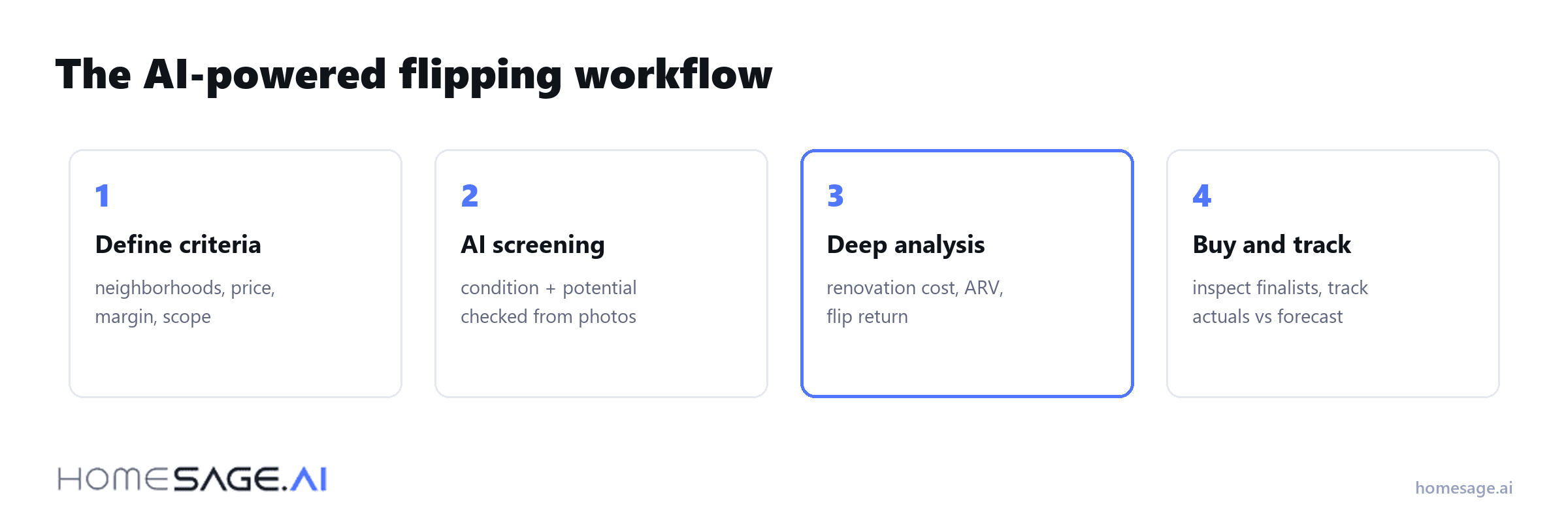
Start by defining clear investment criteria: target neighborhoods, maximum purchase price, minimum margin, acceptable renovation scope. Configure AI search to monitor matching listings and alert you to new opportunities.
When a promising property appears, run the condition check from the photos, then request the renovation estimate and ARV prediction, and compare projected cost against predicted value the platform’s Full Property Report runs the whole analysis in seconds. Schedule in-person inspections only for the properties with strong profit potential.
After purchase, rank improvements by value added, and track actual costs against the AI’s forecasts to sharpen your next deal.
A few habits keep the workflow honest:
- Use multiple data points to validate AI-generated insights.
- Combine AI analysis with local market knowledge.
- Regularly monitor market conditions, as recommendations change.
- Verify AI insights with on-site visits before final decisions.
Key Takeaways
- AI search tools spot undervalued listings first, monitoring continuously and alerting you before mainstream buyers notice.
- Computer vision pre-screens property condition from photos, replacing dozens of site visits with targeted inspections of real candidates.
- Renovation estimates arrive in seconds, and the Maximum Recommended Renovation Cost threshold protects margins from over-improvement.
- Condition-aware ARV beats comps-only estimates, because the physical state of the house is priced into the valuation.
- One API suite covers the whole flip, from the five discovery signals — including the Seller Motivation Score — through flip-return analysis.
- 2026 rewards speed: with rates easing and millions of buyers returning, the investors who analyze fastest will get the best deals.
Conclusion
House flipping in 2026 demands more than intuition and renovation experience. Investors who integrate AI gain measurable advantages in discovery, cost estimation and analysis of institutional grade capability, now available to individuals.
Homesage.ai delivers those capabilities through IT developer-friendly real estate APIs and MCP for investors, agents, contractors and PropTech platforms.
Ready to systematize your flips? Create a free account or review pricing to get started.
This video shows the property-condition side of the workflow in about two minutes, from photos to a usable condition grade.





Peter January 5, 2026
Very helpful!!!
Syadra January 5, 2026
Nice info in this blog. Thanks.
Robin January 6, 2026
Good read!
Mia January 6, 2026
Insightful article, very helpful info.
Brian January 9, 2026
AI can definitely make flipping easier
How Long Does It Take To Flip A House? 2026 Data October 10, 2026
[…] How do you flip houses with AI? […]