
Why coverage decides more than accuracy
Most writing about prediction argues about accuracy. That is the wrong first question. An indicator you cannot read on the house in front of you has an accuracy of nothing.
Coverage is the share of listings that actually carry a field. It varies enormously between fields, and almost nobody publishes it. So a model can be excellent and still be silent on two thirds of the market you are shopping in.
That is the gap this guide is built around. Each indicator below gets what it answers, how to read it, and how often it was actually there when we counted.
The 5 AI market prediction indicators that actually work
1. Price trend forecasting
Price trend forecasting projects where values in an area are heading, usually over six to twenty-four months. It leans on transaction history, inventory and days on market. It is strongest in liquid markets with plenty of recent sales. It is weakest exactly where you most want it, in thin markets with few comparable transactions.
Read it as a direction with a width, never a target price. A single projected value with no band around it is the midpoint of a distribution, presented as a fact. Ask what the forecast said six months ago, then compare that with what happened.
Best for: Deciding whether to buy now or wait a quarter in a market you already know.
2. Neighbourhood analytics
Neighbourhood analytics scores a block rather than a house. Permit activity, ownership turnover, rental concentration and new construction all feed it. Two streets a mile apart can move in opposite directions, and this is the only indicator that sees that.
Its weakness is lag in places where little is filed. Permit data is the backbone of most neighbourhood scores, so a city with slow or patchy permitting produces a score that describes last year. Check what feeds it before trusting a block-level verdict.
Best for: Choosing between submarkets inside one city.
3. AVM accuracy scoring
An automated valuation model returns a number. An accuracy score tells you how much to trust it, usually as a confidence band or a forecast standard deviation. Treat a value without one as an opinion. The band is the part that should change your offer.
In practice the band widens on exactly the properties investors buy. Unusual layouts, homes in poor condition and anything with few recent comparable sales all push uncertainty up. A tight band on a standard suburban house is easy. A tight band on a gutted duplex should make you suspicious.
Best for: Knowing when to pay for an appraisal instead of trusting the model.
4. Rental income forecasting
Rental forecasting estimates what a property will let for, and increasingly how occupancy moves through the year. It is the input every yield calculation rests on. It is also the field most often missing, which is the finding in the study below.
Where it exists, check the basis. A rent derived from active asking prices is not the same as one derived from signed leases. The gap widens in a soft market. Asking rents are what landlords hope for. Signed leases are what they got.
Best for: Underwriting a buy-and-hold before committing to a price.
5. Market cycle timing
Cycle timing places a market on the expansion to contraction curve, using absorption rates, price-to-rent ratios and construction starts. It will not time a top for you. It will tell you if you are buying into acceleration or into a slowdown.
It works at the scale of a year, not a quarter. Investors who try to use it to time an individual purchase usually end up waiting through a rise. Its real use is setting how aggressive your acquisition pace should be over the next several months.
Best for: Setting the pace of acquisitions across a year rather than a single deal.
How the five compare
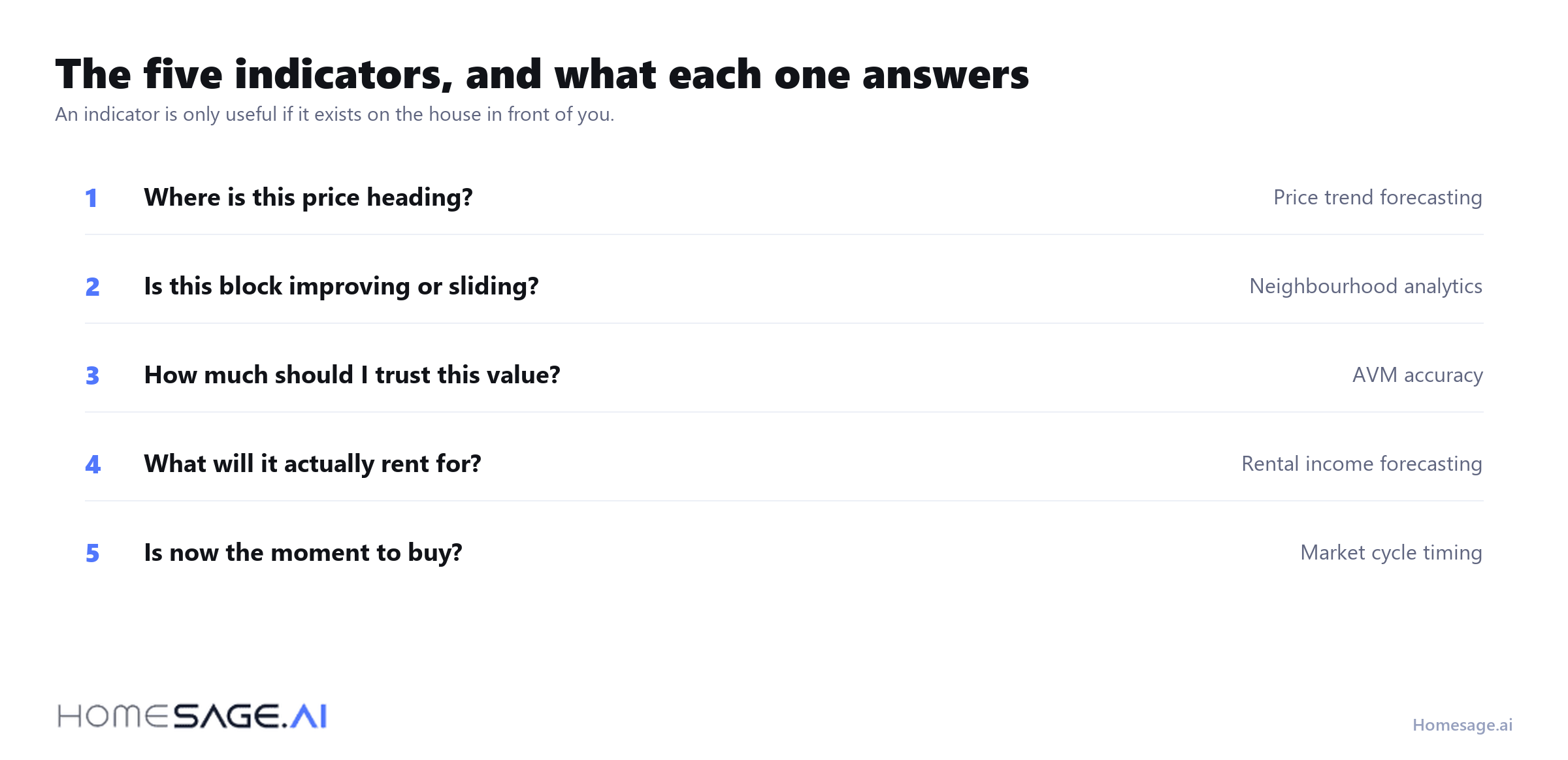
| Indicator | What it answers | Where it is weakest |
|---|---|---|
| Price trend forecasting | Where values are heading | Thin markets with few sales |
| Neighbourhood analytics | Which block is improving | Areas with little permit data |
| AVM accuracy scoring | How much to trust a value | Unusual or custom properties |
| Rental income forecasting | What it will earn | Coverage, not method |
| Market cycle timing | Whether to buy now | Short horizons and single deals |
Four of the five are limited by method. One is limited by whether the data is there at all, and that one is rental income.
How often these indicators are actually there
On 19 October 2026 we counted how many of the 1,021 active listings in Tulsa, Oklahoma carried each signal, using the Homesage.ai property database.
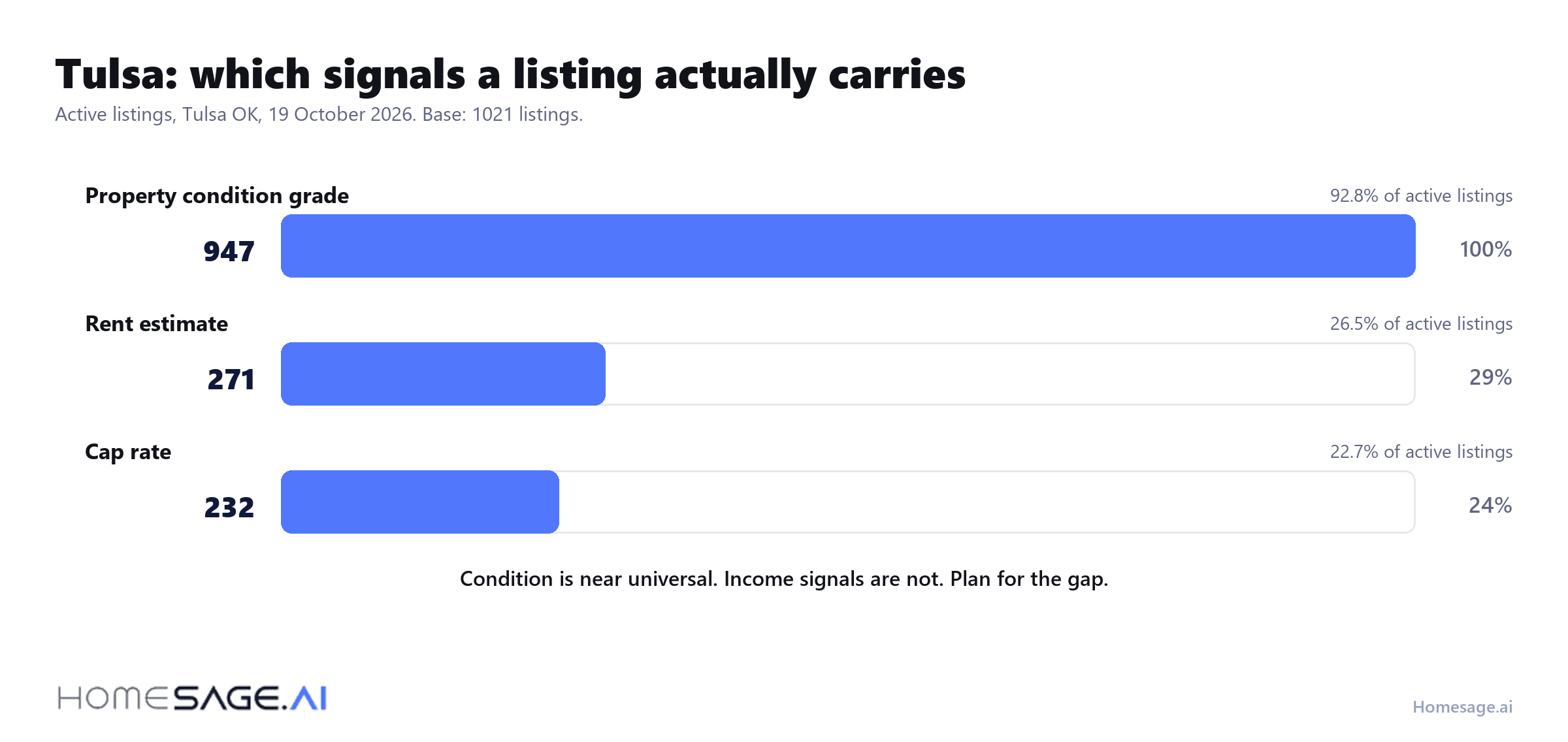
Property condition is close to universal at 92.8%. The income signals are not. A rent estimate exists on 26.5% of listings and a cap rate on 22.7%.
That gap is not a Tulsa quirk. We ran the same counts in Jacksonville, Florida and Omaha, Nebraska on the same day. Condition landed between 87.7% and 94.6%. Rent landed between 26.5% and 34.3%. Cap rate landed between 22.7% and 29.0%. The shape held in all three cities.
Condition is on nine listings in ten. A cap rate is on fewer than three.
The practical consequence is straightforward. A model leaning on rent or yield is working from roughly a quarter of the market. A model leaning on condition is working from nearly all of it. Neither is wrong, but the first deserves a wider error bar.
Every percentage above is a share of that city’s active listings on the day we counted. A listing missing a signal is absent from that count rather than scored as a failure.
What these indicators cannot tell you
Every indicator here describes a population, not your house. A neighbourhood score of eighty does not promise that the specific property on that street appreciates. It says the block has been behaving well. Individual outcomes scatter widely around any area average, and the scatter is usually wider than the forecast implies.
None of them price a shock. Rate moves, a plant closure, a zoning change, an insurance market repricing a coastline. None appear until the transactions that reflect them have happened. Every model here is backward-looking by construction, however current the data feed.
They also cannot see inside the house unless something is measuring condition. A model reading beds, baths and square footage treats a gutted property and a renovated one as the same asset. That is the single largest source of error in automated valuation. It is why a condition grade is worth more than another decimal place on a forecast.
Finally, they do not account for what you bring. Your cost of capital, your crew, your tolerance for a six-month hold. Two investors can read the same five indicators correctly and reach opposite, defensible decisions about the same house.
How to read an indicator without being led by it
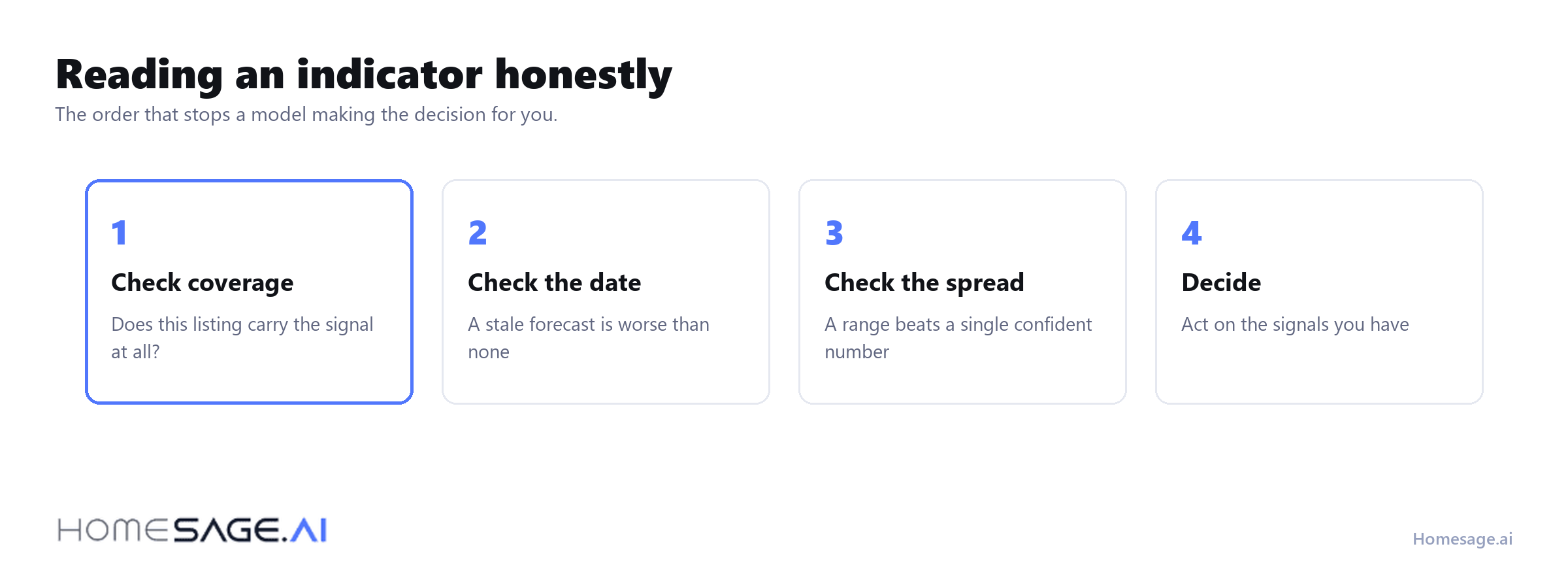
Check coverage first. Ask what share of listings in your markets carry the field before you build a process on it. A vendor demo always uses a well-covered property.
Check the date next. A forecast with no stated vintage is not a forecast, and housing data goes stale faster than most dashboards admit.
Then check the spread. A range you can argue with beats a single confident number. If a tool will not show you its uncertainty, treat the point estimate as marketing.
For the valuation half of this, our guide to the best real estate AVM tools goes deeper on how each model is built. For the platforms that package these indicators together, start with the best AI property analysis tools.
Estimated values, after-repair values, renovation costs and returns are model-derived estimates, not investment advice. Property data as of 19 October 2026.
Key takeaways
- Coverage beats accuracy as a first question. An indicator absent from your listings cannot help you however good the model is.
- Condition data is dependable, at 87.7% to 94.6% across three cities measured on the same day.
- Income data is not. Rent sat between 26.5% and 34.3%, and cap rate between 22.7% and 29.0%.
- Treat any valuation without a confidence band as an opinion rather than a measurement.
- Cycle timing sets your pace across a year. It will not time a single deal for you.
Conclusion
These five indicators are worth reading, but not equally and not everywhere. Condition and neighbourhood signals are dense enough to build a process on. Income signals are thin enough that you should plan for their absence rather than assume them. Ask any vendor what share of your market actually carries the field you are buying, and treat a vague answer as the answer.
Frequently asked questions
How accurate are AI market predictions compared with traditional methods?
It depends far more on data density than on the model. In a liquid market with many recent comparable sales, automated forecasts track professional estimates closely. In thin markets both struggle, and the automated version is simply faster about it.
Can AI predict which neighbourhoods will appreciate before prices move?
It can flag the leading signals, such as permit activity, ownership turnover and falling days on market. Those are correlations rather than guarantees. They are useful for ranking submarkets, not for promising an outcome.
What is the difference between an AVM and an appraisal?
An AVM is a statistical estimate produced from records and comparable sales, available in seconds. An appraisal is a licensed professional inspecting the property and defending a figure. The AVM is a screen. The appraisal is evidence.
Which indicator should I start with?
Property condition, because it is the one most likely to be present on the listing in front of you. It was on 92.8% of Tulsa listings when we counted.





Robin January 17, 2026
Good read!
Chris January 20, 2026
This is really useful information
Realtor.com API Vs Homesage API: 3 Use Cases Compared (2026) October 10, 2026
[…] Homesage.ai takes a fundamentally different approach by combining AI-powered property intelligence with comprehensive market analytics. […]