
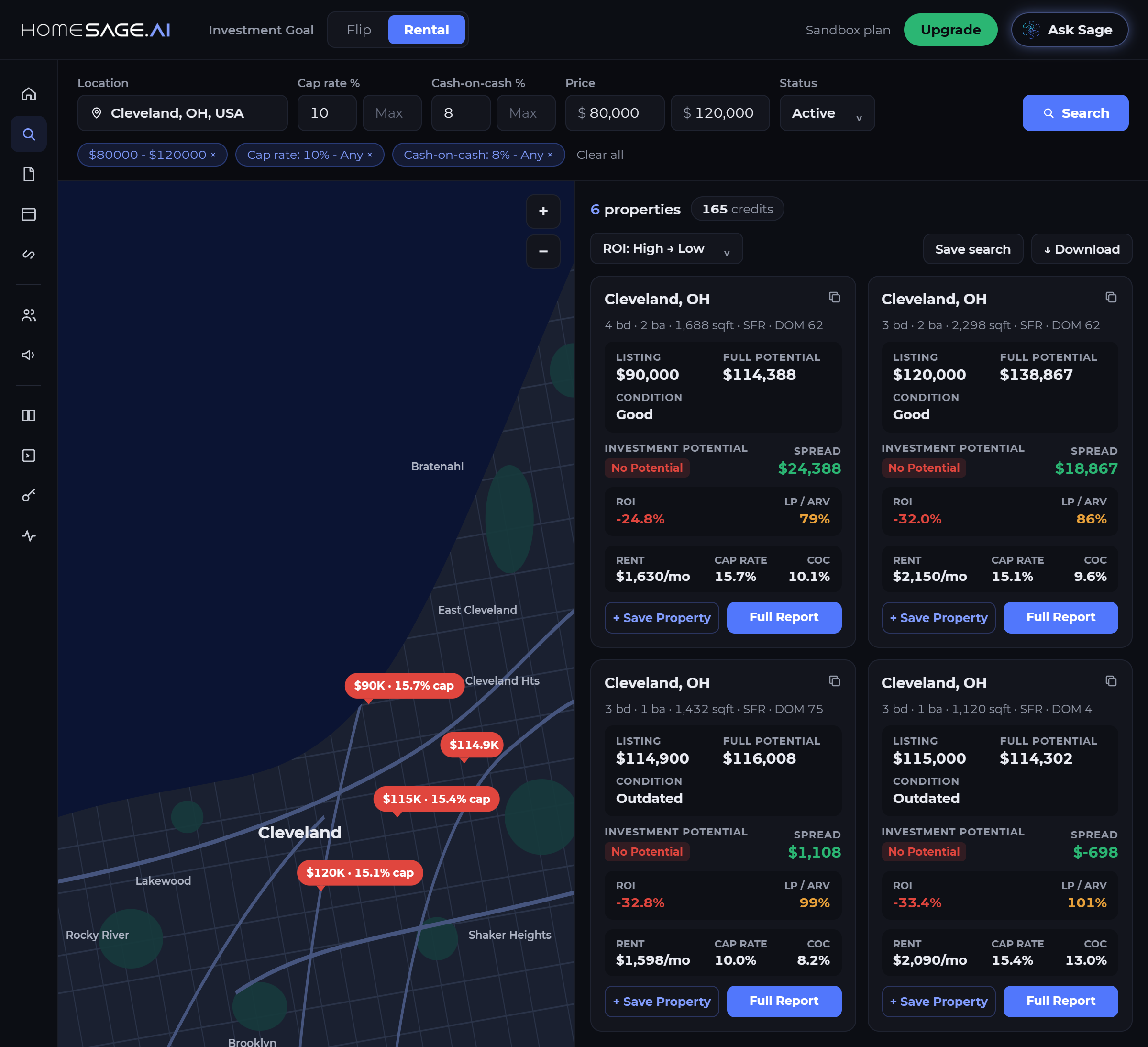
“Quick answerAn investment property search is a rejection exercise. 5 strategies do the work. Screen the criteria you set in advance. Read property condition from the photos. Let the financials make the first cut. Watch inventory move rather than waiting for a monthly report. Reach owners before a listing exists. On 11 October 2026, those filters took Cleveland from 1,099 active listings to 5 worth paying to see.
Most property search still happens the way shopping does. You open a portal, sort by price, and scroll.
That works for buying a home, where there is one of you and one decision. It fails for investing, where the job is to reject 99% of a market quickly and cheaply.
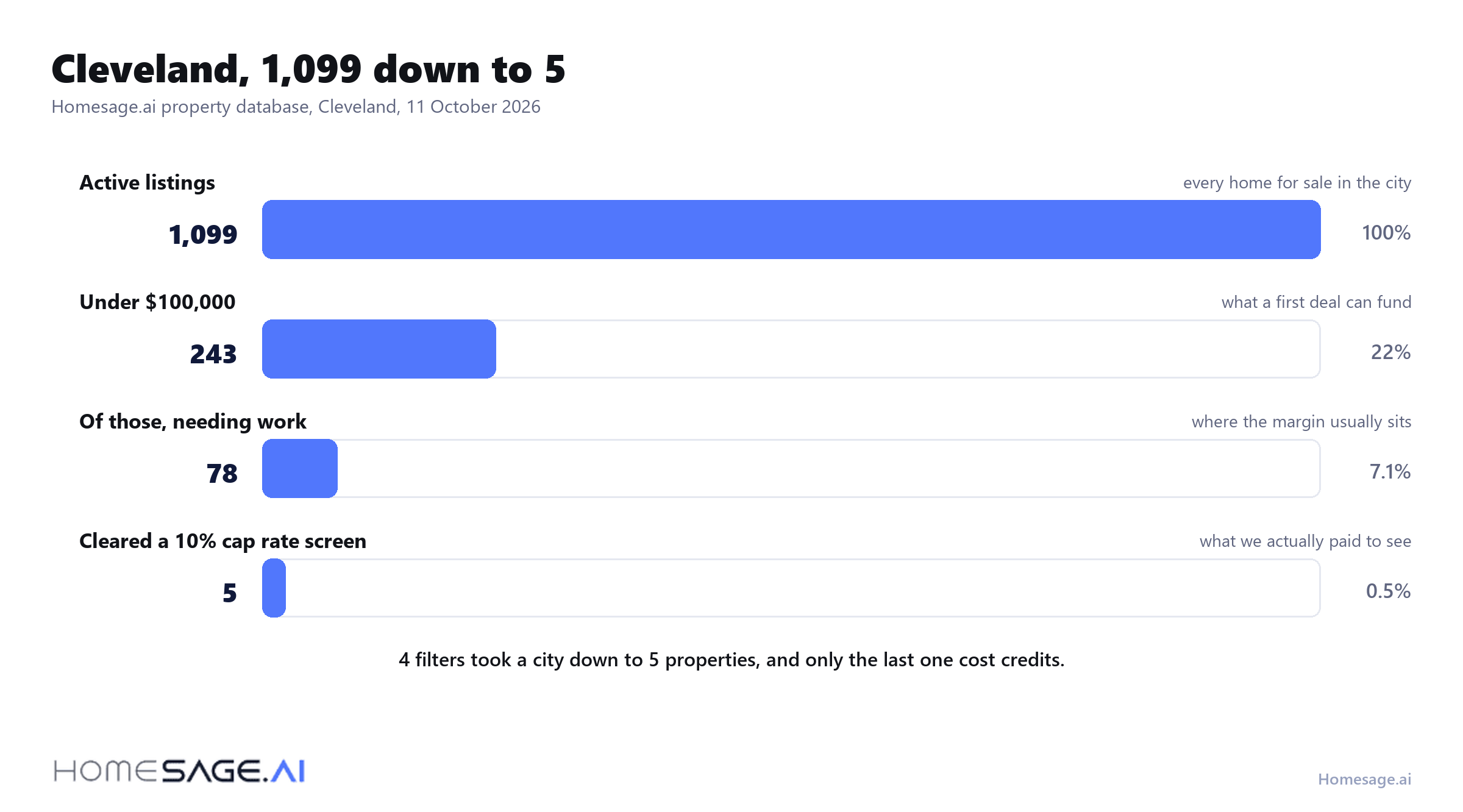
What the funnel looks like
We ran Cleveland through our property database on 11 October 2026 to put numbers on it.
| Filter | What it keeps | Listings left |
|---|---|---|
| Cleveland, active listings | Every home for sale in the city | 1,099 |
| Under $100,000 | What a first deal can fund | 243 |
| Outdated, poor or very poor condition | Where the margin usually sits | 78 |
| A 10% cap rate and 8% cash-on-cash floor | What the financing makes real | 5 |
Homesage.ai property database, Cleveland active listings, 11 October 2026. Counts move daily.
4 filters, a city down to 5 properties, and only the last step cost anything. That ratio is the whole argument for screening over scrolling.
Pick the market before the property
The first filter is the city, and it decides how much the rest of the funnel can do.
Cleveland carried 243 active listings under $100,000 on 11 October 2026. Columbus, 2 hours
That is a 6 times difference in how often the cheap end of the market even exists. A screen
that works in one city returns almost nothing in the other, on identical filters.
Property condition follows the same split. 78 of the 243 cheap Cleveland listings were in outdated,
poor or very poor condition, which is where a renovation margin lives.
Run the funnel in 2 or 3 markets before you commit to one. The counts tell you which city
your criteria can actually survive in. Our post on
buying a rental in a market you do not live in
covers what changes once that market is not your own.
1. Screen the criteria, not on listings
A portal asks what you want to look at. What makes a good investment property is the list those criteria come from. A screen asks what you refuse to buy.
Set the floors first. A price ceiling your financing supports, a yield floor you would accept, a property type you know how to run.
Then let the market fail your test. The 1,099 listings above did not need reading. 1,094 of them needed rejecting, and a filter does that in a second.
2. Read property condition from the photos
Listing photos are chosen to sell. The copy around them is written to sell.
A property condition score reads those photos and grades every house on one scale, from excellent and good down to outdated, poor, and very poor.
It is a screening instrument and not an inspection. It tells you which 78 of 243 houses are worth an inspector’s time.
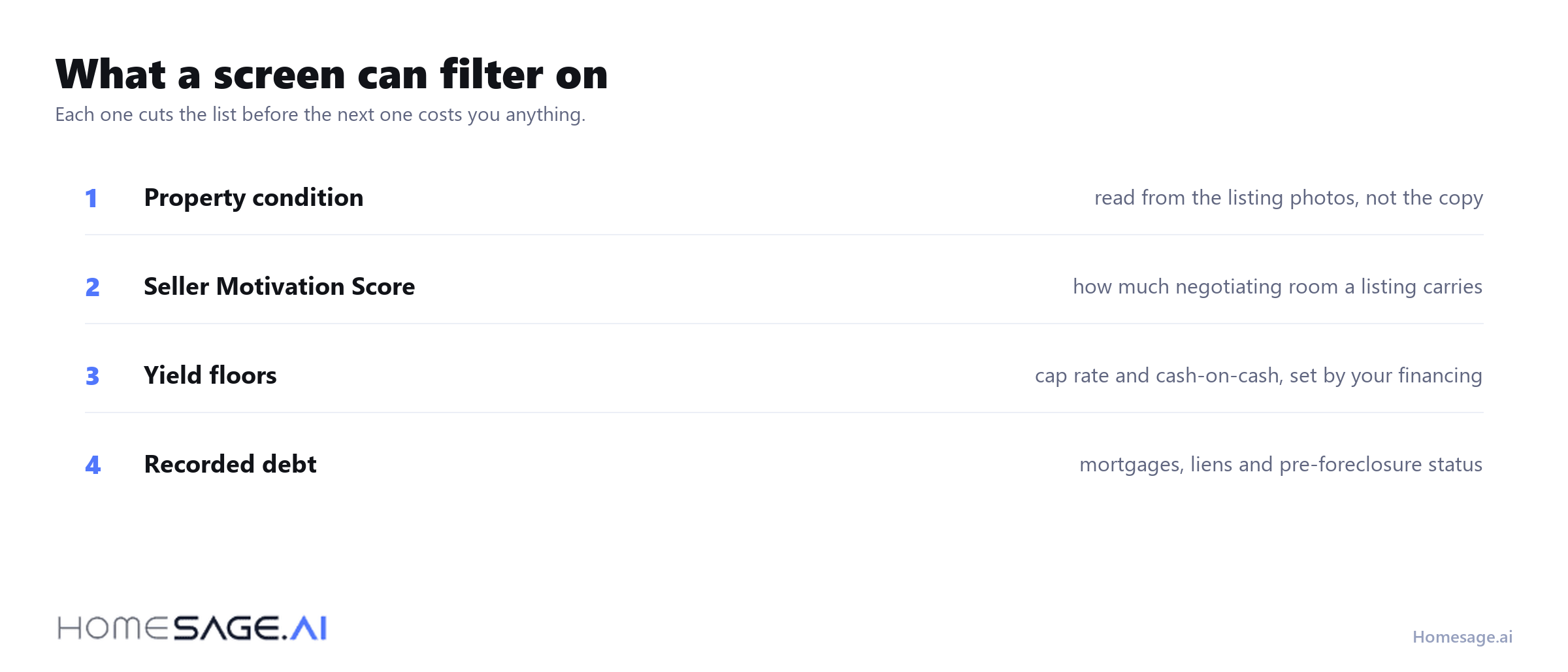
3. Let the financials make the first cut
Cap rate and cash-on-cash belong in the filter, not in a spreadsheet you build afterward. A good cash-on-cash return sets the floor worth screening on.
The difference matters because of what it saves. Pulling 243 properties into a model to find 5 is 238 pieces of wasted work. Filtering on the same numbers up front leaves only the 5.
Pick the right bar for your financing. A cap rate assumes you paid cash, so a leveraged buyer should screen cash-on-cash instead.
Most of the property search is throwing houses out. The sooner you do it, the less it costs.
4. Watch inventory move, not the monthly report
A monthly market report describes a month that has already closed. Finding undervalued properties depends on reading inventory as it moves.
Inventory does not wait for it. Cleveland went from 1,010 active listings on 7 October to 1,099 on 11 October, which is 89 new listings in 4 days.
Screen weekly and you meet 7 days of inventory at once, after everyone who screened sooner. Days on market only goes up, and a price cut is most useful the week it happens.
5. Reach owners before a listing exists
The hardest competition is the listing itself. Once a property is public, every screen in the market sees it on the same day.
Off market works in the other direction. You pick the houses you want on the criteria above, then find the owner.
That is a different job, and it has its own costs. Our guide to skip tracing data providers covers how to do it without tracing a whole city.
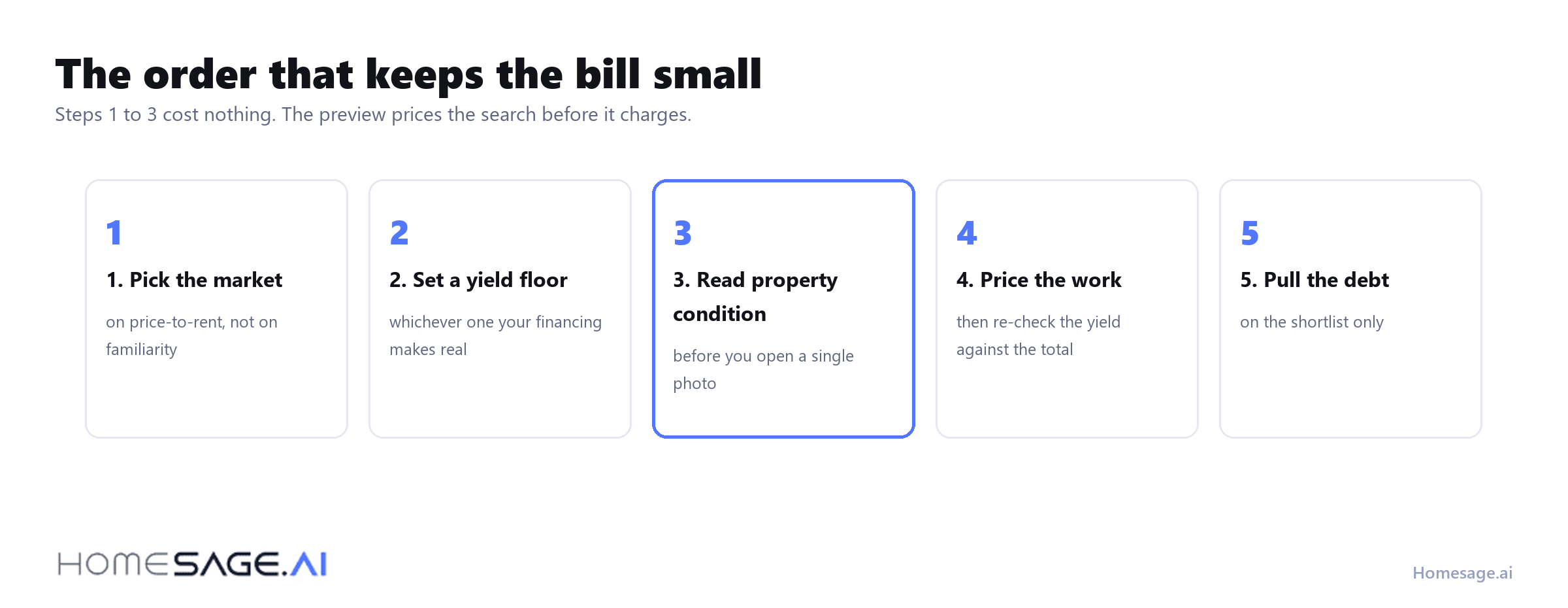
The order that keeps the bill small
Each step should cut the list before the next one costs anything. The same order underpins the rent or flip crossover.
- Pick 2 or 3 markets on price-to-rent, not on familiarity.
- Set the yield floor your financing makes real.
- Filter on property condition before you open a single photo.
- Price the work on whatever survives, then re-check the yield against purchase plus renovation.
- Pull the recorded debt on the shortlist only.
The preview returns the match count and the cost before a search charges.
What 5 results look like
The output is not a list of addresses. Each result includes the numbers that drive it.
Listing price against estimated after-repair value, the spread between them, the property condition score, the Seller Motivation Score, estimated rent, cap rate, and cash-on-cash. Enough to reject or shortlist without opening anything else.
Here is a short video on what a single property report returns.
What a screen cannot do
3 limits are worth saying out loud.
- A cap rate needs a verified rent. About 35% of for-sale listings carry one. The rest are absent from a yield filter rather than counted as zero.
- Property condition is read from photos. It does not see a roof from the inside or a furnace that is about to fail.
- A screen has no local knowledge. It cannot tell you which street floods or which block is about to change.
The point of the funnel is to get you to 5 properties worth that local work, rather than 1,099.
Ask Sage to run the screen
Sage is our AI assistant, and it runs the same screen from a plain-language question inside the AI tool you already use.
Connect Homesage.ai to Claude, ChatGPT, Gemini, or Perplexity through our Real Estate MCP and screen a market in a sentence.
“How many active listings in this city are under $100,000, need work, and clear a 10% cap rate?”
Setting this up in ChatGPT takes 3 steps. Connect to ChatGPT in the MCP portal, then ask in plain language.
Key takeaways
- An investment property search is a rejection problem. 1,099 Cleveland listings came down to 5.
- Screen the criteria you set in advance, rather than browsing a portal.
- Property condition read from the photos put 78 of 243 cheap listings in play.
- Put cap rate and cash-on-cash in the filter, not in a spreadsheet afterward.
- Inventory moved 89 listings in 4 days, so a monthly report is context rather than a signal.
- Only the final step costs credits.
Conclusion
Investors who find deals aren’t looking at more properties. They are rejecting more properties, faster, and for less money.
Set the floors before you look. Let property condition and yield do the cutting first.
Then spend your attention, and your credits, on the handful that survive. On 11 October, that was 5 houses in a city of 1,099 listings.
Start with a Homesage.ai account and run the same 4 filters on a market you know.





Peter November 28, 2025
Very helpful for developers
Robin November 29, 2025
informative!
Marco December 3, 2025
great read!
Hamza December 7, 2025
Insightful.
5 Off-Market Property Finder Strategies | Homesage.ai October 10, 2026
[…] databases of these properties requires systematic approaches rather than random searching. The most productive wholesalers use multiple sourcing methods simultaneously, creating deal flow […]
Rent Or Flip? The Price Where It Flips | Homesage.ai October 15, 2026
[…] your market, set both bars, and count by band. The same counting method drives our investment property search strategies. The band where the rental count passes the flip count is the only version of this answer that […]
Skip Tracing API: 3 Best Providers For Developers (2026) October 15, 2026
[…] that survive 2 free filters, and the same step costs 312. Pass only the survivors to the trace. Our investment property search strategies cover how to build that […]