

What an extension can actually see
A browser extension reads the page you are on and adds to it. That sounds minor and is the whole point. It puts the numbers where the decision happens, rather than in a tab you have to remember to open.
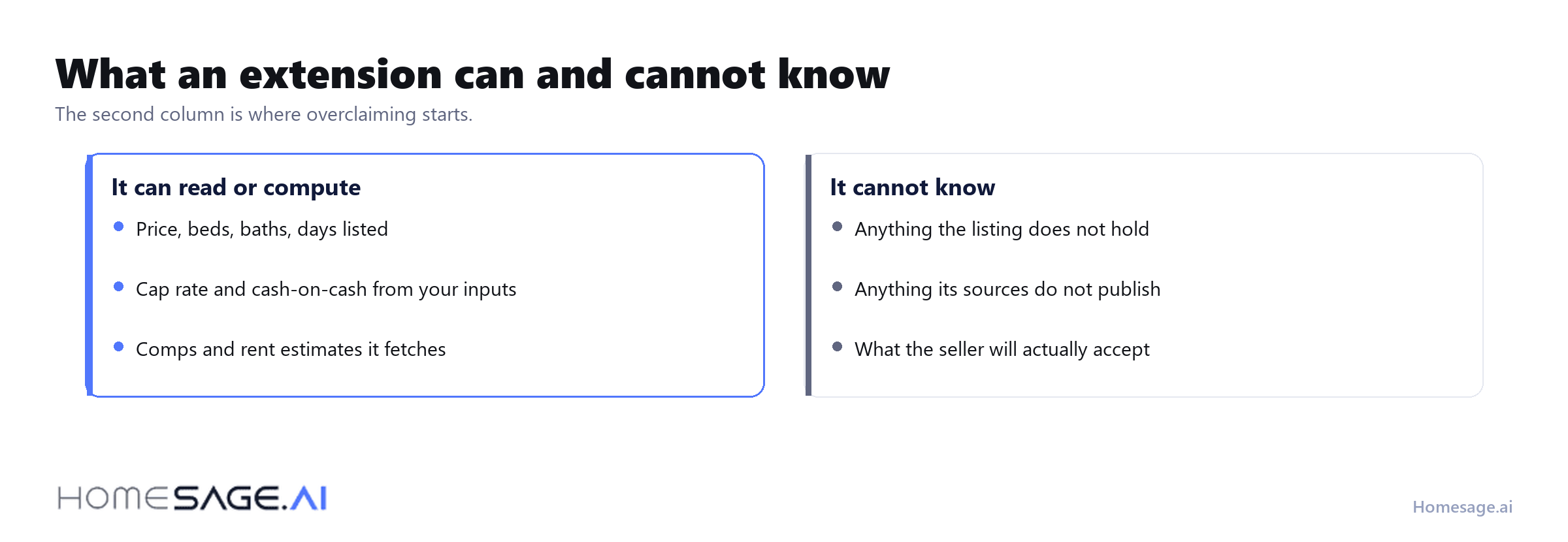
It also sets a hard limit. An extension can use what is on the listing, what it can calculate from your assumptions, and what it can fetch from its own backend. Nothing else exists to it.
That distinction matters when a tool claims to score a deal. Scoring needs data the listing does not hold, which means a backend, which means coverage limits like the ones measured below.
We checked every extension here on its own Chrome Web Store listing on 20 October 2026, including install counts. A tool with 76 users is a different proposition from one with thousands.
The 5 best browser extensions for real estate investors
1. DealFinder by Homesage.ai
DealFinder overlays property condition, renovation cost, after-repair value, and projected return directly on a listing page, drawn from the same models behind our API.
Because it grades property condition from the listing photographs, it answers the question an investor has while looking at the photos. It is also the only extension here that prices the work rather than only the deal.
Best for: Investors who want property condition and renovation numbers without leaving the listing.
2. REI Lense
REI Lens, published by DreamTeam Mobile, calculates cash-on-cash, cap rate, median rent, and cash flow on Zillow, Redfin, and Realtor listing pages.
It is a focused calculator rather than a data product, and it does that job cleanly. Its store listing showed 93 users and a 5.0 rating from 5 ratings when we checked. Treat it as a small, actively maintained tool rather than an established platform.
Best for: Running standard return maths quickly on listings you are already browsing.
3. Realyst
Realyst evaluates a property on Zillow, with rental analysis, cash-on-cash, mortgage, and ROI calculations, plus neighborhood comparables.
Two caveats, both from its own store listing. It showed 76 users, and the listing was last updated in February 2024. Its description makes no mention of AI, despite claims to that effect elsewhere, so judge it as a financial calculator.
Best for: Single-family rental math, if you are comfortable with a small, infrequently updated tool.
4. Comp Crunch
Comp Crunch analyzes or exports any Zillow search, sold, for-sale or rental, to PDF or CSV with price statistics, handling roughly 500 listings per search.
It is a search exporter rather than a comparables product. That is more useful than it sounds when you want a whole submarket in a spreadsheet. It showed 1,000 users, the largest install base of the four outside tools here.
Best for: Pulling a whole Zillow search into a spreadsheet for your own analysis.
5. BetterDeal.ai
BetterDeal.ai adds one-click cash flow, ROI, cap rate and cash-on-cash to Zillow listings, along with after-repair value estimates with comparables, public records and rental data.
Its listing describes analysis and ARV estimates rather than a deal score, so expect numbers to interpret rather than a verdict. It showed 461 users and was last updated in April 2026.
Best for: Investors who want ARV and comparables alongside the usual return maths.
How the five compare
| Extension | What it adds | Install base | Last updated |
|---|---|---|---|
| DealFinder | Property condition, renovation cost, return | Chrome and Apple | 2026 |
| REI Lense | Cash-on-cash, cap rate, cashflow | 93 users | March 2026 |
| Realyst | Rental analysis and ROI | 76 users | February 2024 |
| Comp Crunch | Zillow search export with stats | 1,000 users | June 2026 |
| BetterDeal.ai | Cash flow, ROI, ARV with comps | 461 users | April 2026 |
Install counts and update dates were read on each extension’s own Chrome Web Store listing on 20 October 2026, and they move.
What the listing page does not tell you
An extension can only show what its sources hold. On 20 October 2026 we counted, across all 561 active listings in Akron, Ohio, how far that actually goes.
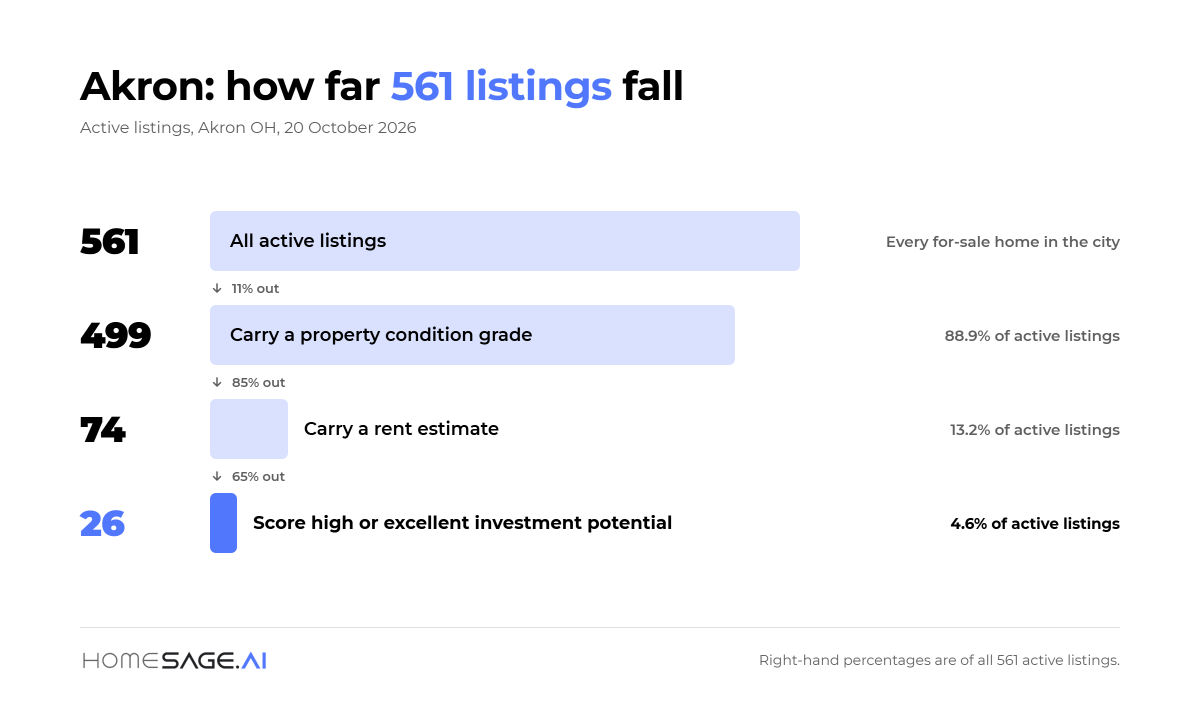
A property condition grade exists on 499 listings, or 88.9%. A rent estimate exists for 74 listings, or 13.2%. Only 26 listings (4.6%) score high or excellent on investment potential.
Two extensions can show different returns on the same house, and both can be working correctly.
Akron has the thinnest rent coverage of the six cities we measured this month. The range ran from 13.2% here to 41.6% in Little Rock. Any extension computing a yield is therefore using its own rent model on most Akron listings, not a market figure.
That is not a criticism of the tools. It is why two extensions can show different cash-on-cash numbers for the same house. The assumption panel matters more than the headline figure.
Each percentage is a share of all 561 active Akron listings on the day we counted. A listing missing a field is absent from that count rather than scored as a failure.
How to choose between them
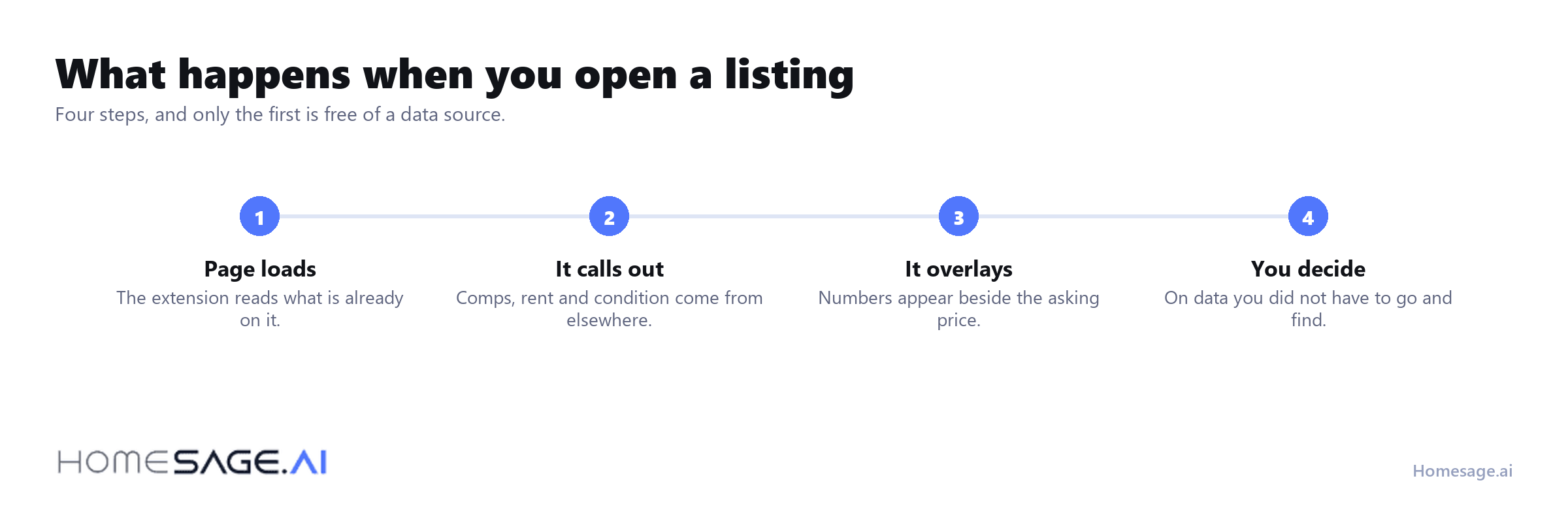
Decide between a calculator and a data product. REI Lense and Realyst compute from your assumptions. DealFinder and BetterDeal.ai bring their own data to the page.
Check the assumption panel before you trust any number. Vacancy, management and repair allowances are where two tools diverge, and the defaults are rarely your figures.
Weigh the install base and the update date. A tool last touched in early 2024 may still work, but it is not tracking changes to the sites it reads.
For the wider toolset, our guide to the best AI property analysis tools covers the platforms these feed into. For underwriting, investment property analysis tools goes further.
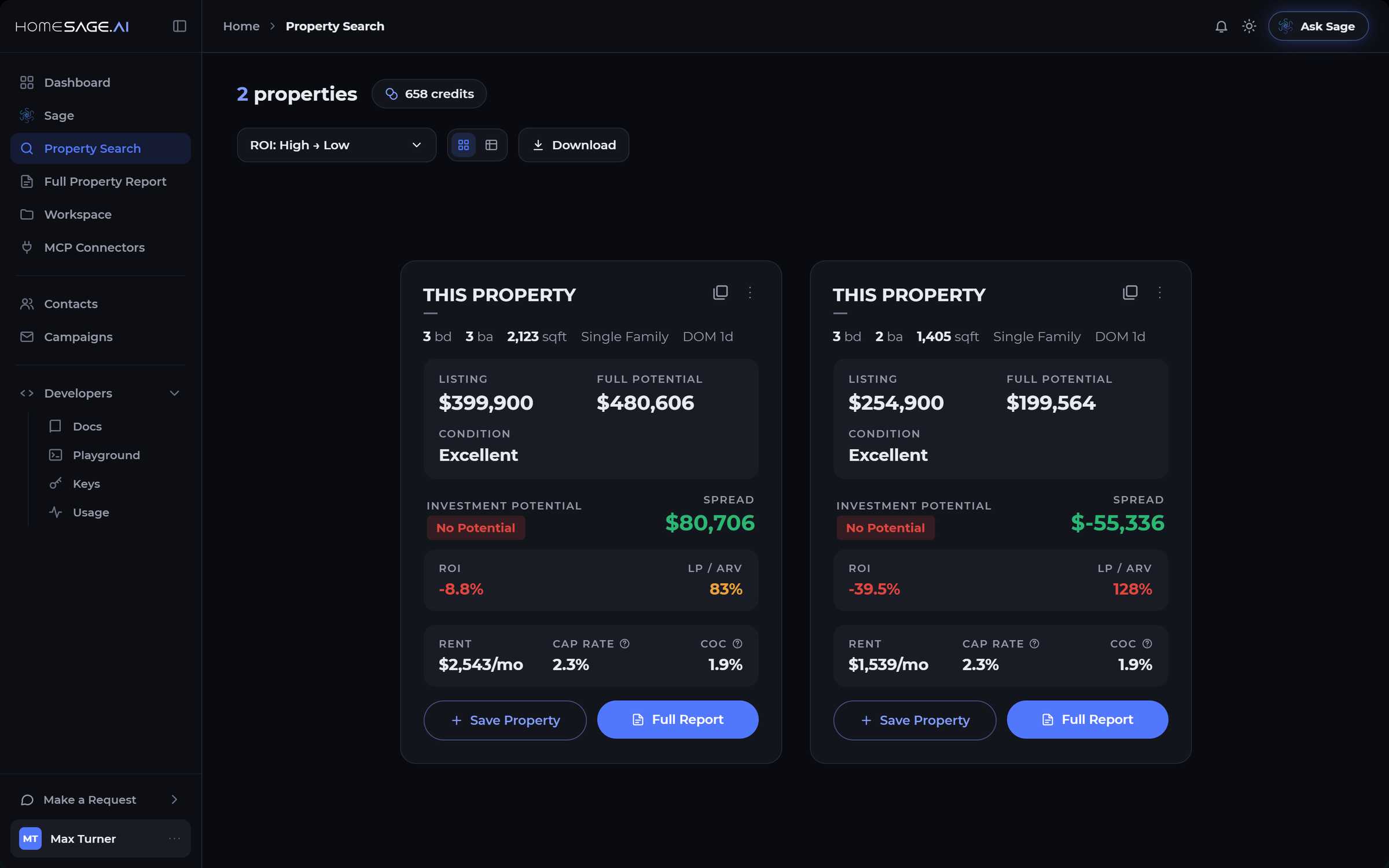
Estimated values, after-repair values, renovation costs and returns are model-derived estimates, not investment advice. Property data as of 19 October 2026.
Key takeaways
- An extension can only use what the listing holds, what it computes, and what its backend fetches. Claims beyond that deserve a second look.
- Four of the five outside tools are small. Install bases ran from 76 to 1,000 users.
- Check the last-updated date. One listing here has not been touched since February 2024.
- Rent coverage in Akron is 13.2%, so most yield figures there come from a model rather than a market rate.
- Compare assumption panels, not headline returns. That is where two tools actually differ.
Conclusion
All five extensions are real, installable and do roughly what they claim, once the AI language is set aside. What separates them is where the number comes from. The useful question is not which is best. It is if you want a calculator or a data source, and how comfortable you are depending on a tool with fewer than a hundred users. Check the assumptions before you trust the number.
Frequently asked questions
Are these extensions safe to install?
All five are listed on the Chrome Web Store, which applies its own review. Read listing pages, so check the permissions each one requests before installing, and be wary of any that ask for access beyond the sites they claim to support.
Why do two extensions show different returns for the same property?
Because they use different assumptions. Vacancy rate, management fee, repair allowance and financing terms all move cash-on-cash substantially, and where rent data is thin each tool falls back to its own model.
Do any of them work outside Zillow?
REI Lens states Zillow, Redfin, and Realtor. The others describe Zillow specifically. DealFinder works across the listing sites our own coverage supports.
Is a small install base a problem?
Not by itself, but it is a signal. A tool with 76 users and a listing untouched since early 2024 is less likely to track changes to the sites it reads than one updated this year.





Nourhan M. March 20, 2026
Very helpful!
Lil March 26, 2026
What a great extension!
5 Best Real Estate Affiliate Programs In 2026 (Compared) October 21, 2026
[…] is investors, our guide to the best AI property analysis tools shows what they already buy. The best browser extensions for investors covers the smaller tools they adopt […]