
Why the platform you pick decides what you see
Every investor works from a filtered view of the market. The filter is whichever platform you opened first, and it decides which houses you ever consider. That is a bigger decision than it looks, because the platforms differ less on quality than on what they are built to answer.
A listings portal answers what is for sale. A records provider answers who owns it and what they paid. A condition model answers what state it is in. Ask one of those the other two questions and you get a confident answer built on nothing.
So the useful comparison is not which platform is best. It is which job each one does, and what you are left holding when you stack them. We measured that on a real market rather than asserting it.
The 8 best PropTech companies for investors in 2026
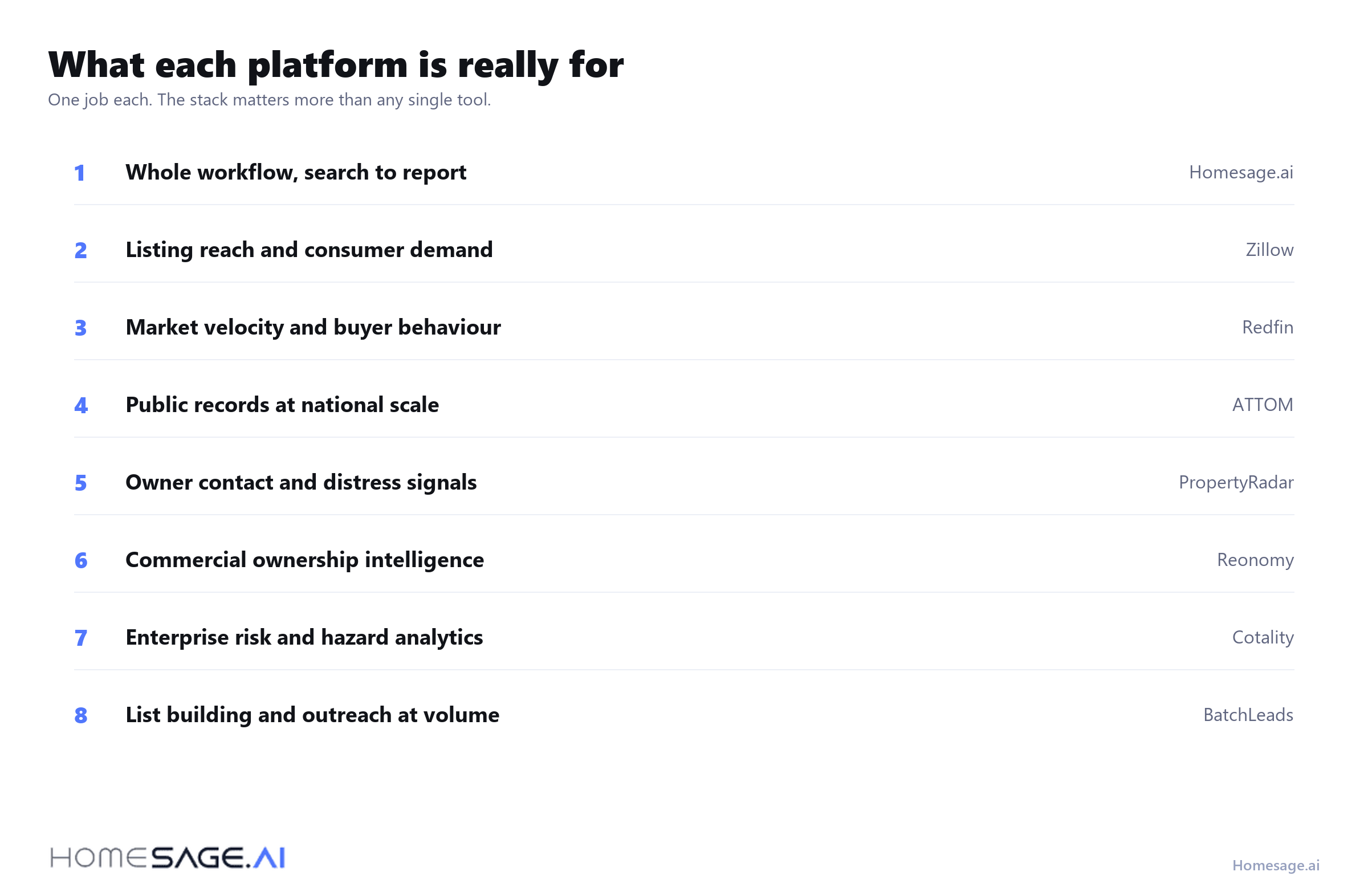
1. Homesage.ai
Homesage.ai grades a property from its listing photos, then prices the work and the return in the same pass. A search returns property condition, renovation cost, after-repair value, projected return and a Seller Motivation Score. The same fields are available through the API, for teams building their own tools.
Best for: Investors who want the condition and the return in one place, and developers who would rather call an endpoint than build the model.
2. Zillow
Zillow is where the demand is. For an investor the useful parts are Zillow Research and the Zestimate. Together they give a baseline for choosing a market and a rough opening value on a specific house.
Best for: Market-level research and a first sanity check on price. Thin for property-level underwriting.
3. Redfin
Redfin publishes its Data Center openly, with monthly figures on prices, inventory and days on market by metro. Because Redfin is also a brokerage, its numbers on how fast homes are actually going under contract are unusually current.
Best for: Timing a market entry, and checking whether a city is cooling before you commit.
4. ATTOM Data Solutions
ATTOM is a records business. It covers tax, deed, mortgage, foreclosure and environmental risk data on more than 160 million US properties. It arrives as bulk files or an API, with no opinion layered on top.
Best for: Teams with engineers, building their own deal-sourcing or risk models on raw records.
5. PropertyRadar
PropertyRadar turns public records into a contactable list. It filters on equity, ownership type and more than 30 distress signals. Its own site reports 160 million properties and 318 million mortgages across more than 3,000 counties. Foreclosure tracking and skip tracing sit in the same product.
Best for: Finding the owner before the market does, on preforeclosure, probate, vacant and absentee-owner plays.
6. Reonomy
Reonomy covers the commercial side, mapping ownership through the holding companies that usually sit between a building and the person who controls it.
Best for: Multifamily and mixed-use buyers who need to reach a decision maker, not a registered agent.
7. Cotality
Cotality traded as CoreLogic until it was renamed on 24 March 2025. It is the infrastructure much of the mortgage industry runs on. Nine REST API products cover property characteristics, spatial boundaries, tax servicing, fraud and underwriting, and the reference documentation can be read without an account.
Best for: Lenders and institutional teams that need property, risk and tax data under one contract.
8. BatchLeads
BatchLeads sits at the outreach end. Property data, skip tracing and direct mail run in one workflow, so a list becomes a campaign without an export step in between.
Best for: Wholesalers and acquisition teams running outreach at volume.
How the eight compare
| Platform | What it is for | Where the data comes from | Who it suits |
|---|---|---|---|
| Homesage.ai | Condition, cost and return in one pass | Listing photos plus public records | Investors and developers |
| Zillow | Market baseline and a rough value | Consumer listings and the Zestimate | Early-stage screening |
| Redfin | Market timing | Brokerage transactions and the Data Center | Buy-and-hold timing |
| ATTOM | Raw records at national scale | Tax, deed, mortgage and foreclosure filings | Teams with engineers |
| PropertyRadar | Owner contact and distress signals | Public records plus skip tracing | Direct-to-seller outreach |
| Reonomy | Commercial ownership | Entity and ownership graphs | Multifamily buyers |
| Cotality | Enterprise property and risk | Nine REST API products | Lenders and institutions |
| BatchLeads | List building and outreach | Property data plus direct mail | Wholesalers at volume |
The split in that table is between platforms that hand you records and platforms that hand you a judgement. Records are cheaper and age better. Judgements save time but have to be checked, which is why the coverage question below matters more than any feature list.
What stacking these signals actually leaves you
The case for a stack rather than a single tool is easy to assert and harder to show, so we measured it. On 19 October 2026 there were 1,208 active listings in Cleveland, Ohio. We counted how many survived each filter an investor would reasonably apply.
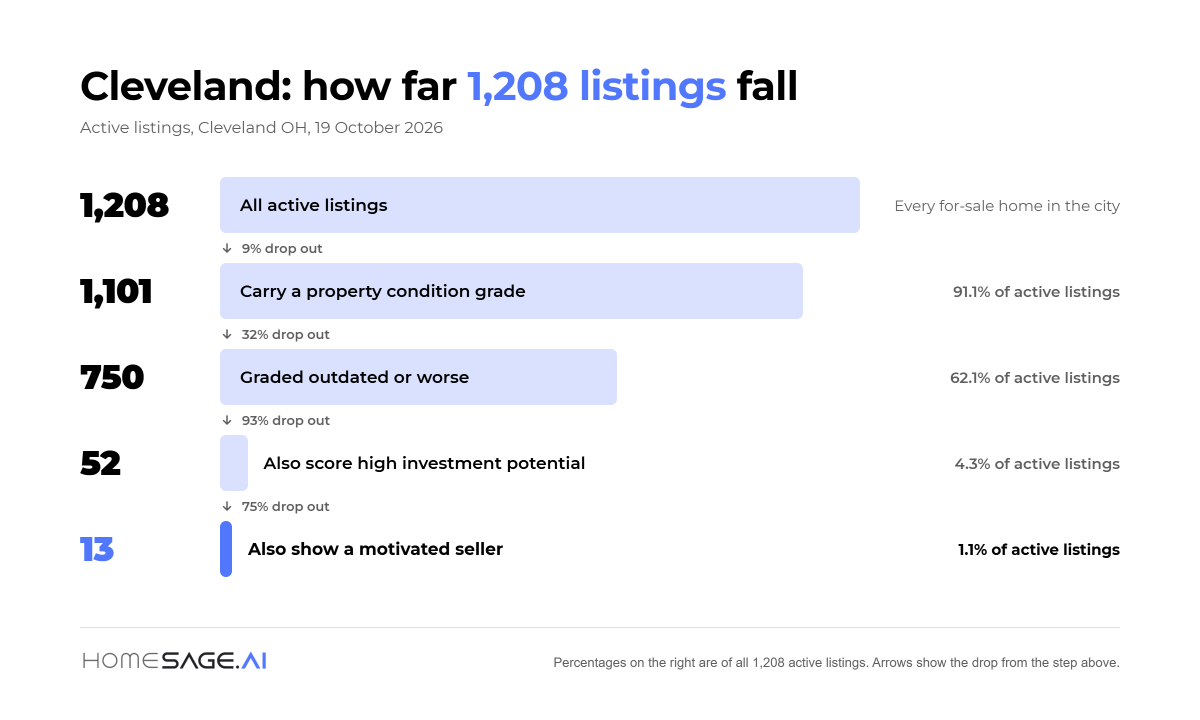
A property condition grade exists on 1,101 of the 1,208 listings, or 91.1%, so condition is a filter you can lean on. Then the drop. 750 listings are graded outdated or worse. 52 of those also score high or excellent on investment potential. 13 of those also show a seller scoring 70 or above on motivation. That last number is 1.1% of the market.
A platform that only sources leads hands you the 750. A platform that only underwrites hands you a verdict on whichever houses you fed it. The 13 appear only when the signals are applied together.
Thirteen listings out of 1,208. That is what stacking every signal actually leaves.
One caveat, stated plainly. Every percentage above is a share of all 1,208 active listings. Where a signal is missing from a listing, that listing is absent from the count rather than counted as a failure. Cleveland on one day is also not every market, and a city with newer housing stock would produce a shallower funnel.
How to choose between them
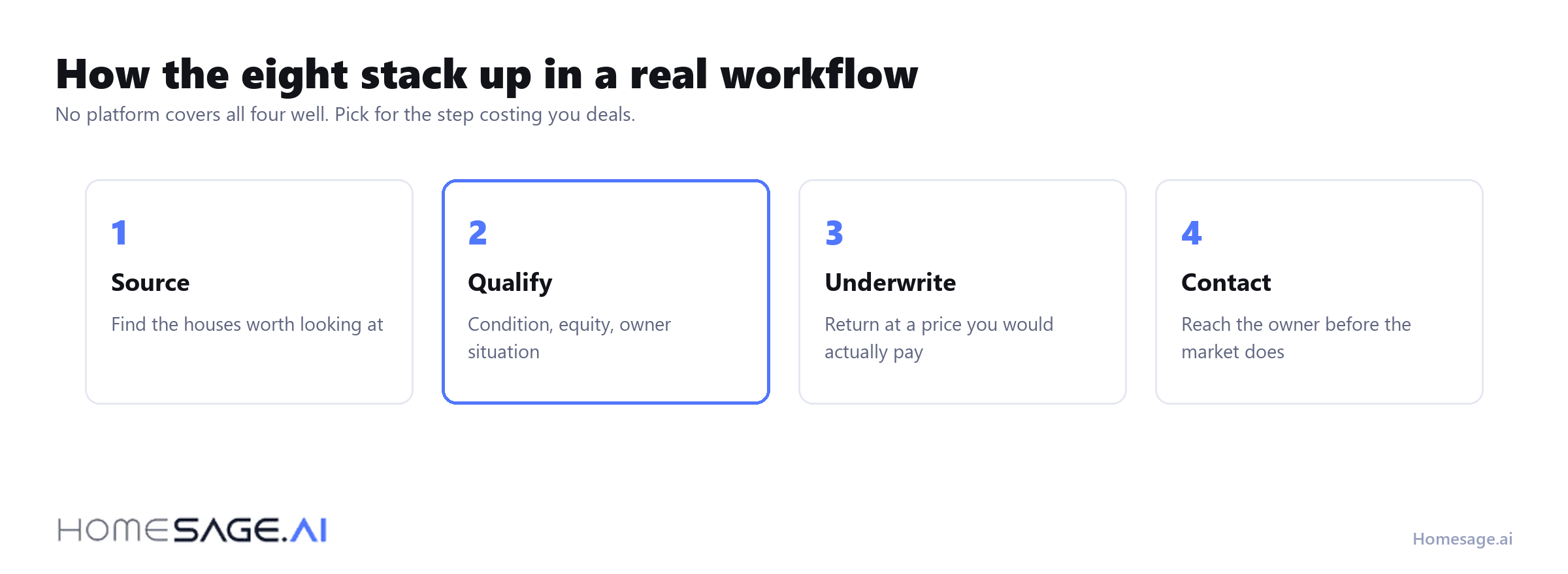
Pick for the step that is currently costing you deals, not for the longest feature list. If you are not seeing enough houses, that is a sourcing problem, and PropertyRadar or BatchLeads is the answer. If you are seeing plenty and cannot tell which are worth an offer, that is an underwriting problem. Our guide to the best AI property analysis tools goes deeper on that half.
Two further checks before you commit. Ask what share of listings in your markets actually carry the field you are buying the platform for. A demo property is always a well-covered one. Then ask what the licence lets you store. That is the constraint that usually surfaces after the integration is built.
If your problem is finding houses nobody else is looking at yet, start with our list of platforms to find off-market property. If it is working out what a specific house is worth after the work, start with investment property analysis tools.
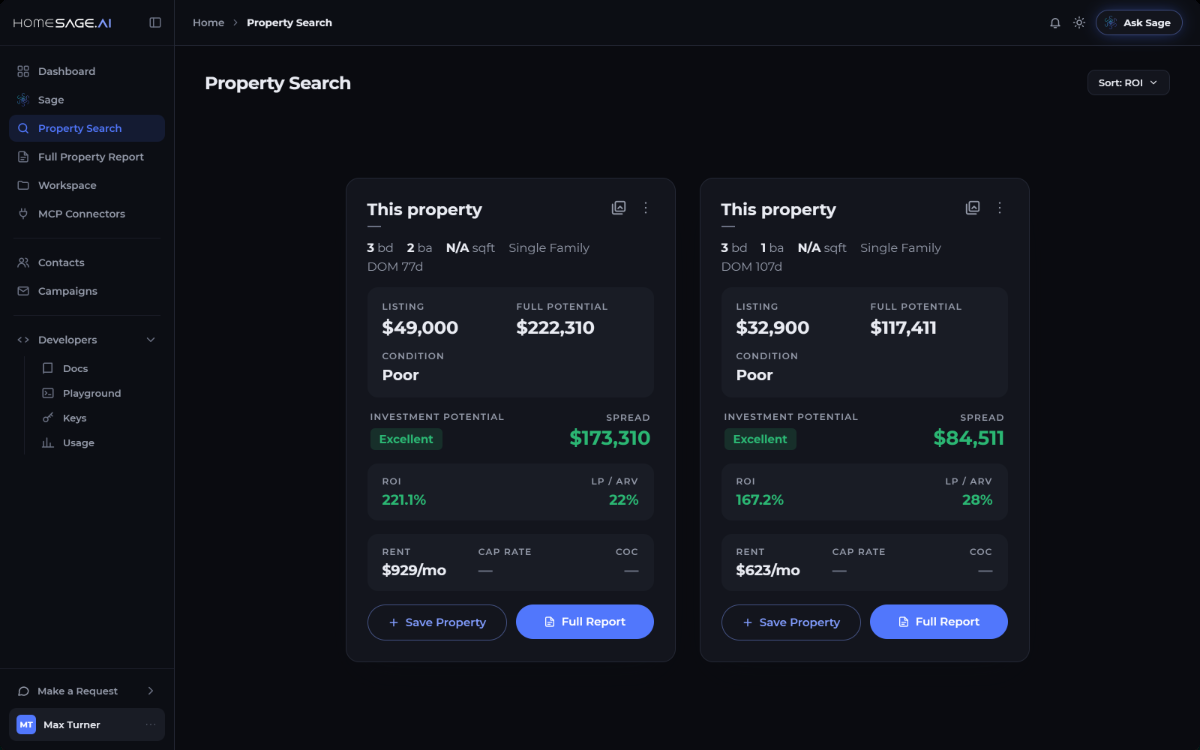
Estimated values, after-repair values, renovation costs and returns are model-derived estimates, not investment advice. Property data as of 19 October 2026.
Key takeaways
- No platform on this list covers sourcing, qualifying, underwriting and contact well. Expect to run two.
- Condition data is dependable. It exists on 91.1% of active Cleveland listings, so it is a filter you can build a process on.
- Stacking filters is brutal. 1,208 listings became 13 once condition, investment potential and seller motivation were all applied.
- Ask about coverage before features. A field that is absent on two listings in three will not carry your underwriting.
- CoreLogic is now Cotality. The rename took effect on 24 March 2025 and the old name still appears in a lot of older comparisons.
Conclusion
These eight are not competing for the same job. That is why ranking them one to eight matters less than knowing what each is for. Decide which step of your workflow is leaking deals, buy for that step, then check coverage on your own markets before committing. The Cleveland funnel is the honest version of what a stack leaves you: a small, workable list rather than a market.
Frequently asked questions
What is a PropTech company?
It is a business that sells software or data for buying, valuing, financing or managing property. The term covers everything from a consumer listings portal to a records provider that only ever talks to engineers.
Do I need more than one of these platforms?
Usually yes, and the Cleveland funnel above is why. Sourcing, qualifying, underwriting and contacting are four different jobs, and no platform on this list does all four well. Most investors pair a sourcing tool with an analysis tool.
Can a small investor use these, or are they built for institutions?
PropertyRadar and BatchLeads are priced for solo operators. ATTOM, Cotality and Reonomy are enterprise products that expect a contract and, in ATTOM and Cotality’s case, a developer. Homesage.ai sits in both camps, with a product for investors and an API for teams building their own.
What should I check before committing to one?
Coverage on the properties you actually buy. A platform can look complete in a demo and still miss the field you need on two listings in three. That is what the funnel above measures.




Nourhan M. March 4, 2026
Insightful!
Sophie March 4, 2026
Very interesting!
Unlimited wp files March 8, 2026
excellent post, very informative. I wonder why the other experts of this sector don't notice this. You should continue your writing. I'm confident, you have a huge readers' base already!