
Foreclosure filings have risen year-over-year for 12 consecutive months, and most agents aren’t ready for what’s coming. According to ATTOM’s February 2026 Foreclosure Market Report, 38,840 U.S. properties recorded foreclosure filings in February, a 20% increase from a year earlier. Completed bank repossessions (REOs) jumped 35% year-over-year. The trend is gradual, but it is consistent, and it is creating a category of listings that many agents haven’t had to navigate since before the pandemic.
This isn’t 2008. NAR’s Chief Economist Lawrence Yun has been direct on the point: roughly 2% of all current home sales are distressed properties, compared to one-third of all transactions during the 2010 foreclosure crisis. What’s happening today is a normalization. The market is returning from historically low foreclosure levels toward something closer to its long-run baseline. But normalization still means new listings, new client needs, and a specific skill set that separates agents who capitalize from those who watch the opportunity pass.
Platforms like Homesage.ai give agents a data edge when evaluating distressed properties helping you analyze condition, run comps, and assess investment potential before bringing a buyer or seller to the table.

What the 2026 Foreclosure Data Actually Shows
The numbers tell a story of sustained but measured increase. ATTOM’s February 2026 report shows that foreclosure starts, where lenders initiate proceedings, rose 14% year-over-year to 25,928. Completed REO repossessions climbed 35% annually to 4,077. January’s data was even sharper: 40,534 total filings, up 32% from the same month a year earlier, with completed foreclosures up nearly 59%.
The geography matters. States leading in foreclosure starts include Texas, Florida, California, Georgia, and Indiana. At the metro level, Lakeland, FL recorded the worst rate in February, one filing for every 1,075 housing units. Indianapolis and Columbia, SC also ranked near the top nationally.
For agents working in these markets, the pipeline is real. For everyone else, understanding local foreclosure data in your specific market is the essential first step because the national trend doesn’t land everywhere equally.
Why Foreclosures Are Gradually Rising and What’s Driving It
Three structural forces explain the current trend. Understanding them helps you speak credibly to distressed sellers and the investors or buyers you’ll bring to these deals.
Sustained high mortgage rates. With the 30-year fixed rate holding around 6–7%, homeowners who stretched to buy in 2021–2022 are under payment pressure. Refinancing options that were readily available during the low-rate era are now limited or cost-prohibitive.
Expiration of pandemic-era protections. The moratorium period is fully behind us. Courts are working through a backlog of filings that were paused between 2020 and 2023. Some of what’s appearing now as “new” activity was delayed activity finally reaching the filing stage.
Regional affordability stress. Markets with surging insurance premiums, Florida being the prime example, are compounding payment burdens. Homeowners who can manage a mortgage alone are sometimes pushed into default when insurance, HOA fees, and property taxes are factored in together.
What all three factors share: they create motivated sellers, not just vacant properties. That is the opportunity for agents who know how to approach these situations correctly.
How to Identify and Win Distressed Property Listings
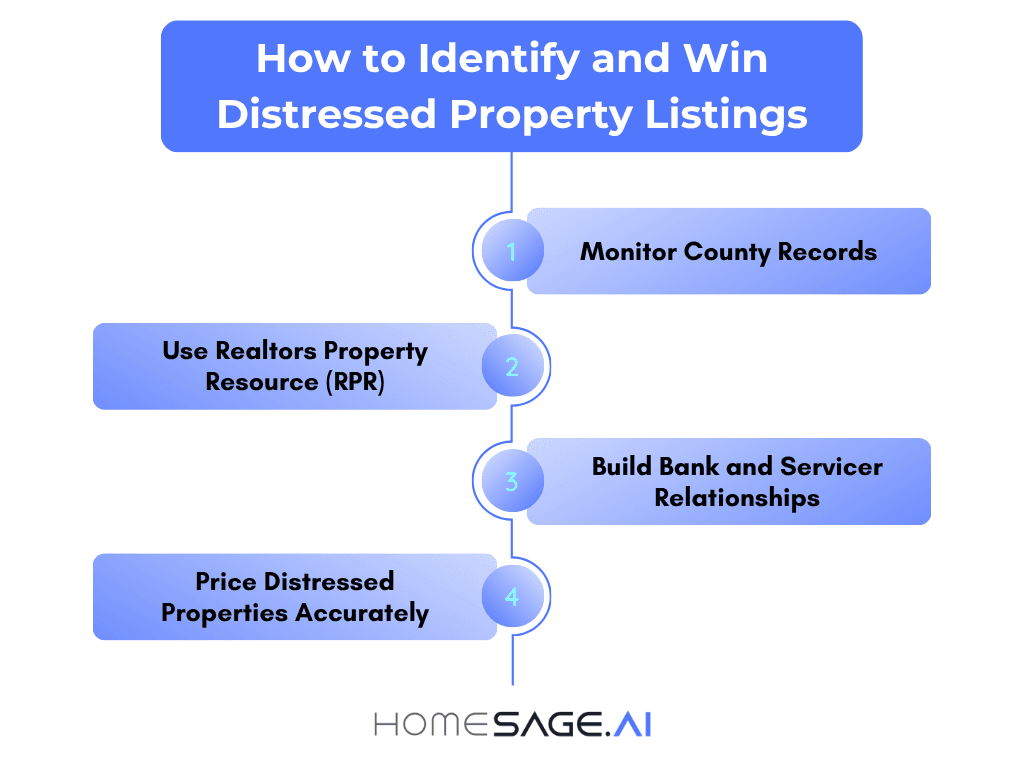
Distressed listings don’t surface in the MLS the way traditional listings do. Agents who build pipeline upstream of public activity consistently win more of these opportunities. Here is where to look:
- Monitor county records. Notices of Default (NODs) and Lis Pendens filings are public records in most states. Agents who track these filings can reach homeowners 30–180 days before a property enters formal foreclosure, while a traditional listing or short sale is still possible.
- Use Realtors Property Resource (RPR). The NAR platform for members allows you to filter by distressed status, pre-foreclosure, foreclosure, and REO, giving early visibility before active listings appear. It’s free for all NAR members.
- Build bank and servicer relationships. REO listings are assigned by banks directly to agents on approved vendor lists. Getting on a servicer’s list takes time, but it produces consistent listing volume that isn’t dependent on competitive prospecting.
- Price distressed properties accurately. This is where most agents lose credibility. Distressed homes require condition-adjusted comps, not standard CMA methodology. Agents using AI property reports can pull condition scores and renovation cost estimates that make pricing precise rather than a rough approximation. This matters especially when advising a distressed seller on whether listing makes more sense than a short sale.
For agents newer to this space, pursuing the NAR SFR® certification formalizes the knowledge base that earns client trust in complex distressed transactions.
Distressed Property Stages: What Every Agent Needs to Know
| Stage | Timing | Agent Role | Buyer Financing | Key Lead Source |
|---|---|---|---|---|
| Pre-Foreclosure | 30–180 days post-default | Represent seller (short sale or traditional listing) | Standard financing available | County NOD / Lis Pendens records |
| Short Sale | Concurrent with pre-foreclosure | Represent seller; negotiate with lender for payoff | Standard financing available | Same as pre-foreclosure |
| Auction / Foreclosure | After Notice of Trustee Sale | Minimal to none | Usually cash required | Auction platforms, court listings |
| REO (Bank-Owned) | After bank repossession (completed foreclosure) | Represent bank as listing agent | Standard financing available | Servicer approved vendor lists |
How Property Data Changes the Game for Agents
Distressed listings are complex transactions. The homeowner may be overwhelmed. The bank may be slow to respond. The property may have deferred maintenance you can’t fully assess at a walk-through. Each of these friction points gets smaller when you arrive with solid data.
Homesage.ai is an AI-powered real estate data platform that analyzes 155M+ US properties using machine learning models incorporating over 50 data points per property, including property condition scoring, renovation cost estimates, and investment potential metrics. For agents working distressed listings, this means faster pricing decisions, more confident buyer consultations, and fewer surprises at inspection.

Pair it with the DealFinder Chrome extension, which auto-detects U.S. property addresses on any website and generates an instant AI-powered property report, useful when reviewing public foreclosure auction listings or lender-owned property databases online.
Key Takeaways
- Foreclosures on the rise is a data-confirmed trend. ATTOM reports 12 consecutive months of year-over-year increases through February 2026, with completed REOs up 35% annually.
- This is normalization, not a crisis. NAR data shows distressed sales represent only about 2% of all current transactions, far from the 33% seen during the 2010 foreclosure crisis.
- The best leads come before the MLS. Pre-foreclosure activity visible through county records and RPR puts agents in front of sellers before properties reach auction or bank repossession.
- Accurate pricing requires condition-adjusted comps. AI-powered tools like Homesage.ai’s property analysis provide condition scoring and renovation cost data that make distressed property pricing defensible, not just estimated.
- Geographic concentration creates local opportunity. Texas, Florida, California, Georgia, and Indiana are seeing the highest foreclosure start volumes. Agents in these markets should be building distressed listing workflows now.
Conclusion
Foreclosures on the rise doesn’t mean the sky is falling, it means a segment of the market is reopening that rewards preparation. Agents who understand the three stages of distressed properties, build lead sources ahead of the MLS, and come to every pricing conversation armed with accurate condition data will consistently close more of these listings than those reacting after the fact.
The skill set is learnable. The data infrastructure is available. What separates agents who build a distressed listing practice from those who don’t is mostly a matter of starting before it becomes obvious.
Watch how Homesage.ai‘s AI-powered property reports surface condition scoring, renovation cost estimates, and investment data for any U.S. address in minutes, giving you the analysis you need to price distressed listings accurately and advise buyers with confidence.
People Also Ask
Q: Are foreclosures actually on the rise in 2026?
A: Yes. According to ATTOM’s February 2026 data, U.S. foreclosure filings rose 20% year-over-year, marking the twelfth consecutive month of annual increases. Foreclosure starts are up 14% and completed bank repossessions (REOs) are up 35% compared to a year ago. Overall activity remains far below historical crisis levels, NAR confirmed distressed sales represent only about 2% of all current transactions.
Q: Should real estate agents be worried about rising foreclosures?
A: Not worried, prepared. Rising foreclosures create a new category of listing opportunity for agents who know how to work pre-foreclosure outreach, short sales, and REO assignments. The volume is manageable and agents who build the skills early gain a clear competitive edge in markets where foreclosure activity is concentrated.
Q: How do agents find pre-foreclosure listings before they hit the MLS?
A: The most reliable method is monitoring county Notice of Default (NOD) and Lis Pendens filings, which are public records in most states. NAR’s Realtors Property Resource (RPR) platform also lets members filter by distressed status, pre-foreclosure, foreclosure, and REO, giving early visibility before active listings appear. You can supplement this with AI-powered distressed property tools that surface leads from multiple data sources simultaneously.
Q: What is an REO property and how do agents get assigned to list them?
A: REO stands for Real Estate Owned, properties repossessed by the bank after a completed foreclosure. Banks and mortgage servicers maintain approved vendor lists for agents who handle these listings. Getting on these lists requires applying directly to servicers, meeting licensing and insurance requirements, and in many cases demonstrating experience running comps and pricing bank-owned properties accurately.





Val March 26, 2026
Interesting take!
Emma March 26, 2026
Great read!
Peter March 27, 2026
Helpful for investors that want to buy distressed properties