
Part of our complete guide to real estate investing in 2026.
“Quick answer AI levels the real estate playing field by giving individual investors the same market intelligence institutional firms use. That means instant property analysis and a condition score read from photos. It also means comp-anchored estimated values and automated return math, all from 1 address. The 3 barriers that once decided who won were data access, analysis speed and deal-flow networks. All 3 are now software features any investor can use. The edge shifts from who you know to how well you read the numbers.

Real estate investing once favored investors with the biggest networks, the most capital and the longest experience. In 2026, AI tools give a solo investor the same market intelligence and property evaluation that institutional firms use.
The shift is fast. Platforms now process millions of property records, read market trends as they happen and surface deals that manual research would never reach.
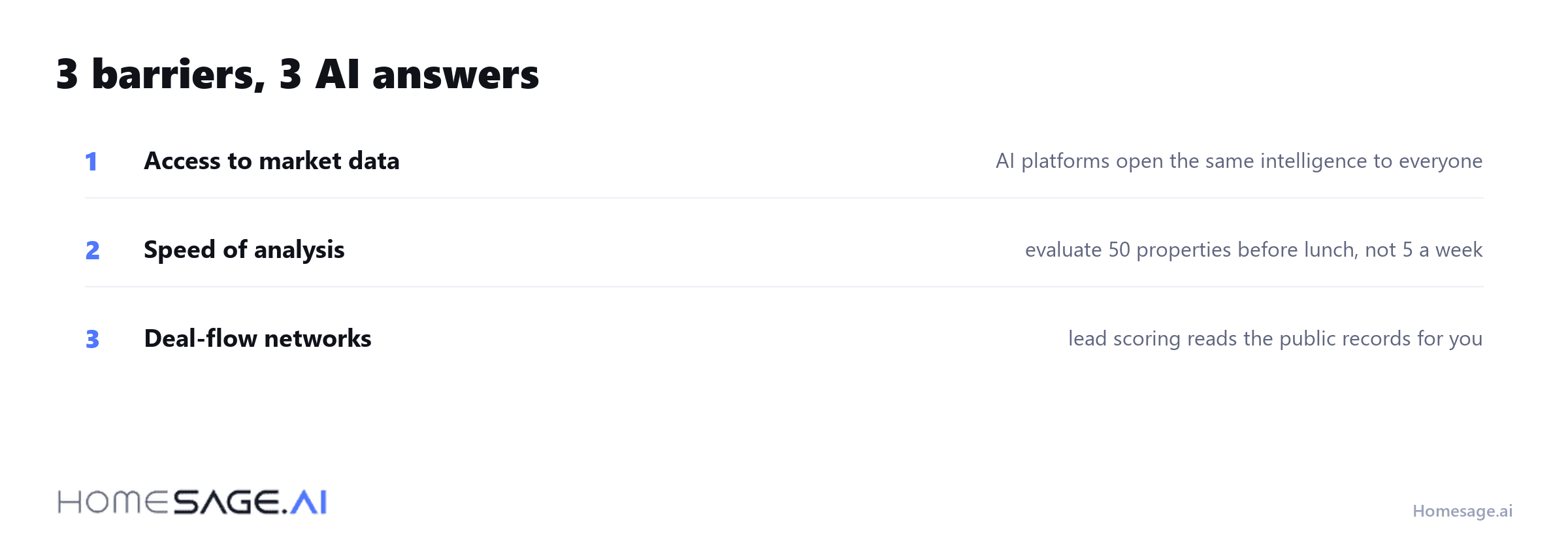
The 3 barriers that decided who won are now software features anyone can use.
For the investor who felt locked out by a lack of connections, AI opens real estate intelligence to everyone. We built Homesage.ai for that investor. It is an AI real estate intelligence platform with insights on 155M+ US properties. It offers AI-powered Investment Property Search and property condition analysis from photos. Its automated return calculations run through real estate APIs any developer can integrate.
A first-time investor with no broker on speed dial now works from data instead of insider knowledge. Equity Trust describes the same shift in its guide to AI for real estate investing. This guide shows how AI levels the playing field for real estate investors in 2026.
Before signing on any property, our framework for evaluating a residential neighborhood covers the demographic, school and crime data points that drive appreciation.
The barriers that kept investors out
Real estate investing has required years of local knowledge, professional networks, capital and time to research properties. Those barriers gave institutional investors and experienced professionals the best deals. By the time the average investor heard about a promising property, it was gone.
The information gap was stark. Large firms employed teams of analysts, paid for proprietary databases and ran models to find undervalued properties and emerging markets. An individual investor working from public listings and manual research started at a disadvantage.
Access to market data
Institutional investors pay for data services that deliver market analytics, comparable sales and trend forecasts. Individual investors had little access to that intelligence. They had no way to tell a real deal from an overpriced risk.
Speed of analysis
A professional firm analyzes dozens of properties a day with dedicated staff and systems. An investor who researches on evenings and weekends evaluates a handful a week and misses deals in fast markets.
Off-market deal access
The most profitable investment properties often never reach public listings. Institutional investors reached off-market deals through relationships with wholesalers, brokers and property owners. Individual investors lacked those connections.
How AI removes the barriers
AI changes real estate investing by automating analysis, opening data access and removing the need for a large professional network. M&G Investments describes how AI platforms process information at a scale no individual can match and deliver it through accessible interfaces.
Instant property analysis
AI tools analyze a property in seconds. They return an estimated renovation cost, an estimated after-repair value and an estimated ROI. Property condition models read the photos and give the house a condition score with no site visit. The scale runs from Excellent and Good down to Outdated, Poor and Very Poor.
That speed means an investor evaluates 50 properties before lunch. In a competitive market, it is the difference between winning and losing the deal.
Market intelligence for everyone
AI platforms provide the market data and trend analysis that only institutional investors had before. These systems track permit activity, demographic shifts, employment trends and infrastructure development to flag neighborhoods before prices rise. See our guide on finding undervalued properties.
Natural language processing scans city planning documents and zoning changes for early signals of neighborhood change, before most buyers notice the trend.
Appreciation signals
AI models read historical price trends, neighborhood trajectories and economic indicators. They flag which areas are set up to appreciate over the next 1 to 5 years. That helps investors find properties positioned for growth instead of immediate cash flow alone.
The AI tools reshaping real estate investment
5 AI capabilities are reshaping how investors find, evaluate and manage properties in 2026. Together they form the intelligence system SmartAsset describes for improving real estate investments.
| AI capability | What it does | Investor benefit |
|---|---|---|
| Computer vision | Reads property photos to detect condition issues | Remote evaluation before a site visit |
| Automated valuation models | Estimates property value from a larger set of comparables | Instant, consistent estimated values |
| Appreciation signals | Reads appreciation drivers and market trends | Find emerging markets before prices rise |
| Financial modeling | Calculates estimated ROI, cash flow and returns | Evaluate a deal in seconds instead of hours |
| Lead scoring | Flags motivated sellers from public records | Reach deals earlier than the crowd |
Property search and discovery
AI-powered property search platforms understand investment criteria and surface only the properties that match. Instead of filtering thousands of listings by hand, an investor names the goal as fix-and-flip, rental income or wholesale. The search finds the matching deals.
The Investment Potential API grades properties by estimated return, which separates winners from time wasters. The search analyzes active listings and property records, including foreclosures and distressed properties, to surface deals aligned with the investor’s strategy.
Condition score through computer vision
AI reads property photos to identify roof damage, outdated kitchens, foundation issues and deferred maintenance. It delivers a condition score that once needed an inspector visit. A remote investor evaluates a property in another state without traveling.
The model examines the images in seconds. The condition score is accurate enough to narrow a property list to the strongest candidates before scheduling in-person inspections.
Automated financial analysis
AI platforms calculate the estimated after-repair value and the estimated renovation cost. They project long-term and short-term (Airbnb) rental income, cash flow and estimated ROI. The Flip Return API returns the financial projection for a fix-and-flip. It details purchase costs, renovation expenses and expected profit from current market data.
For rental investors, the same tools return cash flow projections, occupancy estimates and comparative rental rates for both traditional leases and short-term rentals. An investor evaluates far more properties than a spreadsheet allows.
What each investor type gets
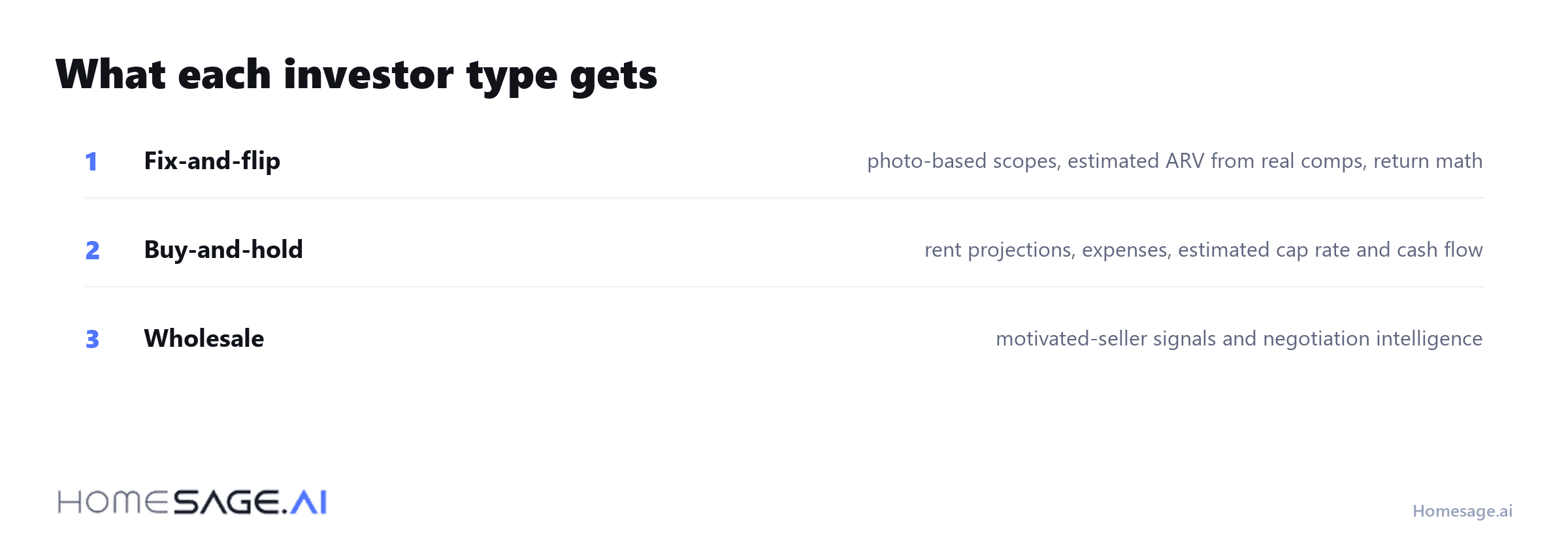
AI tools serve different strategies with different outputs.
Fix-and-flip investors
AI finds undervalued properties that need renovation, estimates repair costs from photos and calculates estimated after-repair value from comparable sales. The Homesage.ai Renovation Cost API returns an itemized estimated renovation cost with a confidence score. The Renovation Return API calculates the estimated ROI from the improvements, showing the investment required and the expected return.
Buy-and-hold rental investors
AI projects long-term rental cash flow, flags neighborhoods set up for appreciation and compares traditional leasing with short-term rental. The model reads the local rental market to return income projections from comparable properties and seasonal demand.
Wholesale investors
AI lead-generation systems find motivated sellers through public records and track deals before they become public listings. The Seller Motivation Score API estimates how likely a seller is to accept an offer below the asking price. That is negotiation intelligence from data.
Getting started with AI tools
Adopting AI investment tools takes little technical knowledge. Most platforms offer interfaces built for investors, not developers. Start by naming your primary strategy as fix and flip, rental income or wholesaling. Then match the tools to it.
Try a sandbox first. Most platforms let investors explore features with real data before paying. Choose tools that fit your existing workflow instead of forcing a new process.
Key takeaways
- AI opens real estate investing by giving institutional-grade market intelligence and property analysis to individual investors at accessible prices.
- Computer vision reads a property from its photos. That cuts travel costs and speeds up deal screening for investors working across more than 1 market.
- Automated financial analysis returns estimated ROI, estimated renovation cost and rental income in seconds instead of hours. An investor evaluates far more properties with the same effort.
- Appreciation signals flag emerging neighborhoods and appreciation drivers before the trend is obvious, which gives the first mover the advantage.
- AI lead scoring flags motivated sellers through public records, earlier than manual research allows.
- Homesage.ai combines property condition analysis, investment scoring, estimated renovation cost and rental projections in 1 system. Property analysis goes from days of manual work to minutes of data-driven review.
Conclusion
The playing field for real estate investing is more level in 2026 than at any point before. AI removes the barriers that favored large networks, big teams and proprietary data. An individual investor now holds the same analytical power that institutional firms used to dominate markets. AI does not remove the need for judgment or discipline.
Winning still takes local knowledge, sound risk management and execution. What AI gives you is the data to compete.
Explore the real estate API library for property condition analysis, investment scoring, renovation analysis and rental projections built for 2026.
This video shows how real estate data and AI build investment property lists for investors.
Estimated values. Not investment advice. Data as of 2026-09-16. This article is general information. Evaluate every property against your own finances, local costs and a professional inspection.





N December 13, 2025
Insightful!
Robin December 13, 2025
Great read
Mia December 13, 2025
Very helpful!
Hamza December 22, 2025
Great guide!