
Quick answer: “A real estate analytics platform turns property and market data into a decision you can act on. 5 platforms are worth a professional’s time in 2026. Homesage.ai for property-level investment analysis, Explo for embedded dashboards, Qlik for forecasting, Domo for mobile teams and PropertyShark for urban ownership research. The question that separates them is whether the tool answers about a property or about a portfolio.”
Every real estate analytics platform promises the same thing, which is less manual research. What they actually differ on is the unit of the answer.
Some tell you about 1 house. Some tell you about 10,000 of them. Buying the wrong kind is the mistake that wastes a year of subscription.
Ask what the tool answers about. A property, a market, or a business. Almost nothing does all 3 well.
What a real estate analytics platform actually does
Underneath the feature lists, these tools do 4 jobs. Most platforms are strong at 1 or 2 and pass on the rest.
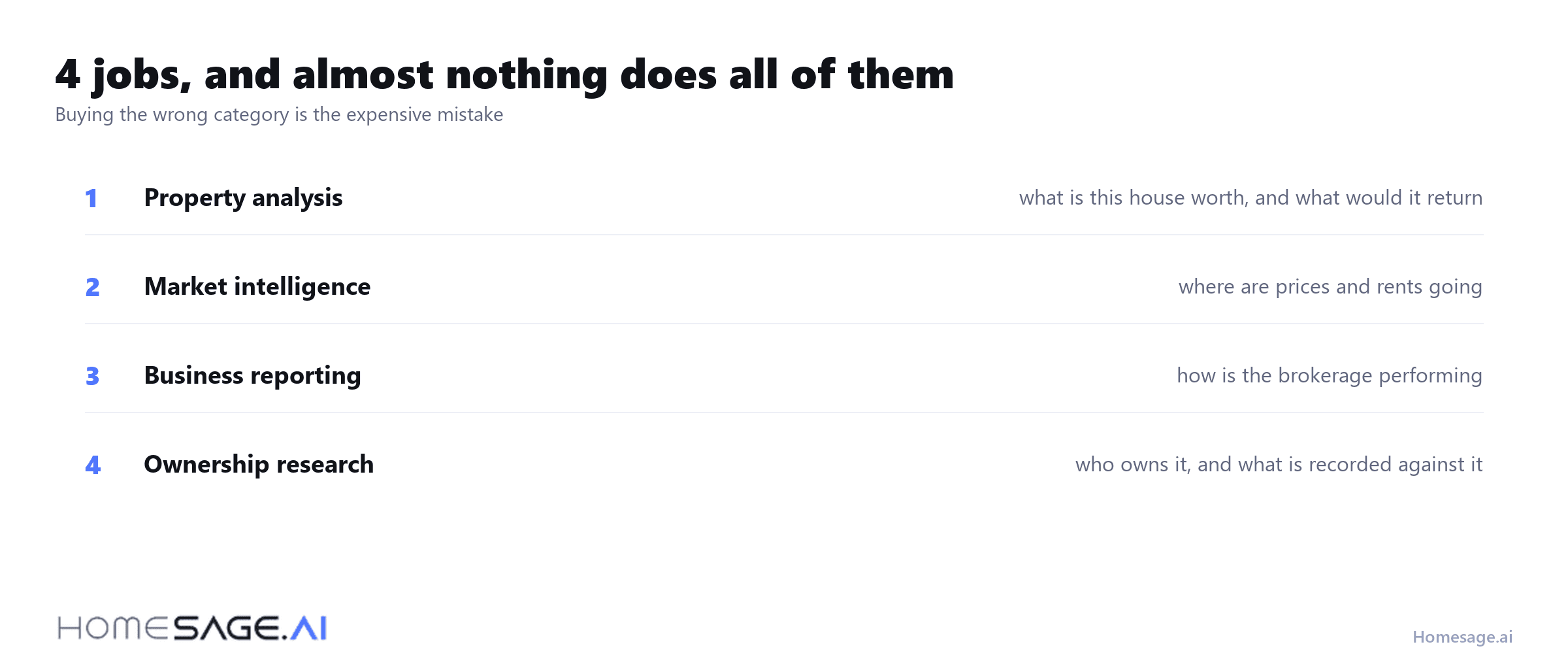
| The job | What it answers | Who needs it most |
|---|---|---|
| Property analysis | What is this house worth, and what would it return | Investors and the realtors who serve them |
| Market intelligence | Where are prices and rents going | Listing agents and advisors |
| Business reporting | How is the brokerage performing | Team leads and brokerage owners |
| Ownership research | Who owns it, and what is recorded against it | Commercial and development work |
1. Homesage.ai, for property-level investment analysis
We built our platform around the single-property question rather than the dashboard. One address returns a property condition score read from the property photos, an estimated current value and an estimated after-repair value.
It also returns an estimated renovation cost with a confidence score, a Seller Motivation Score, and rental projections for long-term and short-term strategies. It covers 155M US property records.
The same analyses reach a CRM through our real estate APIs, or an AI assistant through the MCP connector, so the analysis can sit inside the workflow rather than beside it.
Best for investors, and for realtors who want investor clients. See the Full Property Report.
2. Explo, for dashboards inside your own product
Explo embeds analytics into an application you already run, rather than sending people to another portal. Brokerages use it to give clients a branded view of their own data.
It is a presentation layer, not a property data source. You still need something to put in it.
Best for brokerages with a portal and a developer. See Explo.
3. Qlik, for forecasting and scenario work
Qlik is general business intelligence applied to property. Its strength is associative modelling, which connects data sets without being told in advance how they relate.
That suits what-if questions across a portfolio. It is heavy for anyone asking about 1 house.
Best for enterprise teams with an analyst. See Qlik.
4. Domo, for teams working from a phone
Domo is cloud-first business intelligence with genuinely good mobile dashboards and alerting. Agents can pull a view during a property tour instead of afterwards.
Like Qlik, it reports on data you supply. It does not know anything about property on its own.
Best for distributed teams who need the number in the field. See Domo.
5. PropertyShark, for ownership and development research
PropertyShark trades national breadth for depth in dense metros. It surfaces ownership records, title documents, liens, zoning and the construction pipeline.
Best for commercial analysts and anyone working a small number of cities. See PropertyShark.
How the 5 platforms compare
| Tool | Answers about | Brings its own property data | Best for |
|---|---|---|---|
| Homesage.ai | 1 property, or a whole market | Yes, 155M US records | Investment analysis |
| Explo | Whatever you feed it | No | Embedded dashboards |
| Qlik | Portfolios and markets | No | Forecasting at scale |
| Domo | Portfolios and teams | No | Mobile access |
| PropertyShark | 1 property, on the record | Yes, deep in select metros | Ownership research |
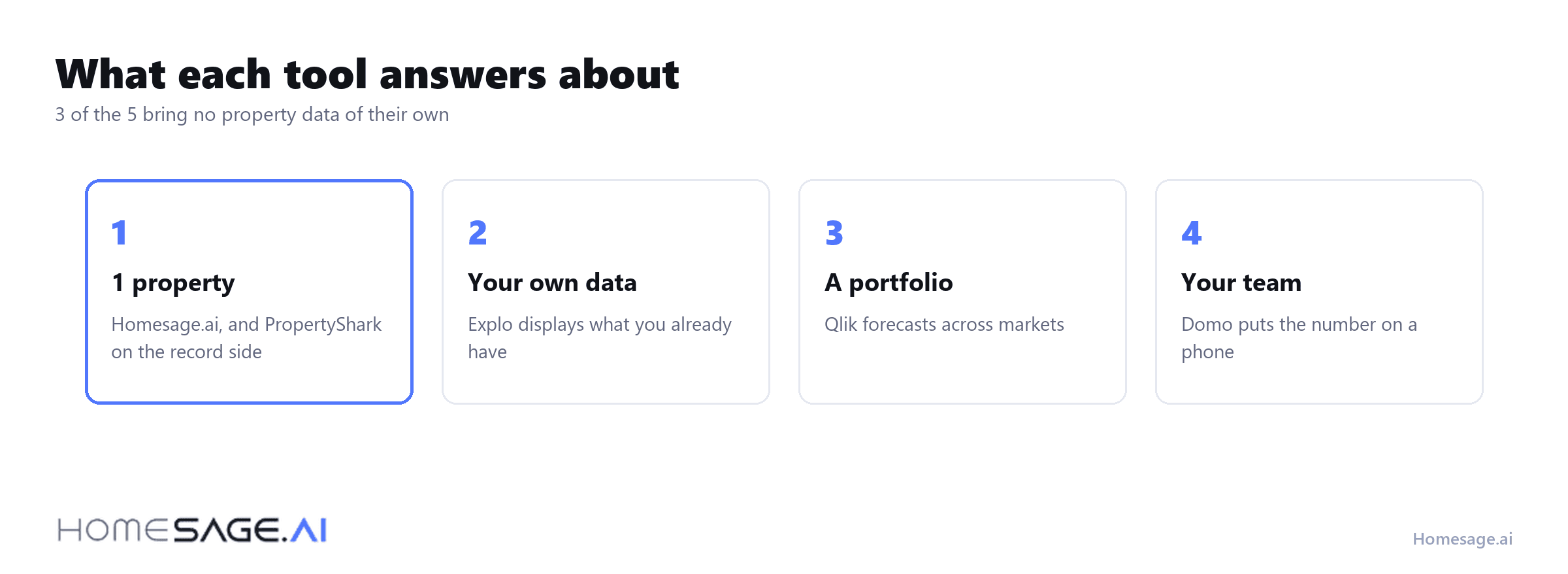
3 of the 5 platforms are general business intelligence tools. That is not a criticism. It is the thing to know before you buy: they are excellent at showing data and they will not find you a deal.
What a property-level answer looks like
We ran Cleveland through Investment Property Search on 20 September 2026 to show the difference between a dashboard and a shortlist.
| Filter | What it keeps | Listings left |
|---|---|---|
| Cleveland, active | Every home for sale in the city | 1,174 |
| Property condition Outdated, Poor or Very Poor | The houses that need work | 466 |
| Investment potential grade Excellent | Estimated ROI of 35% or more | 33 |
| Inside a first-deal budget | What a starter budget can fund | 29 |
Estimated values. Not investment advice. Data as of 2026-09-20.
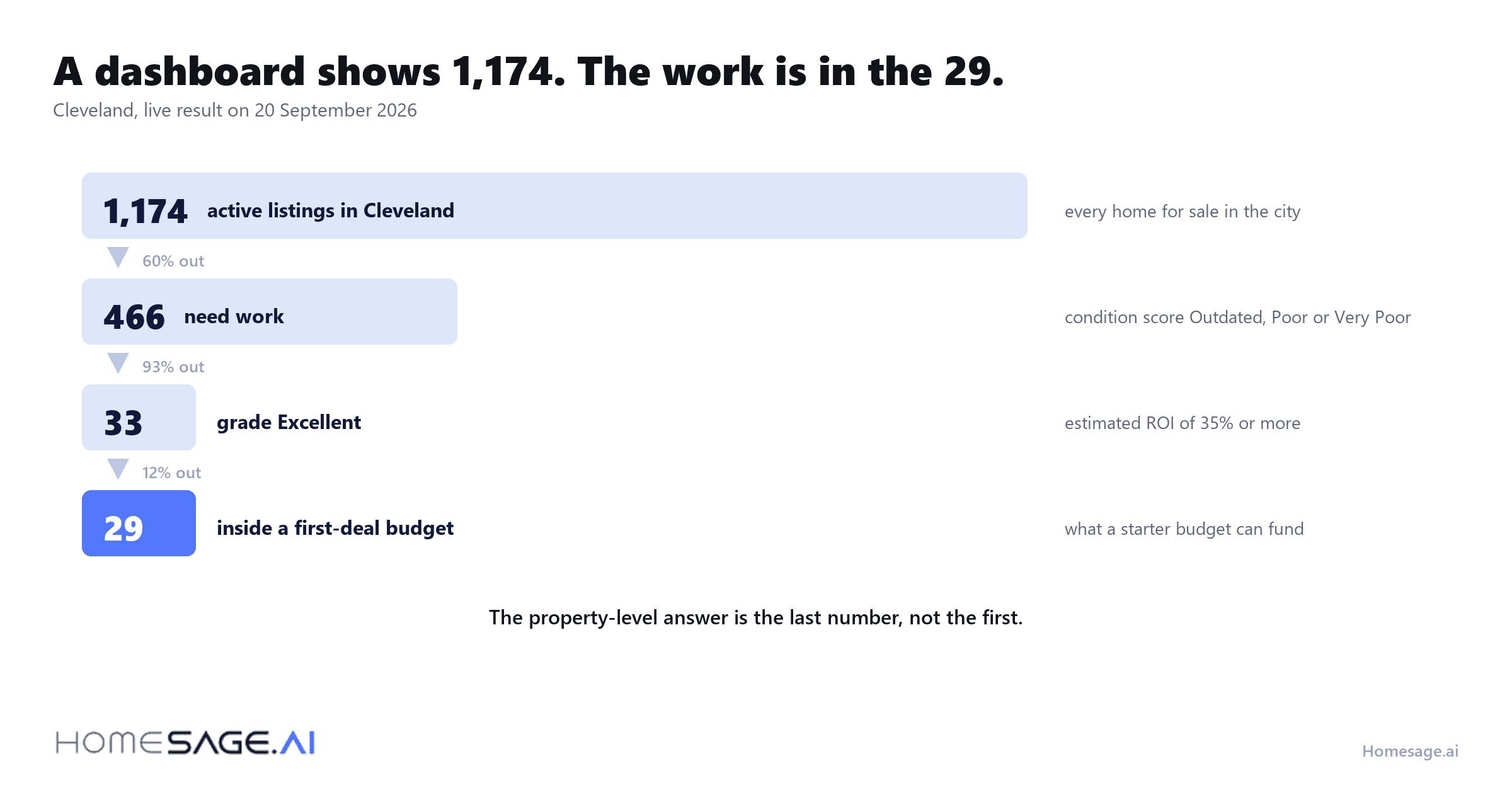
A dashboard would show you that Cleveland has 1,174 listings. The property-level answer is the 29.
How to choose between them
- Name the question first. About a property, about a market, or about your business. The answer picks the category for you.
- Ask whether the tool brings its own data. 3 of the 5 here do not, which means a second subscription.
- Check the property condition signal. A valuation that cannot see what state a house is in will misprice every property that needs work.
- Test the integration before the features. A number that has to be copied between systems gets copied wrongly.
- Look for a confidence score. A tool that tells you when its estimate is weak is worth more than one that never does.
- Start with the free route where there is one, then plan the paid step before you depend on it.
Here is a short video on what a single property report returns.
Ask Sage instead of opening a dashboard
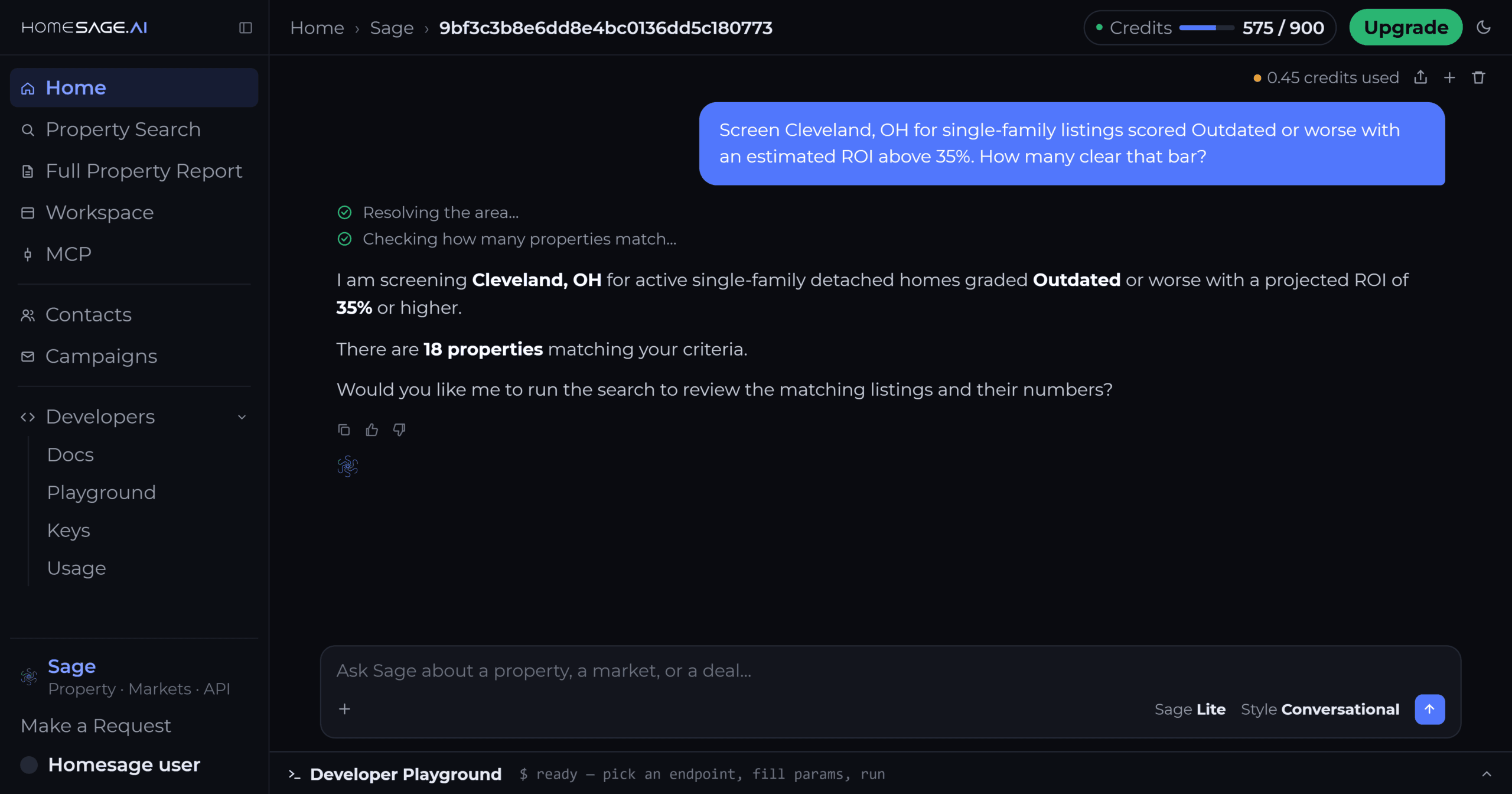
You do not have to learn another interface to get the property answer. Sage is our AI assistant, and it runs the same analyses from a plain-language question inside the AI tool you already use.
Connect Homesage.ai to Claude, ChatGPT, Gemini or Copilot through our MCP connector and ask about the property in front of you.
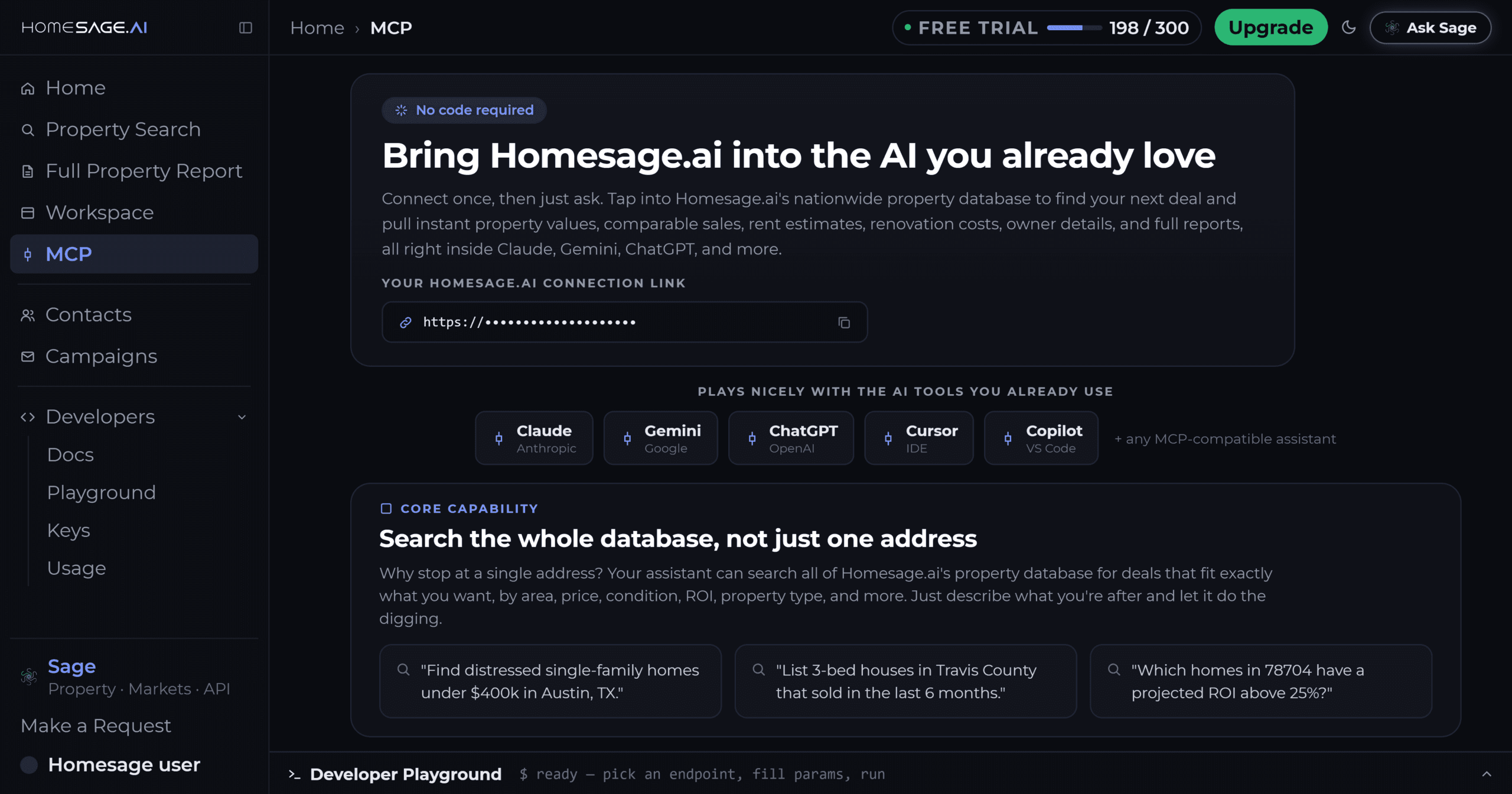
“What is the property condition of this house, what would it cost to fix, and what would it rent for?”
Sage previews the cost before spending anything, then returns the analysis against your own account.
Key takeaways
- A real estate analytics platform answers questions about a property, a market or a business. Buying the wrong category is an expensive mistake.
- 5 platforms are worth a professional’s time in 2026. Homesage.ai, Explo, Qlik, Domo and PropertyShark.
- 3 of the 5 platforms bring no property data of their own. They display what you already have.
- The property condition read is the dividing line on property analysis, because it is what separates a tired house from a renovated one at the same address.
- On 20 September 2026, Cleveland had 1,174 active listings, 466 needing work and 29 worth a call. A dashboard shows the first number. The work is in the last.
Conclusion
The right analytics tool is the one whose answer matches the decision in front of you. Test that on a property you already know rather than on a feature table. Start with an API key and compare what comes back with your own read.
Estimated values. Not investment advice. Data as of 2026-09-20. This article is general information. The Cleveland counts come from a Homesage.ai Investment Property Search run on 20 September 2026 and change daily. Third-party product capabilities are the vendors’ own published descriptions and change without notice. Evaluate every property against your own finances, local costs and a professional inspection.





Robin December 3, 2025
Great read!
Mia December 3, 2025
Insightful!
Peter December 5, 2025
You need to measure in order to improve. Analytics are the key in this process
Hamza December 7, 2025
Great insight.
Nourhan December 10, 2025
Great read!
6 Best AI Property Analysis Tools 2026 (Comps, ARV & Rehab) October 10, 2026
[…] tools, see our review of the AI investment property analysis tools, or our breakdown of dedicated real estate analytics tools for dashboard-first […]
Streamline Real Estate Due Diligence With AI October 10, 2026
[…] consistent, data-backed foundation for every due diligence conversation. Explore the full range of AI real estate analytics tools built for agent […]
10 Real Estate APIs That Drive Traffic & Leads (2026) October 10, 2026
[…] Discover investment analysis tools in our investment workflow blog. […]