
“Quick answerA property analysis platform has to do five jobs in one place. Search, value, comp, score the return, and report. Six platforms clear that bar in 2026, and each one is built for a different investor. Homesage.ai covers the whole workflow. BatchLeads builds the lead list and AirDNA prices short-term rental income. DealCheck underwrites fastest, DealMachine sources on the street, and Roofstock sells the finished rental.
Investors have stopped asking whether to use AI on a deal. They are asking which platform to standardize on.
JLL’s 2025 Global Real Estate Technology Survey found that 88% of investors, owners and landlords have started piloting AI. Most of them run about five use cases at once. Adoption is no longer the question. Consolidation is.
On the agent side the shift is sharper. NAR’s 2026 Technology Report surveyed 1,200 agents. Only 12% do not use AI and have no plans to, down from 32% a year earlier.
What a property analysis platform has to do
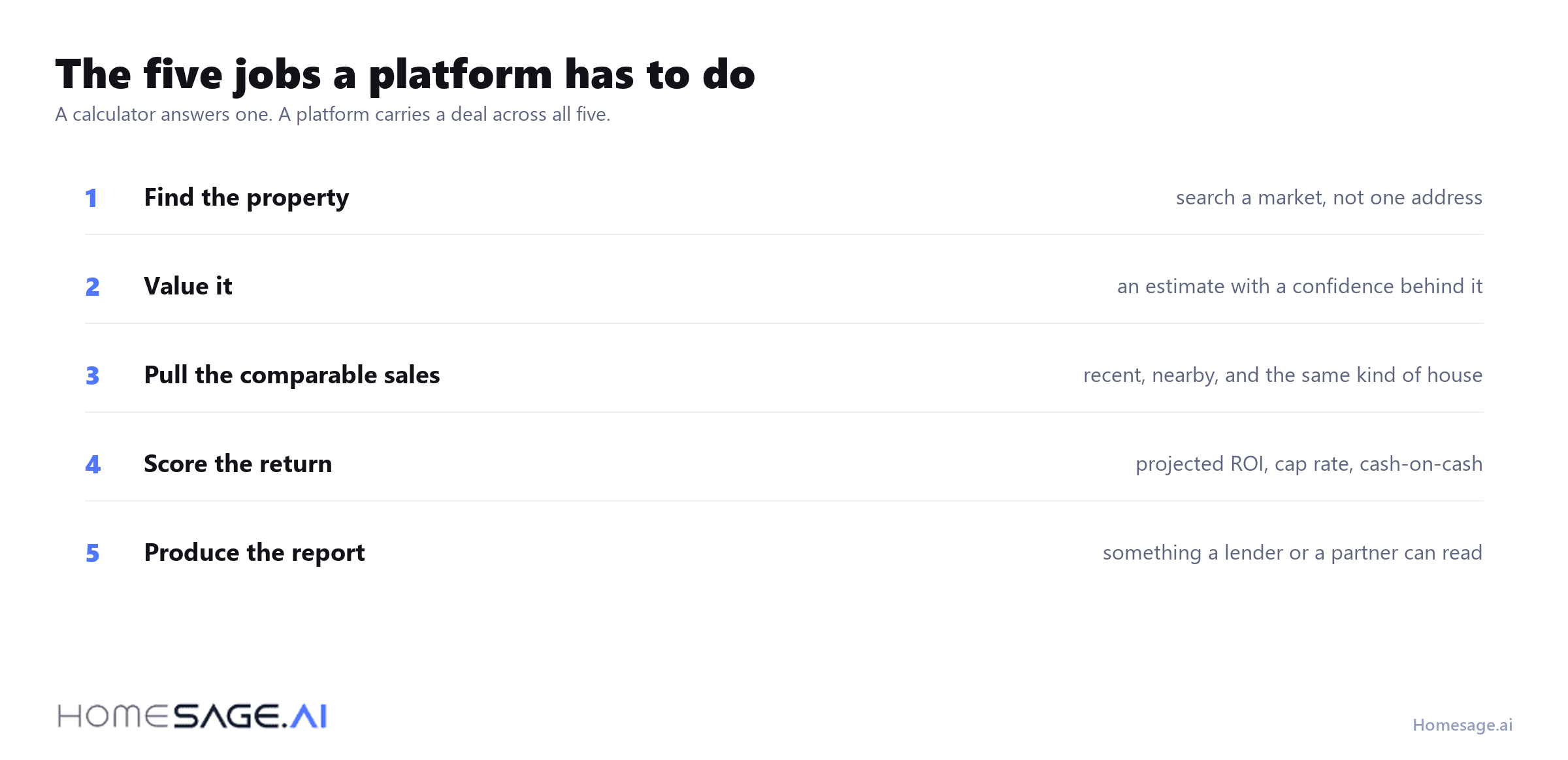
A calculator answers one question. A platform carries a deal from a search box to a report you can send a lender. The 3 best investment property analysis tools goes narrower, on the tools that price the work.
Five jobs define the category. Find the property, value it, pull the comparable sales, score the return, and produce the document. Every platform below handles at least four. The 7 platforms for finding off-market property covers the sourcing half of the same job.
Single-purpose calculators and standalone valuation models did not make this list. They are useful, and they are not platforms. The 5 best tools for finding out a home value compares the valuation models themselves.
Why price alone picks the wrong house
The reason the five jobs belong together is that each one disqualifies different houses. Run them separately and the list you end up with depends on the order you ran them in.
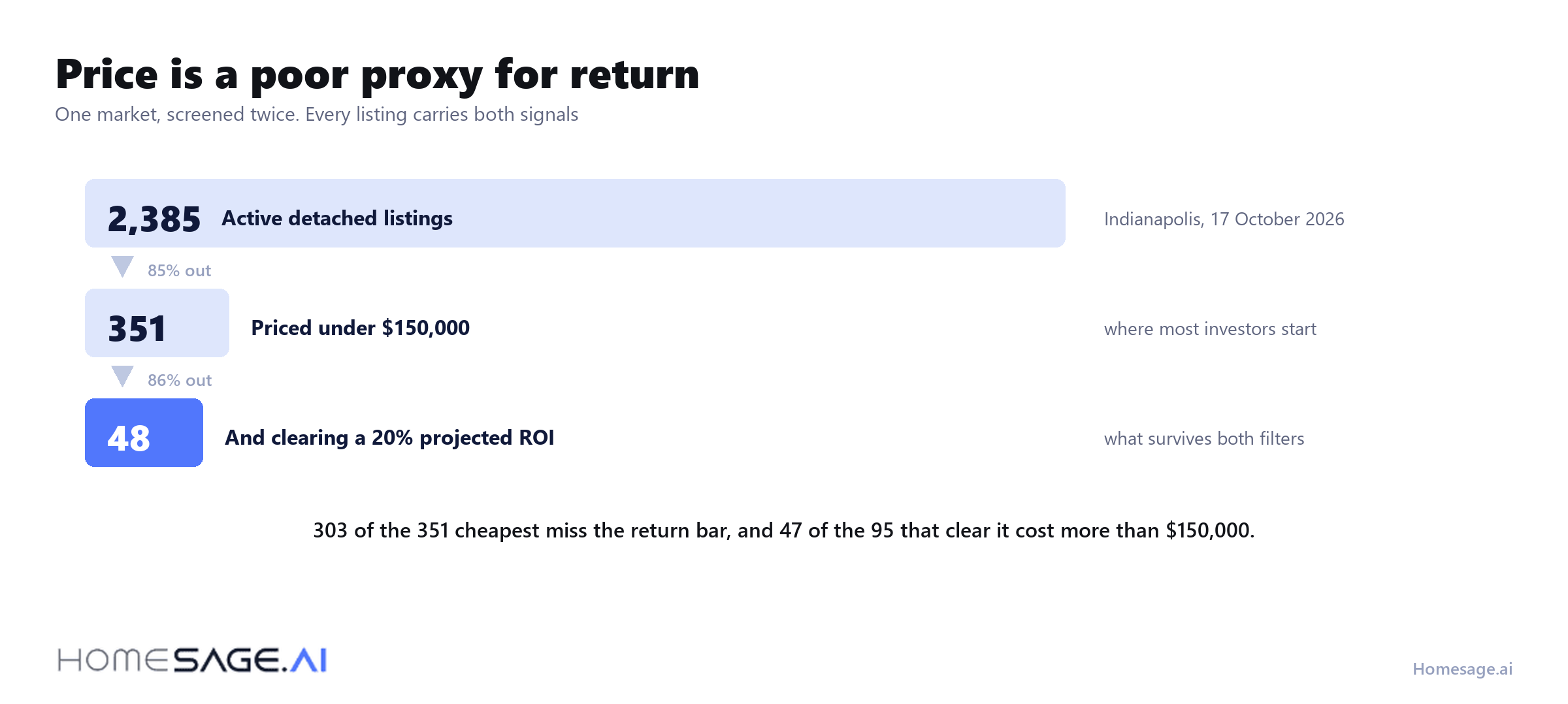
We screened one market to show the size of the gap. Indianapolis, active detached listings, 17 October 2026.
| Indianapolis screen | Listings | Share of the market |
|---|---|---|
| Active detached listings | 2,385 | 100% |
| Priced under $150,000 | 351 | 14.7% |
| Clear a 20% projected ROI | 95 | 4.0% |
| Both, under $150,000 and clearing 20% | 48 | 2.0% |
Homesage.ai property database, Indianapolis active detached listings, 17 October 2026. Every listing carries a price and a projected return, so the price and return rows cover the whole market. 2,148 of the 2,385 carry a property condition grade, which is 90.1%, so the condition figure is a share of those. Counts move daily.
303 of the 351 cheapest houses fail the return test. That is 86% of the list most investors start from.
The reverse is just as costly. 47 of the 95 listings that clear a 20% projected ROI cost more than $150,000, so a price ceiling alone hides half the winners.
Cheap is not a return, and a return is not a budget. A platform earns its price when it holds both numbers in the same view.
Property condition is the third filter, and it moves the answer again. Of the 95 listings clearing 20%, 55 are graded outdated, poor or very poor. The return is real and the work is real with it.
The 6 best AI property analysis tools
1. Homesage.ai. Best all-in-one platform for investors
Homesage.ai provides insights on 155M+ US properties and runs all five jobs under one login.
Investment Property Search scores listings on projected return. Full Property Reports carry an estimated value, estimated ARV, automated comps and an estimated renovation cost. They also carry rental projections, a property condition grade read from photos, and a Seller Motivation Score that estimates the room in the asking price.
The DealFinder browser extension turns any page mentioning a US address into a report. Paste the address, open the pop-up, and the analysis loads.
Best for: investors who want one environment instead of five subscriptions. Pricing is credit-based.
2. BatchLeads. Best for building lead lists at volume
BatchLeads is a list-building platform built around nationwide property records, distress filters and skip tracing.
Investors pull lists by high equity, vacancy, pre-foreclosure, absentee ownership and tax delinquency. Contact data and direct mail run from the same place.
The analysis layer is deliberately light. BatchLeads tells you who to call, and leaves the underwriting to the tool you call it from.
Best for: wholesalers and high-volume investors who need the list first.
3. AirDNA. Best for short-term rental underwriting
AirDNA tracks short-term rental performance across markets, with occupancy, average daily rate and revenue history pulled from live listing data.
For an investor weighing a market for short-term rental potential, it answers the revenue side better than a general platform does.
Flip analysis is outside its scope. There is no estimated ARV and no renovation costing, so a hybrid strategy needs a second tool beside it.
Best for: short-term rental operators sizing a new market.
4. DealCheck. Best for underwriting speed
DealCheck turns an address or a pasted listing into a complete underwriting model in under a minute.
It runs cash flow, ROI, BRRRR and flip analysis, prices the rehab, and exports a branded PDF for a partner or a lender.
The database behind it is lighter than a sourcing platform’s. DealCheck assumes you already know which house you are analyzing.
Best for: investors who source elsewhere and want the fastest underwriting on a known address.
5. DealMachine. Best for driving for dollars
DealMachine built the modern street-level workflow. Photograph a neglected house, pull the owner record, and start a campaign from the pavement.
It has since added skip tracing, direct mail and a CRM, which makes it a complete sourcing environment for off-market acquisition.
Its depth is in acquisition rather than financial modeling. Most investors pair it with an underwriting tool once a lead turns into a real opportunity.
Best for: wholesalers and flippers building an off-market pipeline.
6. Roofstock. Best for turnkey single-family rentals
Roofstock is a marketplace for already-tenanted rental houses, with a neighborhood rating built from school, employment and housing data.
After the Mynd merger it spans the whole rental lifecycle, from buying through leasing and management to the eventual sale.
The trade-off is curation. Every property has been vetted and listed by Roofstock, so open searching is not on the table.
Best for: investors who want rental exposure without finding or managing the house.
How the 6 platforms compare
| Platform | AI valuation | Native comps | Deal sourcing | Estimated ARV and flip | Built for |
|---|---|---|---|---|---|
| Homesage.ai | Yes | Yes | Yes | Yes | The whole workflow |
| BatchLeads | No | Limited | Yes, lists | No | List volume |
| AirDNA | No | Market level | No | No | Short-term rental revenue |
| DealCheck | Limited | Yes | No | Yes | Speed on a known address |
| DealMachine | Lead scoring | Yes | Yes, off-market | Limited | Street-level sourcing |
| Roofstock | Neighborhood rating | Limited | Yes, curated | No | Turnkey rentals |
Published capabilities, checked 17 October 2026.
What the analysis looks like on one house
A platform is easier to judge on output than on a feature list. The report below is our own analysis of a single property, with the location masked.
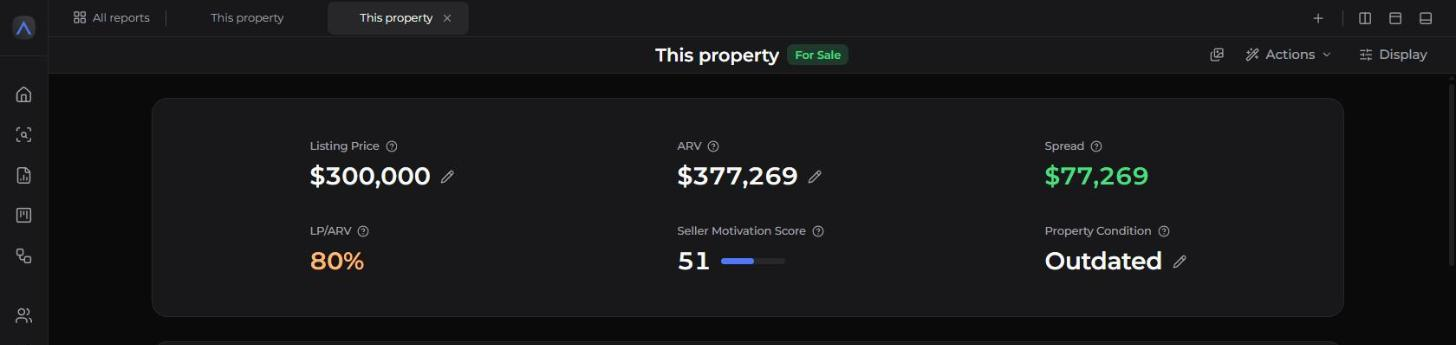
Every number an offer depends on sits on one screen. The spread between the price and the estimated ARV, the condition grade, and the seller’s likely flexibility.
Ask Sage before you subscribe
Sage, our assistant, runs these analyses from inside the AI tool you already use, through the Homesage.ai MCP connector.
Ask it “screen Indianapolis for detached houses under $150,000 that clear a 20% projected ROI” and it returns the count before anything is charged. That is the same screen behind the table above.
How to choose
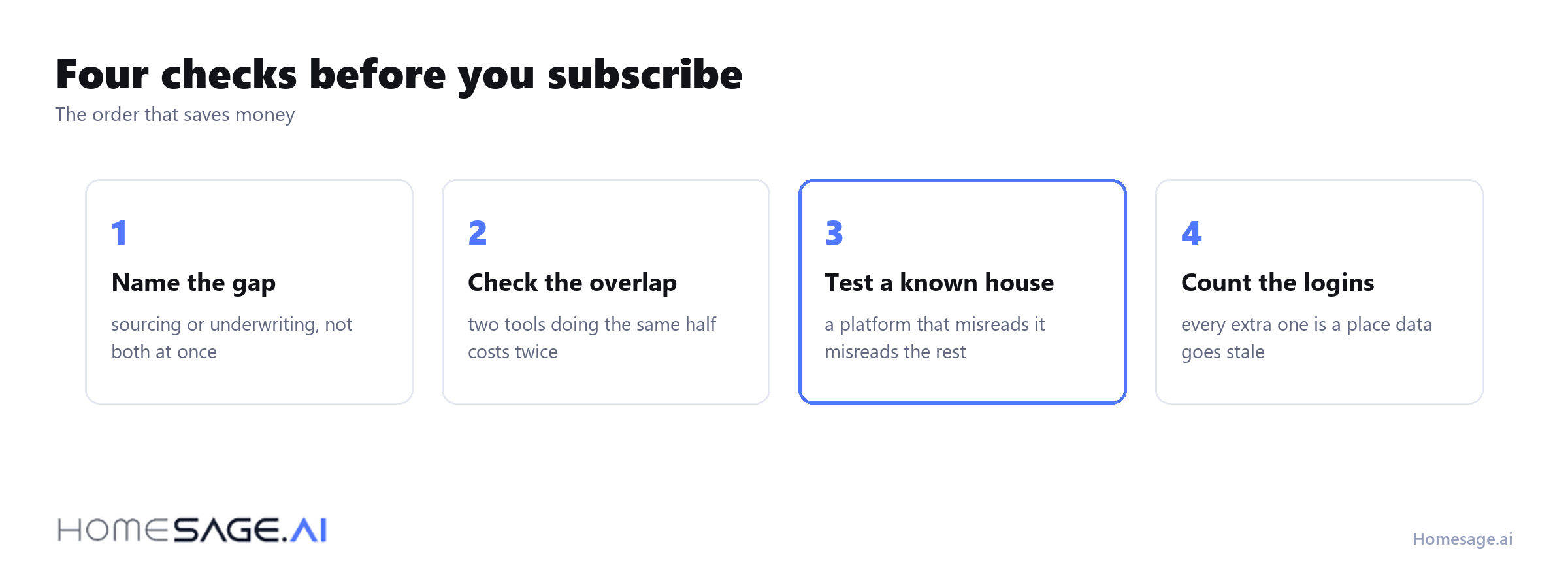
Start from the job you cannot already do. An investor drowning in leads needs underwriting, and one with a clean spreadsheet and no deals needs sourcing.
Then check the overlap. Two platforms that both source and neither values will cost twice and answer the same half of the question.
Last, test on a house you already know. A platform that misreads a property you understand will misread the ones you do not.
Key takeaways
- A property analysis platform has to search, value, comp, score and report. Four of the five is the working minimum.
- Price is a poor proxy for return. In Indianapolis, 86% of listings under $150,000 missed a 20% projected ROI.
- A price ceiling also hides winners. 47 of the 95 listings clearing 20% cost more than $150,000.
- Condition decides what the return costs. 55 of those 95 are graded outdated, poor or very poor.
- Our platform fits the investor who wants the whole workflow in one place.
- BatchLeads and DealMachine source, DealCheck underwrites, AirDNA prices short-term rental income, and Roofstock sells the finished rental.
Conclusion
The platform question is really a strategy question. High-volume sourcing rewards different software from careful underwriting, and no single tool is best at both for every investor.
What the Indianapolis screen shows is that the filters have to meet. Price, return and property condition each eliminate a different set of houses. An investor who applies them in separate tools works from whichever list came out last.
One environment can carry a deal from the search box to the report. Compare the Homesage.ai plans, or Start now and run a report on a house you already know.
The walkthrough below opens a Full Property Report on a real US house and shows what an investor gets back.
Estimated values, ARV, renovation costs and returns are model-derived estimates, not investment advice. Property data as of 17 October 2026.
Frequently asked questions
What is an AI property analysis platform?
It is investor software that uses machine learning to value a house, run comps, score the projected return and build a report. The stronger platforms also handle the search that finds the house.
How accurate are AI property valuations?
Accuracy varies by market and by comp coverage. Estimates are tightest in active markets with recent sales nearby, and they widen in rural or low-transaction areas. Check an estimate against recent local sales before making an offer.
Is one platform enough, or do investors need several?
It depends on the gap between sourcing and underwriting. An investor who finds deals easily needs analysis, and one who analyses well but finds nothing needs sourcing. Platforms covering four or five of the jobs reduce how many subscriptions that takes.
Can AI replace an agent or an appraiser?
No. Models handle data at a scale a person cannot, and appraisers, agents and inspectors still carry negotiation, on-site verification and legal compliance. These platforms are decision support.
What is the difference between a platform and a valuation model?
A valuation model returns one number. A platform treats that number as one input. Comps, property condition, rental projections, estimated ARV and a return score complete the view.
Sources
- JLL, 2025 Global Real Estate Technology Survey, published 28 October 2025.
- National Association of Realtors, 2026 Technology Report, published 22 September 2026.
- Homesage.ai property database, Indianapolis active detached listings, 17 October 2026.





Sam April 30, 2026
Very interesting read!
Peter April 30, 2026
Helpful for investors...
Nourhan April 30, 2026
Insightful!