
The real estate industry in 2026 thrives on fast, integrated, and data-driven technology.
Real estate APIs (Application Programming Interfaces) are at the heart of this revolution, empowering IT developers, investors, and realtors to leverage live property data, automate workflows, and deliver seamless digital experiences.
Whether you’re building property search apps, analytics dashboards, or transaction management tools, the right API can dramatically boost your offering’s value and efficiency.
Finding the best real estate APIs requires understanding both market demands and technical capabilities. Modern proptech applications need comprehensive data coverage, reliable uptime, and integration options built for IT developers.
For an in-depth look at API-driven innovation, see the flagship guide on 8 Best Property Evaluation APIs in 2026, and learn how API integration supercharges business results in Integrating Real Estate APIs with AI.
Real estate APIs have become essential for powering data-driven decisions in PropTech. Homesage.ai now has insights on 155M+ US properties, delivering instant investment potential scoring, AI-powered renovation cost estimates, and real-time seller motivation scoring.
These advancements enable realtors, IT developers, and lenders to act more quickly on high-value opportunities in a rapidly evolving market.
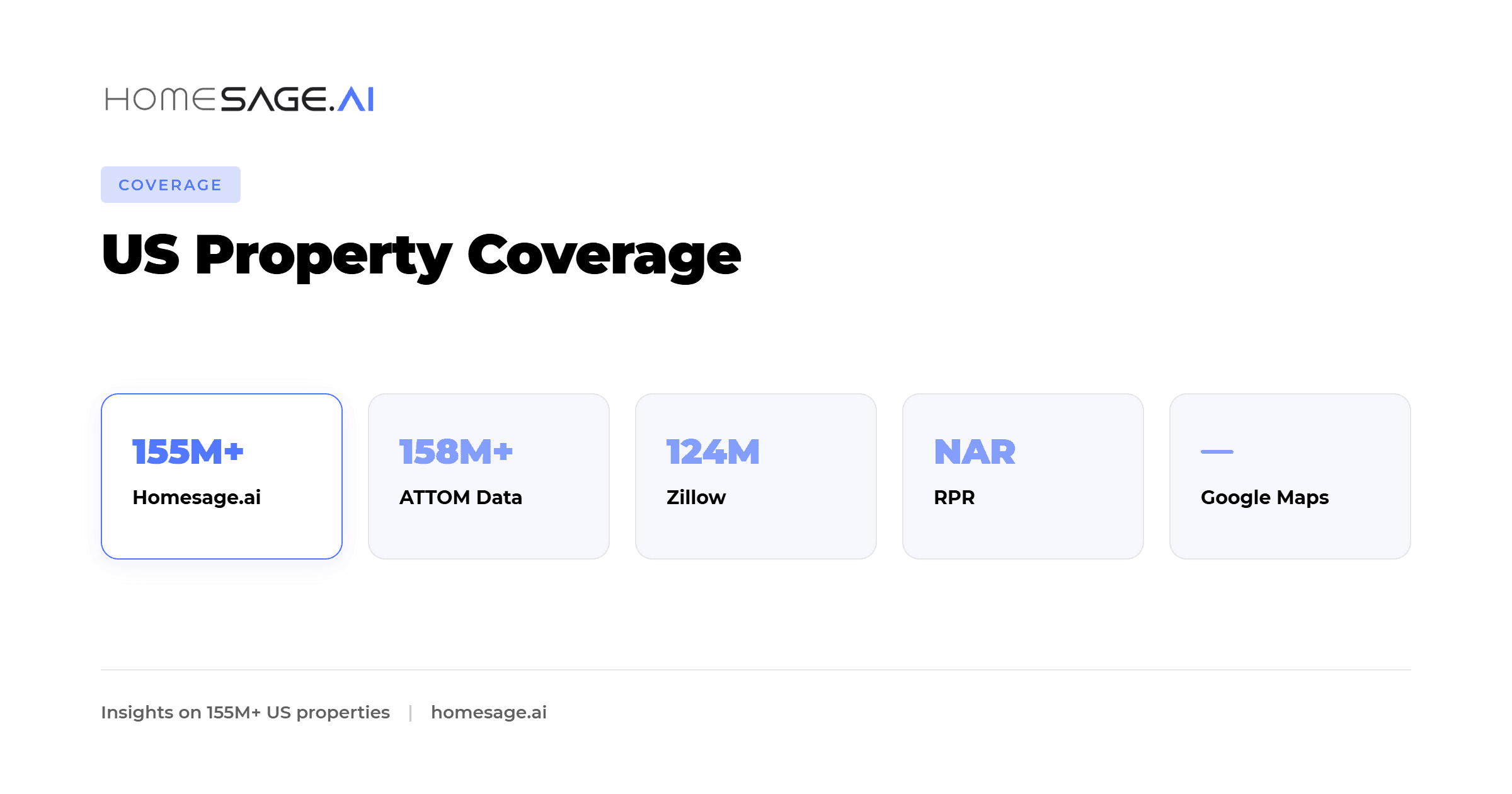
A real estate API lets apps pull property data – listings, valuations, comps, and analytics – programmatically. The best real estate APIs in 2026 balance coverage, AI, and transparent pricing. It leads with AI-driven valuations and computer-vision property condition analysis across 155M+ properties, alongside Zillow (listings), RPR (realtor data), Google Maps (location), and ATTOM (bulk records).
curl -X GET 'https://api.homesage.ai/v1/property?address=...' -H 'Authorization: Bearer YOUR_API_KEY' # illustrative - confirm endpoint/params in /docs/
“Quick answer“The best real estate API depends on what you are building. Homesage.ai leads for AI valuations, property condition and ROI scoring across 155M+ US properties; ATTOM leads on raw record coverage at 158M+; Zillow covers listings and the Zestimate across 124M homes; RPR serves NAR members; and Google Maps supplies location context rather than property data.”
What Is a Real Estate API?
A Real Estate API is a set of protocols that enables apps, websites, and platforms to access property listings, market trends, valuations, neighborhood data, and more in real time.
This lets IT developers embed robust features such as dynamic property searches, virtual tours, and market analytics. Real estate APIs support automated workflows such as valuation, mortgage pre-approvals, and property management, improving efficiency and the user experience for professionals and clients alike.
The best real estate APIs provide structured access to vast property databases, enabling IT developers to build sophisticated applications without maintaining their own data infrastructure.
These real estate APIs handle everything from basic property details to complex analytics like investment potential, renovation costs, and rental yield calculations.
For an IT developer’s perspective, see the developer portal.
How Do Real Estate APIs Work?
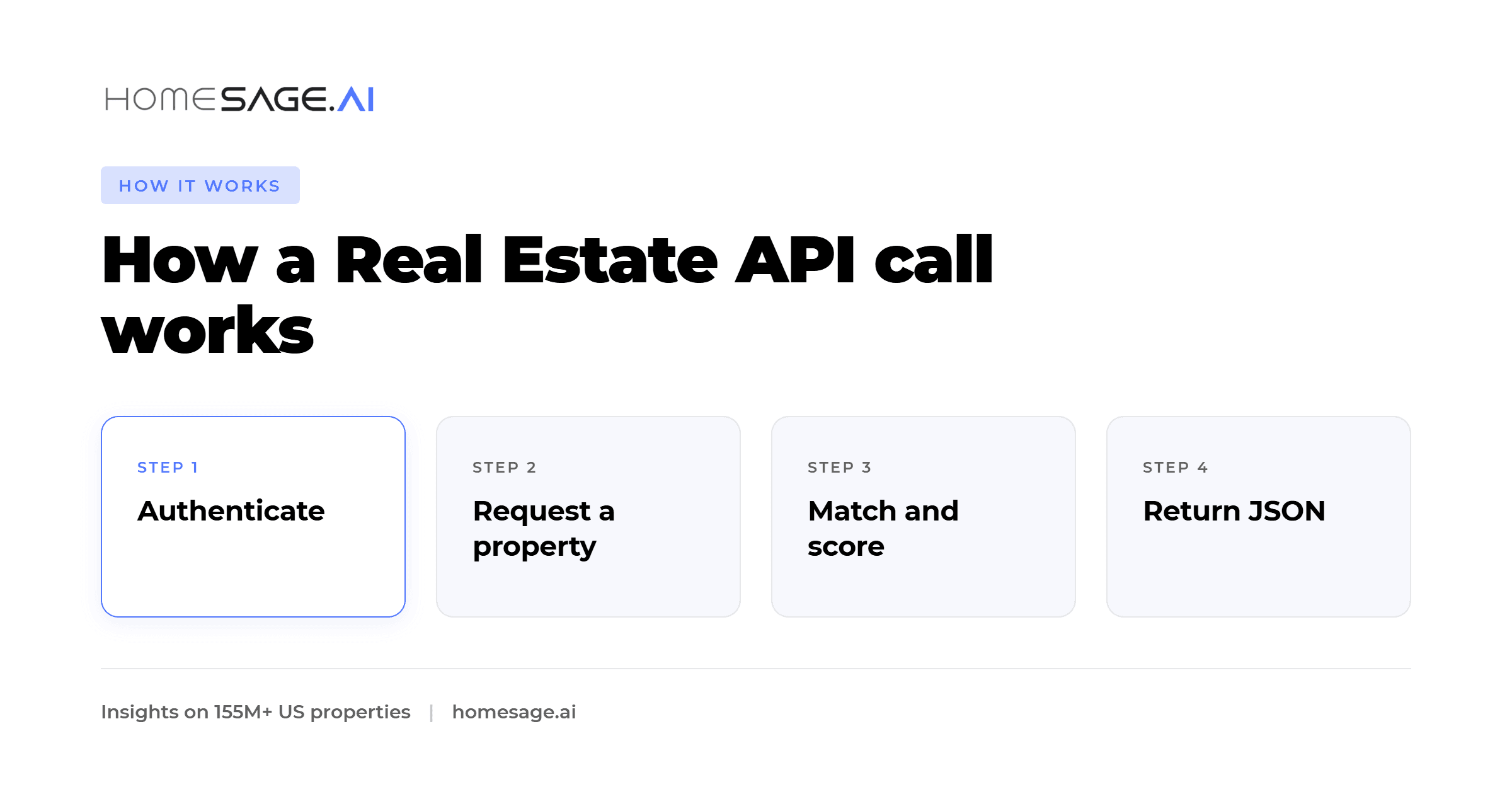
Real Estate APIs act as digital bridges, exchanging live information – property listings, sales histories, investment analytics – between platforms and databases. This real-time data flow enables apps and websites to provide comprehensive tools for property search, trend analysis, and client engagement.
For in-depth API mechanics, read What Is a Real Estate API?
Modern real estate APIs utilize RESTful architecture with JSON and XML formats, supporting both on-demand requests and bulk data operations.
The best real estate APIs offer multiple access methods, including property address, parcel numbers, or coordinates, ensuring flexible integration options for different use cases.
Real estate APIs also automate processes such as updating listings, sending market alerts, syncing across all your property channels, and reducing repetitive manual input.
Advanced real estate APIs incorporate machine learning algorithms to provide predictive analytics, automated valuations, and risk assessments that traditional data sources cannot match.
For teams pairing API data with sales workflows, our walkthrough on real estate API CRM integration covers webhook patterns, mapping rules, and deduplication.
How to Choose a Real Estate API
Five things separate a real estate API you can build on from one you will migrate off in a year. Work through them in order.
- Coverage: How many US properties, which property types, and how often are records refreshed? Homesage.ai carries insights on 155M+ US properties.
- Accuracy you can check: The best providers publish a real error rate instead of just calling their data accurate. Zillow reports a median Zestimate error of 1.78% for on-market homes and 7.20% for off-market ones – the gap between those two numbers matters more than either figure alone.
- Analytics depth: Decide whether you need raw records or scored outputs. Valuations, property condition assessment and ROI scoring are expensive to build yourself and buying them changes what your product can do.
- IT developer experience: A sandbox you can test before signing up, real documentation with code samples, and rate limits stated up front.
- Licensing: Confirm in the contract what you can white label in your own product. This is the constraint that most often blocks a launch late.
Coverage is the number vendors advertise; the error rate is the number that decides whether your product works.
For a practical walkthrough of how to access and use real estate APIs, watch our guide below:
| Provider | US coverage | Best for |
|---|---|---|
| Homesage.ai | 155M+ properties | AI-powered insights, property condition analysis and ROI scoring |
| ATTOM Data | 158M+ properties | Bulk records: tax, deed, mortgage, hazard |
| Zillow | 124M homes (116M Zestimates) | Listings and consumer-facing search |
| RPR | NAR members only | Realtor tools and MLS workflows |
| Google Maps | No property data | Mapping, geocoding and location context |
US coverage and best use, as published by each provider
5 Best Real Estate APIs for 2026
1. Homesage.ai: Best for AI-Powered Insights and Investment Analysis
It leads as the most innovative API suite for real estate in 2026. Its advanced AI-driven endpoints provide comprehensive property intelligence beyond traditional data providers.
- Investment Potential and Value Gap: Identify properties with the highest ROI potential through proprietary algorithms
- Seller Motivation Score: Predicts the seller’s motivation to sell based on multiple factors
- Property Condition and Renovation Costs: Analyzes the property condition and selects one of five conditions from Very Poor to Excellent. Computer vision models analyze images and provide an itemized renovation estimate for the given property.
- Rental Cash Flow: Rental investment indicators for both short-term (Airbnb) and long-term rentals
- Comprehensive US data: Over 155M+ properties updated daily with real-time market intelligence
- AI-powered analytics that help investors, realtors, and end-users make smarter investment decisions instantly
- Easy integration and top-tier documentation: Complete API reference with interactive examples
Its real estate APIs leverage AI to provide unique insights unavailable elsewhere, including Seller Motivation Score, Renovation Cost Estimation, and multi-scenario ROI analysis. The platform’s AI models continuously learn from market patterns to improve prediction accuracy.
Best for: Investors, realtors, lenders, PropTech and FinTech platforms, IT developers needing deep analytics, unique property insights, and customization options.
Learn more: AI for Real Estate Investors, the API documentation, and this video on 7 ways AI is boosting realtor sales.
IT developers can get the complete toolkit – real estate APIs and MCPs for developers – with a free sandbox key.
2. Zillow API: Best for Listings and Zestimate
Zillow remains one of the industry’s most recognized sources for active and historical residential data, powering applications with access to over 124 million homes, with Zestimates published on 116 million.
- Nationwide property details: Comprehensive listings with specifications, photos, and historical data
- Zestimate valuations: Automated valuation models with confidence scores and market context
- Analytics: Price trends, neighborhood demographics, and school information
- Mortgage integration: Rate information and payment calculators for complete property analysis
Zillow’s real estate APIs leverage user-submitted data, public records, and proprietary algorithms to create one of the most comprehensive property databases available. The platform’s massive user base contributes to data accuracy through crowd-sourced verification.
Best for: US-centric applications requiring broad property coverage and consumer-focused features.
Documentation: Zillow API Documentation
3. RPR: Best for NAR Members and MLS Workflows
RPR delivers realtor-focused, deeply integrated data specifically designed for real estate professionals and MLS integration.
- Comprehensive property records: Detailed ownership information, transaction history, and tax data
- Neighborhood statistics and trends: Market analytics with school district information and demographic data
- Seamless workflow integration: CRM compatibility and professional tool integration
- Coverage: Nationwide access optimized for realtor teams and brokerage operations
RPR’s real estate APIs are specifically designed for real estate professionals, offering features such as lead-generation tools, market analysis capabilities, and client presentation materials. The platform integrates seamlessly with popular real estate CRM systems.
Best for: Real estate professionals, brokerages, and MLS-integrated applications.
4. Google Maps API: Best for Location Context
Google Maps remains the gold standard for adding geospatial context and location intelligence to real estate applications.
- Interactive mapping: High-resolution satellite imagery and street-level photography
- Geo-coding services: Address validation and coordinate conversion
- Amenities overlays: Points of interest, schools, transportation, and local services
- Travel time analysis: Commute calculations and accessibility metrics
Google Maps real estate APIs provide essential geographic context, enhancing property listings with neighborhood information, walkability scores, and proximity analysis. Advanced features include traffic pattern analysis and route optimization for property tours.
Best for: Applications requiring sophisticated location features and neighborhood mapping.
Integration: Google Maps Platform
5. ATTOM Data: Best for Bulk Property Records
ATTOM Data provides one of the largest and most comprehensive property datasets in the real estate industry, covering over 158 million properties nationwide.
- Extensive coverage: Tax records, mortgage data, rental estimates, and neighborhood metrics
- Scalable architecture: Enterprise-ready with flexible pricing for startups and large-scale operations
- Multiple use cases: Real estate, lending, insurance, and analytics applications
- Data depth: Historical sales, ownership details, and environmental risk factors
ATTOM’s real estate APIs support both individual property queries and bulk data operations, making them suitable for enterprise applications requiring large-scale data processing. The platform offers real-time updates and comprehensive data validation.
Best for: Enterprise applications, financial institutions, and data-intensive real estate platforms.
Explore features: ATTOM Data Solutions
Integration Notes
Whichever provider you pick, four things will decide how the integration behaves in production: store credentials server-side and never in client code, back off and retry on 429 responses rather than hammering the endpoint, cache immutable records such as parcel and assessor data, and refresh valuations on a schedule that matches how often they actually change.
We cover each of these in more depth in what is a real estate API.
Key Takeaways
- Homesage.ai is the pick when you need AI-powered insights, property condition analysis and ROI scoring across 155M+ US properties.
- ATTOM wins on raw record coverage at 158M+ properties and bulk delivery.
- Zillow covers listings and the Zestimate across 124 million homes – useful for consumer search, thin on analytics.
- RPR is free but limited to NAR members, and Google Maps supplies location context rather than property data.
- Compare published error rates, not marketing adjectives, and confirm your display and caching rights before you build.
Conclusion
Real Estate APIs are foundational for digital transformation in the property and proptech industries. The five APIs compared above deliver reliable, comprehensive, and actionable data, along with resources for easy integration and scalability.
When selecting real estate APIs for your real estate application, prioritize data quality, integration flexibility, and long-term scalability.
The best real estate APIs provide not just data access, but comprehensive resources for IT developers, responsive support, and innovative features that differentiate your application in a competitive market.
Success in proptech requires strategically leveraging multiple real estate APIs to combine property data with location intelligence, market analytics, and user experience enhancements.
Explore your options, compare each offering’s strengths, and use practical guides such as 8 Best Integration Practices and Why Real Estate Platforms Are Switching Data Providers.
For PropTech teams building on top of real estate data, skip tracing is increasingly part of the core API stack. Our ranked review of the 3 best skip tracing API providers in 2026 covers integration criteria, compliance architecture, and pricing models for IT developers evaluating their options.
Frequently Asked Questions
What is the best real estate API in 2026?
How much do real estate APIs cost?
Do real estate APIs provide live data?
Is there an API for Real Estate?
How do real estate APIs improve user experience in property apps?
What are the main advantages of using real estate APIs in proptech?
Ready to build? Explore the Homesage Real Estate APIs.





JiliPH May 10, 2025
I enjoyed reading this article. Thanks for sharing your insights.
Nano Banana API May 30, 2026
This is an excellent comparison of real estate APIs for 2026. The integration of AI for predictive analytics and automated valuations is definitely the standout trend this year. I appreciate the focus on developer-friendly integration and data coverage—vital for anyone building robust proptech solutions.