
What actually breaks a property app
Property apps rarely fail on the API call. They fail on the field missing from a third of properties, discovered after the interface has been designed around it.
Field lists do not warn you about that, because they describe what can come back rather than what usually does. Coverage is what matters, and it is rarely published.
The second thing that breaks an app is the license. Many property feeds permit display but restrict storage, which changes your caching layer after you build the integration.
So each API below gets what it is for and what it returns. The study then measures coverage across a whole city rather than a handful of demo addresses.
The 10 best real estate APIs for app builders in 2026
1. Homesage.ai property reports
Homesage.ai returns property condition, renovation cost, after-repair value, projected return and a Seller Motivation Score for one property in a single response.
For most apps this is the fastest way to find out which fields you actually use. Call it once, see the shape of the response, then move to narrower endpoints if call volume justifies it.
Best for: Getting a complete picture in one call, and for prototyping.
2. Homesage.ai property condition
Homesage.ai grades a property from its listing photos, from excellent through to unlivable.
This is the field most property APIs infer from year built and square footage. Reading it from the photographs is an observation rather than a guess, and it was on 91.7% of Spokane listings when we counted.
Best for: Any app that has to tell a renovated house from a tired one.
3. ATTOM Data API
ATTOM covers more than 160 million US properties with tax, deed, mortgage, foreclosure and environmental risk records, as bulk files or an API.
No interpretation is layered on top, which is the attraction if you intend to build your own model. The filings don’t change between releases.
Best for: Teams with engineers building their own valuation or risk logic.
4. Zillow API
Zillow provides the Zestimate and Zillow Research. Together, they provide a value and market context your users have likely seen already.
Developer access is more restricted than people expect and the terms on storage and display are tight. Treat it as a familiar reference point, not as infrastructure.
Best for: Showing several users already trust next to your own.
5. Regrid
Regrid returns standardized parcel boundaries, ownership, addresses, zoning, and building footprints across more than 160 million parcel records.
Asynchronous batch endpoints handle portfolio-sized jobs. Parcel geometry is also what separates an accurate map from an approximate one.
Best for: Maps, zoning and anything where the boundary matters as much as the building.
6. Cotality
Cotality publishes nine REST API products covering property characteristics, spatial boundaries, derived scoring, tax servicing, fraud and underwriting. The company traded as CoreLogic until it was renamed on 24 March 2025.
You can read its reference documentation without an account, which makes evaluation much faster. Expect an enterprise contract rather than a self-serve key.
Best for: Regulated and institutional products needing several data families under one contract.
7. Smarty
Smarty turns an address into a property record. Its US Address Enrichment API returns what the company describes as more than 350 property attributes.
Address validation and property enrichment arriving in one call removes a whole class of matching bugs. On any app with user-entered addresses that is worth more than it sounds.
Best for: Apps where the user types an address and expects a record back.
8. Rentometer
Rentometer answers the long-term rent question. Its self-service API returns a rent estimate with percentile ranges, and nearby rent comparables with rent, distance, beds, baths and square footage.
The comparables matter more than the estimate. A rent figure you can defend with the units behind it survives scrutiny. It returns no property values, so pair it with a records provider.
Best for: Showing a defensible rent with the evidence that produced it.
9. Walk Score
Walk Score publishes three APIs. A Score API for Walk Score, Transit Score and Bike Score, a Public Transit API for nearby routes and stops, and a Travel Time API.
It is a small, well-scoped service that answers a question buyers genuinely ask. Location context is also one of the few fields that does not go stale weekly.
Best for: Adding neighborhood context without building it yourself.
10. Eagleview
Eagleview measures the building, not the record. Its Property Data API returns verified roof and wall measurements, plus orthogonal and oblique aerial imagery, surface materials, and solar shade metrics.
It is the only API here that can tell you about a roof without anyone standing on it. In renovation, insurance, and solar, that difference can mean the difference between an estimate and a quote.
Best for: Apps that turn on the physical state of the structure.
How the ten compare
| API | What it returns | Access |
|---|---|---|
| Homesage.ai | Property condition, cost, return, motivation | Self-serve and enterprise |
| ATTOM | Tax, deed, mortgage, risk records | Enterprise |
| Zillow | Consumer value estimate and research | Restricted |
| Regrid | Parcels, boundaries, zoning | Self-serve and bulk |
| Cotality | Property, spatial, risk, tax | Enterprise |
| Smarty | Address enrichment, 350+ attributes | Self-serve |
| Rentometer | Long-term rent and comparables | Self-serve |
| Walk Score | Walk, transit and bike scores | Self-serve |
| Eagleview | Roof measurement and aerial imagery | Per-report and API |
Four of these are self-serve, which matters more than feature count when you are still deciding whether the product works at all.
Coverage, measured on a whole city
On 20 October 2026, we counted how many of the 1,058 active listings in Spokane, Washington, carried each field an investment app typically needs.
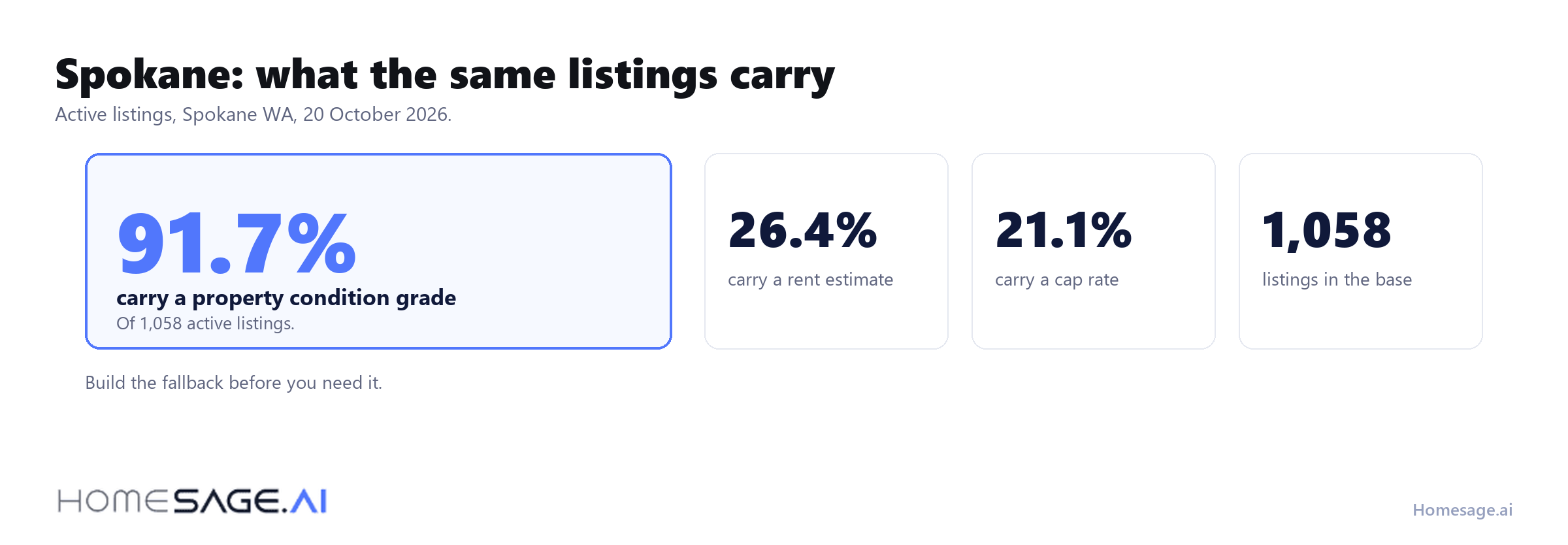
A property condition grade exists on 970 listings, or 91.7%. A rent estimate exists for 279 listings, or 26.4%. A cap rate exists on 223, or 21.1%.
A long feature list is not coverage. Measure the one field you cannot ship without.
Spokane is not unusual. Across six cities measured this month, property condition landed between 87.7% and 94.6%, while rent ranged from 13.2% in Akron to 41.6% in Little Rock. Property condition is dependable everywhere. Income data is not, and it varies enormously by market rather than settling around a national average.
For an app, that is an architecture decision rather than a footnote. Design the screen that appears when the yield figure is absent, because in some markets it will be absent more often than it is present.
Every percentage is a share of that city’s active listings on the day we counted. A listing missing a field is absent from that count rather than recorded as a zero.
How to choose between them
Start from the field your app cannot ship without. That usually eliminates most of this list in one step.
Then decide between records and judgments. Records need you to build the model and age predictably. Judgments save months and need to be checked against reality.
Then read the license before the documentation. Storage limits shape your caching layer, and finding out late is expensive.
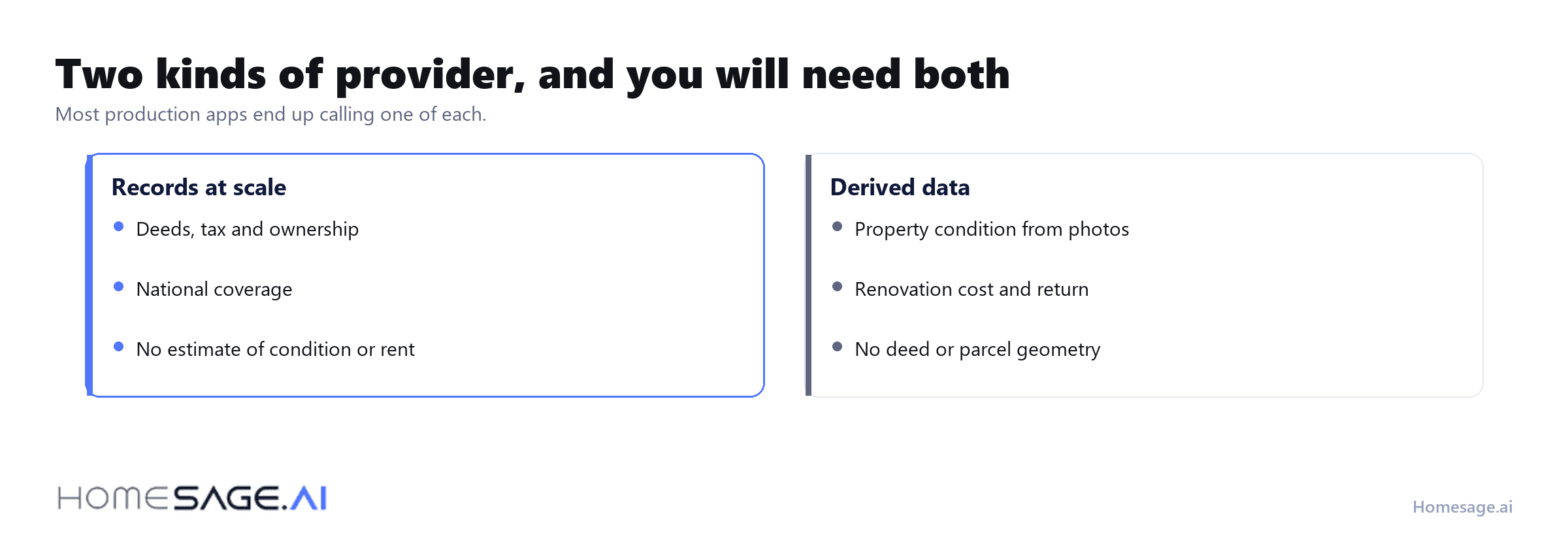
Most production apps end up with two providers: one for records and one for derived data. For the evaluation-specific comparison, see the best property evaluation APIs. For the developer view, see the best property data APIs.
Estimated values, after-repair values, renovation costs and returns are model-derived estimates, not investment advice. Property data as of 19 October 2026.
Key takeaways
- Pick for the field your app depends on, not for the longest feature list.
- Property condition data is dependable, at 91.7% of Spokane listings and 87.7% to 94.6% across six cities.
- Income data is not. Rent ranged from 13.2% to 41.6% depending on the market.
- Design the missing-field state deliberately. A null that becomes a zero ships as a bug.
- Read the license early. Storage limits change your architecture and your contract.
Conclusion
Ten APIs, and almost none of them compete directly, which is the useful part. A records provider will not grade a roof and a derived-data provider will not hand you a deed. Decide the field your app cannot ship without, pick the provider built for it, and ask for coverage figures in your own markets before you commit. The Spokane counts show the shape of the problem: property condition is there, income data often is not, and the gap is an architecture decision.
Frequently asked questions
Which API should I start with for a new property app?
Start with whichever returns the field your product cannot work without. If that is property condition, start with Homesage.ai. If it is parcel geometry, start with Regrid. If you intend to build your own valuation model, start with a records provider.
Do I need more than one API?
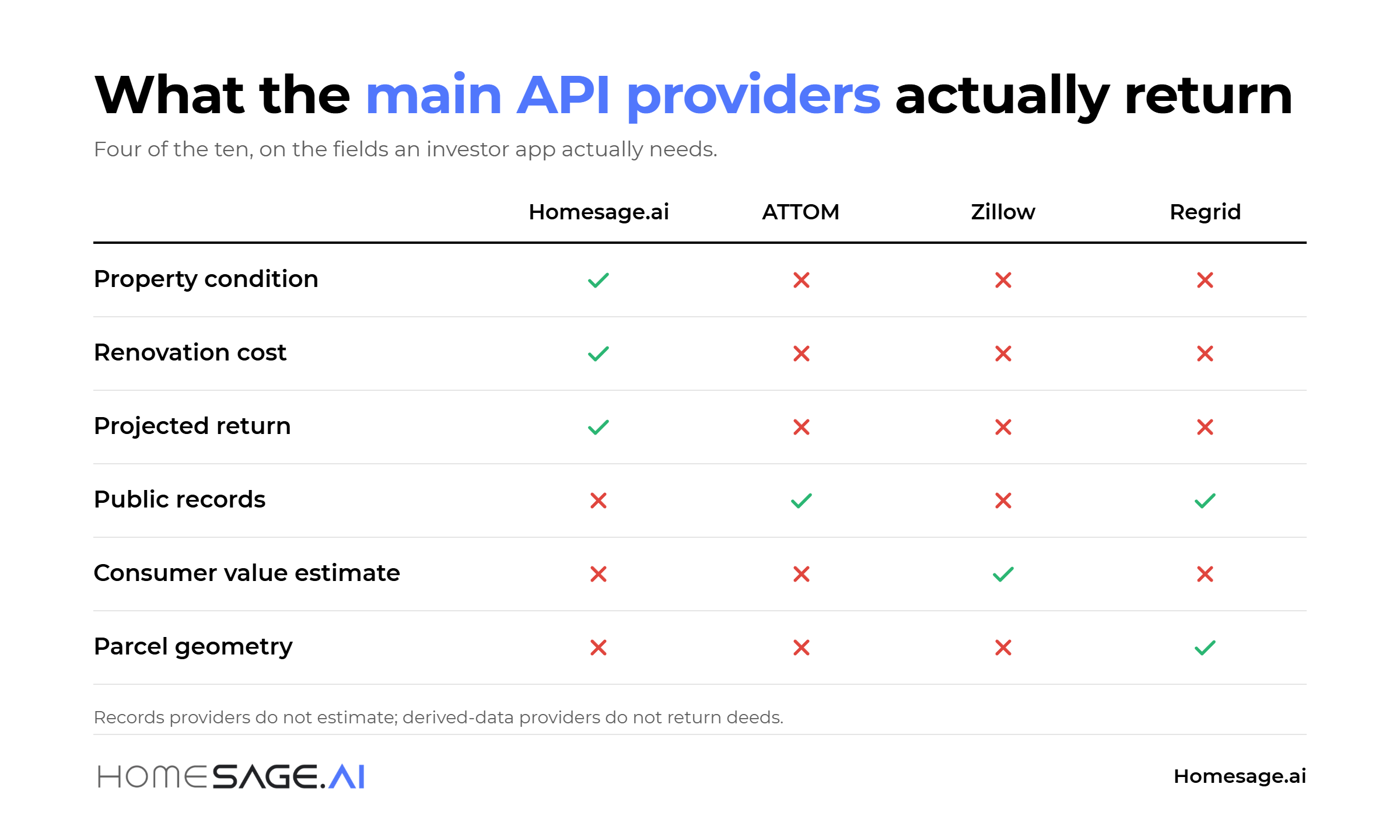
Most production apps use two. Records providers don’t estimate rent or property condition, and derived-data providers don’t return deeds. The alternative is one provider that covers both, which removes the identifier-matching work.
Can I store the data I retrieve?
It depends on the provider and often the underlying source. Several property feeds permit display but restrict retention. Read the license before you design the caching layer rather than after.
What happens when a field is missing?
A well-built API returns an explicit null. Your own code has to carry that absence through to the interface. Substituting a zero produces confident, wrong numbers.





Peter September 25, 2025
AI-powered real estate apps are the future!
MLS API & Data Integration: 3 Best Methods For 2026 October 10, 2026
[…] For a broader view of real estate API options that complement MLS feeds, see the best real estate APIs for building apps in 2026. […]
How To Find Out Home Value: 5 Best AI Tools (2026) October 10, 2026
[…] clients question pricing strategies, explaining how AI property condition analysis captures factors that AVMs miss becomes essential for maintaining professional […]
How AI Helps Lenders Attract Investors | Homesage.ai October 10, 2026
[…] the Investment Potential API, lenders can evaluate properties to determine their suitability as investments, categorizing them […]
5 Must-Have Real Estate API Features (Dev Checklist) October 19, 2026
[…] out this API integration guide or the API developers blog in the Homesage.ai docs section for in-depth […]
6 Ways Realtors Attract Real Estate Investors | Homesage.ai October 21, 2026
[…] Explore realtor tips for investors and our 5 best APIs blog or Homesage.ai API developers page. […]