

Why a real estate API can earn traffic at all
People do not search for real estate APIs. They search for answers: what is this house worth, what will the work cost, what will it rent for.
An endpoint that answers one of those questions can power a page that answers it in public. That is the whole mechanism, and it is less about the API than about whether the page shows its working.
The failure mode is a tool page with a form and no answer. It ranks for nothing because it says nothing until someone submits something.
This is our own suite, so treat it as opinionated documentation. The study below measures where the data is thin, which is the part that decides whether a page can answer honestly at scale.
The 7 real estate API endpoints and the questions they answer
1. Full Property Report
The Full Property Report endpoint returns property condition, renovation cost, after-repair value, projected return and a Seller Motivation Score for one property in one call.
It answers the broadest query: what is this property worth? It is usually the right place to start an integration.
Best for: A single page that answers everything about one address.
2. Investment Potential
Investment Potential scores how strong a property looks as an investment, graded from excellent down to no potential.
It answers: Is this worth buying? That is a different question from what it’s worth, and it’s far more commercial.
Best for: Ranking and filtering pages, where a grade does more work than a number.
3. Seller Motivation Score
The Seller Motivation Score rates how much negotiating room an asking price is likely to carry, from 1 to 100.
It answers how negotiable this price is, a question buyers ask constantly and almost nobody answers publicly with a number.
Best for: Content about offers and negotiation.
4. Renovation Cost
Renovation Cost estimates what it would take to bring a property to a stated standard, based on its assessed condition and local cost data.
It answers what the work will cost, which has enormous search volume and almost no property-specific answers.
Best for: Renovation and remodeling content tied to real addresses.
5. Renovation ROI
Renovation ROI pairs that cost with the projected value afterward and returns a return, not a figure to interpret.
It answers whether the work is worth doing, which is the question behind most renovation searches even when people phrase it as a cost question.
Best for: Project-level content where the verdict matters more than the estimate.
6. Rental Estimate
Rental Estimate returns projected long-term and short-term rent for a property.
It answers what it will rent for. Note the coverage finding below. Rent is the thinnest field in every market we have measured, so a page built on it needs an honest fallback.
Best for: Buy-and-hold and short-let content.
7. Property Condition
Property Condition grades a property from its listing photographs, from excellent to unlivable.
It is the densest field we publish, and it underpins most of the others. It answers what state this house is in, which is the question photographs provoke and rarely settle.
Best for: Anything that has to distinguish a renovated house from a tired one at scale.
Which real estate API endpoint answers which query
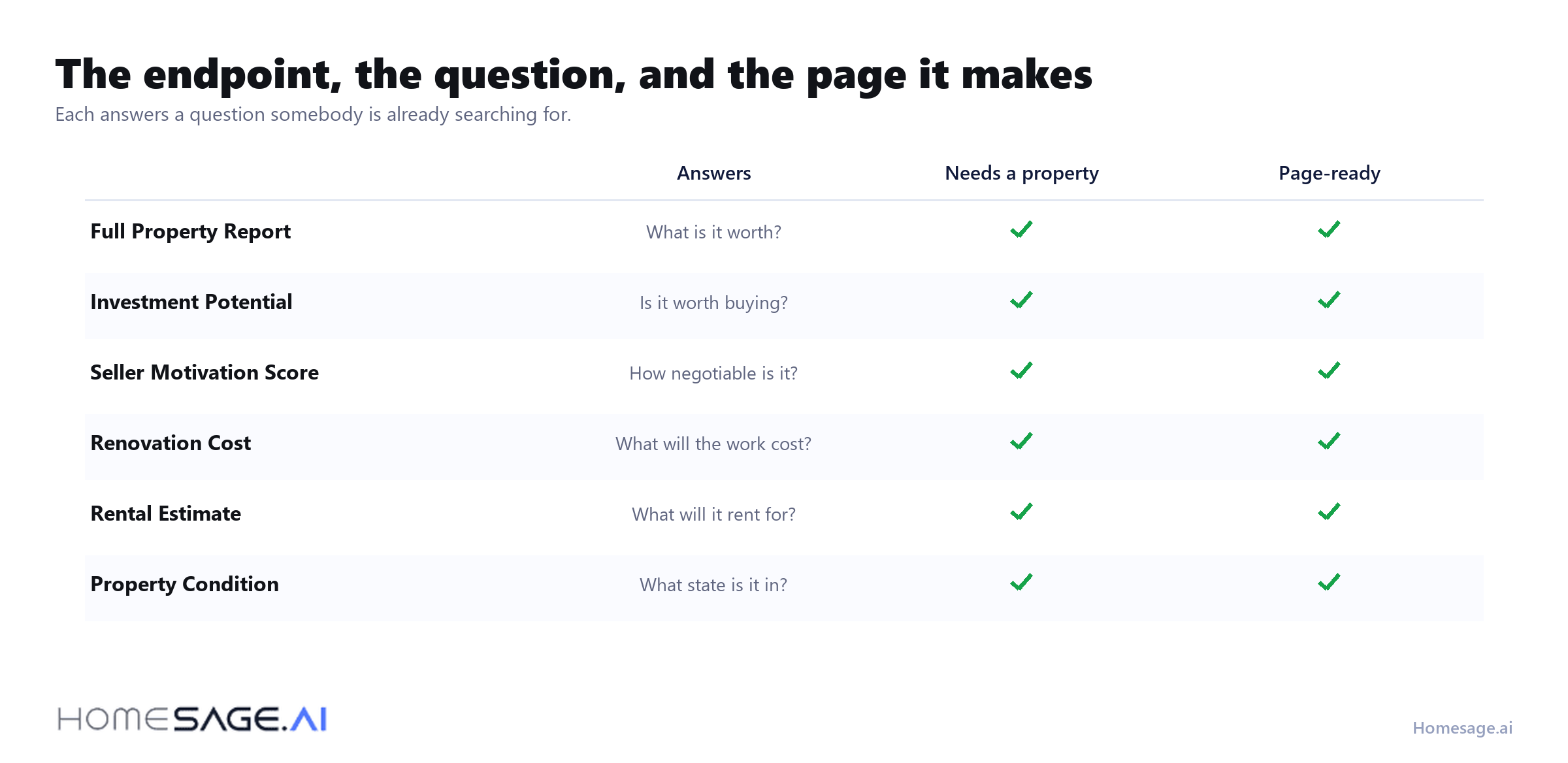
| Endpoint | The question it answers | Content it suits |
|---|---|---|
| Full Property Report | What is this property worth? | Address-level pages |
| Investment Potential | Is it worth buying? | Ranking and filtering |
| Seller Motivation Score | How negotiable is the price? | Offer and negotiation |
| Renovation Cost | What will the work cost? | Renovation content |
| Renovation ROI | Is the work worth doing? | Project decisions |
| Rental Estimate | What will it rent for? | Buy-and-hold content |
| Property Condition | What state is it in? | Anything at scale |
Each row is a query people already type. The endpoint is only useful if the page built on it answers that query without requiring a form submission.
Where the data is thin enough to change the page
A page can only answer honestly where the data exists. On 20 October 2026 we counted across all 735 active listings in Little Rock, Arkansas.
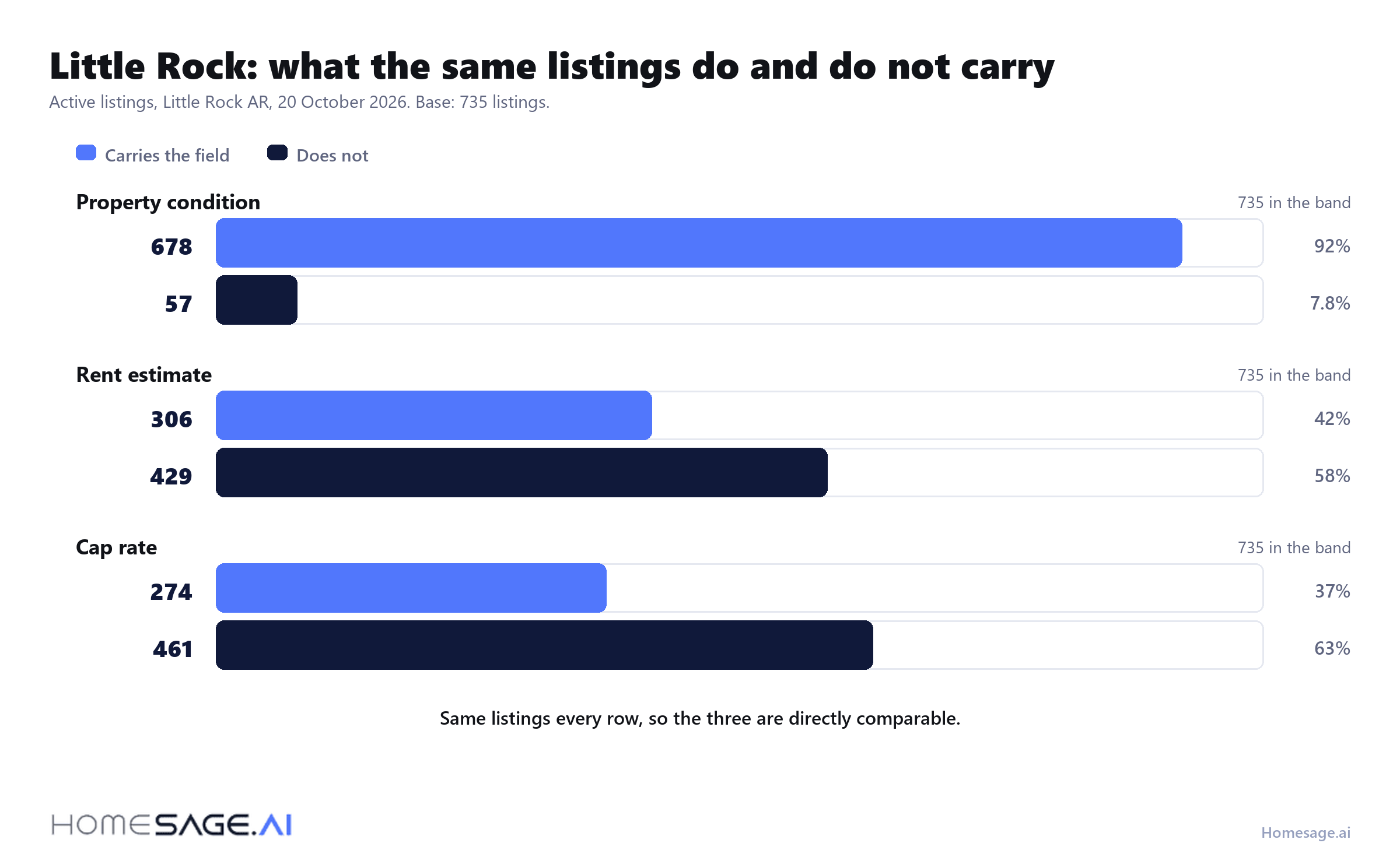
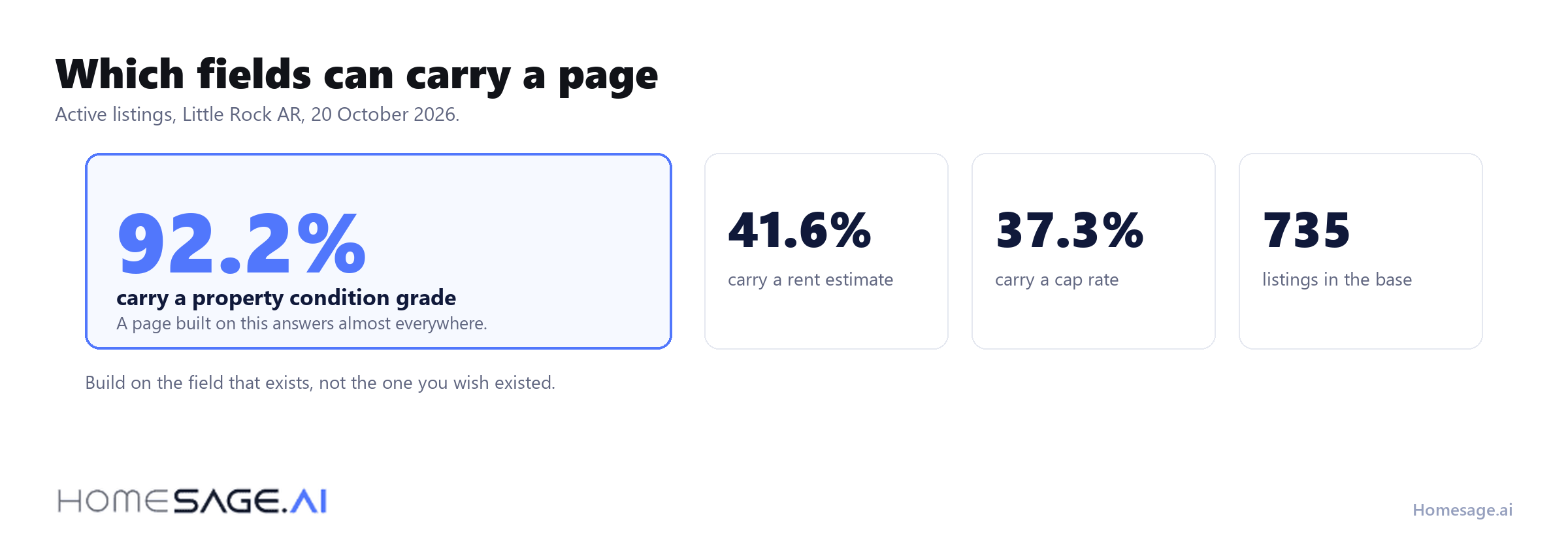
A property condition grade exists on 678 listings, or 92.2%. A rent estimate exists for 306 listings (41.6%). A cap rate exists for 274 listings, or 37.3%.
Little Rock has the best rent coverage of the six cities we measured this month. The range ran from 13.2% in Akron to 41.6% here, which is a threefold spread between markets rather than a stable national figure.
Build the page on the field that exists on almost every listing, not the one that sometimes does.
For content that is the difference between a page that answers and a page that apologizes. Pages led by property condition work almost everywhere. Pages led by rent work well in some markets and need a visible fallback in others.
Each percentage is a share of all 735 active Little Rock listings on the day we counted. A listing missing a field is absent from that count rather than recorded as a zero.
Turning an endpoint into a page that ranks
Build one page per question, not one per endpoint. Readers arrive with a question, not with a field name, and two endpoints often serve the same query.
Show the answer before the form. A page that withholds everything until submission has nothing for a search engine to rank and nothing for a reader to trust.
Show the working. The number plus where it came from plus when it was produced is what separates a useful page from a widget.
Say what is missing. Where rent coverage is thin, a page that says so reads as more credible than one that quietly substitutes an estimate.
For the full endpoint list, see our renovation API guide. For how these compare with outside providers, see the best property data APIs.
Estimated values, after-repair values, renovation costs and returns are model-derived estimates, not investment advice. Property data as of 19 October 2026.
Key takeaways
- People search for answers, not APIs. Build the page around the question.
- Property condition is the densest field, at 92.2% of Little Rock listings and 87.7% to 94.6% across six cities.
- Rent coverage swings threefold between markets, from 13.2% to 41.6%.
- Show the answer before the form, or there is nothing to rank.
- Saying a field is unavailable builds more trust than quietly substituting an estimate.
Conclusion
These seven endpoints each answer a question people already search for. Traffic doesn’t come from the API; it comes from building a page that answers the question in public and shows it working. Where the data is thin, say so. The Little Rock counts show how much that varies between markets.
Frequently asked questions
What is a real estate API?
An interface that returns structured property data to software, from an address or a parcel identifier. Some return records such as tax and deed history. Others return derived figures such as a property condition grade or a projected return.
How does an API endpoint actually drive traffic?
By powering a page that answers a question people search for, with the answer visible rather than behind a form. The endpoint supplies the number. The page has to supply the context and the evidence.
What does the Seller Motivation Score do?
It rates how much negotiating room an asking price is likely to carry, from 1 to 100. It is the field that answers how negotiable this price is, which buyers ask constantly and few publishers answer with a number.
What happens when a field is unavailable for a property?
The response returns an explicit null rather than a default. For a public page the right response is to say the figure is unavailable, which reads as more credible than a silent substitution.





https://Lvivforum.pp.ua October 23, 2024
Pretty! This was a really wonderful article. Thanks for supplying this information. https://Lvivforum.pp.ua
https://Lvivforum.pp.ua October 23, 2024
Pretty! This was a really wonderful article. Thanks for supplying this information. https://Lvivforum.pp.ua
AnnaMoroz AnnaMoroz October 8, 2025
This is a great article on real estate APIs and how they drive web traffic and lead generation.
N December 16, 2025
great read!
Real Estate Data For Developers: Sources, APIs & Guide October 10, 2026
[…] Real estate applications often experience significant traffic variations based on market conditions, time of year, and user behavior patterns. Design applications with scalable architecture that can handle peak loads without compromising performance or reliability. […]
8 Best Home Improvement APIs For Developers (2026 Guide) October 10, 2026
[…] Home Improvement APIs for IT Developers in 2026, each capable of elevating your home improvement websites and proptech […]