
What is a real estate API, and why does nearly every modern property app quietly depend on one? In short, it is the pipe that lets your product pull live property data – listings, valuations, owner details, and investment metrics – on demand.
It is fast becoming a core infrastructure. The PropTech market these APIs power was estimated at about $35.4 billion in 2024 and is projected to reach roughly $114.8 billion by 2033, according to IMARC Group.
In 2026, APIs power property portals, AVMs, mortgage risk models, and AI investment platforms alike.
“Quick answer“A real estate API is an interface that lets developers pull property data – listings, valuations, comparables, owner and condition data – programmatically into their own apps. Instead of manual data collection or static file downloads, the API returns structured, current data on request. The Homesage.ai Real Estate API delivers AI-enriched data across 155M+ U.S. properties through a single integration.”
What API Stands For, in Plain English
API stands for application programming interface. Think of it as a waiter between your app and a data provider’s kitchen.
Your app asks for something specific – the data on 123 Main Street – and the API carries the request to the data source. It brings back a structured answer your app can use immediately.
You never touch the kitchen: the storage, cleaning, and updating of the underlying data. A real estate API applies that pattern to property data.
How a Real Estate API Works
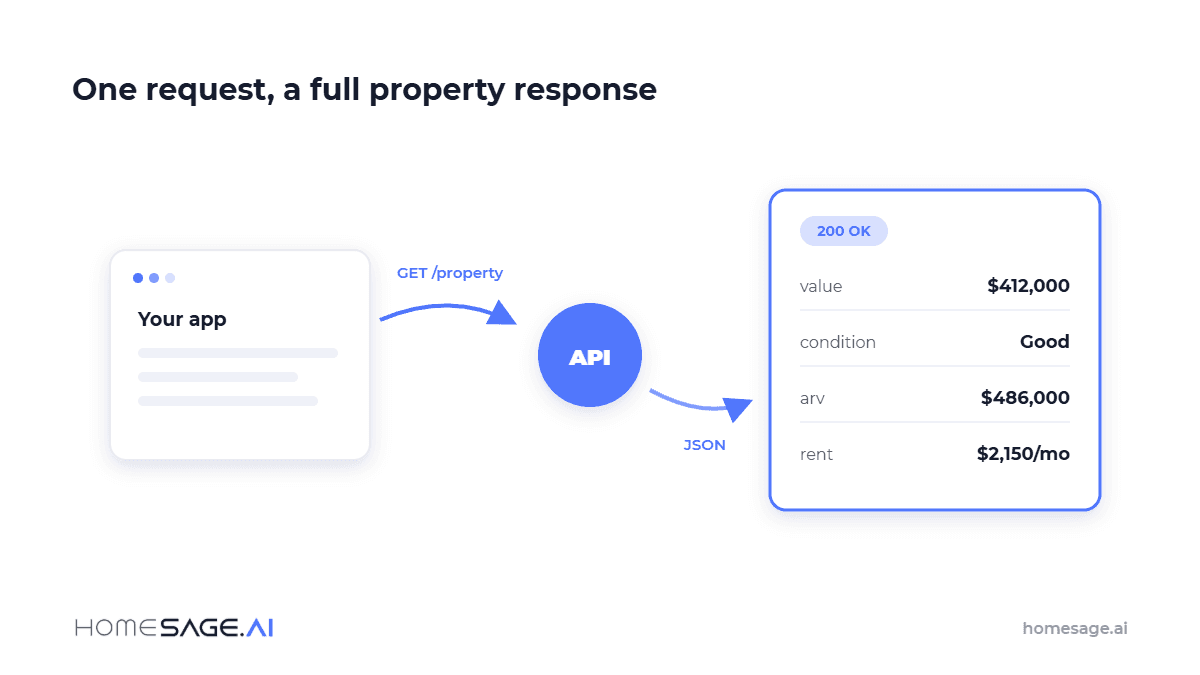
The mechanics are straightforward. Your application sends a request – an address or a set of search filters – and the API returns structured data, usually JSON.
That response can be a value estimate, comparable sales, condition, ownership, or investment metrics. You integrate once, then get fresh data continuously, rather than reconciling static files that go stale the day you buy them.
Most modern APIs are cloud-based and RESTful, which is why integration is now measured in hours, not months. If you are evaluating providers, our roundup of the 5 best real estate APIs for 2026 compares coverage, pricing, and developer experience side by side.
The Main Types of Real Estate API
Real estate API is an umbrella term. Most products fall into a few categories, and knowing which you need saves a lot of wasted integration time.
1. Listings and IDX APIs
Return active and sold listings, prices, photos, and status – these power search portals and consumer-facing apps. Listing data is licensed market by market, so many teams use an aggregated API to avoid dozens of separate approvals.
2. Property data APIs
Return the deep record behind a property: ownership, tax, deed, mortgage, characteristics, and history. This is the backbone of investment, lending, and analytics tools.
3. Valuation and AVM APIs
Return automated value estimates, comparables, and – with the better providers – condition and after-repair value. These sit inside underwriting and investment workflows.
4. Rental and investment APIs
Return rent estimates, ROI, cap rate, and forecast metrics used by investors and property managers.
Homesage.ai spans these categories in one integration. For a data-type-by-data-type breakdown of what each returns, see our 7 best property data APIs for developers.
Types of Real Estate API at a Glance
- Property data – owner, characteristics, tax & sale records. Best for skip tracing, due diligence.
- Listings / IDX – active listings and media. Best for search portals and apps.
- Valuation / AVM – value estimate, comps, and ARV. Best for lending and investment analysis.
- Rent estimate – long- and short-term (Airbnb) rent estimates. Best for rental and flip ROI.
- Condition & motivation – computer-vision property condition + the Seller Motivation Score. Best for condition-aware valuation.
The video below shows how to get started with our real estate APIs – from your first key to your first response.
What Data Does a Real Estate API Return?
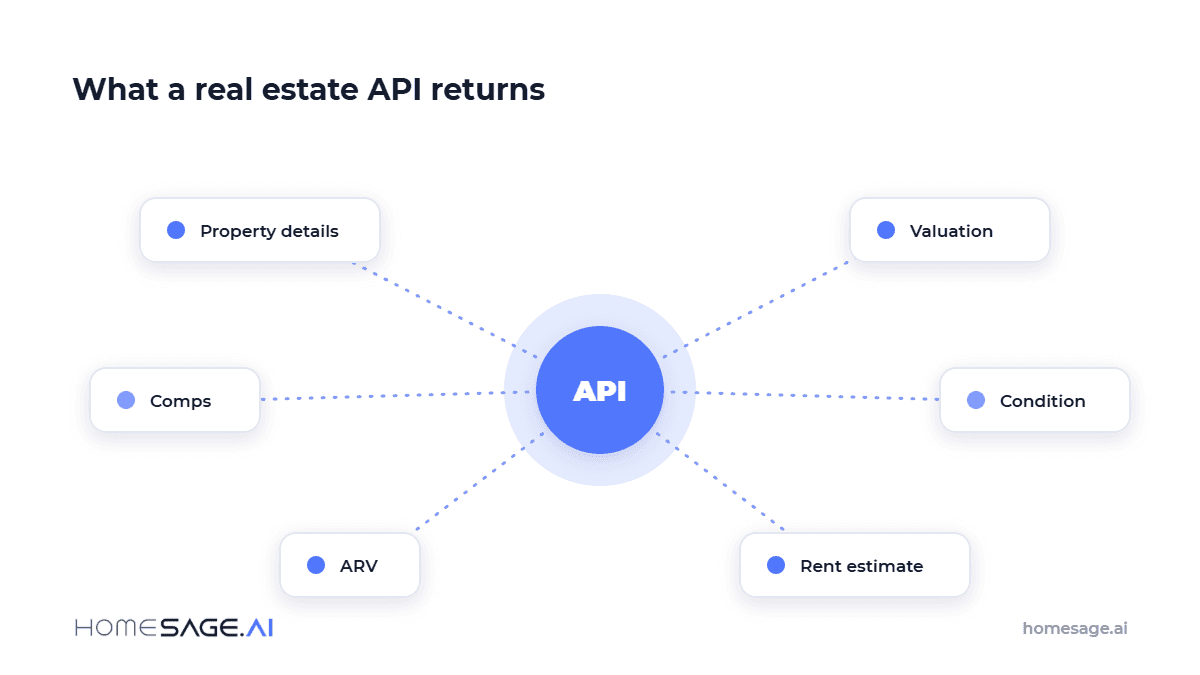
The exact fields vary by provider, but four groups appear in almost every response:
- Property details and ownership records
- Valuations and comparable sales (AVM, comps)
- Property condition and after-repair value, where the provider supports it
- Rental and investment metrics (ROI, ARV, seller motivation)
Coverage and enrichment are where providers separate. The Homesage.ai Real Estate API returns AI-enriched fields – computer-vision condition and the Seller Motivation Score – across 155M+ properties.
The API tells you not just what a property is, but what it could be worth and how negotiable the seller is likely to be.
What Our Own Platform Data Shows
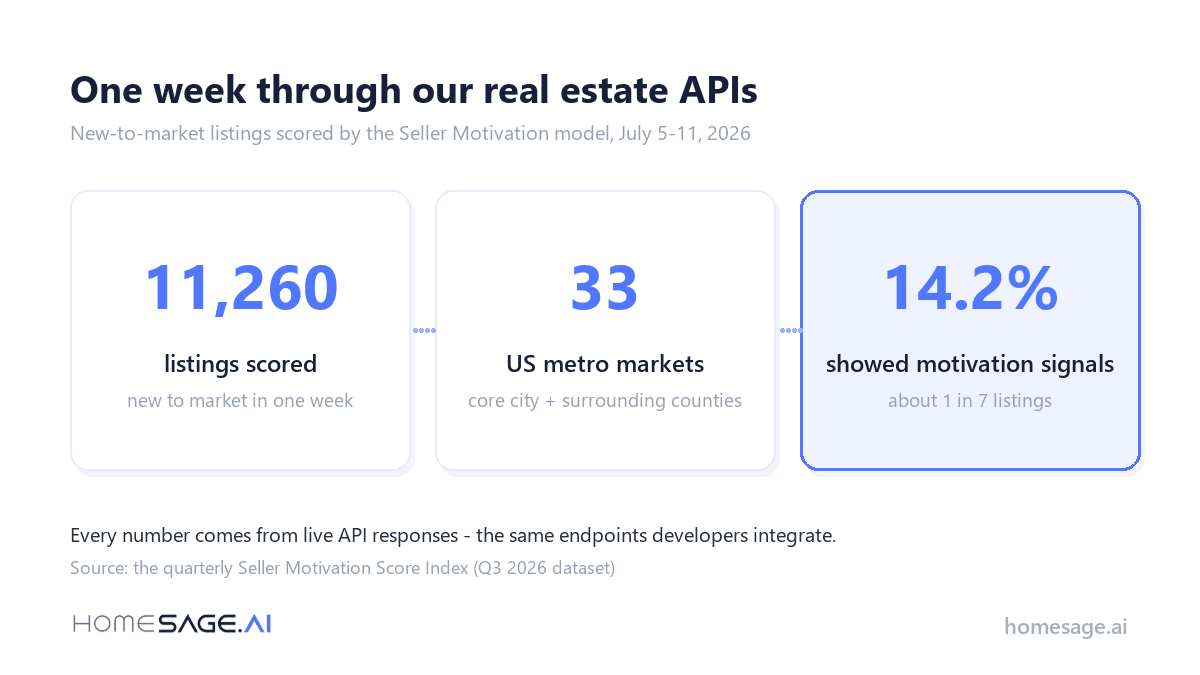
Here is that pipeline in real numbers. In one July 2026 week, our platform scored 11,260 listings that were new to market across 33 US metros – through the same real estate APIs described above.
The output is interpreted insight, not raw records. That week, 14.2% of listings – about 1 in 7 – showed measurable seller-motivation signals in the Seller Motivation Score.
The full metro-by-metro breakdown is published in our quarterly Seller Motivation Score Index.
Common Use Cases
These are the products teams most often build on top of property data:
- Property search and listing portals that need live inventory and details
- Investment analysis and deal-sourcing dashboards
- Automated valuation and lending workflows (AVMs in underwriting)
- Rental and flip ROI calculators
- AI-driven investment platforms that rank opportunities automatically
- CRM and marketing tools that enrich a lead with full property context
Why Build on an API Instead of Buying Data?
You could license raw datasets and maintain them yourself. Most teams stop doing that once they price it out.
Raw data means storage, cleaning, deduplication, and constant refresh cycles – an engineering cost that grows every month. An API turns that fixed liability into a usage-based line item and hands you clean, current fields on request.
For a startup shipping an MVP, that difference is often the difference between launching this quarter and next year. The trade-off is that you now depend on the provider’s coverage and uptime, so choose one built for developers.
Our developers’ guide to real estate data covers how to evaluate reliability. The real estate API documentation guide shows what good endpoint design looks like in practice.
How to Choose a Real Estate API
Six criteria separate a provider you can build on from one you will migrate away from within a year:
- Coverage: how many properties and which data types the provider actually spans.
- Accuracy: is the valuation condition-aware, and are confidence scores exposed.
- Pricing: transparent credit-based or usage-based pricing versus custom enterprise contracts.
- Developer experience: clear docs, well-designed endpoints, onboarding support, and a sandbox.
- Enrichment: does it return only raw records, or AI insight like ARV and seller motivation.
- Reliability: uptime, rate limits, and how the provider handles data freshness.
Common Pitfalls to Avoid
Most integration regret traces back to one of these four decisions:
- Choosing on price alone and discovering thin coverage in your target markets.
- Committing to a large annual contract before validating the data on your own properties.
- Ignoring rate limits and pagination, then hitting a wall at scale.
- Assuming all valuation APIs are condition-aware – most are not.
How to Get Started
Five steps take you from evaluating providers to running in production:
- Define the exact fields your product needs (listings, valuation, condition, rental).
- Shortlist providers whose coverage and data types match, and read their docs.
- Test on a free tier or trial with your own addresses before committing.
- Build against a stable, well-documented endpoint and handle rate limits from day one.
- Monitor accuracy and freshness in production, and revisit as you scale.
Ready to build? Browse the full real estate API library to see every available endpoint, then start in the Sandbox.
A Quick Reality Check on Cost
Pricing models vary from credit-based usage to enterprise contracts. Credit-based pricing keeps costs predictable as you scale, which is why it suits startups and product teams testing product-market fit.
Watch for providers that require a large annual commitment before you can validate the data on your own properties. A free trial or usage tier lets you prove value first, then commit.
Real Estate API vs Web Scraping
Some teams try to gather property data by scraping websites instead of using an API. It looks cheaper until it breaks.
Scrapers shatter every time a site changes its layout, they often violate terms of service, and the data arrives messy and unstructured. An API returns clean, structured, permitted data on a stable contract.
Your engineers build features instead of babysitting brittle scripts. For anything you plan to run in production, an API is the responsible choice.
How Real Estate APIs Get Their Data
Behind every good real estate API is a data pipeline that ingests public records, listing feeds, tax and deed data, and – for AI-enriched providers – imagery and model outputs. The provider does the expensive work of cleaning, matching, deduplicating, and refreshing that data continuously.
Understanding this helps you evaluate providers. Ask how often data refreshes, where coverage is strongest, and how conflicting records are handled – those choices determine the quality of what your app receives.
Security and Compliance to Check
Property data can include owner and contact information, so treat security as a selection criterion, not an afterthought.
Confirm the provider uses encrypted connections, offers key-based authentication, documents its data sources, and gives guidance on permissible use – especially for owner contact data, which carries its own compliance rules. A provider that is transparent about sourcing and usage is one you can build on safely.
The Future of Real Estate APIs
Two trends are shaping where real estate APIs go next. First, enrichment: the market is moving past raw records toward APIs that return interpreted insight – condition, ARV, risk, and seller motivation – so developers do less modeling and ship faster.
Second, real-time: as buyers and investors expect instant answers, APIs are pushing toward fresher data and lower latency. Our platform sits at the front of the enrichment trend, which is exactly where this fast-growing market is heading.
The practical takeaway: pick a provider investing in enrichment and freshness, not just the cheapest per-call price.
The API you integrate now is infrastructure you will depend on for years – switching later is expensive.
Real Estate API Terms Worth Knowing
A few terms come up constantly when you evaluate providers. Knowing them makes any comparison faster:
- Endpoint: a specific URL you call for a specific job – one for valuation, another for comps.
- Rate limit: how many calls you can make in a window; plan for it so you do not stall at scale.
- JSON: the structured format most APIs return, easy for your app to parse.
- Sandbox: a test environment where you can try calls without touching production or spending real credits.
- Enrichment: the API returns interpreted insight – condition, ARV, seller motivation – not just raw records.
- Coverage: the share of properties and markets the data actually spans.
Keep those six terms in mind and you can read any provider’s documentation with a clear eye.
Key Takeaways
If you take nothing else from this guide, take these five points:
- A real estate API returns structured, current property data on request, so you never maintain raw datasets yourself.
- The main types are listings/IDX, property data, valuation/AVM, and rental/investment APIs.
- The PropTech market these APIs power is projected to grow from about $35.4B (2024) to roughly $114.8B by 2033 (IMARC Group).
- Choose on coverage, condition-aware accuracy, developer experience, and transparent credit-based pricing – not price alone.
- The Homesage.ai Real Estate API returns AI-enriched, condition-aware fields in one integration.
Conclusion
A real estate API is simply the pipe that feeds property data into your product. It looks like a technical detail, but the pipe you choose quietly decides how far your product can go.
Every feature you ship downstream inherits the strengths and limits of that data source. If the API only sees beds, baths, and square footage, your product will never see more than that either.
That is why the smart way to compare providers is not by counting endpoints. Prioritize coverage across markets, condition-aware accuracy, transparent pricing, and a developer experience that lets your team ship in days instead of months.
Remember that an API is not a one-time purchase. It becomes infrastructure you build on for years, so pick a provider that keeps investing in enrichment, freshness, and new signals rather than one that just resells the same static records.
Homesage.ai was built for exactly that role. Our modern real estate APIs deliver AI-enriched fields you will not find in traditional feeds, including computer-vision property condition and the Seller Motivation Score, with insights on over 155M US properties.
Create a free Sandbox account and ship your first call today, or see our convenient pricing to find the tier that fits your roadmap.
Frequently Asked Questions
What is a real estate API used for?
What data does a real estate API provide?
How much does a real estate API cost?
Is there a free real estate API?
What is the difference between a listings API and a property data API?
Do I need coding skills to use a real estate API?
Why is the real estate API market growing so fast?
Platform statistics come from the Q3 2026 Seller Motivation Score Index dataset (11,260 new-to-market listings scored July 5-11, 2026, across 33 US metros). Market figures per IMARC Group, accessed July 2026.





Emma August 10, 2026
Great read