
“Quick answer The best real estate API for property evaluation is the one whose answer your product can act on. A property evaluation API returns a property value from an address, over HTTP, without a person in the loop. 4 are worth an IT developer’s time in 2026. Homesage.ai for condition-aware valuations and ATTOM for breadth. Cotality for lending-grade depth and Zillow for consumer reach behind a partner gate. The 1 question that separates them is whether the model can see what condition the property is in.
Choosing the best real estate API is really 4 choices, because the shortlist is short. Any product that shows a property value calls somebody’s API for it. The integration work is similar across vendors. What differs is the shape of the answer and what it costs you to get a useful one.
Every one of these returns a number. Only some of them tell you how much to trust it.
What a home valuation API does
A home valuation API and a property evaluation API are the same thing under 2 names. You send an address. It returns a value estimate, usually with the comparable sales behind it and some description of the property. Better ones add a confidence signal, a condition read and the return math on top.
The common uses are lead qualification and portfolio monitoring. Others are underwriting screens, listing tools and investment analysis. The right choice depends on which of those you are building.
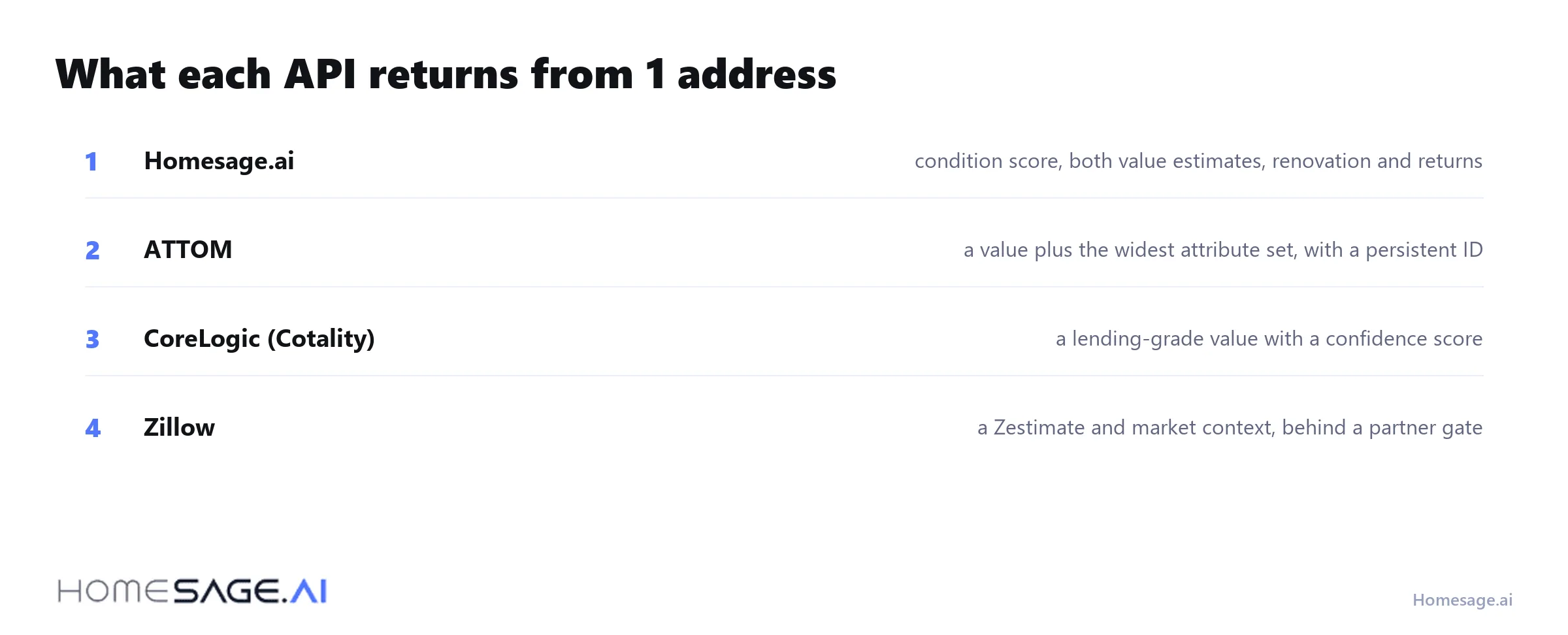
1. Homesage.ai
We built ours for the case most APIs skip, which is a property that is not in good condition. Property condition scoring analyzes reads the property photos and returns a condition score, and that score feeds the valuation.
One address returns an estimated current value and an estimated after-repair value. It also returns an estimated renovation cost with a confidence score, comparable sales and both return models. It covers 155M+ US property records.
Integration is REST and JSON with an API key issued in minutes and no approval queue. The same analyses are reachable from an AI assistant through our MCP connector, which is unusual among property APIs.
Best for investor tools, renovation products and any app where the condition of the property changes the answer. See the real estate APIs and the API library.
Here is a short video on what one property report returns.
2. ATTOM
ATTOM covers 158M+ US residential and commercial properties with valuation models sitting alongside a very wide attribute set. Every property carries a persistent ID, which is what makes joins survive a data refresh.
It ships REST and JSON with bulk and cloud delivery, and the documentation is solid. Our comparison of when to use each real estate API covers the split between us in detail.
Best for platforms that need breadth, history and reliable record identity. See ATTOM Data.
3. CoreLogic, now Cotality
Cotality sells the valuation products most US lenders already use. That includes confidence scoring, hazard and risk data, and enterprise delivery.
Access is a commercial conversation rather than a signup, which suits an institution and blocks a weekend prototype. Best for lending, insurance and regulated workflows. See Cotality.
4. Zillow
Zillow publishes data on 124M homes and produces Zestimates on 116M of them. For consumer-facing products the brand recognition alone carries weight.
Access is partner-gated and the review takes weeks, which is the constraint teams underestimate. Our Zillow API guide for developers covers what clears the gate.
Best for consumer search and market context. See Zillow Research.
How the 4 best real estate APIs compare
| API | Reads property’s condition | Time to first call | Best for |
|---|---|---|---|
| Homesage.ai | Yes, from property photos | Seconds | Investor, Lenders and Realtors |
| ATTOM | No | Commercial signup | Platforms needing breadth |
| CoreLogic (Cotality) | No | Enterprise contract | Lending and insurance |
| Zillow | No | Weeks, partner approval | Consumer-facing products |
What to check before you integrate
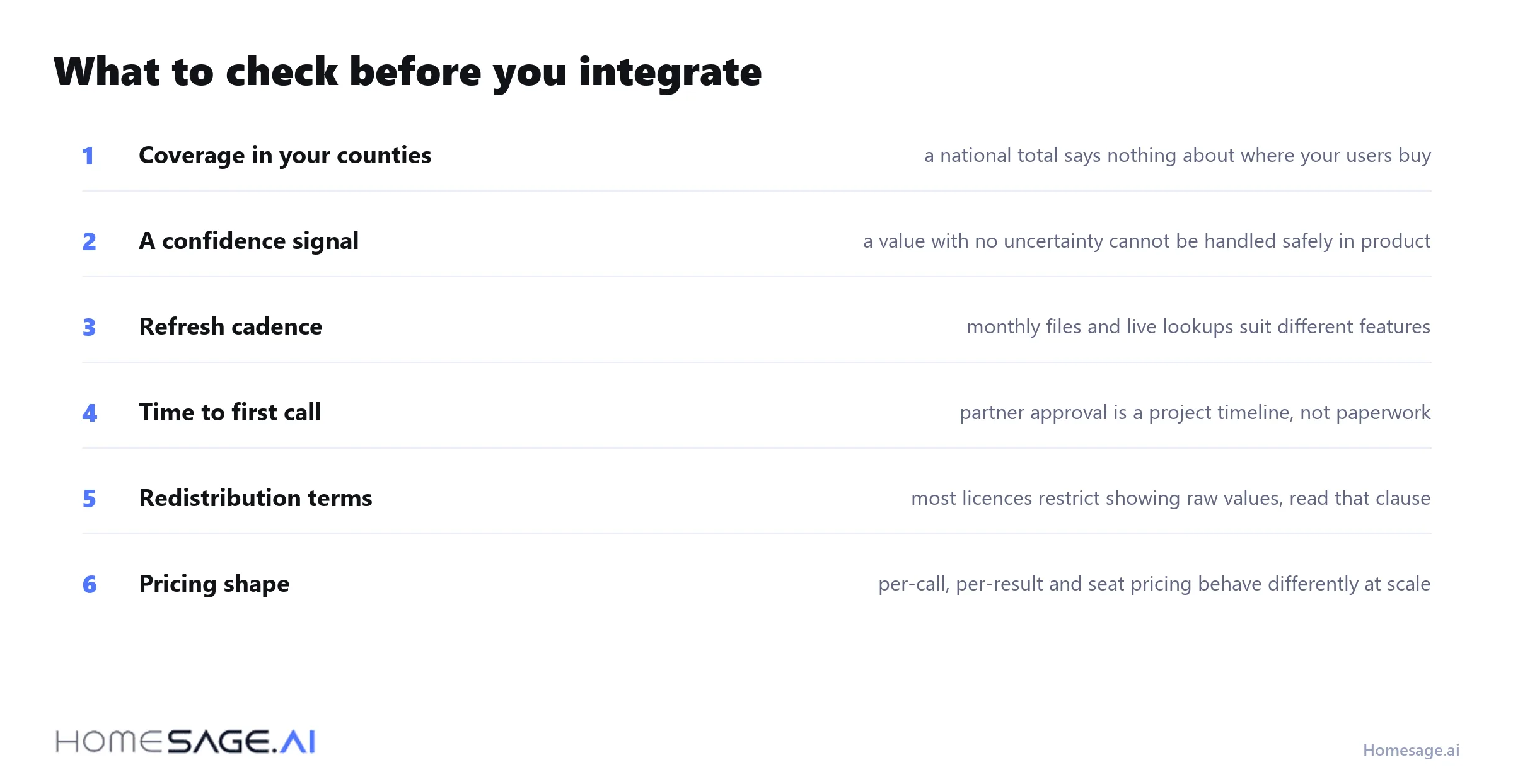
- Coverage in your counties, not nationally. A national total says nothing about where your users buy.
- Whether a confidence signal comes back. A value with no uncertainty attached cannot be handled safely in product.
- Refresh cadence. Monthly files and live lookups suit very different features.
- Time to first call. Partner approval and enterprise contracts are project timelines, not paperwork.
- Redistribution terms. Most licences restrict showing raw values to your own users. Read that clause first.
- Pricing shape. Per-call, per-result and seat pricing behave differently at scale. See our pricing page for how ours works.
Why the property condition read matters in code?
In code it decides how many numbers you get back, and that changes what your product can do. A condition-blind API returns 1 value for a house in any state. Your app cannot tell a tired house from a renovated one at the same address.
Anything that depends on the difference has to be filled in by the user. That is the renovation estimate, the offer price and the return math, and asking for it is the step users abandon.
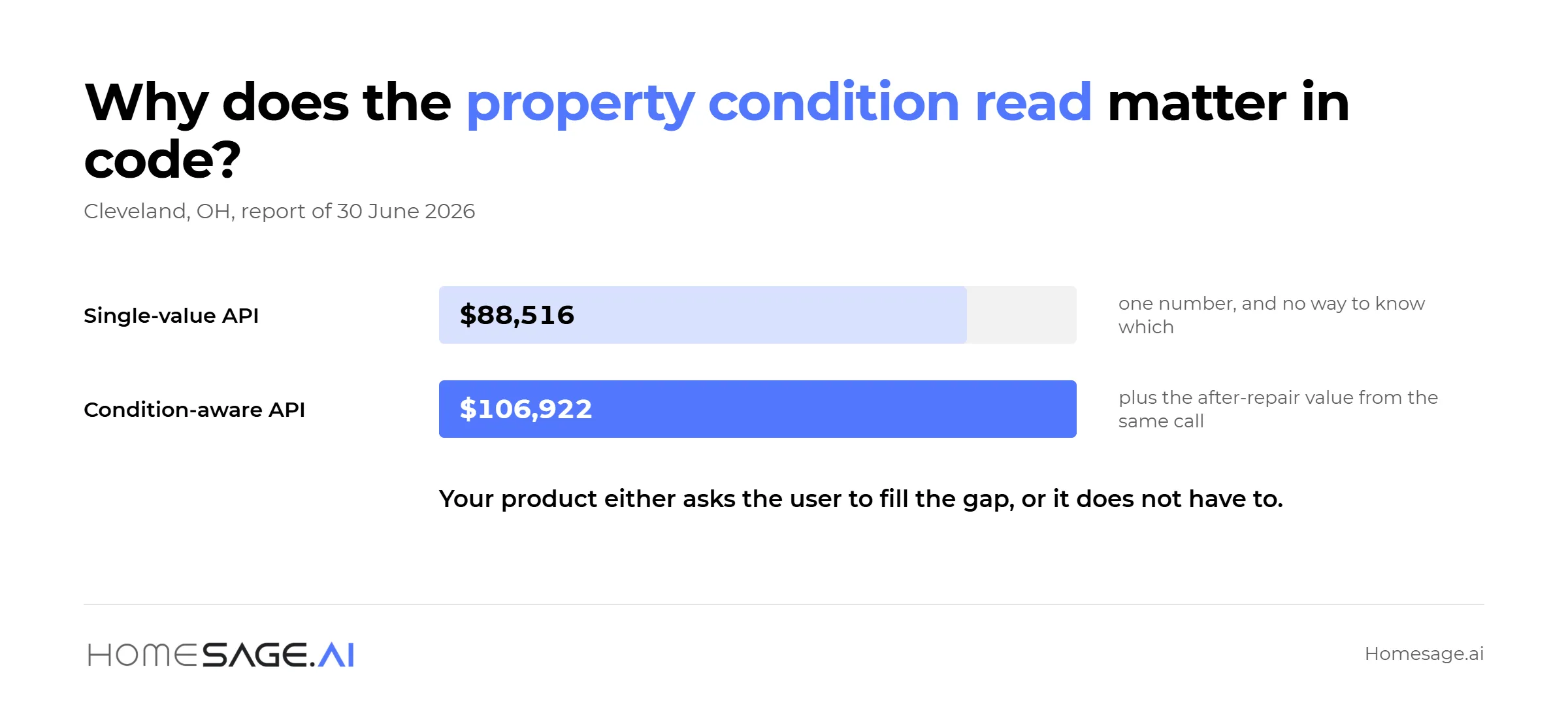
Take a 3-bed 1-bath house in Cleveland, Ohio On 30 June 2026 one call returned an $88,516 estimated current value and a $106,922 estimated after-repair value. A single-value API gives you 1 of those and no way to know which.
Estimated values. Not investment advice. Data as of 2026-06-30.
Ask Sage instead of writing the first integration
Before you write any code, check the answer shape. Sage is our assistant, and it runs the same endpoints from a plain-language question inside the AI tool you already use.
Connect Homesage.ai to Claude, Perplexity, ChatGPT or Gemini through our MCP connector and ask for the analysis you were about to build.
“Give me the property condition score and both value estimates for this address.”
You see the real fields and the real numbers before committing a sprint to them. Anything chargeable shows its cost before it runs.
Key takeaways
- 4 property evaluation APIs are worth an IT developer’s time in 2026. Homesage.ai, ATTOM, Cotality and Zillow.
- The dividing line is the property condition read. Most return 1 value for a house in any state.
- Time to first call varies from minutes to weeks. That is a project risk, not an administrative detail.
- On that Cleveland property, 1 call returned an $88,516 estimated current value and a $106,922 estimated after-repair value.
- Check coverage in your counties, the confidence signal and the redistribution clause before you integrate.
Conclusion
The best property evaluation API is the 1 whose answer your product can act on without asking the user to fill the gaps. Test that with a real address rather than a feature table. Start with an API key and run a property you already know.
Estimated values. Not investment advice. Data as of 2026-06-30. This article is general information. Figures come from a Homesage.ai Full Property Report for a property in Cleveland OH 44120. It was pulled on 30 June 2026 and the figures change as the market moves. Third-party coverage figures and access terms are the vendors’ own and change without notice. Evaluate every property against your own finances, local costs and a professional inspection.





www.binance.com registrera dig March 16, 2026
Thanks for sharing. I read many of your blog posts, cool, your blog is very good.
How To Run Comps In Real Estate With AI (2026) October 10, 2026
[…] AI evaluates property differences through advanced algorithms and image recognition technology, automatically calculating adjustments for renovations, condition variations, and unique features. […]
3 Best Ways To Introduce AI In Your Real Estate Business October 10, 2026
[…] Scalable, secure, and developer-friendly APIs […]
10 AI Marketing Ideas For Realtors That Get Leads October 10, 2026
[…] from Real Estate APIs: 8 Best Implementation Practices and the latest insights found in 7 Best Property Evaluation APIs in 2026, to help you stay ahead in a competitive, data-powered […]
What Is A Real Estate API? Types, Data, Cost And How To Start October 12, 2026
[…] is why the smart way to compare providers is not by counting endpoints. Prioritize coverage across markets, condition-aware accuracy, […]