
“Quick answer Neither is universally better. Off-market properties, deals sold privately before they ever reach the MLS, offer lower competition and below-market pricing potential but carry thinner information and higher risk. MLS listings offer transparency, easier financing, and volume at market-rate prices. The best investors work both, and the data says the line between them is blurring in two ZIP codes we screened on 7 September 2026, 52% of all active listings had sat for more than 30 days, and a stale on-market listing often negotiates like an off-market deal.
Real estate investors constantly face a key decision: should they focus on off-market properties or stick with traditional MLS listings? This choice can considerably affect their investment success, profit margins, and overall portfolio growth.
Understanding the key differences between these two acquisition methods is essential to making informed investment decisions.
A stale on-market listing often negotiates like an off-market deal. The data trail just happens to be public.
Both off-market properties and MLS listings offer specific pros and cons for investors. While MLS listings provide transparency and accessibility, off-market deals often offer better pricing with less competition. The key is knowing when and how to use each tactic effectively.
What Are MLS Listings?
The Multiple Listing Service (MLS) is a comprehensive database real estate professionals use to share information about properties for sale. When a property is listed on the MLS, it becomes visible to all participating real estate agents, brokers and, eventually, the public through various real estate websites.
MLS listings represent the traditional, transparent marketplace for real estate transactions. These properties are actively marketed, professionally photographed, and available for any interested buyer to view.
The MLS system provides standardized information sharing and creates a level playing field by giving all market participants access to the same property data.
Properties on the MLS typically go through a formal listing process, complete with property descriptions, pricing history, and detailed specifications.
This clear transparency makes MLS listings ideal for first-time investors or those who choose a straightforward, well-documented investment process. For the full definition, see NAR’s explainer on what a Multiple Listing Service is.
What Are Off-market Properties?
Off-market properties, also known as “pocket listings” or “whisper listings,” are properties available for purchase that aren’t listed on the MLS or advertised publicly. These off-market listings change hands through private networks, direct marketing, or word-of-mouth referrals before they hit the open market.
Off-market deals commonly arise from distressed sales, estate settlements, divorce proceedings, or situations where sellers prefer privacy. Property owners might choose to sell off-market to avoid the standard listing process, reduce marketing costs, or maintain confidentiality.
These properties represent a hidden marketplace where many investors consider the holy grail of real estate investing. Because they’re not widely advertised, off-market properties typically face less competition and may allow investors to negotiate better terms and prices.
Why Each Channel Matters to Investors
MLS listings: transparency, support, and financing
MLS listings provide comprehensive property information, including detailed descriptions, high-quality photos, pricing history, and similar sales data.
This disclosure allows investors to make informed decisions based on complete market information, with a professional support network of agents and brokers to handle negotiations and guide complex transactions.
Properties listed on the MLS typically have clear titles, professional inspections, and established market values, making financing and due diligence more straightforward. Lenders are generally more comfortable with financing MLS-listed properties because of their transparency and market validation.
Off-market properties: less competition, more leverage
Since off-market properties aren’t publicly advertised, they attract fewer potential buyers, which often allows investors to negotiate better prices and terms without bidding wars.
Many come from motivated sellers facing time constraints, financial difficulties, or other pressing circumstances, creating access to distressed opportunities and below-market acquisitions.
Investors who master sourcing off-market properties can also scale faster, building a continuous pipeline of real estate investment deals that aren’t available to the public.
Off market vs. MLS briefly
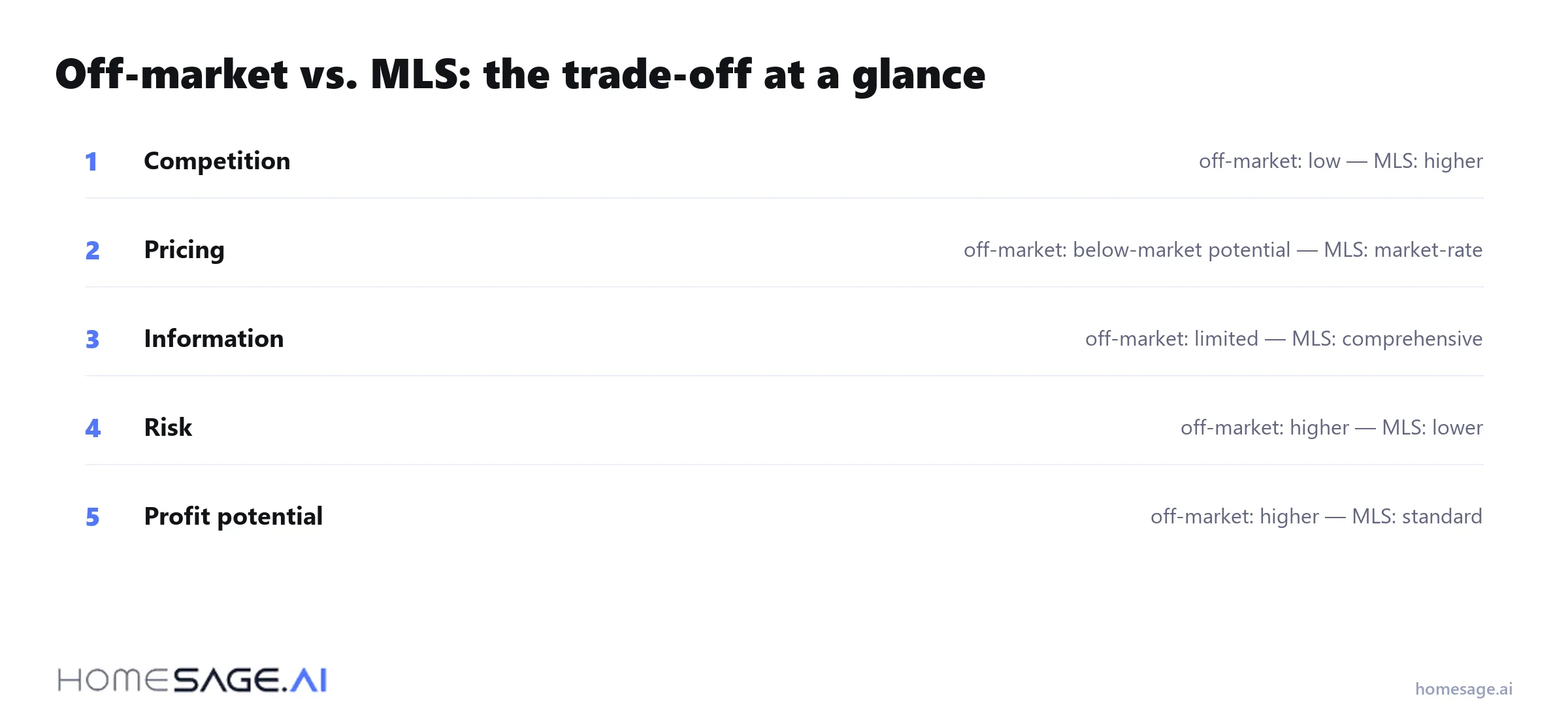
Here is the trade-off in one view; the full pros and cons follow.
| Feature | Off-market Properties | MLS Listings |
|---|---|---|
| Competition level | Low to medium | Higher |
| Pricing | Below market potential | Market rate |
| Information access | Limited | Comprehensive |
| Inventory size | Limited | Extensive |
| Negotiation power | Higher | Moderate |
| Time investment | Higher | Moderate |
| Risk level | Higher | Lower |
| Profit potential | Higher | Standard |
Pros of MLS listings:
- Clarity and dependability: Complete property information and specialist oversight.
- Wide selection: Access to thousands of properties in any given market.
- Professional support: Real estate agents provide help throughout the process.
- Financing accessibility: Lenders readily finance MLS-listed properties.
- Legal protection: Standardized contracts and disclosure requirements.
Cons of MLS listings:
- High competition: Multiple buyers often compete for desirable properties.
- Market rate pricing: Properties usually priced at or near market value.
- Limited negotiation power: Sellers have multiple options and less motivation to negotiate.
- Timing constraints: Popular properties may sell quickly, leaving little time for analysis.
Pros of off-market properties:
- Below-market pricing opportunities: Possibility of considerable discounts.
- Reduced competition: Fewer buyers compete for the same property.
- Direct seller relationships: Room to build rapport and understand seller motivations.
- Flexible terms: More room for creative financing and deal structuring.
- Higher profit potential: Better margins from lower acquisition costs.
Cons of off-market properties:
- Limited inventory: Fewer available properties compared to the MLS.
- Due diligence challenges: Less information is available, requiring more independent research.
- Higher risk potential: Properties may have hidden issues not immediately apparent.
- Financing difficulties: Lenders may be more cautious with off-market properties.
- Time-intensive process: Building networks and finding deals takes significant effort.
Where to Find Off-market Properties and MLS Listings
Homesage.ai
Homesage.ai approaches the search differently: rather than a listing marketplace, it is an AI analysis layer overactive listings and 155M+ US property records.
Investors screen a whole market’s listings for property condition, value gaps, projected returns, and seller motivation, surfacing both conventional buys and stale, negotiable listings that behave like off-market deals.
It is powered by one of the 5 best real estate APIs for 2026, and investors can compare opportunities side by side, examine market trends, and identify the best strategies lacking switching between tools.
If you want to see how AI simplifies research across both channels, this short video is a great place to start. It shows how much of the due diligence that makes off-market deals risky can be automated.
Zillow
Zillow remains one of the most popular consumer-facing platforms for MLS listings.
It offers extensive property data, market analytics, and easy-to-use search functionality. The platform provides estimated property values, rental estimates, and neighborhood information, making it valuable for preliminary investment analysis.
Redfin
Redfin provides direct MLS access with instant updates and comprehensive property information.
This platform delivers advanced search filters, market insights, and direct agent connections. Redfin’s data accuracy and professional integration make it notably valuable for serious investors.
DealMachine
DealMachine specializes in helping investors find distressed and off-market properties through driving dollars, direct mail campaigns, and lead generation tools.
The platform combines property data with marketing automation to help investors identify and contact potential sellers.
Public records, probate, and HUD homes
The oldest off-market channels are free and public. County auditors and recorder sites surface pre-foreclosures, tax delinquencies, and probate transfers before any marketing begins, and the government’s HUD Home Store lists foreclosed FHA properties that most retail buyers never see.
These sources demand more legwork than any platform, which is exactly why the deals on them last long enough to find.
Here is how the channels compare briefly.
| Platform | Property Types Covered | Key Features | Best For |
|---|---|---|---|
| Homesage.ai | Analysis across active listings and 155M+ property records | AI condition grades, Seller Motivation Score, return analysis | Investors / Proptech / Fintech |
| Zillow | MLS listings | User-friendly, market estimates, wide coverage | Beginner investors |
| Redfin | MLS listings | Real-time MLS, professional tools, accurate data | Active investors |
| DealMachine | Off-market leads | Lead generation, direct mail, mobile app | House flippers |
| HUD Home Store & county records | Foreclosures and pre-listing distress | Free, public, unmarked inventory | Patient deal hunters |
Investment Strategy Considerations
Successful real estate investors often use a blended approach, relying on both MLS listings and off-market properties depending on market conditions, investment goals, and available opportunities.
In 2026, investors are seeing a clear split: institutional buyers leaning heavily on MLS data pipelines, while small and mid-sized operators increasingly depend on AI tools to uncover off-market opportunities at scale. See the top real estate APIs to increase website traffic.
New platforms now scan public records, owner distress signals, and community trends to surface motivated sellers long before a listing ever appears online, changing how serious investors build their acquisition funnels.
The key is understanding when each strategy delivers the greatest advantage. In competitive markets with low inventory, off-market properties become increasingly valuable as they provide access to deals unavailable through traditional channels.
In buyer’s markets with abundant inventory, MLS listings may offer sufficient opportunities without the additional sourcing effort.
Market timing also plays an important role in strategy selection. In economic downturns or periods of distress, off-market opportunities typically increase as more property owners seek quick, private sales.
During stable or appreciating markets, MLS listings may provide more dependable investment opportunities.
Key Takeaways
- Off-market properties offer higher profit potential but need more effort and carry additional risks.
- MLS listings provide honesty and professional support but face more competition and market-rate pricing.
- The line blurs in practice: 52% of active listings on our 7 September two-ZIP screens sat for over 30 days, and stale on-market listings negotiated like off-market deals.
- Successful investors combine both channels and let data, not the channel label, pick the target.
- Zillow, Redfin, DealMachine, and free public sources like HUD Home Store and county records each serve a different part of the funnel, while Homesage.ai’s AI analysis ranks what they surface.
- Due diligence requirements differ greatly between off-market and MLS properties, and market conditions should drive which channel gets your time.
Conclusion
The choice between off-market properties and MLS listings isn’t always a simple decision. The most successful real estate investors understand the specific advantages of each approach and leverage both strategies depending on market conditions, investment goals, and available opportunities.
While off-market properties offer the potential for below-market acquisitions and higher profits, they demand significant time, strong networks, and improved due diligence.
MLS listings provide transparency, professional support, and extensive inventory, but typically come with more competition and market-rate pricing.
The key to success is building capability in both areas and letting analysis close the gap between them: when you can read condition, value, and seller motivation across every active listing, negotiable deals surface no matter which channel they started in.
That dual approach delivers maximum coverage while keeping the flexibility to adapt as markets change.
This article is general information, not investment advice. Evaluate every property against your own finances, local costs, and professional inspection.





Are AVMs Finally Seeing Property Condition? | Homesage.ai October 10, 2026
[…] bedrooms/bathrooms, lot size, age), location data, public records (tax assessments, sales history), MLS data (listing information, days on market, comparable sales prices), and local market trends (price […]