
Understanding property values accurately is the make-or-break factor in real estate investing and, therefore, in real estate technology. For IT developers building PropTech platforms, integrating reliable property valuation intelligence can transform a basic listing site into a powerful investment decision tool that users trust.
For IT developers, the challenge isn’t whether to integrate property valuation; it’s choosing the right API that balances accuracy, speed, and ease of integration.
Platforms like Homesage.ai are leading this transformation by offering developer-friendly APIs that combine computer vision, neural networks, and real-time market data into endpoints you can integrate in minutes, not months.
Why Do AI Property Valuation APIs Matter for IT Developers?
Property valuation APIs automate complex analysis that once took teams months to complete. Traditional appraisals rely on manual comparisons and expert judgment—slow, costly, and hard to scale.
AI-powered APIs transform property valuation by analyzing massive datasets in milliseconds. They use public records, MLS data, and imagery to deliver instant insights. IT developers can provide real estate intelligence without complex infrastructure or in-house experts.
Modern API valuation leverages machine learning techniques such as gradient boosting, random forests, and neural networks to identify complex relationships between property features and market values.
Research shows that AI models achieve strong accuracy, especially on active-market properties when sufficient input data is available.
For a hands-on comparison of the leading options, our breakdown of the best property data APIs walks through pricing, coverage, and integration speed side by side.
Real-World Applications IT Developers Can Build
Property valuation APIs enable platforms to analyze ROI scoring, automated fix-and-flip calculations, long-term and short-term (Airbnb) rental estimates, real-time portfolio tracking, and lead generation for undervalued properties.
Agents tracking distressed inventory should also read our analysis of rising foreclosures in 2026, which breaks down the data state by state.
Core Technologies Behind AI Property Valuation APIs
1. AI Models and Data Processing
Property valuation of APIs relies on AI models trained on millions of past transactions. They analyze sale prices, market time, and buyer behavior to uncover value drivers. Advanced systems combine multiple algorithms, improving accuracy and reducing bias across property types.
2. Automated Valuation Models (AVMs)
Automated Valuation Models (AVMs) are the standard for API-based property valuations. They continuously learn from new data and update predictions as markets change. AVMs now use MLS feeds, public records, and satellite imagery for real-time, increasingly precise assessments.
For IT developers, AVMs offer critical advantages: they’re fast (typically responding in under 100ms), consistent (eliminating human bias), and scalable (handling thousands of concurrent requests).
The challenge is understanding their limitations—AVMs perform best with typical properties in active markets but may struggle with unique homes or thin comparable data.
3. Computer Vision for Property Assessment
Advanced APIs now incorporate computer vision to analyze property images directly. These systems detect renovation needs, assess property conditions, and estimate repair costs by examining photos, which are capabilities that traditional AVMs lack.
Homesage.ai‘s Property Condition API exemplifies this approach, using computer vision to categorize properties as in Excellent, Good, Average, Outdated, Poor or Very Poor condition, based on visual analysis. This automated assessment helps IT developers build applications that go beyond simple.
If you want a tested shortlist, our piece on sales-boosting APIs for realtors does the comparison work for you.
Technical Integration: Getting Started with Property Valuation APIs
Integrating a property valuation API follows standard REST patterns, but real estate data introduces unique considerations around authentication, rate limiting, and data validation that developers need to understand.
Authentication and API Keys
Most real estate APIs use straightforward API key authentication, though enterprise implementations may require OAuth 2.0 for enhanced security.
Start by signing up for API credentials; platforms like Homesage.ai offer instant API key generation with generous free tiers for testing.
Security best practices include rotating keys regularly, never committing credentials to version control, and implementing key management systems for production deployments.
Understanding Response Structures
Property valuation APIs return JSON responses with nested objects containing different data layers. A comprehensive response includes valuation estimates with current value, minimum and maximum value ranges, and confidence scores.
Comparable sales show recently sold similar properties with adjusted values, while market metrics include days on market, price per square foot, and neighborhood trends. Investment metrics provide rental estimates, renovation potential, and ROI projections.
Platforms like Homesage.ai aggregate multiple data sources into unified responses, simplifying integration by eliminating the need to call separate endpoints for each data type.
Check our complete guide to Real Estate APIs:
Advanced Integration Patterns for Production Applications
Basic integration gets you started, but production applications require sophisticated patterns for performance, reliability, and user experience.
Caching Strategies
Property valuations don’t change constantly, so multi-layer caching is key for performance and cost savings. Use client-side caching for frequently viewed properties, application caching (Redis or Memcached) for 24–48 hours, and CDN caching for global static data.
Balance freshness with performance—residential properties can typically cache for 24-48 hours, while volatile markets may require hourly updates. Always include cache timestamps so users understand data recency.
Specialized APIs for Different Investment Strategies
Property valuation represents just one component of investment analysis. Modern API platforms offer specialized endpoints tailored to specific investment strategies—fix-and-flip, rental properties, wholesale deals, and more.
1. Fix-and-Flip Intelligence
Fix-and-flip investors need three critical numbers: current value, renovation costs, and after-repair value (ARV). APIs that combine these elements streamline deal analysis from hours to minutes.
Homesage.ai’s Flip Return API estimates purchase price, renovation costs, sale price, holding costs, and ROI. IT developers can create flip calculators that show instantly if a property meets the 70% rule or custom investment criteria.
2. Rental Property Analysis
Buy-and-hold investors need rental projections, cash flow, and cap rates. APIs estimate long-term rent and short-term (Airbnb) income using local data and occupancy trends. They provide financial metrics, operating expenses, and vacancy projections for both rental types.
3. Wholesale Deal Evaluation
Real estate wholesalers need lightning-fast analysis to evaluate dozens of properties daily and identify deals worth pursuing. Speed matters more than perfection; wholesalers look for obvious opportunities where distressed properties sell below market value.
Homesage.ai‘s Price Flexibility Score (PFS) quantifies negotiation leverage by analyzing listing history, price reductions, days on market, and seller motivation signals. This gives wholesale platforms data-driven insights about which properties offer the best deal-making opportunities.
Performance Optimization and Scalability
As your user base grows, API performance becomes critical. Slow response times frustrate users and hurt conversion rates—IT developers must optimize integration patterns for speed and reliability.
1. Response Time Benchmarks
Aim for under 200ms total response time for property valuations, including network, API, and app processing. Responses over 1 second feel slow to users. Homesage.ai delivers sub-100ms response times with 99.9% uptime, ideal for high-traffic apps.
2. Geographic Distribution and Edge Computing
For global applications, API latency varies by geographic distance from data centers. Leading providers use a distributed infrastructure with regional endpoints that serve requests from the nearest location.
When possible, route API requests through CDN edge locations or implement your own edge functions that cache and serve property data closer to end users. This reduces round-trip times and improves perceived performance, especially for international users.
3. Data Privacy and User Consent
Many jurisdictions regulate how property data can be collected, stored, and displayed. Implement clear privacy policies explaining what data you collect through APIs and how you use it. For applications serving European users, ensure GDPR compliance by allowing users to request data deletion.

API Key Management
Never expose API keys in client-side code or commit them to version control. Use environment variables for configuration and implement secrets management systems like AWS Secrets Manager or HashiCorp Vault for production deployments.
Implement key rotation policies that regularly generate new credentials and revoke old keys. Monitor API usage for anomalous patterns that might indicate compromised credentials—unusual request volumes, geographic anomalies, or suspicious endpoint access.
Comparing Leading Property Valuation API Providers
Not all property valuation APIs offer the same capabilities, accuracy, or developer experience. Understanding key differentiators helps you choose the right platform for your application requirements.
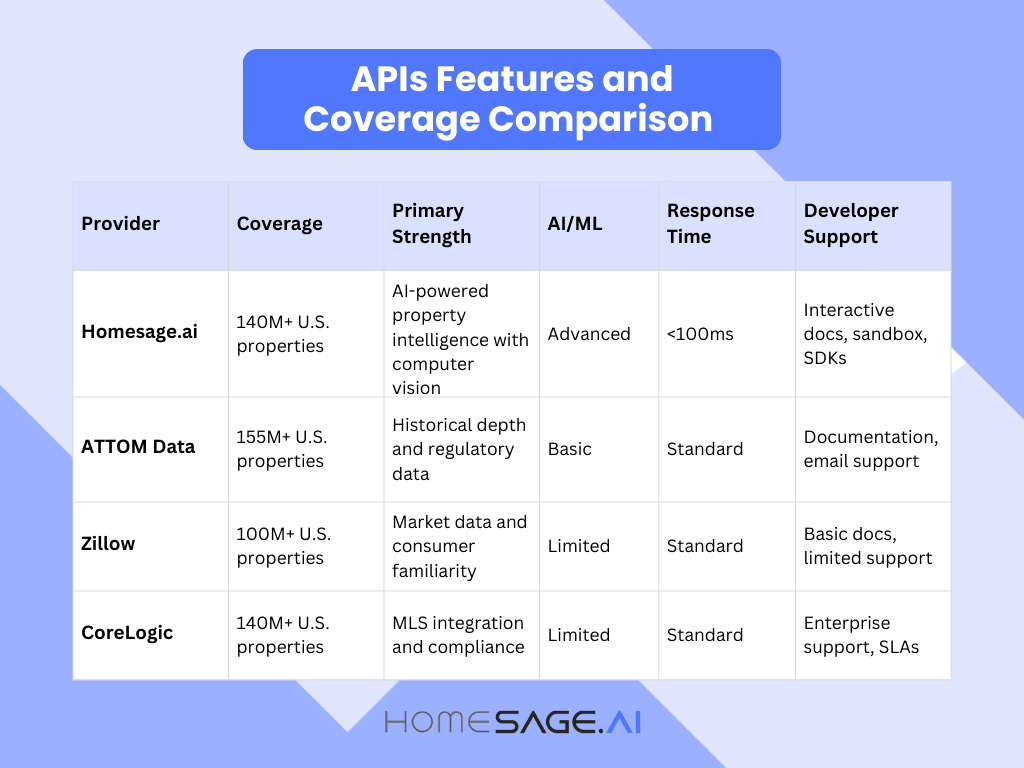
Feature and Coverage Comparison
Provider | Coverage | Primary Strength | AI/ML | Response Time | Developer Support |
Homesage.ai | 140M+ U.S. properties | AI-powered property intelligence with computer vision | Advanced | <100ms | Interactive docs, sandbox, SDKs |
ATTOM Data | 155M+ U.S. properties | Historical depth and regulatory data | Basic | Standard | Documentation, email support |
Zillow | 100M+ U.S. properties | Market data and consumer familiarity | Limited | Standard | Basic docs, limited support |
CoreLogic | 140M+ U.S. properties | MLS integration and compliance | Limited | Standard | Enterprise support, SLAs |
Homesage.ai Advantages for IT Developers
Homesage.ai provides a unified API for valuations, renovation costs, rental estimates, and investment scoring. It includes computer vision for property condition, fix-and-flip, and rental endpoints, sub-100ms performance, transparent pricing, and developer-friendly REST APIs with docs and SDKs.
Key Takeaways
- AI property valuation APIs transform real estate applications by automating complex analysis that would require teams of experts, delivering accurate estimates in milliseconds instead of hours.
- ATTOM Data excels in historical depth, Zillow offers consumer familiarity, CoreLogic specializes in MLS integration and enterprise compliance, while Homesage.ai leads with AI-powered intelligence, computer vision, sub-100ms response times, and developer-first tools.
- Integration follows standard REST patterns with straightforward authentication, JSON responses, and comprehensive documentation—most IT developers complete basic integration in minutes or hours.
- Production applications require advanced patterns, including batch processing, multi-layer caching, webhook integration, and async processing for optimal performance and user experience.
- Specialized APIs serve different investment strategies. Homesage.ai offers dedicated endpoints for fix-and-flip analysis, rental income projection, wholesale deal evaluation, and comprehensive property intelligence.
- Homesage.ai leads developer-focused property intelligence with computer vision, investment-specific endpoints, transparent pricing, and comprehensive documentation that accelerates time-to-market for PropTech applications.
Conclusion
The real estate tech landscape favors IT developers who integrate advanced property intelligence into their apps. Users now expect instant valuations, investment analysis, renovation estimates, and rental projections to make confident decisions.
Consumer-based platforms should consider Zillow‘s brand recognition; enterprise/regulatory applications fit ATTOM Data or CoreLogic, while PropTech startups needing cutting-edge AI and fast integration benefit most from Homesage.ai‘s modern architecture.
AI property valuation APIs enable this without building infrastructure or hiring experts. Accuracy rivals’ professional appraisals, response times meet consumer standards, and integrations use familiar REST conventions.
Choosing the right API partner is key for PropTech developers. Homesage.ai offers property valuations, condition assessments, renovation insights, and investment scoring, delivering reliable, secure, and high-performance property intelligence for your application.
Frequently Asked Questions
Q: How accurate is AI property valuation of APIs compared to professional appraisals?
A: AI APIs can reach up to 98% accuracy for typical homes, but lenders still require professional appraisals. Hybrid models combining AI and human expertise are even more accurate, improving results by 15%.
Q: What’s the typical cost structure for property valuation of APIs?
A: Pricing varies by provider and typically follows per-request models ranging from $0.10 to $2.00 per valuation, depending on data depth and features. Volume discounts apply for high-usage applications.





3 Comments
Robin November 25, 2025
Very insightful!
Peter November 26, 2025
AI can significantly improve AVMs!
Hamza December 1, 2025
Great guide!