
“Quick answer The best AVM in real estate is the one that can see the condition of the house. An AVM is an automated valuation model. It estimates what a property is worth from comparable sales, public records and property characteristics, in seconds and without an appraiser. The 3 worth using in 2026 are CoreLogic for lending scale, Homesage.ai for condition-aware investor valuations, and ATTOM for data breadth. The difference that matters is whether the model can see the condition of the house. On a real Cleveland property we ran, the same address carried an $88,516 estimated value as-is and a $106,922 estimated after-repair value.

Picking the best AVM for real estate work starts with what the model can see. Every lender, investor and realtor now leans on an automated valuation somewhere in the workflow. The models are not interchangeable. They differ in what data they see, how often they refresh and whether they tell you how confident they are.
An AVM that cannot see the condition of a house is valuing a photograph of the street, not the property.
How AVM real estate valuations work
An automated valuation model estimates a property value using math instead of a site visit. It reads recent comparable sales and public records. It reads tax assessments and property characteristics. Then it returns a number in seconds.
Lenders use AVMs to screen applications before ordering an appraisal. Investors use them to rank deals. Realtors use them to set listing expectations. None of those uses replaces an appraisal, and no lender will fund on an AVM alone.
How to pick the best AVM in real estate
Most AVMs are condition-blind. They know the house sold, how big it is and what the street is doing. They do not know the kitchen is original and the roof is 25 years old.
That matters most where it costs most. A tired house and a renovated house on the same street have the same records and very different values. A condition-blind model splits the difference and is wrong about both.
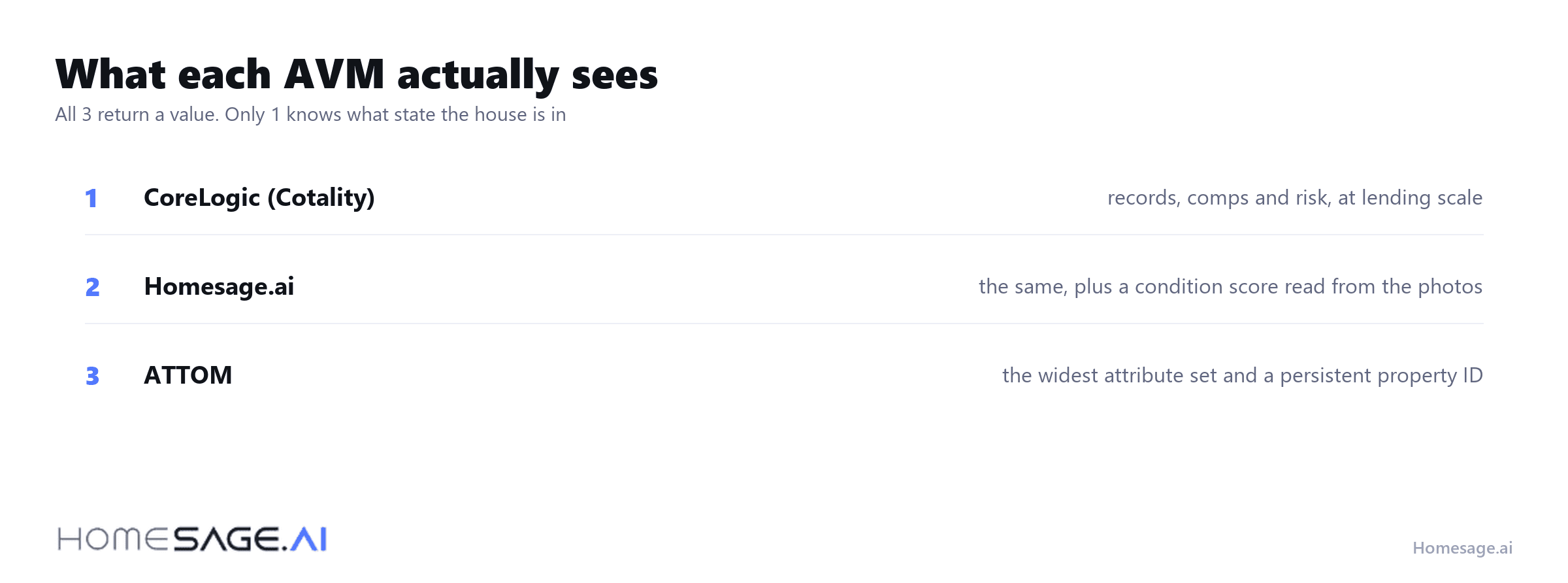
1. CoreLogic AVM
The CoreLogic AVM, now sold under the Cotality name, is the model most US lenders already touch. Its property database is one of the largest in the country. Its valuation products sit inside mortgage and insurance workflows.
It reports a confidence score with each valuation, integrates through established enterprise pipelines, and covers residential and commercial. Pricing is enterprise and negotiated, which is the right shape for a bank and the wrong shape for 1 investor checking 5 houses.
Best for lenders, insurers and anyone who needs valuations inside an existing underwriting stack. See Cotality for the current product line.
2. Homesage.ai, for condition-aware investor valuations
We built our model for the investor question, which is not what a house is worth today. It is what the house is worth today and what it is worth after the work.
Property condition analysis reads the listing property photos and returns a condition score, from Excellent and Good down to Outdated, Poor and Very Poor. That score feeds the valuation, so a tired house and a renovated one on the same street do not come back with the same number.
The report returns an estimated current value and an estimated after-repair value together. It shows the comparable sales behind each, plus an estimated renovation cost with a confidence score. The full walkthrough is in our guide to calculating property ARV.
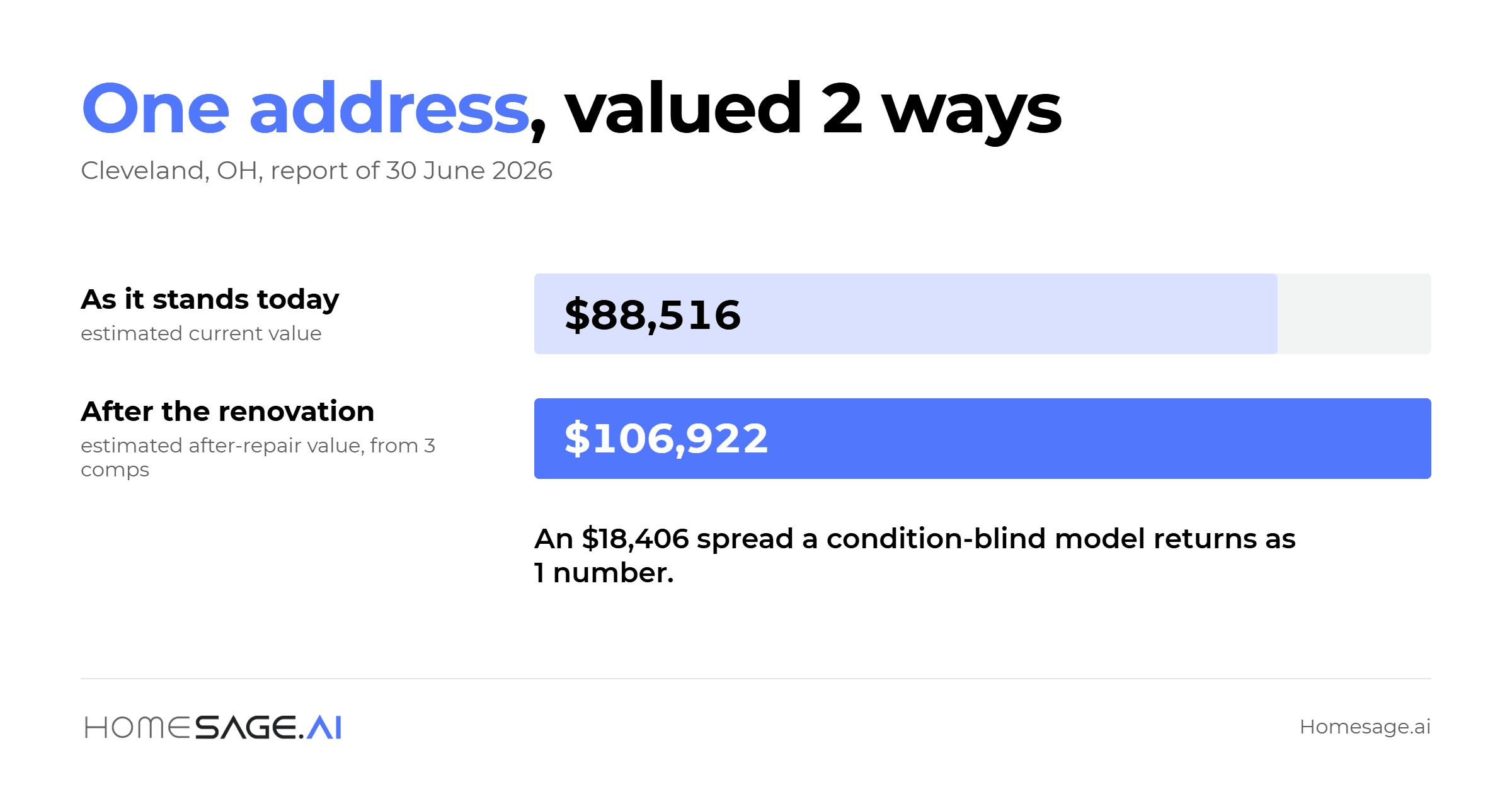
Here is what that looks like on 1 address. We ran a 3-bed 1-bath house in Cleveland OH 44120 through the Full Property Report on 30 June 2026.
| What the report returned | Cleveland OH 44120 |
|---|---|
| Estimated current value | $88,516 |
| Estimated after-repair value, from 3 comps | $106,922 |
| The spread a condition-blind model misses | $18,406 |
| Estimated renovation cost, with a confidence score | $100,484 |
Estimated values. Not investment advice. Data as of 2026-06-30.
Best for investors, flippers and realtors who need the after-repair number as well as the current one.
Here is a short video on reading a property condition in 2 minutes.
3. ATTOM, for data breadth
ATTOM covers 158M+ US properties across residential and commercial. It runs each record through a standardization process. Every property gets a persistent ID that holds across datasets.
Its valuation models sit alongside a very wide attribute set. That set includes neighborhood, environmental, school and demographic overlays. The breadth is why platform builders and public agencies choose it.
Best for teams building on top of property data rather than looking up 1 house. See ATTOM Data, and our comparison of when to use each real estate API.
How the 3 compare
| Provider | Reads property condition | Returns an after-repair value estimate | Best for |
|---|---|---|---|
| CoreLogic (Cotality) | No | No | Lenders and insurers at scale |
| Homesage.ai | Yes, from property photos | Yes, alongside the current value | Investors, lenders, flippers and realtors |
| ATTOM | No | No | Platform builders needing breadth |
Read the confidence before you read the number
Every AVM is an estimate and the honest ones say how sure they are. Ours reports a confidence level with the valuation, and it will tell you when the answer is weak.
We ran a second Cleveland property on 13 September 2026, this one in 44111. The report returned an estimated value of $85,900 and flagged the valuation confidence as insufficient. That is the model saying there are not enough usable comparable sales to stand behind the number. An appraisal is the next step on that house, not an offer.
A number without a confidence level is a guess wearing a suit.
Ask Sage for the valuation
You do not have to open a portal to run any of this. Sage is our assistant, and it runs the same valuation from a plain-language question inside the AI tool you already use.
Connect Homesage.ai to Claude, ChatGPT or Gemini through our MCP connector, then ask for the address.
“What is this Cleveland address worth now, and what after a renovation?”
Sage returns both estimated values, the comparable sales behind them and the condition score, in 1 answer. Ask a follow-up and it prices the renovation. The work runs against your own account and credit balance.
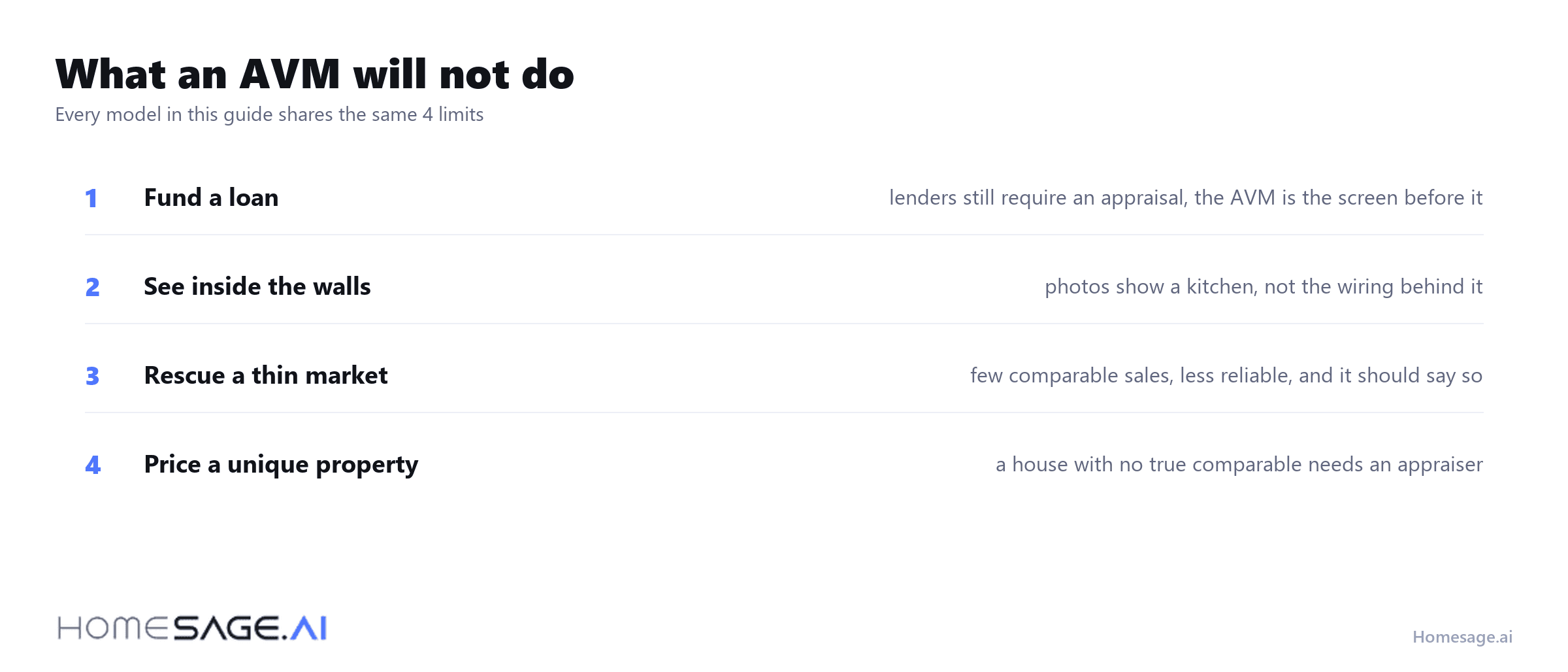
What an AVM will not do
- It will not fund a loan. Lenders still require an appraisal, and an AVM is the screen before that step.
- It will not see inside the walls. Photos show a kitchen, not the wiring behind it.
- It will not rescue a thin market. Where comparable sales are few, every model gets less reliable, and the good ones say so.
- It will not price a unique property. A house with no true comparable needs an appraiser.
Key takeaways
- An AVM estimates a property value from comparable sales and records in seconds, without an appraiser.
- The 3 worth using in 2026 are CoreLogic for lending scale, Homesage.ai for condition-aware investor valuations and ATTOM for data breadth.
- Condition is the dividing line. On the first of those 2 houses the same address carried an $88,516 estimated current value and a $106,922 estimated after-repair value.
- Read the confidence level first. On the second our report flagged the valuation confidence as insufficient, which is the model telling you to order an appraisal.
- No AVM replaces an appraisal, sees inside the walls or prices a property with no comparable sales.
Conclusion
The right AVM is the one that answers your question. A lender screening thousands of files and an investor weighing 1 renovation need different models. The second one has to see the condition. Run the Full Property Report on an address you are weighing and read the confidence level before the number.
Estimated values. Not investment advice. Data as of 2026-09-13. This article is general information. Figures come from Homesage.ai Full Property Reports for 2 Cleveland OH properties. One was pulled on 30 June 2026 and the other on 13 September 2026. Both change as the market moves. Third-party coverage figures are the vendors’ own published numbers. Evaluate every property against your own finances, local costs and a professional inspection.





Emma December 9, 2025
Insightful!
Kevin December 9, 2025
Exactly what I was looking for!
Peter December 10, 2025
Great read
Nourhan December 10, 2025
Insightful!
Robin December 13, 2025
Great read
Mia December 13, 2025
Very helpful!
Hamza December 22, 2025
Great insight!