
The two halves of an investment question
Every investment decision has two halves. What will this cost me, and what will it earn me. Almost every API is strong on one half and weak on the other.
The cost half is well served. Records providers have decades of tax, deed and mortgage filings, and condition models are now dense enough to use. The earnings half is thinner than the marketing suggests, and the study below measures exactly how much thinner.
That matters because yield is where the money is decided. Build an underwriting flow on a rent figure that exists two times in three and it will silently drop a third of your pipeline. Or worse, treat the gap as a zero.
So each API below gets the half it serves, and then we hold the properties constant and count which fields actually come back.
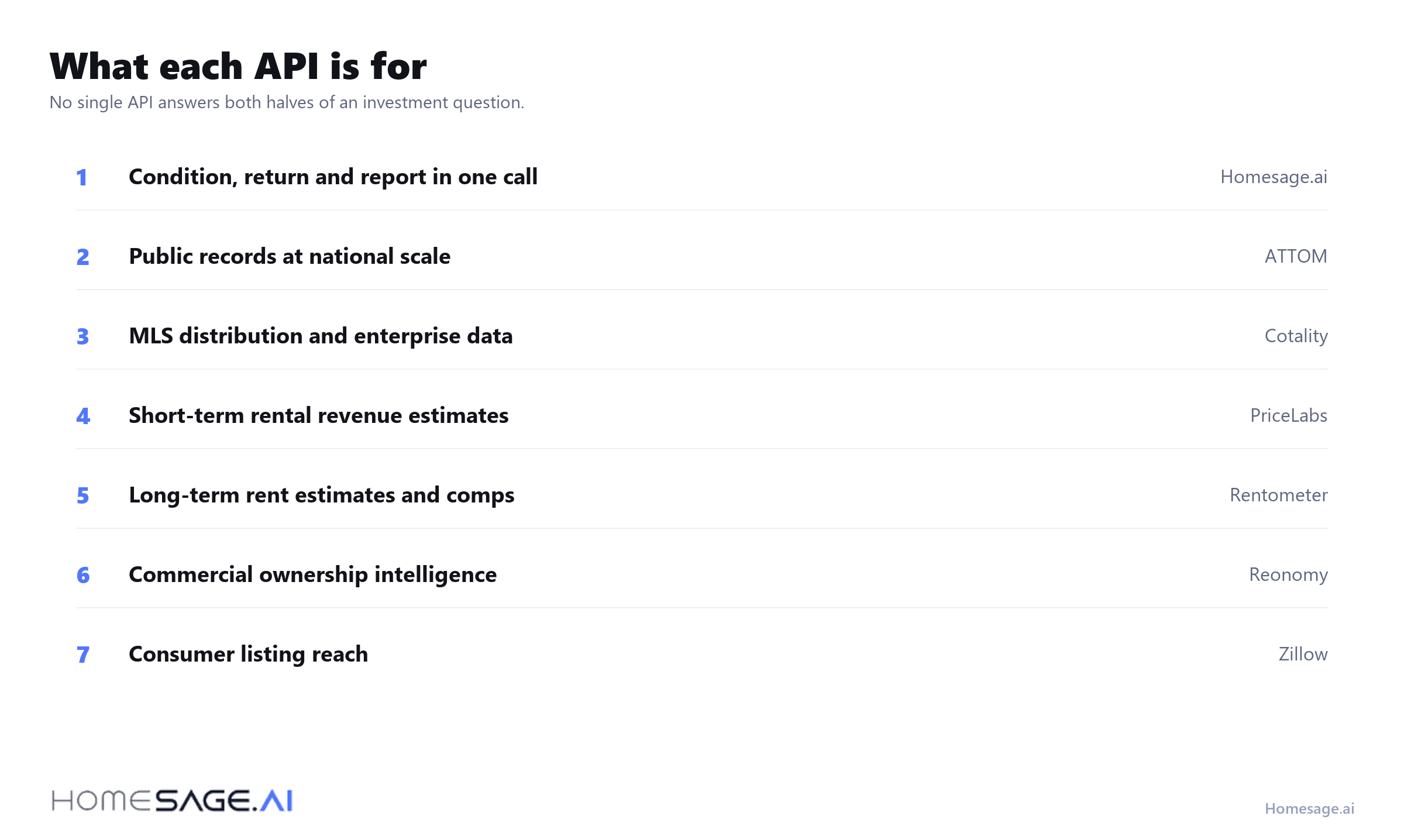
The 7 best investment property APIs in 2026
1. Homesage.ai
Homesage.ai answers both halves in one call. Property condition graded from listing photos, renovation cost, after-repair value, projected return and a Seller Motivation Score come back together.
For an underwriting flow that removes the join. You are not reconciling a condition figure from one vendor with a rent figure from another, each with its own property identifier and refresh cycle.
Best for: Teams building investor-facing analysis who want one identifier and one refresh cycle.
2. ATTOM Data Solutions
ATTOM covers more than 160 million US properties with tax, deed, mortgage, foreclosure and environmental risk data. It is the records layer much of the industry quietly runs on.
It will not tell you what a property is worth or what it earns. That is the point. You get the filings, and the opinion stays yours.
Best for: Engineering teams building their own valuation or risk models from primary records.
3. Cotality Trestle API
Trestle is the MLS data distribution product from Cotality. The company traded as CoreLogic until its rename on 24 March 2025. Trestle standardises listing feeds from many MLSs into one schema.
If you need live listing data across markets, this is the usual route, and the standardisation is worth more than it sounds. Each MLS otherwise arrives with its own field names and its own rules.
Best for: Products that need current MLS listings across more than one market.
4. PriceLabs
PriceLabs covers the short-term rental side. Its Revenue Estimator API returns revenue, average daily rate and occupancy estimates for a location, and a Customer API manages listings and prices programmatically.
Short-term and long-term rentals are genuinely different businesses, with different seasonality and different cost structures. Using a long-term rent figure to underwrite a nightly let is a category error, not a rounding one.
Best for: Underwriting a property that will be let nightly rather than annually.
5. Rentometer
Rentometer answers the long-term rent question and only that question. Its self-service API exposes a Rent Estimate with percentile ranges, a Pro Report, and Nearby Rent Comps returning rent, distance, bedrooms, bathrooms and square footage.
The comparables are the useful part. A rent estimate you can defend with the specific units behind it survives a conversation with a lender. A single number does not. It returns no property values, so pair it with a records provider.
Best for: A defensible long-term rent figure with the comparables that produced it.
6. Reonomy
Reonomy maps commercial ownership, tracing the holding companies that usually sit between a building and the person who decides about it.
For multifamily and mixed-use that is often the whole job. The building is easy to find. The person who can sell it is not.
Best for: Commercial and multifamily buyers who need to reach a decision maker.
7. Zillow
Zillow provides consumer reach and a widely recognised baseline value through the Zestimate, plus market context through Zillow Research.
Developer access is more restricted than people expect, and the terms on storage and display are tight. Treat it as a reference your users already trust rather than as infrastructure you build on.
Best for: Showing a familiar number alongside your own analysis.
Which half each API answers
| API | Cost half | Earnings half | Access |
|---|---|---|---|
| Homesage.ai | Condition, renovation, ARV | Rent and projected return | Self-serve and enterprise |
| ATTOM | Tax, deed, mortgage, risk | No | Enterprise |
| Cotality Trestle | MLS listing detail | No | Enterprise |
| PriceLabs | No | Short-term revenue, ADR, occupancy | Self-serve |
| Rentometer | No | Long-term rent and comps | Self-serve |
| Reonomy | Ownership and entity data | No | Enterprise |
| Zillow | Baseline value | Limited | Restricted |
Only one row answers both halves without a second vendor. That is the real shape of this market, and it is why most production stacks run two APIs.
Which fields the same listings actually carry
The honest way to compare data APIs is to hold the properties constant and ask which fields come back. On 19 October 2026 we took all 1,162 active listings in Omaha, Nebraska and counted.
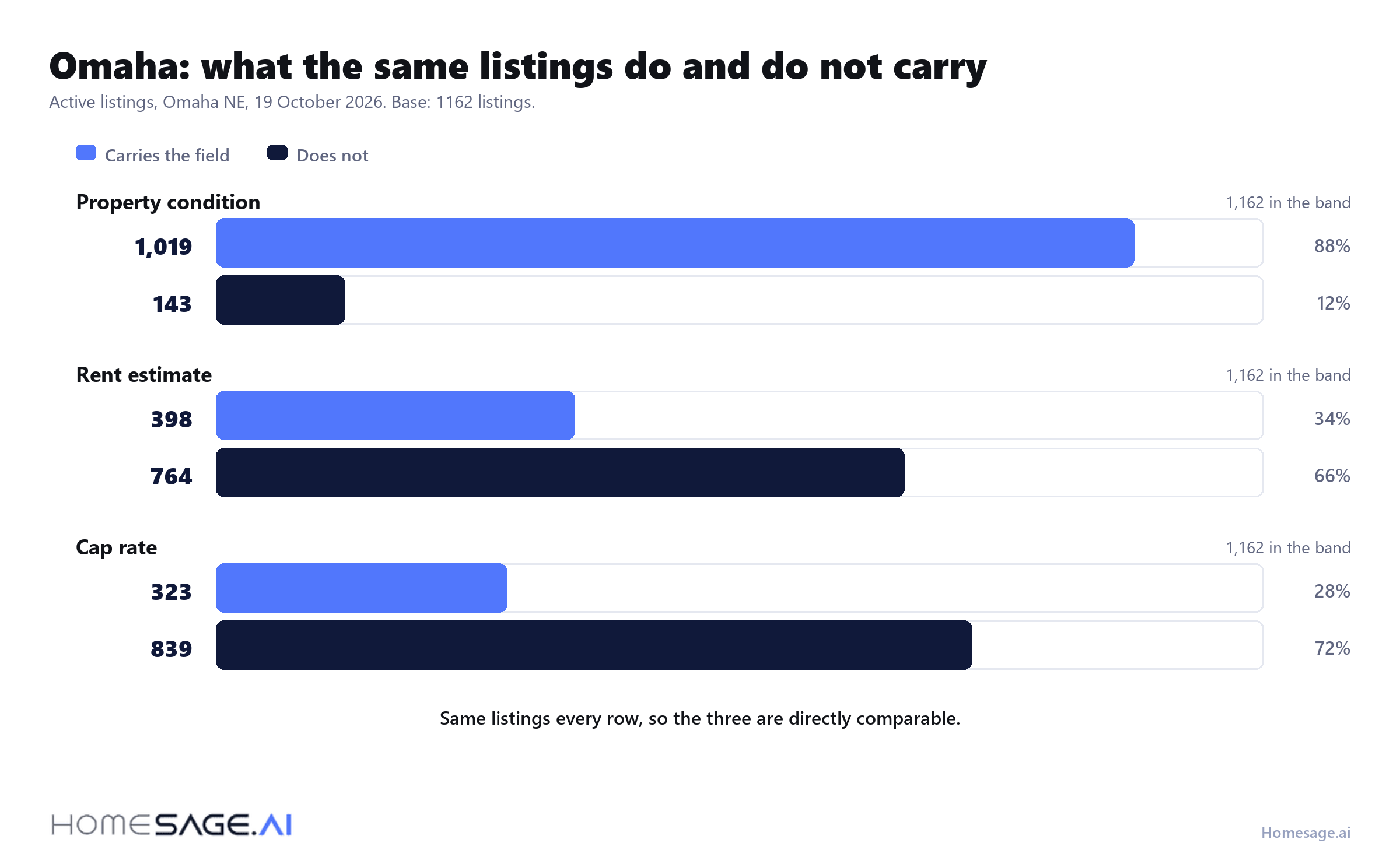
A property condition grade came back on 1,019 listings, or 87.7%. A rent estimate came back on 398, or 34.3%. A cap rate came back on 323, or 27.8%.
Every row is the same 1,162 listings, so the three are directly comparable. That is the part that usually goes wrong when coverage figures get quoted. Each number comes from a different sample, and they cannot honestly be set against each other.
Every row is the same 1,162 listings, so the three numbers can honestly be compared.
For anyone building on these APIs, that is the figure that should shape the architecture. A rental underwriting flow assuming a yield figure exists will find it missing about two thirds of the time. The correct response is a stated fallback, not a silent zero.
Each percentage is a share of all 1,162 active Omaha listings on the day we counted. A listing missing a field is absent from that count rather than recorded as a zero.
Building on more than one API without creating a mess
Decide the identifier first. One vendor may key on a parcel number and another on a normalised address. You need a resolution step of your own, and it should be the only place that logic lives.
Store the vintage with every field. Records, valuations and rent estimates refresh on different cycles, so a combined report has to show the oldest date among them rather than the newest.
Make every missing field explicit all the way to the interface. Nulls that become zeroes somewhere in the middle of a pipeline produce confident yields on properties with no rent data at all.
Cache within the licence, not within your convenience. Several feeds here permit display but restrict retention, and that constraint should be encoded in the storage layer rather than remembered by a developer.
Budget calls as well as money. Rate limits bite during a bulk import long before the invoice does, which is why batch endpoints matter more than per-call latency.
How to choose between them
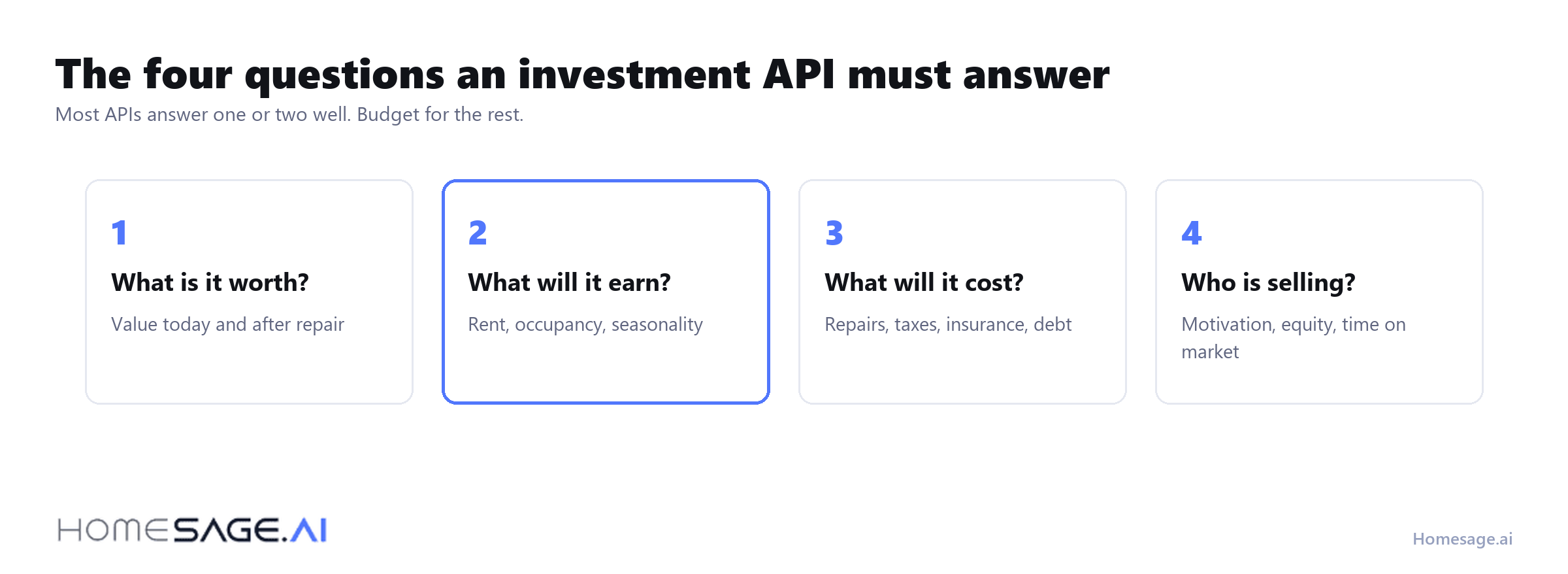
Start from the half of the question you cannot already answer. If you have records and need yield, that points at PriceLabs or Rentometer. If you have yield and need condition, it points elsewhere.
Then decide if you want one vendor or two. Two is usually cheaper and more flexible. One is simpler to operate and removes the identifier-matching work entirely.
Then test against a whole market, not a list of addresses. The addresses you choose are the ones you already know exist, and they are better covered than average.
For the broader developer comparison, see the best property data APIs. For the evaluation-specific fields, see the best property evaluation APIs.
Estimated values, after-repair values, renovation costs and returns are model-derived estimates, not investment advice. Property data as of 19 October 2026.
Key takeaways
- Investment questions have two halves. Most APIs answer one, and the stack has to cover the other.
- Condition data is dense at 87.7% of Omaha listings. Rent is 34.3% and cap rate 27.8%.
- Hold the properties constant when comparing coverage. Figures from different samples cannot honestly be set against each other.
- Short-term and long-term rental are different businesses. Do not underwrite one with the other’s numbers.
- CoreLogic is now Cotality. Trestle is its MLS distribution product and the rename took effect on 24 March 2025.
Conclusion
Pick for the half of the question you cannot answer today. Expect to run two APIs unless one covers both halves. Plan an explicit fallback for the yield fields that will be missing about two thirds of the time. The Omaha counts are the honest version of what these APIs return when you stop choosing the addresses yourself.
Frequently asked questions
What makes an investment property API different from a general property API?
A general property API returns what a property is and what happened to it. An investment API adds what it would earn and what the work would cost. The second set is derived rather than filed, which is why coverage on those fields is thinner.
Do I need both a records API and a rent API?
Usually, unless one vendor covers both halves. Records providers do not estimate rent, and rent providers do not return deeds. The alternative is one vendor that does both, which removes the identifier-matching work.
How current is the data?
It varies by field rather than by vendor. Tax and deed records move on county schedules, listing feeds move continuously, and derived figures rebuild on their own cycle. A combined report should show the oldest date among its inputs.
What happens when a field is missing?
A well-built API returns an explicit null, ideally with a reason. Your own code then has to carry that absence to the interface. The failure mode to avoid is a null that becomes a zero somewhere in the pipeline.





admin November 8, 2025
AI can be very powerful if used right
Hamza November 13, 2025
Great insight.
Can AI Find Investment Properties? 4 Tools That Work October 10, 2026
[…] Investment properties represent real estate assets acquired primarily for generating financial returns rather than personal occupancy. […]
7 Best Property Evaluation APIs In 2026 (Compared) October 21, 2026
[…] For the developer-facing comparison of these, see our guide to the best property data APIs. For the investment-specific fields, see the best investment property APIs. […]