“Quick answerThere is a purchase price in every market where flipping stops being the better use of a house and renting takes over. In Cleveland on 11 October 2026, it sat between $100,000 and $150,000. Below $100,000, 78 of 243 active listings cleared a 20% projected flip ROI while only 31 cleared a 6% cap rate. In the $100,000 to $150,000 band that reversed, 22 against 36. Columbus, screened the same day on the same filters, never flipped at all.
Rent or flip is usually argued as a matter of temperament. Flippers want the cash now, and landlords want the cash forever.
The houses themselves settle it more often than temperament does. What you pay decides which strategy the property can support.
What the question really asks
A flip monetizes work. Our guide to flipping a house with AI walks the whole process. You buy a house that is worth less than it could be, pay to close that gap, and sell the difference.
A rental monetizes occupancy. What counts as a good cap rate sets the bar this post screens on. You buy a house someone will pay to live in, and the return comes from rent against what you paid.
Those are different products, and they sit at different ends of the same price list. The cheap end of a market is cheap because the houses need work. The middle is where houses are already liveable.
The crossover price is not a rule of thumb. It is a number you can measure in your own market, in an afternoon.
Where the Cleveland math flips
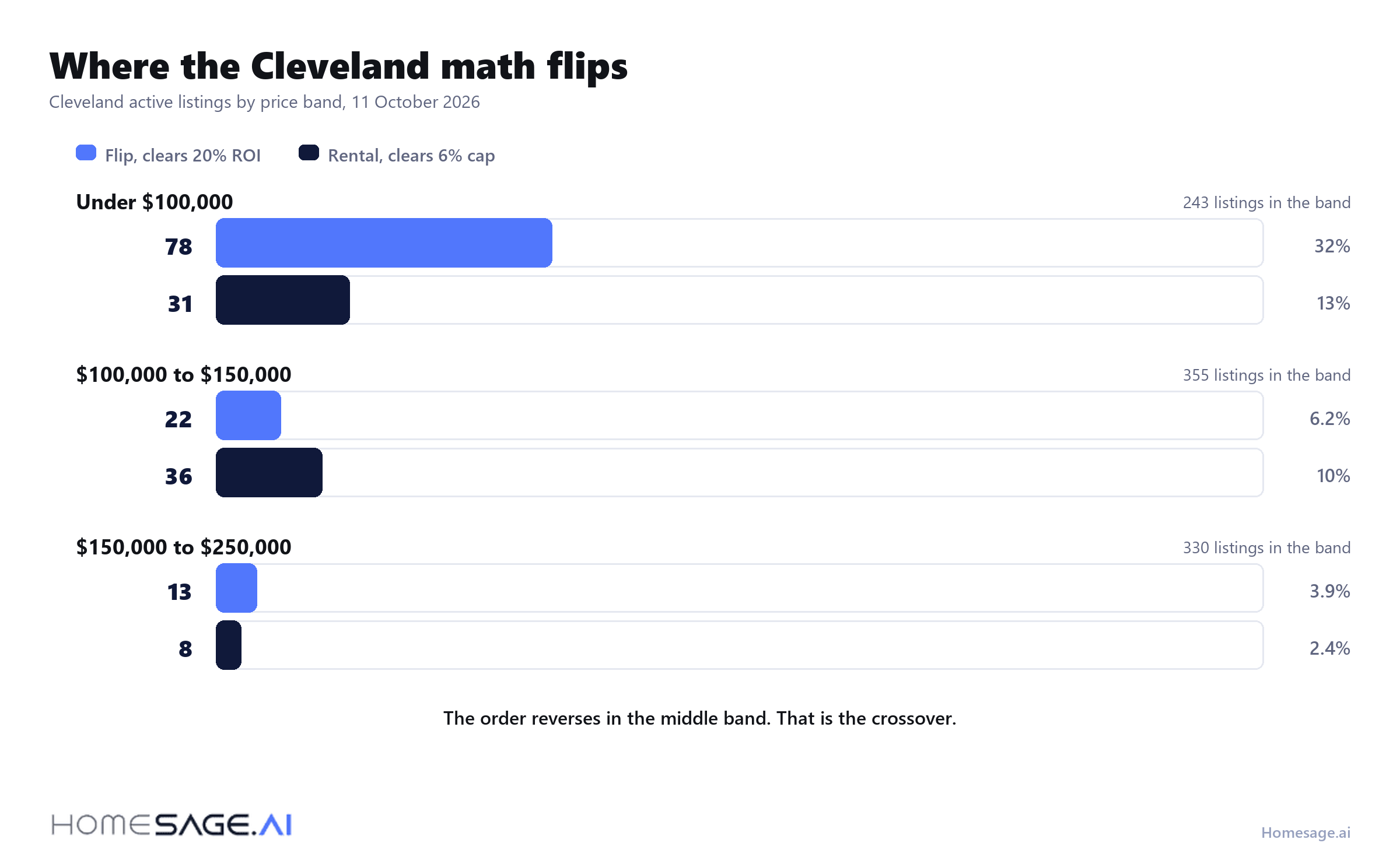
We ran the same screen against our property database on 11 October 2026. One city, active listings, split into price bands, counted twice. Once for listings clearing a 20% projected flip ROI, once for listings clearing a 6% cap rate.
| Cleveland price band | Active listings | Clear a 20% flip ROI | Clear a 6% cap rate |
|---|---|---|---|
| Under $100,000 | 243 | 78 | 31 |
| $100,000 to $150,000 | 355 | 22 | 36 |
| $150,000 to $250,000 | 330 | 13 | 8 |
Homesage.ai property database, Cleveland active listings, 11 October 2026. Counts move daily.
Below $100,000, the flip case clears 2.5 times more often than the rental case. Cross into the $100,000 to $150,000 band, and the order reverses.
Above $150,000, both thin out. Whether flipping still pays in 2026 covers what that thinning does to margins. 13 listings clear the flip bar and 8 clear the rental bar, out of 330. That tells you neither strategy is easy at that price.
Why the price decides it
The mechanism is property condition, and it is visible in the same data.
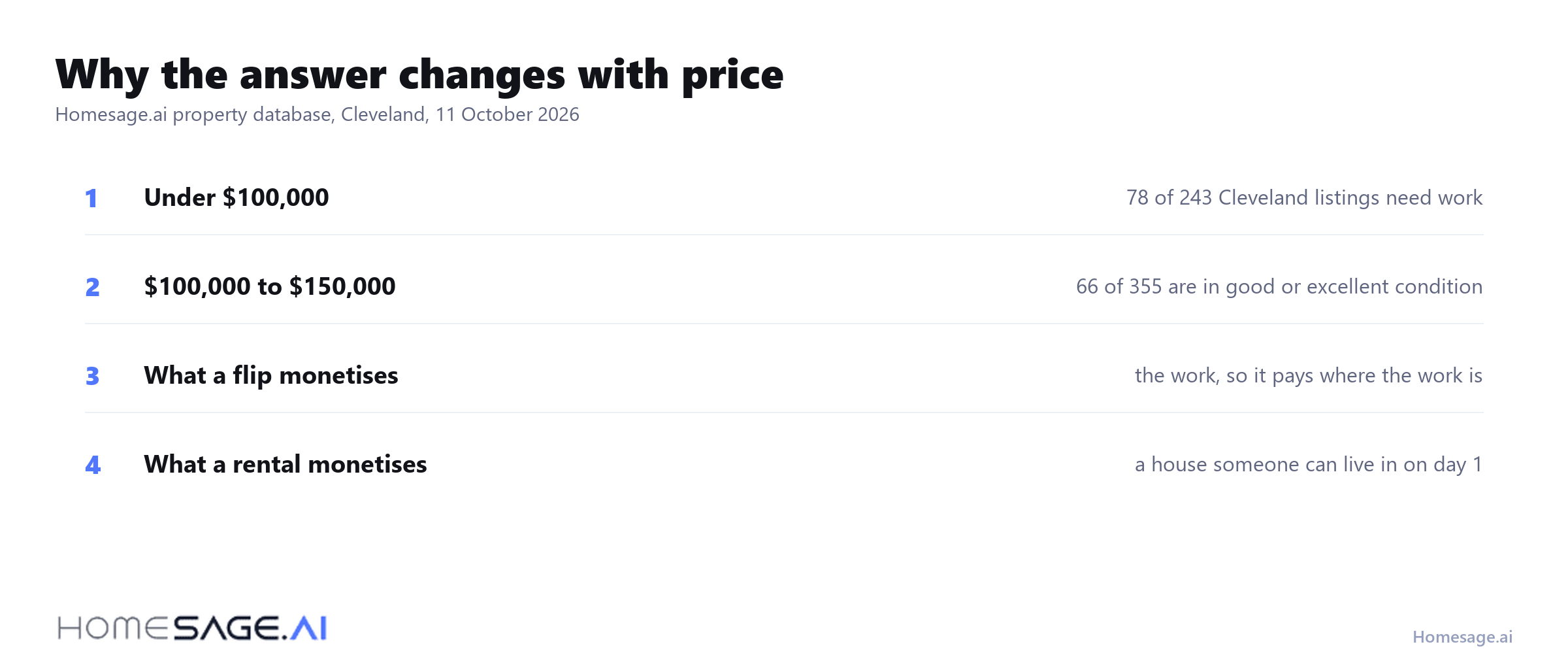
Of the 243 Cleveland listings under $100,000, 78 are in outdated, poor, or very poor condition. That is the same number that clears the 20% flip bar. The cheap end of the market is the work end, and flips are paid for the work.
In the $100,000 to $150,000 band, 66 of 355 listings are in excellent or good condition. Those are houses a tenant can move into, which is what a rental needs and what a flip has nothing left to add to.
Columbus never flips
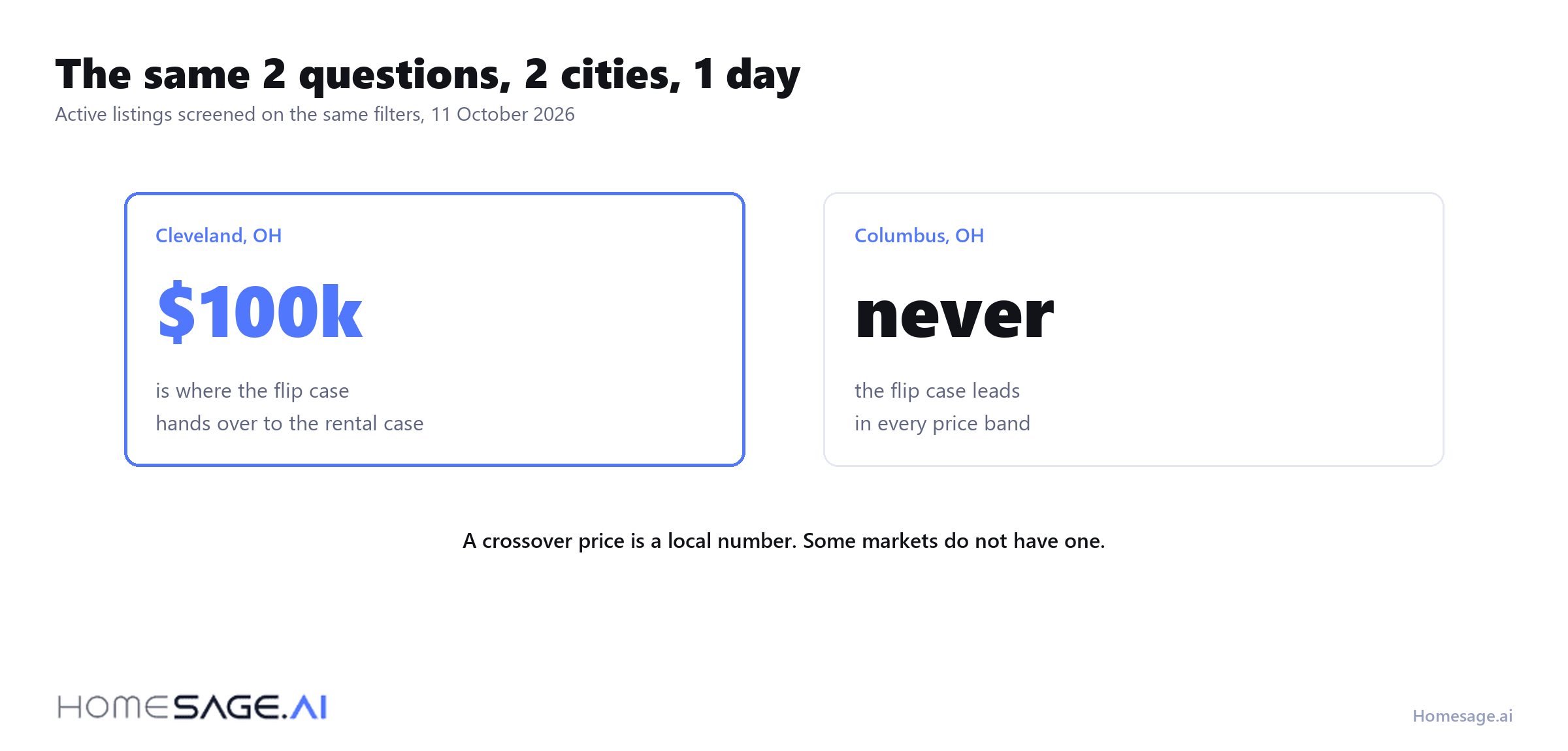
A crossover price is a local number. It is not a national rule, and some markets do not have one.
We screened Columbus the same day, on the same filters. The flip case led in every band we measured.
| Columbus price band | Active listings | Clear a 20% flip ROI | Clear a 6% cap rate |
|---|---|---|---|
| Under $100,000 | 41 | 22 | 0 |
| $100,000 to $150,000 | 130 | 25 | 7 |
| $150,000 to $200,000 | 278 | 21 | 0 |
Homesage.ai property database, Columbus active listings, 11 October 2026.
Two cities, 2 hours apart, same state, same afternoon. One has a crossover price, and the other does not.
Reading one house both ways
A market screen narrows the list. The decision happens on a single address, and the same report prices both strategies side by side.
One Las Vegas condo in our account returns a 40.5% flip ROI, or $72,450 in estimated profit. The residence path on the same condo returns 70.7%, against $104,093 of new equity.
Acquisition cost is identical at $135,325. The renovation budget differs by $3,364 because a flip finishes selling and a hold finishes to live in.
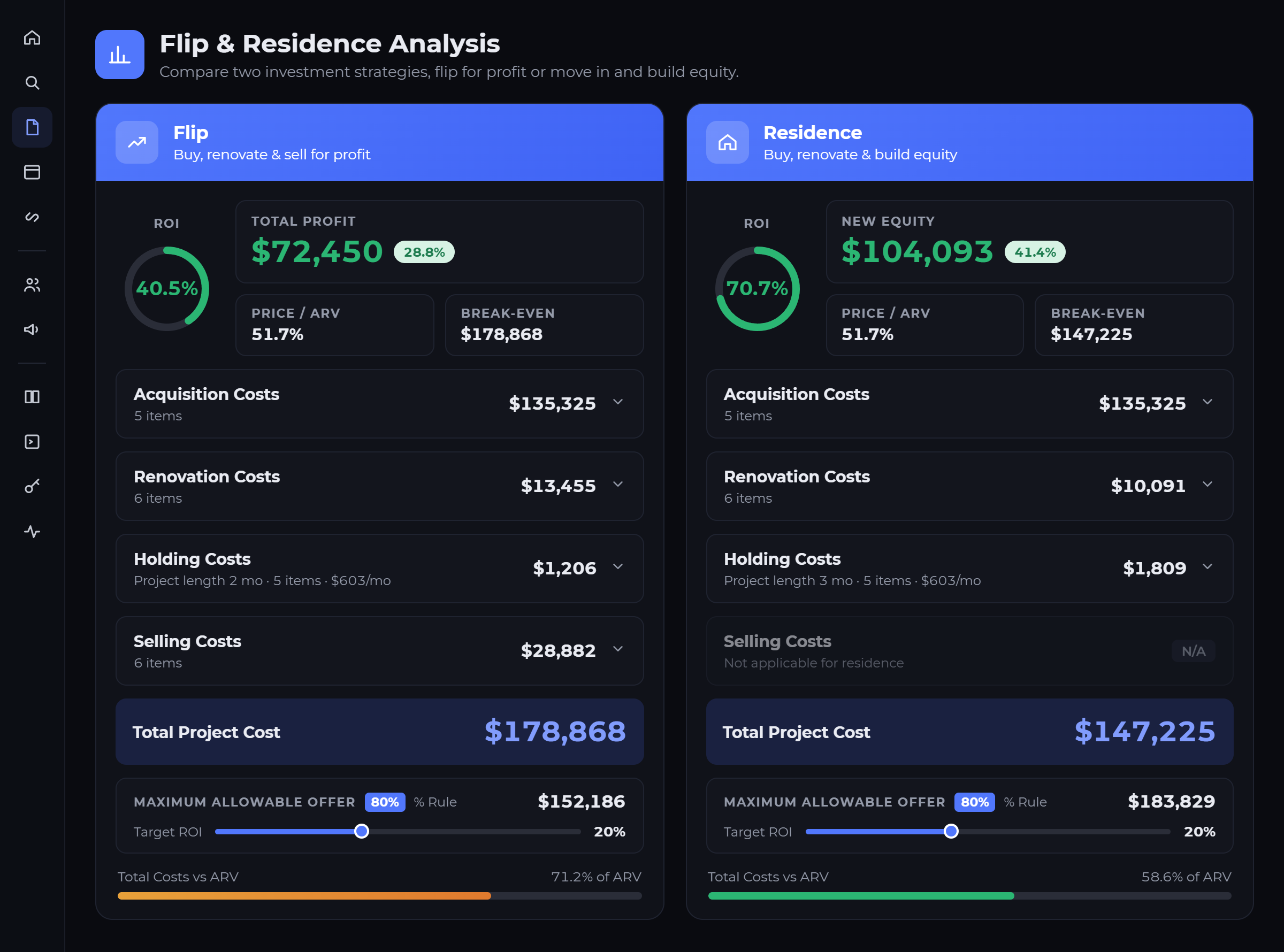
Here is a short video on what a single property report returns.
How to find your own crossover
- Pick one market. The number does not travel, so measure the market you would actually buy in.
- Set both bars. A flip ROI floor and a cap rate floor, each one the number your financing makes real.
- Count by price band. Run the same screen in 3 or 4 bands and record both counts.
- Find the reversal. The band where the rental count passes the flip count is your crossover.
- Re-run it quarterly. Inventory moves, and so does the band.
The preview gives you the match count and the cost before a search charges. Steps 1 to 4 cost nothing while you narrow.
What leverage does to the answer
A cap rate assumes you paid cash. Most investors don't, and that shifts the crossover.
Borrow against a rental, and the return you keep is cash-on-cash, not the cap rate. Debt raises it when rent covers the payment comfortably and sinks it when the margin is thin.
A flip carries debt differently. The loan runs for the length of the project, so the cost is holding, not a permanent drag on yield.
The practical effect is that a leveraged buyer usually finds the crossover lower than an all-cash buyer does. Screen on cash-on-cash rather than cap rate and you will measure your own crossover, not somebody else's.
What the counts do not tell you
4 limits are worth stating plainly.
- A cap rate needs a verified rent. About 35% of for-sale listings carry one. The rest are absent from the rental count rather than counted as zero.
- Projected ROI is a model. It prices the work based on the photos and comparable sales. An inspection can move it. Renovation calculators price the work in more detail.
- One day is a snapshot. Cleveland went from 1,010 active listings on 7 October to 1,099 on 11 October.
- The bars are arbitrary. 20% and 6% are common floors, not laws. Move either one or the crossover band moves with it.
Ask Sage before you choose
Sage is our AI assistant, and it runs the same screen from a plain-language question inside the AI tool you already use.
Connect Homesage.ai to Claude, ChatGPT, Gemini, or Perplexity through our Real Estate MCP and ask about the market you are weighing up.
“In this city, how many listings under $100,000 clear a 20% flip ROI, and how many clear a 6% cap rate?”
Setting this up in ChatGPT takes 3 steps. Connect to ChatGPT in the MCP portal, then ask in plain language.
Key takeaways
- Every market has a price above which renting beats flipping, and the number is local.
- In Cleveland on 11 October 2026, it sat between $100,000 and $150,000.
- Below $100,000, 78 of 243 listings cleared a 20% flip ROI, while 31 cleared a 6% cap rate.
- In the $100,000 to $150,000 band, that reversed to 22 against 36.
- Columbus, screened the same day, had no crossover. The flip case led in every band.
- Property condition is the mechanism. The cheap end is the work end.
Conclusion
Stop arguing rent against flipping in the abstract. The argument has a price attached, and the price is measurable.
Pick your market, set both bars, and count by band. The same counting method drives our investment property search strategies. The band where the rental count passes the flip count is the only version of this answer that applies to you.
Then read the shortlist one house at a time. A market tells you which strategy is likely. A single report tells you which one this house supports.
Start with a free Sandbox and run the same screen in 3 price bands of one city.