
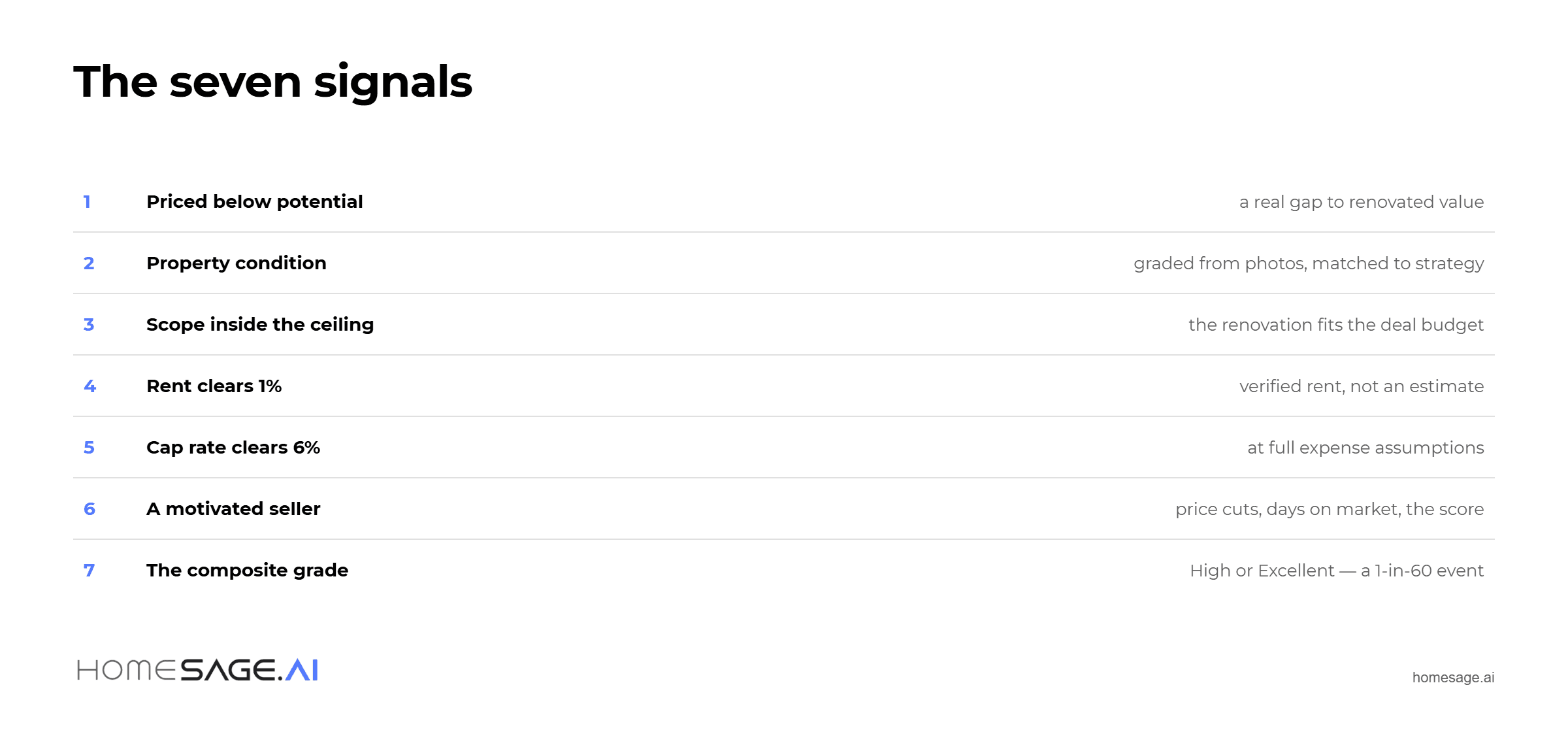
“Quick answer A good investment property is one where seven measurable signals line up: a real gap between price and renovated value, a condition grade that fits your strategy, a renovation scope the deal can absorb, a verified rent near 1% of price, a cap rate above 6%, a motivated seller, and a strong composite investment grade. Lined-up signals are rare: when we screened 177 active single-family listings across a Cleveland and a Phoenix ZIP on 6 September 2026, only 3, about 1.7%, graded High or Excellent investment potential.

Why Good Investment Properties Are Rare
Most listings are priced for homeowners, not for investors. A homeowner pays how a house feels; an investor gets paid for what it earns, and the overlap between the two prices is thin. That is not pessimism; it is arithmetic you can watch in live data.
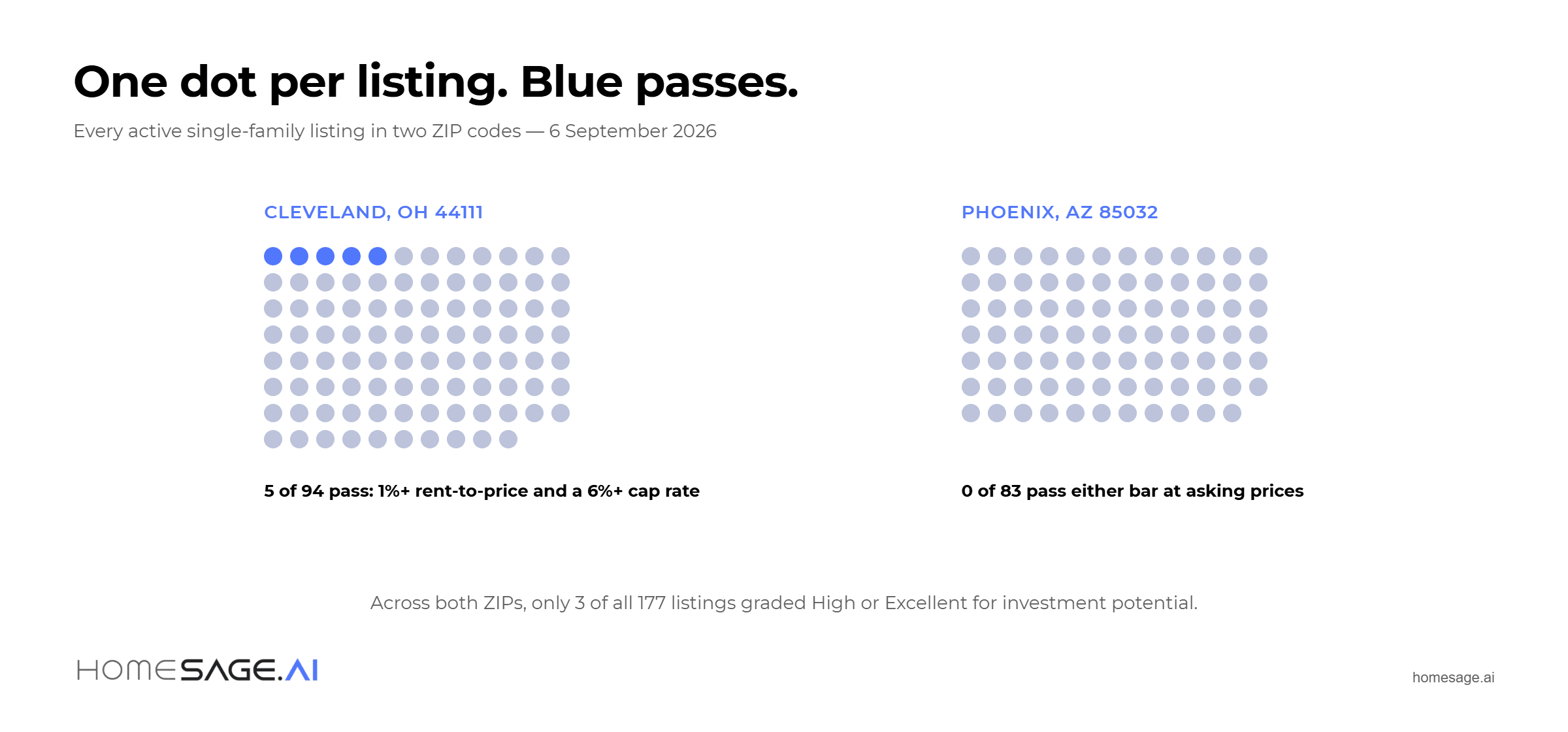
In a live screen of 177 listings, a good investment property was a 1 in 60 event.
On 6 September 2026, we ran the same screen on every active single-family listing in two very different ZIP codes: Cleveland’s 44111 and Phoenix’s 85032. Cleveland’s 94 listings included 5 that cleared a 1% rent-to-price ratio and 5 that cleared a 6% cap rate.
Phoenix’s 83 listings included none that cleared either bar at current prices, though nearly half were in Excellent or Good condition. Different markets fail investors in different ways: one on property condition, the other on price.
The lesson is that “good” is not a feeling about property. It is a short list of numbers, and you can check everyone before you ever call an agent. If you want the fundamentals first, start with our complete data-driven guide to real estate investing; what follows is the checklist our own screening data is built around.
The 7 Signals Our Data Flags
Each signal below is a number our platform computes for live listings, and each comes with a real reading from the market scans we ran on 6 September 2026, so you can see what typical looks like.
A note on how these were measured. Every reading below comes from one market scan: all active single-family listings in each ZIP on 6 September 2026, with property condition grades derived by computer vision from property photos rather than from inspections, and cap rates computed after taxes, insurance, maintenance, vacancy, and management.
Where a listing has no verified rent, it is excluded from the rent, and cap rate counts rather than counted as a zero. Inventory turns over weekly, so the counts move; the pattern they describe does not.
1. Priced below its full potential
The first signal is a genuine gap between the asking price and the property’s estimated value after renovation. In the Cleveland ZIP, 26 active single-family listings graded Outdated or worse. We screened 23 of them extensively, and 11 had a value gap of 25% or more.
A gap is necessary but never sufficient: several of those same listings still failed to be underwritten once the renovation was priced, which is why this signal opens the checklist instead of closing it. Here is how to find undervalued investment properties in the first place.
2. A property condition grade that fits your strategy
Property condition is graded from the listing photos, from Excellent down to Very Poor, and the right grade depends on the plan. A flipper wants honest Outdated stock with sound structure; a remote rental buyer wants Good or better.
The mix is a property of the market itself: 22% of the Cleveland ZIP’s active listings were graded Excellent or Good against 46% in the Phoenix ZIP. If your strategy needs a grade, your market barely produces; that is a market problem, not a patience problem.
3. A renovation scope the deal can absorb
A good property repair bill fits inside its numbers. AI renovation cost estimates price the scope of room by room and attach a confidence score, and the comparison that matters are scoped against the maximum budget the deal supports.
The starkest failure we measured this month: a three-cut Cleveland bungalow whose realistic scope came to $108,295 at 85% confidence, against a flip model that could absorb less than $10,000 at the asking price. With ATTOM’s data putting the typical 2025 US flip at a 25.5% gross return, the lowest since 2008, scope discipline is the margin.
4. A verified rent near 1% of the price
The classic 1% rule says monthly rent should approach 1% of purchase price. Two words matter in 2026: verified rent, from listing feed data rather than an optimistic estimate.
In our screens, 5 of 94 Cleveland listings cleared the bar, and 0 of 83 in Phoenix did. When a market produces zero, the signal tells you the cash flow strategy belongs somewhere else, or at a much lower offer than the ask.
5. A cap rate above 6% at honest assumptions
Cap's rate is net operating income overpriced, and it is only as good as its expense line. Our investment return analysis prices taxes, insurance, maintenance, vacancy, and management before it reports a cap rate, which is why the bar is hard to clear: the same 5-of-94 Cleveland listings and 0-of-83 Phoenix listings cleared 6%.
A list that only works with management or vacancy set to zero is not a deal; it is a spreadsheet decorated to look like one.
6. A seller with a reason to move
Price is negotiable in proportion to motivation, and motivation leaves a data trail: days on market, price change history, comparable activity, and season. A Seller Motivation Score compresses that trail into a 0–100 reading.
High readings are rare, and that is the point: only 1 of those 23 deep-screened Cleveland listings scored 30 or above, and that one had cut its price three times in four weeks with 43 days on market. Motivation converts a merely interesting listing into an actionable one, because it is the signal that makes the other six negotiable.
7. A strong composite grade
The last signal summarizes the rest: a composite investment potential grade from Excellent down to no potential, computed from the price gap, condition, renovation cost, and projected returns. Across all 177 listings in the two ZIP screens, exactly 3 were graded High or Excellent.
Treat the composite as your queue, not your verdict, and the six signals above as the reasons behind it. These AI-powered metrics for spotting good deals are individually simple; the grade is what makes them scannable at market scale.
Here is the whole checklist in one view, with the live readings behind each signal.
| Signal | The check | 6 September 2026 reading |
|---|---|---|
| Price vs potential | Value gap of 25% or more | 11 of 23 deep screened (26 in band) |
| Property condition fit | Grade matches the strategy | 22% Excellent or Good in Cleveland ZIP, 46% in Phoenix ZIP |
| Renovation scope | Scope fits the deal budget | Worst fail: $108,295 scope vs a sub $10,000 ceiling |
| Verified rent | 1%+ rent-to-price | 5 of 94 Cleveland, 0 of 83 Phoenix |
| Cap rate | 6%+ at full expenses | 5 of 94 Cleveland, 0 of 83 Phoenix |
| Seller motivation | Score of 30 or more | 1 of the 23 deep screened (of 26 in band) |
| Composite grade | High or Excellent potential | 3 of 177 across both ZIPs |
How to Read the Signals Together
No single signal makes a deal, and the order you check them in matters less than the discipline of checking all seven.
The practical pattern looks like this: use the composite grade to shortlist, use signals 1, 2, and 6 to decide which shortlisted properties deserve ten minutes of real underwriting, and let signals 3, 4, and 5 set the price at which you would actually buy.
Equity-focused investors can add an eighth lens, searching specifically for properties with equity potential, which is signal 1 run as a filter instead of a check. And when a listing passes, the full underwrite, not the signal scan, decides the offer.
Here is a short video on how a composite deal score works in practice.
Homesage.ai is an AI real estate intelligence platform that delivers insights on 155M+ US properties, scoring seller motivation and assessing property condition from photos.
All seven signals in this post are computed by its Investment Property Search, which lets you run them as filters across a whole market instead of one listing at a time.
Key Takeaways
- A good investment property has seven checkable numbers, not a feeling: price gap, property condition fit, absorbable scope, verified rent, honest cap rate, seller motivation, and the composite grade.
- Lined-up signals are rare. In our 177 listings, two ZIP screens on 6 September 2026, only 3 listings, about 1.7%, graded High or Excellent investment potential.
- Markets fail investors differently: Cleveland ZIP offered cash flow but rough condition, while Phoenix ZIP offered condition but zero listings clearing 1% rent-to-price or a 6% cap.
- A value gap without an absorbable renovation scope is a trap, and it is the most common way a prospective listing dies in underwriting.
- Use the composite grade to shortlist and the individual signals to set your price. The signals scan a market; the underwriter makes the offer.
Conclusion
The unpleasant truth in the data is that on any given day, almost everything for sale is a bad investment at its asking price. That is not a reason to sit out; it is the reason discipline wins. The investor who checks seven numbers on a hundred listings will find the three that work, and the investor who trusts impressions will buy one of the other ninety-seven.
The signals also explain to each other. A motivated seller turns an overpriced listing with a real value gap into a deal; an honest renovation scope stops a discount from becoming a donation. Reading them together is a skill, and it is learnable.
Most of all, numbers replace arguments with evidence. You do not have to wonder whether a market has cash flow; you can count the listings that clear 1%. You do not have to guess whether a seller will move; the score and price history already answer that. Good investment properties are rare, but they are rare in a way you can measure, and what you can measure, you can find.
This article is general information, not investment advice. Evaluate every property against your own finances, local costs, and professional inspection.





Magiz September 21, 2026
The seven-signal framework is genuinely useful — most property checklists float around without naming what the data actually measures. Tying each signal to a concrete threshold (1% rent ratio, 6% cap rate) instead of vague adjectives is exactly what I've been looking for. Curious how you quantify "motivated seller", since that one feels qualitative at first glance.