
Learning how to use AI for real estate investing has gone from an edge to table stakes. Industry analysts estimate the AI-in-real-estate market reached roughly $303 billion in 2025 and is on track for nearly $989 billion by 2029 - a 34.4% compound annual growth rate. Capital is following the same curve: global PropTech funding hit about $16.7 billion in 2025, up almost 68% year over year, and AI-native platforms grew 42% versus 24% for non-AI tools.
For you as an investor, that means the people competing for the same deals are increasingly letting software do the first pass. This guide shows exactly how to fold AI into your own workflow, strategy by strategy - and, just as important, where you still need to be the human in the loop.
“Quick answer“To use AI for real estate investing, turn your investment criteria into data filters, let a model screen on-market and off-market records against them, then use AI valuations, ARV, and rental forecasts to rank the shortlist before you ever drive to a property. Homesage.ai runs this across 155M+ U.S. properties and adds a Seller Motivation Score that predicts how negotiable each seller is - so your time goes to deals you can actually win.”
What AI Real Estate Investing Actually Means
Strip away the hype and AI real estate investing is simple: using machine-learning models to source deals, estimate value and after-repair value (ARV), forecast rent and returns, and flag risk faster and at more scale than a spreadsheet allows.
AI is not a robot that buys houses for you. It is a research assistant that never gets tired, reads more comps than you ever could, and hands you a ranked shortlist so your judgment goes where it matters.
Here is the shift in plain terms
The old way: you scroll listing sites, copy addresses into a spreadsheet, hunt for comps, and guess at repair costs. By the time you have analyzed ten properties by hand, the best one is under contract with someone faster.
The AI way: the AI model does that analysis continuously in the background and surfaces the handful of properties worth your attention this week, already scored - so you are competing on decision speed, not data-entry speed.
Why 2026 Is the Tipping Point for AI Investing
AI adoption used to be the barrier. Now it is the baseline.
The National Association of Realtors' 2025 Technology Survey found 68% of Realtors already use some form of AI, and investor tools have matured alongside them.
The practical consequence is that the manual investor is now at a structural disadvantage. When a competitor's software has already valued, scored, and flagged a new listing before you have finished reading the description, speed of insight becomes the moat - and that is precisely what AI provides.
If you want the strategic version of this shift, our guide to AI-powered real estate investment strategies walks through the specific plays that work in a competitive 2026 market, from data-driven farming to automated off-market outreach.
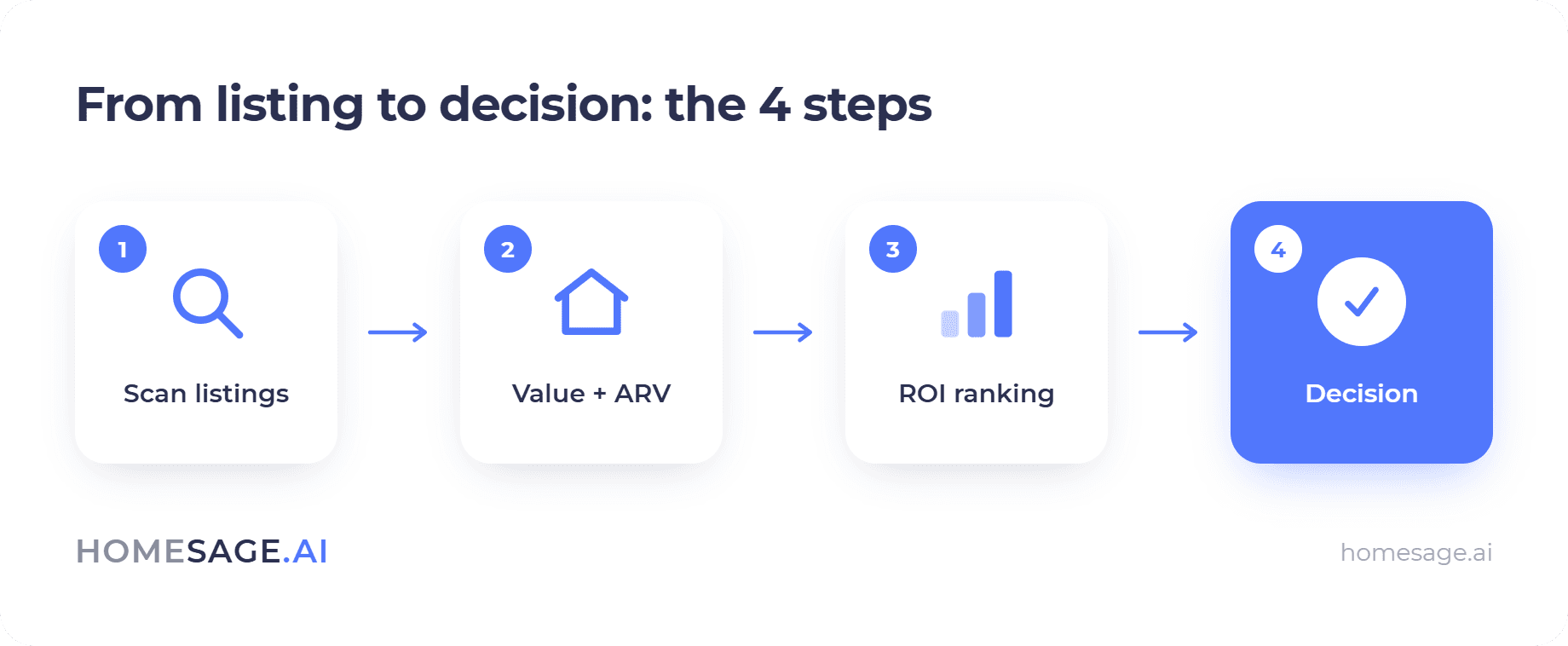
How to Use AI for Real Estate Investing, Step by Step
1. Turn your strategy into clear investment criteria
AI is only as sharp as the criteria you give it.
Write your strategy as filters a model can act on: target markets and ZIP codes, price range, property type, minimum equity, ownership type (owner-occupied, absentee, LLC), and distress signals such as tax delinquency, code violations, or long ownership tenure.
Vague criteria return noise; precise criteria return deals. Spend an afternoon getting this right and every downstream step improves, because the model is now hunting for your deal, not a generic one.
2. Let AI source and screen - including off-market
The biggest time sink in investing is finding candidates, and it is exactly what AI removes. Instead of refreshing a listings tab, point the model at both on-market and off-market records.
The Investment Property Search product screens a database of 155M+ properties and returns a ranked list against your criteria, so you start every week from a shortlist rather than a blank search. Off-market coverage matters most here, because that is where margin lives once a market gets competitive - and it is also where finding properties with equity potential separates disciplined investors from the crowd.
3. Value the property with AI - including condition
A valuation that ignores the roof is a guess. This is where most free tools fall short and where AI has genuinely improved: modern automated valuation models now report median error rates around 3.8% to 5.5% in data-rich urban markets, and machine-learning integration has pushed leading models below 4.5%.
Homesage.ai goes a step further by reading visible condition with computer vision and returning both current value and ARV - the difference between a deal that pencils on paper and one that pencils in reality. A model that assumes average condition will overvalue a distressed property and undervalue a renovated one, and both errors cost you money.
4. Estimate ARV and repair scope before you commit
After-repair value is where flips are won or lost. Getting it wrong by 10% can erase a deal's entire margin. AI shortens this from a day of contractor calls to minutes by combining condition scoring with local renovation costs and comparable renovated sales.
Our walkthrough on how to calculate ARV using AI covers the inputs that matter and the traps that inflate an ARV estimate - such as pulling comps from a different school district or a nicer block. Treat the number as a starting point you then verify, not a promise.
5. Forecast returns and negotiability before you drive out
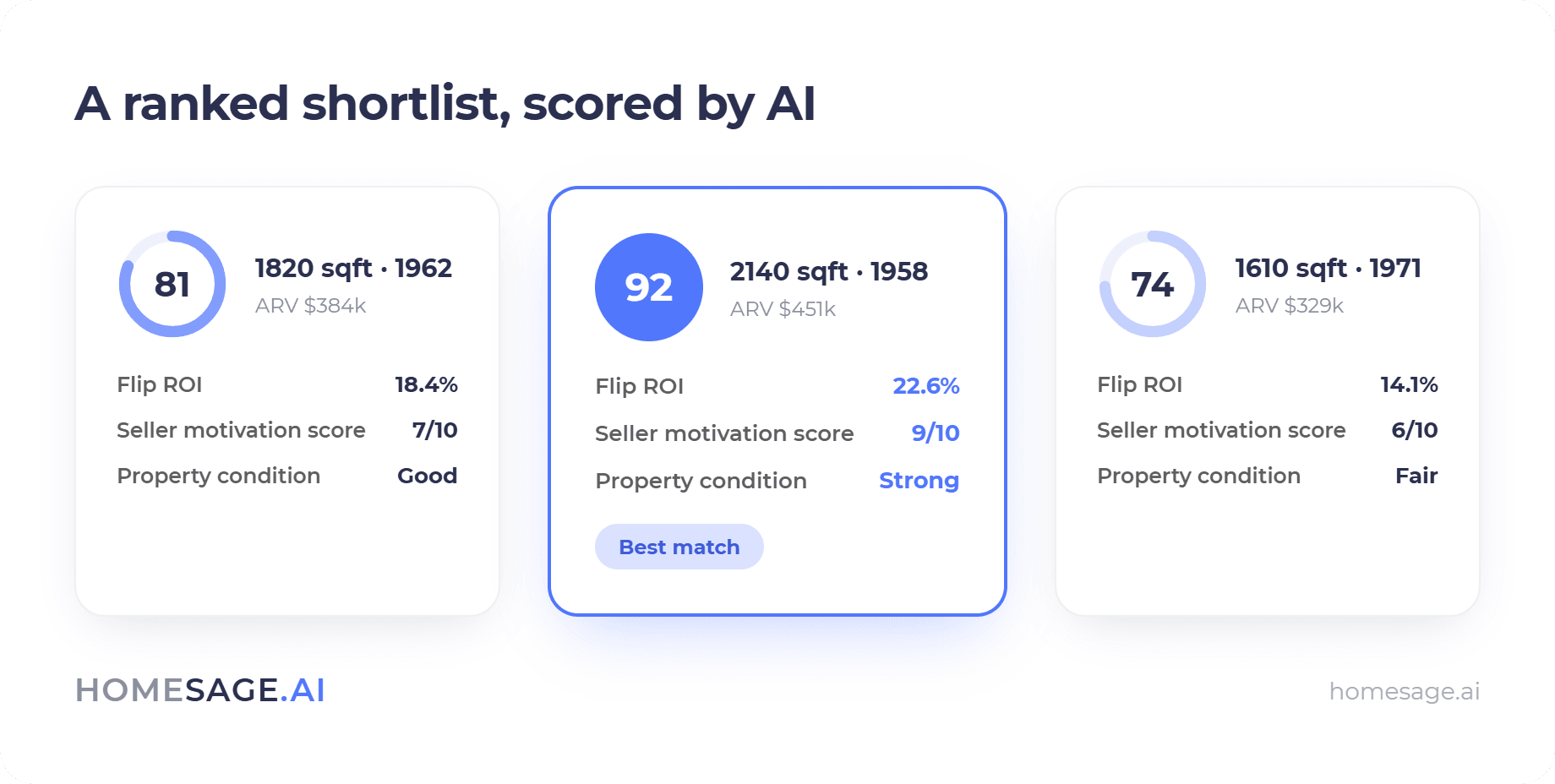
Model cash flow, cap rate, and flip ROI up front so a bad deal never reaches your calendar. Then add the signal most investors miss: how likely the seller is to move on price.
The Seller Motivation Score estimates seller negotiability, so you prioritize offers you can win instead of chasing sellers anchored to a number they will not leave. In a market where you can only make so many offers a week, spending them on flexible sellers is a quiet superpower.
6. Keep a human on the final decision
AI gets you to the right shortlist; you still choose the one. Verify condition in person or with recent photos, confirm title and liens, and layer in local knowledge the model cannot see - a school rezoning, a noisy road, a block that is quietly turning.
The most reliable investors treat AI as a strong first opinion, then apply the kind of manual diligence described in how investors analyze investment properties with AI. The goal is not to remove your judgment; it is to point it at the deals that deserve it.
Where AI Helps vs Where You Decide
| Step | What the AI does | What you still decide |
|---|---|---|
| 1. Define your criteria | Reads your strategy as data filters | Set the criteria and target return |
| 2. Source & screen | Scans on- and off-market records | Confirm the target markets |
| 3. Value + ARV | Estimates value and ARV with computer-vision condition | Verify condition in person |
| 4. Forecast returns | Models cash flow, ROI, and negotiability | Set your price limits |
| 5. Decide | Ranks the shortlist by fit | Choose, and check title and liens |
Here is that workflow in action - a short walkthrough of the platform scoring a real property's investment potential from listing to decision.
How AI Fits Each Investing Strategy
The workflow above is universal, but the emphasis changes with your strategy. Here is how AI earns its keep across the four most common approaches.
1. Fix-and-flip
Flippers live and die by ARV and repair accuracy. AI condition scoring plus renovation-cost modeling gives you a defensible ARV in minutes, and the Seller Motivation Score helps you buy at the margin a flip requires. The risk AI reduces most here is overpaying on entry.
2. Buy-and-hold rentals
Rental investors care about cash flow and long-term appreciation. AI rental forecasts and cap-rate modeling let you compare dozens of markets objectively instead of following hype. Condition-aware valuation also protects you from a property that cash-flows on paper but needs a $30,000 roof in year two.
3. Wholesaling
Wholesalers need volume and speed. AI shines at sourcing distressed and absentee-owned properties at scale and prioritizing the owners most likely to sell - so your marketing budget lands on motivated sellers instead of a random list.
4. BRRRR
The buy-rehab-rent-refinance-repeat model depends on hitting ARV at refinance. Accurate AI valuation and ARV at the buy stage is what makes the refinance math work, and condition analysis keeps your rehab budget honest.
A Quick Worked Example
Say you buy single-family rentals under $250,000 in three metros. Instead of manually checking hundreds of listings, you set those filters once. The model returns twelve candidates ranked by projected cash-on-cash return, each with an AI condition score and ARV.
Three show clear seller motivation. You spend your week on those three - underwriting, offers, walkthroughs - instead of on data entry. Two fall out on inspection; one closes.
That is the entire value of AI investing: it compresses the top of your funnel so your energy goes to closing, not searching. Over a year, that compounding time savings is often the difference between three deals and eight.
What Homesage.ai's Own Market Data Shows
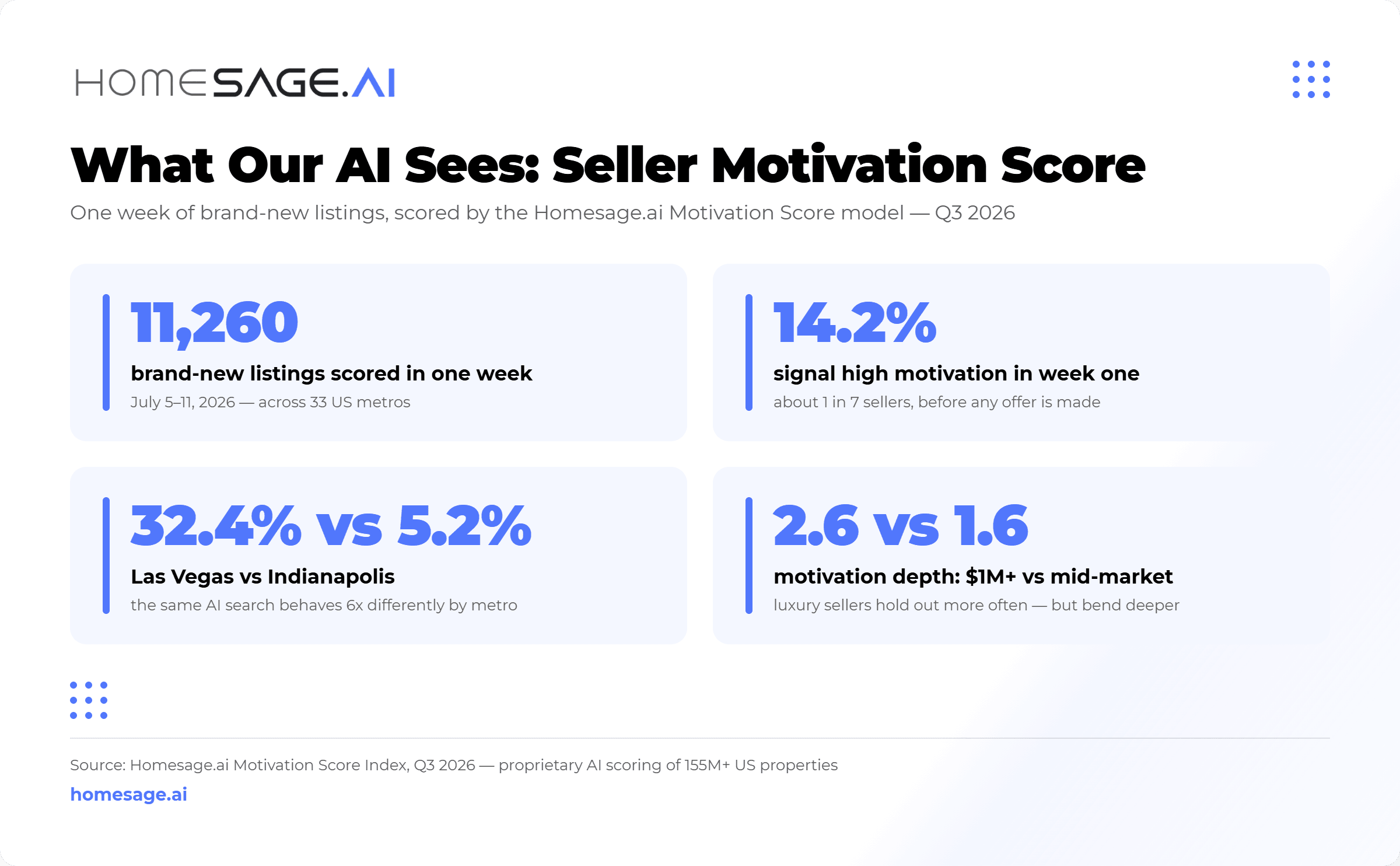
Theory is cheap, so here is a signal only our platform can measure. In a single July 2026 week, our AI scored 11,260 brand-new listings across 33 metros for seller motivation. About 1 in 7 (14.2%) signaled a willingness to negotiate in their very first week on market.
Where you invest changes what AI finds: 32.4% of new Las Vegas listings showed motivated-seller signals versus just 5.2% in Indianapolis. The same ranked shortlist behaves six times differently depending on the metro you point it at.
Price band matters too. Sellers of $1M+ homes signal flexibility less often (13.6%) than entry-level sellers (14.7%) - but when they move, they move the most. Signals like these feed the Seller Motivation Score on every deal, and we publish the full metro breakdown quarterly in our Seller Motivation Score Index.
How to Choose an AI Real Estate Investing Platform
Not every tool that says AI actually helps you buy better. Use this checklist when you evaluate one:
- Coverage: does it span both on-market and off-market records
- Condition-aware valuation: does the AVM account for physical condition, not just square footage and ZIP
- ARV and rehab modeling: can it estimate after-repair value, not just current value
- Negotiability signal: does it flag which sellers are likely to move on price
- Workflow fit: does sourcing, valuation, and outreach live in one place, or will you stitch five tools together
- Transparent pricing and a trial: can you validate the data on your own deals before committing
Common Mistakes to Avoid
- Trusting a valuation that ignores condition - always confirm the model accounts for the physical state of the property.
- Over-broad search criteria that flood you with low-fit leads and bury the good ones.
- Skipping human verification of title, liens, and local nuance.
- Treating AI forecasts as guarantees rather than probability-weighted estimates.
- Chasing every high-score lead instead of the few where the seller is actually motivated.
What AI Still Cannot Do
AI will not walk a property and smell the mold, read a seller's motivation across a kitchen table, or know that the city just approved a rezoning two blocks away. It compresses research and removes guesswork from the numbers, but real estate is still a local, human business at the point of decision. The investors who win in 2026 are not the ones who trust AI blindly - they are the ones who let it handle the first 90% so their judgment is fresh for the 10% that actually closes deals.
The Data That Powers Good AI Decisions
- Coverage that includes off-market: property and ownership records across 155M+ US properties mean the model can surface deals that never reach a listing site.
- Condition that is seen, not assumed: computer-vision assessment grounds every valuation and ARV in the state the property is actually in.
- Comparables and rent estimates: sales and rental data turn a raw listing into a projected return you can compare across markets.
- The Seller Motivation Score: a signal for how likely a seller is to move on price, so your offers go where they can actually land.
More data is not the point; connected data is. When sourcing, valuation, and negotiation signals live in one workflow, you move from a lead to an offer without switching tools - which is the real reason AI-native investors are pulling ahead of investors still working out of spreadsheets.
Key Takeaways
- AI real estate investing means letting models source, value, and rank deals at a scale no spreadsheet can match - while you make the final call.
- Define your investment criteria as data first - the model is only as sharp as the criteria you give it.
- Condition-aware valuation is the accuracy lever: a number that ignores the roof is a guess.
- Forecast cash flow, ROI, and negotiability before you drive out - kill bad deals on screen.
- Keep a human on the final decision: verify condition, title, and local nuance yourself.
Conclusion
AI has not changed what makes a good deal - price, condition, and the return you can realistically pull out of it. What it has changed is how fast you find that deal, and how much you know before you ever leave the house. The investors pulling ahead in 2026 are simply seeing more of the market, sooner, with better information.
So start small and start practical. Define your criteria, let the model build your first shortlist, and test its valuations against a deal you already know well - trust is earned on properties you can verify. Within a few weeks the workflow stops feeling like software and starts feeling like a sharper version of your own instincts.
And keep your judgment in the loop, because AI compresses the research - it does not close the deal. When you want to see what a ranked, condition-aware shortlist looks like in your own market, create a Homesage.ai account, or explore plans and pricing when you are ready to make it part of your week.
Frequently Asked Questions
How do investors use AI in real estate?
Can AI find investment properties?
Is AI accurate for property valuation?
What is the best AI tool for real estate investing?
Do I still need to inspect properties if I use AI?
Is AI investing only for large investors?
How do I start using AI for real estate investing?
Disclaimer: This article is for informational purposes only and is not investment, financial, or legal advice. AI estimates and valuations are not appraisals; verify independently before making decisions. Market figures are third-party estimates.





Steve July 19, 2026
This article has some really good market insights, good job!
Robin July 19, 2026
Great read!
Emma July 19, 2026
insightful