

What a lender is actually deciding
A hard money lender is not assessing a borrower’s salary. They are deciding whether the asset covers the loan if the deal goes wrong, and how quickly it could be turned into cash.
That reduces to four questions. What is the property worth today, what shape is it in, what would it cost to make it sellable, and what is it worth once that is done. A fifth question sits underneath all of them: how long would it sit on the market.
None of those are listing fields. A feed will tell you the asking price and the square footage. It will not tell you the roof is failing, and that is the number the loan turns on.
The real estate API endpoints below answer them individually, so you pay only for the question you asked.
The 7 endpoints, and the question each one answers
1. Property Condition
Property Condition grades a property from its listing photos, returning a grade from excellent down to very poor, plus a fixer-upper indicator.
For a lender, this is the first and cheapest screen. A property graded poor carries a different loan-to-value than one graded good, and knowing which before an inspection changes how you price the inquiry.
Best for: The first screen on any inquiry.
2. Full Property Report
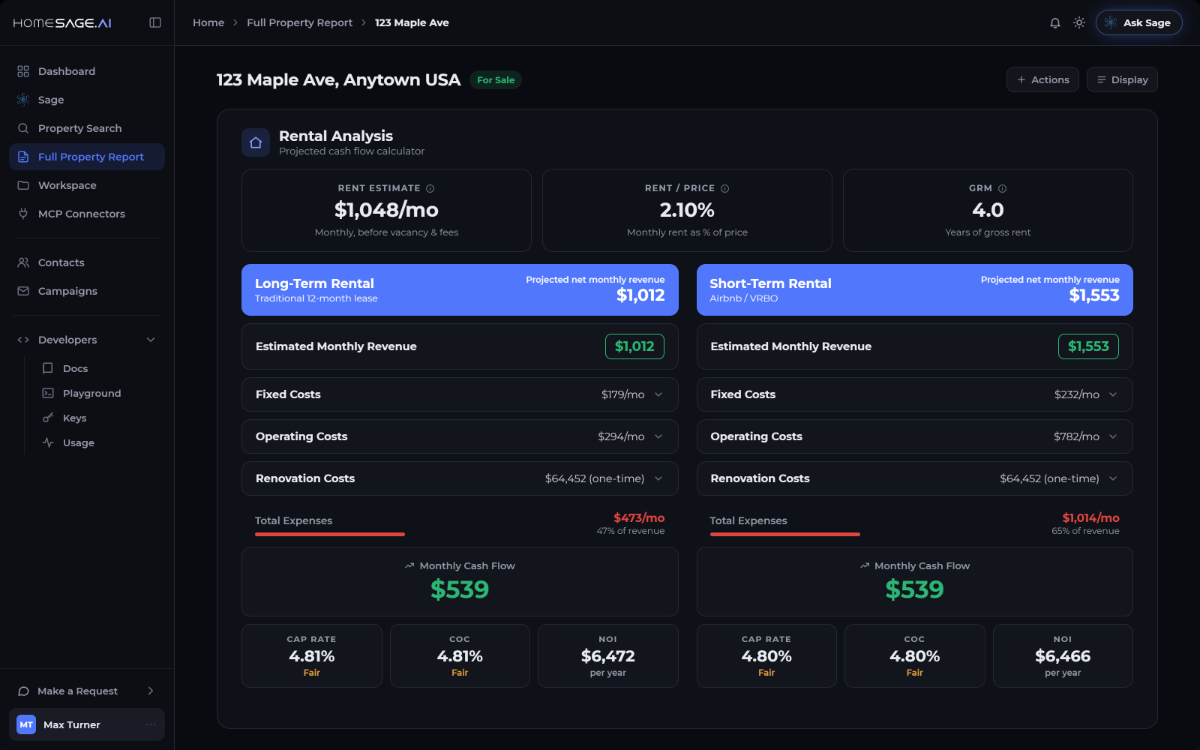
The Full Property Report aggregates everything we hold on one property into a single response: physical facts, valuation and pricing, the property condition grade, resale and fix-and-flip analysis, rental projections, comparables, and local risk factors.
Use it when a deal warrants real attention, not for every inquiry that arrives.
Best for: Full underwriting on a deal you are serious about.
3. Renovation Cost
Renovation Cost estimates what it would take to bring a property to a stated standard, based on its assessed condition and local cost data.
This number determines the draw schedule. A lender advancing against work needs an independent estimate of that work, not the borrower’s.
Best for: Sizing the rehab portion of a loan.
4. Full Potential Value
Full Potential Value is the after-repair value: what the property should be worth once the modeled work is done.
Most hard money lending is sized against this figure rather than the current value, which makes it the single most consequential number in the file.
A quick first ratio is the listing price as a share of the after-repair value. The Full Property Report shows the list price next to the estimated ARV, and the lower that share, the more room the deal leaves for the work and the loan.
Best for: Setting the loan amount.
5. Investment Potential
Investment Potential scores the deal’s projected return and grades it from excellent to no potential.
It is a fast way to sort an inbound pipeline. A deal the model grades as having no potential isn’t automatically a bad loan, but it is a deal where the borrower’s exit deserves a closer look.
Best for: Triaging a pipeline of inquiries.
6. Seller Motivation Score
The Seller Motivation Score indicates how much negotiating room the asking price has, based on days on market and market activity.
For a lender, it proxies liquidity. A property in a segment where prices move is a property you could sell if you had to take it back.
Best for: Judging how quickly an asset could be moved.
7. Rental Estimate
Rental Estimate returns projected long-term rent, and where the data supports it, cap rate and cash-on-cash.
It matters when the borrower’s exit is a refinance into a rental rather than a sale. Note the coverage caveat below: rent is the least dependable field we carry.
Best for: Testing a refinance exit.
What each call costs
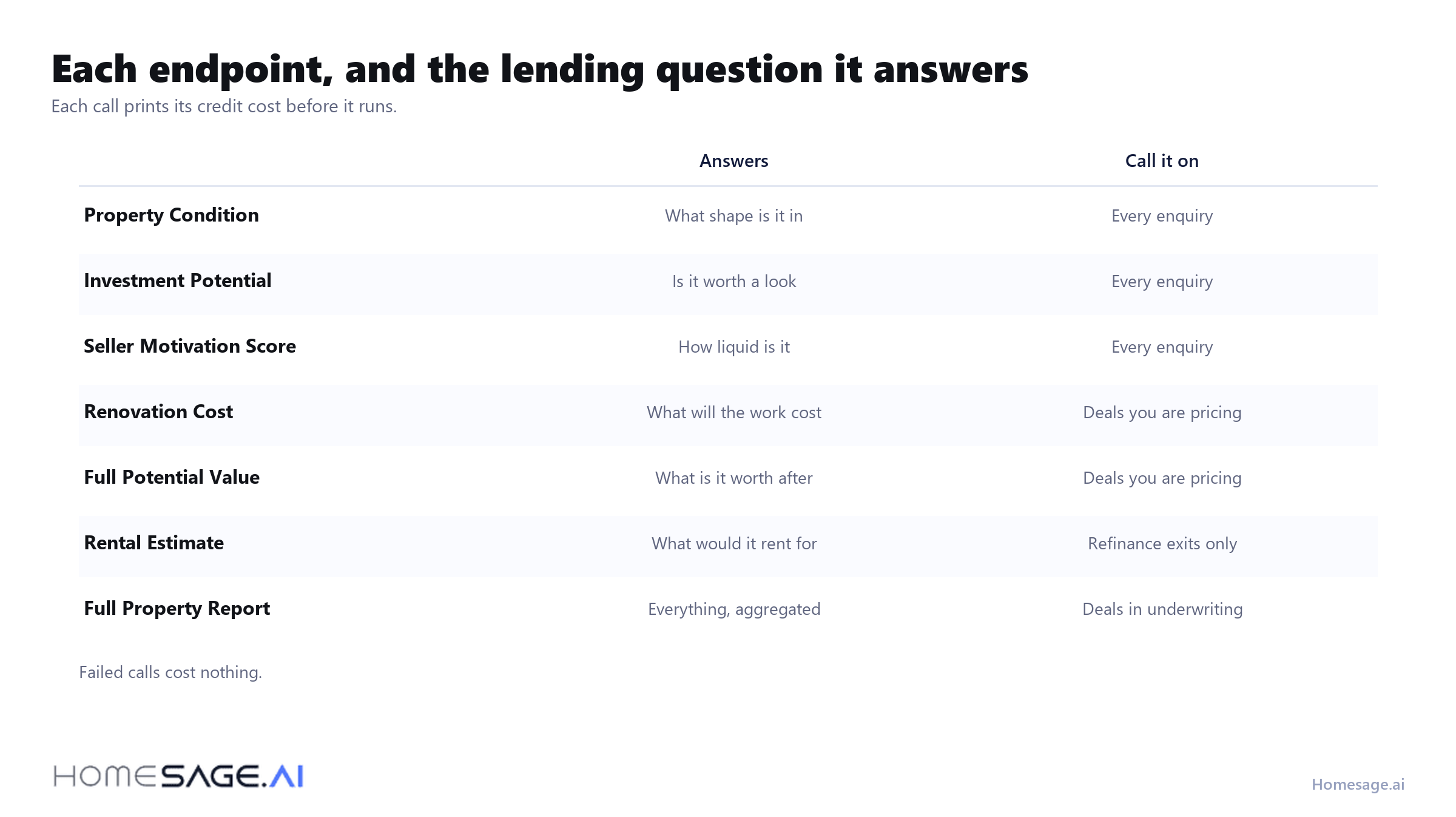
| Endpoint | Answers | When to call it |
|---|---|---|
| Property Condition | What shape is it in | Every enquiry |
| Investment Potential | Is the deal worth a look | Every enquiry |
| Seller Motivation Score | How liquid is it | Every enquiry |
| Renovation Cost | What will the work cost | Deals you are pricing |
| Full Potential Value | What is it worth after | Deals you are pricing |
| Rental Estimate | What would it rent for | Refinance exits only |
| Full Property Report | Everything, aggregated | Deals in underwriting |
Each endpoint prints its credit cost before the call runs, and failed calls cost nothing. Current prices are in the API documentation.
Which answers you can rely on, measured
Build a lending workflow on fields that exist almost everywhere, not on the field that happens to be interesting. We measured coverage across seven cities this week using free preview calls on active MLS listings.
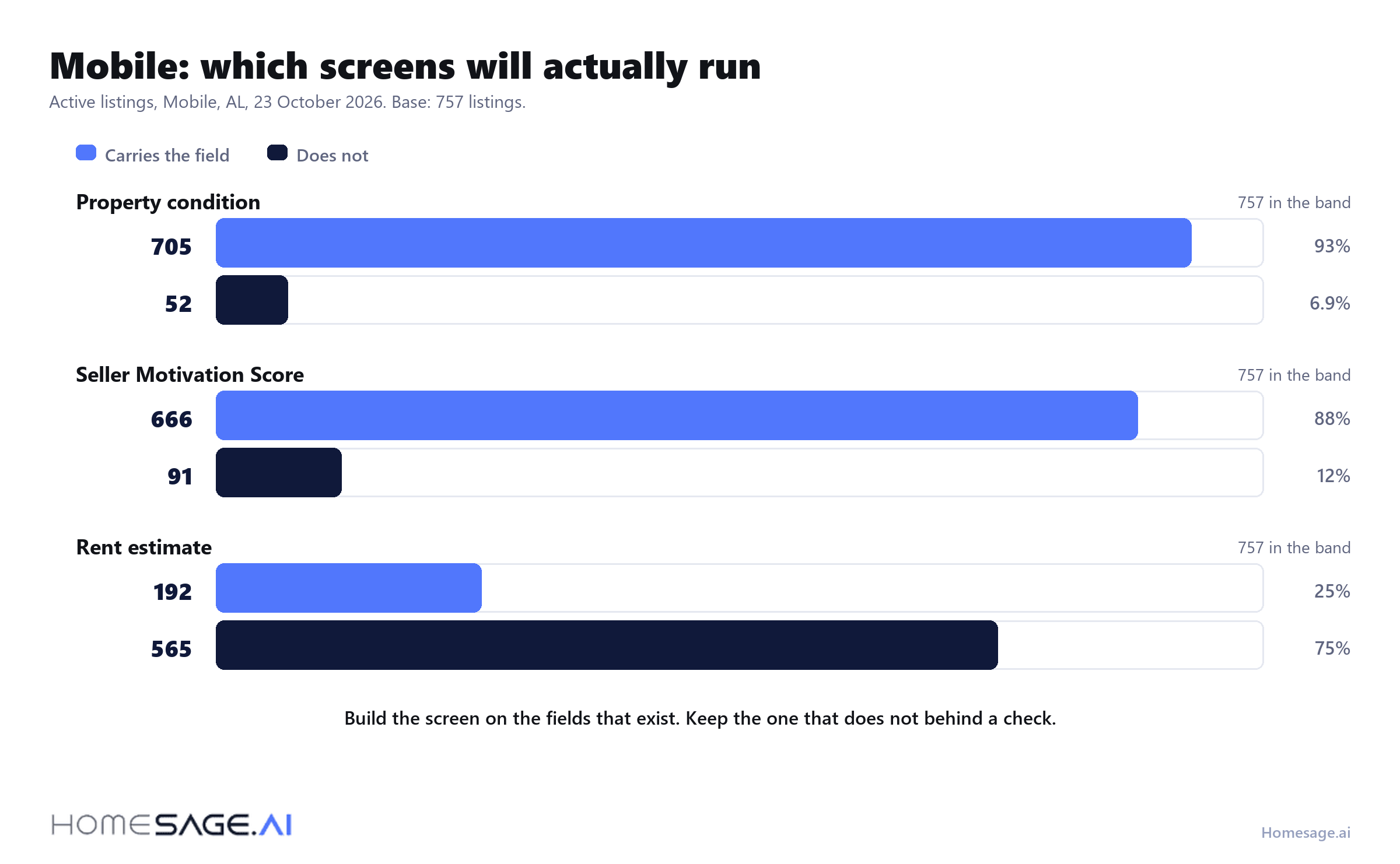
In Mobile, AL, 93.1% of 757 active listings have a property condition grade, and 88.0% have a Seller Motivation Score. Only 25.4% have a rent estimate.
Build the screen on the field that exists everywhere. Keep the one that does not behind a condition.
Across the seven cities, property condition ranged from 86.9% to 94.0%, and the Seller Motivation Score from 82.3% to 90.6%. Rent estimates ranged from 10.8% to 35.4%.
The practical consequence for a lender: property condition and liquidity screens will run on almost every inquiry. A refinance-exit test built on rent will work in some markets and silently fail in others, so hold that one behind a check rather than in the main path.
Wiring it into a lending workflow
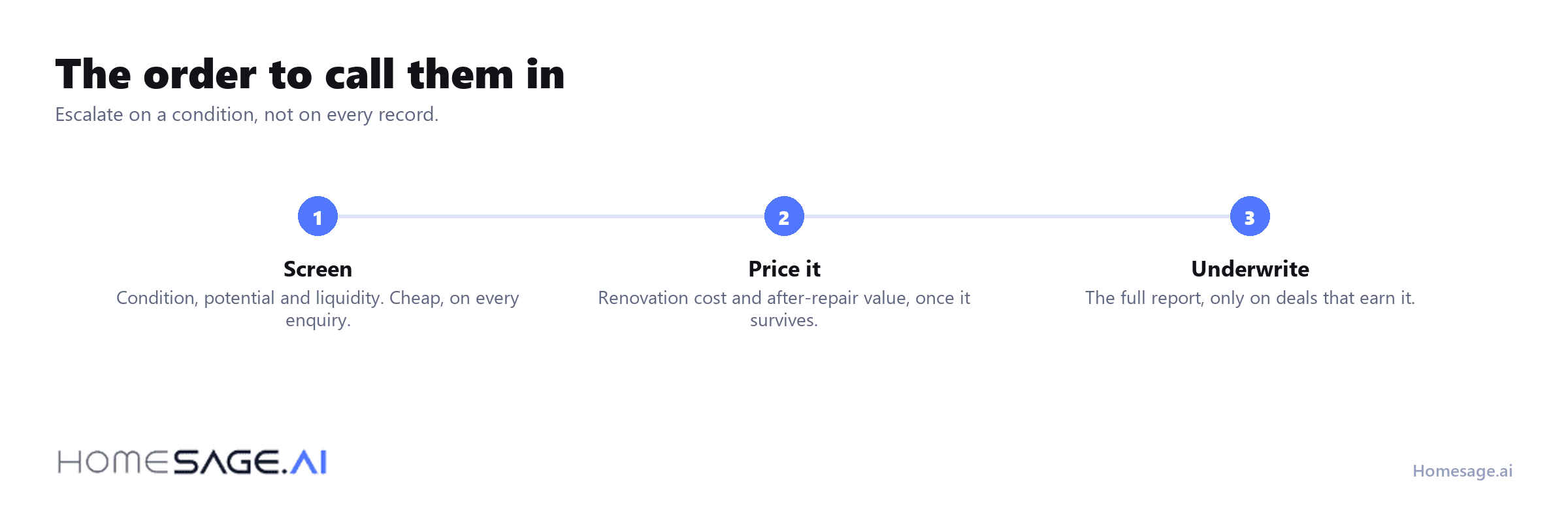
Call the cheap screens first. Property Condition, Investment Potential and the Seller Motivation Score cost little and remove most of what should not reach an underwriter.
Escalate on a condition, not on every record. Renovation Cost and Full Potential Value are worth calling once a deal has survived the screen, and the Full Property Report once it is genuinely in underwriting.
Cache what you get. A property condition grade does not change between Tuesday and Thursday, and re-calling it on every pipeline refresh is how a credit budget disappears.
See the wider API comparison if you also need records or MLS distribution alongside this.
Send Deals to Your Borrowers, Not Just Screen Them
Screening handles the deals that arrive. Volume grows when your borrowers find more deals worth financing.
In the Homesage.ai portal, save a search for each client’s target area and attach a campaign to it. The portal then emails that search’s current results to the client daily, weekly or monthly, so borrowers see new properties with investment potential first and bring them to you.
The same analyses can sit inside your own systems through the real estate APIs.
Estimated values, after-repair values, renovation costs and returns are model-derived estimates, not investment advice. Property data as of 23 October 2026.
Key takeaways
- Hard money underwriting turns on the asset: property condition, cost of work, after-repair value and liquidity.
- None of those are listing fields. They are modeled on top of listing data.
- Call the cheap screens on every inquiry and escalate to the expensive calls on a condition.
- Property condition and the Seller Motivation Score are dependable across cities; rent is not.
- Every endpoint prints its credit cost before it runs, and failed calls cost nothing.
- A saved search emailed to borrowers on a schedule brings deals to the lender instead of waiting for them.
Conclusion
A hard money decision is four questions about an asset, and each has an endpoint that answers it. Wire the cheap ones into the screen, hold the expensive ones for deals that earn them, and keep the one with patchy coverage behind a check. Start now and run the screen on a property you have already lent against.
Frequently asked questions
What APIs does a hard money lender actually need?
Property condition, renovation cost, after-repair value and a liquidity signal. Those four answer whether the asset covers the loan and how quickly it could be sold.
Can I get this from an MLS feed?
No. A feed carries what an agent entered. Property condition, renovation cost and after-repair value are modeled on top of that data, not held within it.
How much does each call cost?
Each endpoint prints its credit cost before it runs, and failed calls cost nothing. Current prices are in the API documentation.
Why not just call the full report every time?
Because most inquiries do not deserve it, the cheap screens remove most inquiries first, which keeps the cost per funded loan sensible.
Can a lender send new deals to borrowers automatically?
Yes. Save a search for each client’s target area and attach a campaign in the portal. It emails that search’s current results to the client daily, weekly or monthly.





How Hard Money Lenders Can Use AI To Grow | Homesage.ai October 10, 2026
[…] Hard money lenders who integrate AI into their operations are discovering unprecedented opportunities to increase deal volume, reduce risk exposure, and maximize returns on investment. This technological evolution isn’t just about keeping up with trends; it’s about fundamentally reshaping how lending decisions are made and how quickly lenders can capitalize on market opportunities. […]