
Hard money lending moves fast, and in 2026, the difference between profitable loans and defaulted deals comes down to the quality of your predictive real estate analytics.
Lenders who rely on gut instinct and outdated spreadsheets are getting left behind by competitors who harness AI-powered property intelligence to assess risk, forecast returns, and underwrite deals in minutes instead of days.
The hard money lending landscape has transformed dramatically. Lenders now integrate AI-driven underwriting and predictive analytics into their processes to gain a competitive edge through superior risk assessment and faster decision-making.
For lenders evaluating fix-and-flip projects, bridge loans, and distressed properties, having access to real-time property intelligence isn’t just helpful; it’s essential for staying profitable and managing risk.
Modern platforms like Homesage.ai combine Property Condition Analysis, Renovation Cost Estimation, and Investment Potential Scoring to deliver the comprehensive intelligence hard money lenders need to make confident lending decisions.
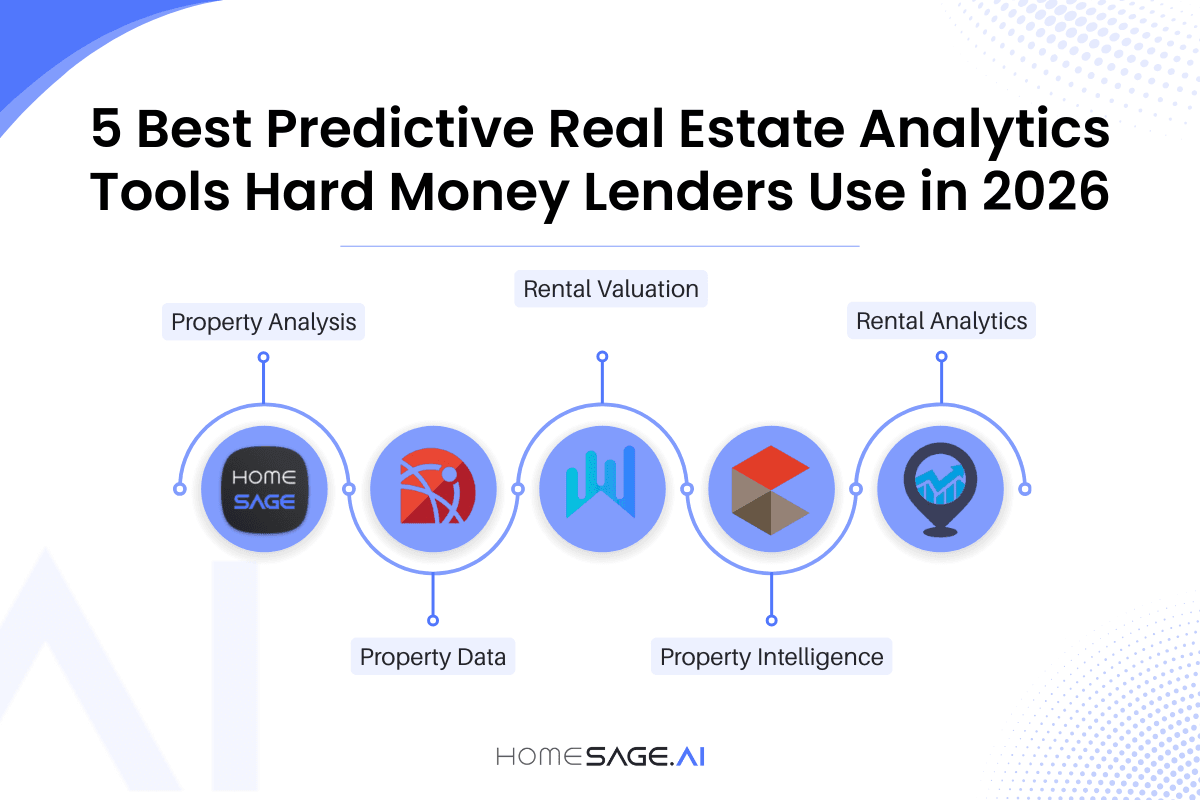
This guide explores the five best predictive analytics tools that hard money lenders rely on in 2026 to underwrite better deals, reduce defaults, and scale their lending operations profitably.
Why Predictive Analytics Matter for Hard Money Lenders
Traditional hard money lending has always relied on property value, borrower equity, and exit strategy. While these fundamentals remain critical, predictive analytics add layers of precision that traditional methods simply cannot match.
Predictive analytics platforms process thousands of data points simultaneously, including comparable sales, neighborhood trends, renovation cost estimates, days on market, and economic indicators, to generate risk scores that identify potential problems before they occur. For lenders, this means fewer surprises and more accurate loan-to-value calculations.
In competitive markets where borrowers have multiple lending options, the lender who can provide the fastest, confident approvals wins the deal. Predictive analytics tools deliver complete property intelligence in minutes, allowing lenders to make same-day decisions while competitors are still waiting for third-party reports.
Advanced predictive models can anticipate potential delinquency based on early indicators, allowing lenders to intervene with targeted support or alternative solutions before issues escalate. This proactive approach preserves loan performance and protects portfolio value.
1. Homesage.ai Property Intelligence Platform
Best for: Comprehensive property analysis for fix-and-flip, rental (short/long term), and bridge loan underwriting
Homesage.ai leads the PropTech analytics space with its comprehensive suite of AI-powered APIs specifically designed for real estate lending and investment professionals. The platform combines computer vision, AI, and real-time market data to deliver insights that traditional appraisals cannot match.
Core Features for Lenders
- Property Condition API: Analyzes property photos using computer vision to categorize condition as Excellent, Good, Outdated, Poor, and Very Poor.
- Investment Potential API: Evaluates properties and scores ROI probability for strong exit strategies.
- Price Flexibility Score: Determines negotiation potential by analyzing listing history and seller motivation.
- Renovation Cost API: Estimates repair expenses based on property photos and local labor rates.
- Flip Return API: Projects complete deal economics, including purchase costs, renovation expenses, and expected profits.
Homesage.ai‘s API architecture allows integration into existing loan origination systems, automating property intelligence without disrupting established underwriting workflows. The platform processes data on over 140 million properties with real-time updates, ensuring valuations reflect current market dynamics.
For lenders evaluating multiple loan applications daily, Homesage.ai dramatically accelerates due diligence while improving accuracy. Instead of waiting days for appraisals and contractor estimates, lenders access comprehensive property analysis in minutes, complete with renovation cost breakdowns and profit projections.
2. ATTOM Data Solutions
Best for: Comprehensive property data depth and foreclosure intelligence
ATTOM remains a cornerstone for institutional-grade property data. Its comprehensive databases cover more than 158 million U.S. property records with extensive historical information that hard money lenders need for risk assessment. See how it compares in our property data API guide.
Key features include property transaction histories and foreclosure data, tax assessment records and lien information, neighborhood demographics and hazard data, and historical price trends and market analytics.
ATTOM excels at providing the deep historical context lenders need to assess property risk profiles. For lenders specializing in distressed properties or working in markets with complex title issues, ATTOM’s comprehensive public records data proves invaluable. Investors should also review the best investment property APIs.
3. RealtyMole(RentCast) Property Data API
Best for: Rental valuation and comprehensive property data at scale
RealtyMole (now operating as RentCast) provides extensive property data and rental valuations that hard money lenders use for underwriting rental acquisitions and BRRRR strategies. The platform offers property details, ownership information, and rental estimates through a developer-friendly API.
Core capabilities include property details and ownership data, rental price estimates for long-term and short-term strategies, comparable property analysis, and neighborhood market trends.

Hard money lenders need to validate both current property values and potential rental income for borrowers planning rental exit strategies. RealtyMole’s comprehensive property database, combined with rental analytics, helps lenders assess whether properties will generate sufficient income to support refinancing into conventional rental loans.
4. CoreLogic Property Intelligence
Best for: Enterprise lenders requiring MLS integration and compliance-ready reports
CoreLogic is trusted by mortgage lenders and financial institutions worldwide for data accuracy and security. The Trestle API provides standardized Multiple Listing Service integration and enterprise-grade property intelligence.
Key features include standardized MLS data integration, enterprise-grade information security (SOC 2 compliant), compliance-ready property reports, and real-time market and valuation insights.
For hard money lenders who also originate traditional mortgages or work with institutional capital partners, CoreLogic provides the compliance infrastructure and data security that regulatory environments demand.
5. Mashvisor Rental Analytics Platform
Best for: Lenders financing rental property acquisitions and BRRRR strategies
Mashvisor specializes in rental property investment analytics, making it particularly valuable for lenders financing buy-rehab-rent-refinance (BRRRR) strategies or traditional rental acquisitions.
Core features include long-term and short-term rental income projections, cash-on-cash return and cap rate calculations, occupancy rate forecasts, and market demand analysis for rental properties.
Hard money lenders financing borrowers who plan to refinance into permanent rental financing need to validate that projected rental income supports the exit strategy. Mashvisor’s detailed rental analytics help lenders assess whether properties will generate sufficient cash flow to support refinancing into conventional rental loans.
Comparison: Analytics Tools for Hard Money Lenders
Platform | Best For | Key Strength | AI/ML Analytics | Pricing Model |
Homesage.ai | Comprehensive property intelligence, Valuation and Repair cost est. | AI property analysis, renovation cost estimation, ARV, hidden insights. | Advanced | Tiered subscriptions |
ATTOM | Historical data depth | Foreclosure intelligence, public records | Basic | Tiered subscriptions |
RealtyMole/RentCast | Rental valuation & property data | Comprehensive property details, rental estimates | Moderate | Subscription-based |
CoreLogic | Compliance and MLS data | Enterprise security, standardized reports | Moderate | Enterprise licensing |
Mashvisor | Rental property lending | Rental income projections, ROI calculations | Moderate | Subscription-based |
How to Choose the Right Analytics Platform
Different analytics tools excel at different loan types. Lenders primarily financing fix-and-flip projects need platforms with robust renovation cost estimation and after-repair-value analysis, such as Homesage.ai. Lenders focused on rental acquisitions benefit from tools that provide detailed rental income forecasting, such as Mashvisor.
Analytics platforms deliver maximum value when they integrate seamlessly with your existing loan origination system (LOS) and workflow tools. API-first platforms like Homesage.ai connect directly with lending software, automating property intelligence without requiring manual data entry or switching between systems.
In competitive lending markets, speed creates decisive advantages. Platforms that deliver comprehensive property analysis in minutes, rather than requiring days for third-party reports, allow lenders to provide same-day approvals while competitors are still gathering information.
Key Takeaways
- Predictive analytics platforms transform hard money lending by automating risk assessment, accelerating underwriting, and improving accuracy, allowing lenders to process more applications with better outcomes.
- Homesage.ai leads in comprehensive property intelligence, combining computer vision for condition assessment, renovation cost estimation, investment potential scoring, and profit projections in a unified platform designed for lending workflows.
- Different platforms serve different lending specialties: ATTOM provides deep historical data, CoreLogic delivers compliance infrastructure, and Mashvisor focuses on rental analytics.
- Integration capabilities determine practical value; analytics platforms that connect seamlessly with loan origination systems deliver measurably better results than standalone tools requiring manual processes.
- Speed creates competitive advantage in 2026, lenders using AI-powered analytics that deliver same-day property intelligence win deals from competitors still waiting for traditional appraisals and reports.
- The most sophisticated lenders combine multiple data sources, using comprehensive platforms like Homesage.ai for core property intelligence while supplementing with specialized tools for specific lending scenarios.
This demonstration shows how lenders integrate predictive analytics into their daily workflow, from initial application review through final loan approval, reducing underwriting time from days to hours while improving accuracy and risk assessment.
Conclusion
Hard money lending in 2026 demands precision, speed, and proactive risk management that traditional underwriting methods cannot deliver. Lenders who integrate AI-driven predictive analytics into their workflows gain decisive competitive advantages through superior risk assessment, faster approvals, and better portfolio performance.
Platforms that combine property intelligence, market forecasting, and workflow integration define what full-service hard money lending means today. The evolution from spreadsheets and gut instinct to AI-powered predictive analytics isn’t optional; it’s the new standard for professional hard money lending.
Frequently Asked Questions
Q: How accurate are AI-powered property valuations for hard money lending?
A: AI property valuation models achieve accuracy rates over 95% for typical residential properties when using advanced techniques. However, hard money lenders should use hybrid approaches that combine AI analysis with human expertise, which deliver approximately 15% higher accuracy than AI-only systems.
For final lending decisions, many lenders use AI analytics for initial screening and rapid underwriting, then validate with traditional appraisals for loans above certain thresholds.
Q: Can predictive analytics really reduce loan defaults?
A: Yes. Studies have found that predictive analytics can reduce loan defaults by around 20% by identifying risk factors that traditional underwriting methods miss.
Advanced models analyze borrower behavior patterns, market conditions, and property characteristics to flag potential problems before they occur, allowing lenders to adjust loan terms or decline applications that are likely to result in default.
Q: What’s the difference between traditional appraisals and AI-powered property analysis?
A: Traditional appraisals are point‑in‑time valuations completed by a licensed appraiser using an inspection and comparable sales, typically costing about $400–$700 and often taking 1–2 weeks overall, with the report commonly delivered 3–15 days after the inspection.
AI-powered property analysis (often via AVMs) can produce valuation estimates in seconds by processing large datasets and algorithms, making it useful for fast initial screening, while an appraisal may still be required for final loan documentation, depending on the lender and loan type.
Q: How does Homesage.ai help hard money lenders differently from other platforms?
A: Homesage.ai uniquely combines multiple specialized APIs: Property Condition assessment through computer vision, Renovation Cost estimation, Investment Potential scoring, Price Flexibility analysis, and complete Flip Return projections, into a unified intelligence platform designed specifically for real estate lending and investment professionals.
Instead of using separate tools for each analysis component or waiting days for third-party reports, lenders access comprehensive property intelligence through one API-first system that integrates directly into existing loan origination workflows.





4 Comments
Peter February 4, 2026
Modern AI powered tools are necessary for lenders
Robin February 4, 2026
great read!
Mia February 4, 2026
Very helpful!
Emi February 4, 2026
Very insightful!