
An AVM is giving you a number. Before you make a credit decision on it, do you know if that number is actually trustworthy?
An automated valuation model (AVM) is a software system that estimates a property’s market value by analyzing public records, MLS sales data, tax assessments, and comparable transactions, all without a physical inspection. For lenders, AVMs speed up collateral screening, support loan-to-value calculations, and help manage portfolio risk across large volumes of properties. But a fast estimate and a reliable estimate are not the same thing.
Since October 2025, the CFPB AVM Final Rule, adopted jointly by the CFPB, OCC, Federal Reserve, FDIC, NCUA, and FHFA, requires mortgage originators and secondary market participants to maintain documented quality control standards for every AVM used in a credit decision. Compliance is now mandatory, and examiners will look for evidence that your program is active, documented, and tested.
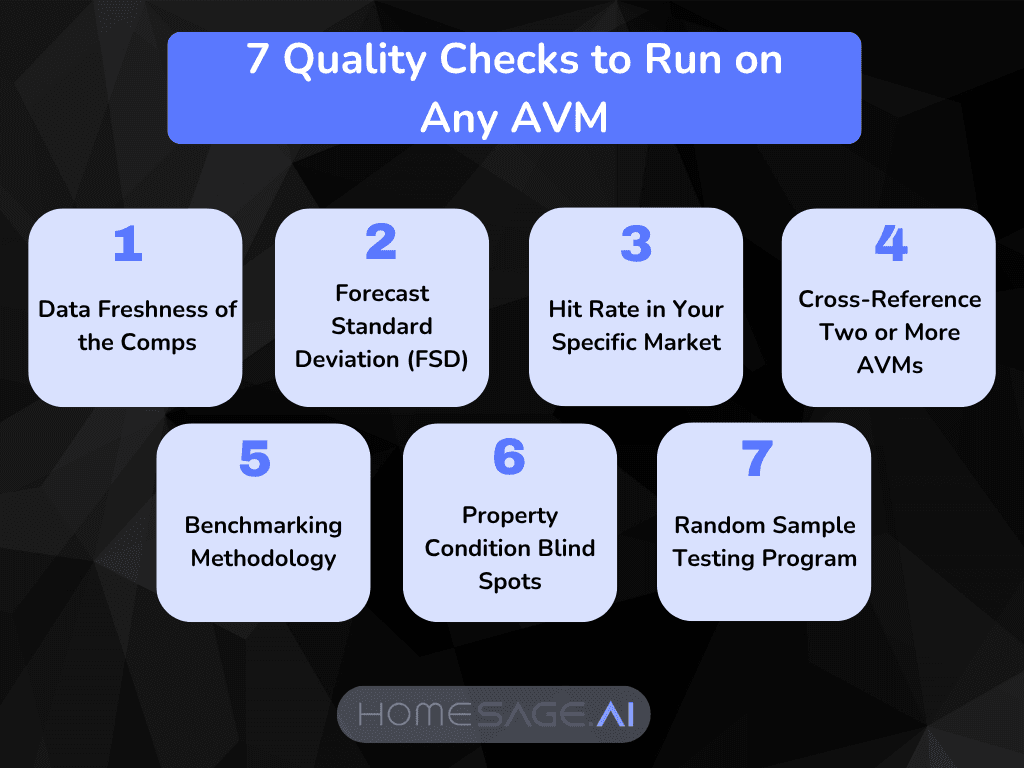
This guide gives lenders a practical seven-check framework to run on any AVM value before it informs an underwriting or collateral decision. For a deeper look at the broader validation methodology, see our guide to validate AVM real estate accuracy.
What the CFPB AVM Rule Actually Requires of Lenders
Before walking through the seven checks, it helps to understand what regulators are actually looking for. The interagency rule mandates that covered lenders maintain policies and control systems ensuring their AVMs meet five quality control standards:
- Ensure a high level of confidence in the estimates produced
- Protect against manipulation of data inputs
- Avoid conflicts of interest
- Require random sample testing and reviews
- Comply with applicable nondiscrimination laws
These five standards are not a checklist you file once. They require ongoing documentation, vendor oversight, and testing. The seven quality checks below are practical ways to operationalize those obligations for individual valuations and your broader AVM program.
Check 1: Confirm the Data Freshness of the Comps
Every AVM is only as accurate as the comparable sales data feeding it. Before relying on any output, verify when the model’s most recent comparable transactions were recorded. In fast-moving or correcting markets, comps that are six months old can push an estimate significantly off target.
Ask your AVM vendor for the data vintage, specifically, the cutoff date for the sales transactions used in the estimate. If the model can’t provide this, that’s a red flag for your vendor due diligence program, which the interagency rule explicitly requires.
What to look for: Comps from the past 90 days for active markets; up to 180 days for slower markets. Flag any estimate built on comps older than six months without explanation.
Check 2: Evaluate the Forecast Standard Deviation (FSD)
The Forecast Standard Deviation (FSD) is the most important accuracy metric an AVM produces. Developed as a standard by Freddie Mac and now referenced across industry guidance, FSD measures the expected proportional error range around a valuation expressed as a percentage. An FSD of 0.10 means there is approximately a 68% probability that the true value falls within ±10% of the AVM’s estimate (Freddie Mac).
In August 2025, MISMO released its AVM Common Confidence Score Standard to create a uniform way for lenders to evaluate and compare AVM confidence across providers. This standardized framework is now the industry benchmark for communicating AVM reliability.
What to look for: An FSD at or below 0.10 indicates a high-confidence estimate. An FSD above 0.20 should trigger escalation to a more robust valuation method before making a credit decision.
Check 3: Verify the Hit Rate in Your Specific Market
Hit rate measures what percentage of queried properties return a valuation. A high national hit rate from your vendor is largely meaningless if the model struggles in your specific lending geography.
An AVM can return a value for 95% of properties nationally and still fail to produce reliable estimates in rural counties, thin-data suburban corridors, or rapidly appreciating micro-markets. Always test hit rate and confidence distributions for the specific ZIP codes, counties, or property types in your pipeline, not the vendor’s headline national number.

What to look for: Request market-specific hit rate and accuracy data from your vendor. If they can only provide national figures, treat their estimates in your local markets with extra scrutiny. This vendor oversight requirement is directly embedded in the interagency rule’s compliance expectations.
Check 4: Cross-Reference Two or More AVM Sources
No single AVM should function as your sole valuation input for credit decisions. Running two or three models against the same property and comparing the spread is a straightforward way to quantify uncertainty before committing to a number.
When two AVMs agree closely, that convergence increases confidence in the estimate. When they diverge by more than 10–15%, that spread signals data sparsity, market volatility, or a property with characteristics that standard models struggle to price, all of which warrant escalation.
The way lenders use real estate data APIs to streamline due diligence makes multi-AVM cross-referencing straightforward to embed directly into your origination workflow.
What to look for: A spread greater than 10% between two independent AVM outputs should automatically trigger secondary review or a desk review from a licensed appraiser.
Check 5: Identify the Benchmarking Methodology
Not all AVM accuracy statistics are created equal, and how a vendor tests their model directly affects how much weight you should give their published accuracy figures. There are three common benchmarking approaches:
- Sale price benchmarking compares AVM outputs against recorded sale prices. It’s the most common method but can overstate accuracy if the model had any visibility into listing activity before generating the estimate.
- Contract price testing compares the AVM against the negotiated pre-closing price; a cleaner blind test.
- Refinance appraisal benchmarking tests the AVM against an independent licensed appraisal with no transaction pressure. This is the most rigorous method and most aligned with current regulatory expectations.
If your vendor only benchmarks against sale prices, their accuracy figures may be optimistic. The interagency rule’s requirement for documented vendor oversight means you should be asking this question as part of your written vendor due diligence file.
What to look for: Prioritize vendors that test against appraisal benchmarks, not just sale prices. Document the benchmarking methodology in your AVM vendor records.
Check 6: Screen for Property Condition Blind Spots
This is where most lenders’ AVM programs have their largest unaddressed gap. Standard automated valuation models are built on public records and sales comps, neither of which reliably reflects the physical condition of the collateral. A property with deferred maintenance, structural issues, or significant interior deterioration can carry the same AVM estimate as a fully renovated comparable.
For lenders, this creates real collateral risk. A loan secured against a property valued at $350,000 by the AVM may actually be secured against collateral worth considerably less in its current condition, and that gap won’t appear until something goes wrong in the loan’s life cycle.
The question of whether AVMs account for property condition is one the industry is still actively addressing. Homesage.ai bridges this gap with its Property Condition API and Computer Vision-powered analysis, which layer condition assessment on top of traditional valuation data so lenders can see what a standard AVM cannot.
What to look for: For higher-risk loans or properties with thin comp data, supplement the AVM with condition assessment. AI-powered Full Property Reports that incorporate visual inspection data alongside automated valuation give lenders a more complete picture of collateral risk.
Check 7: Document Your Random Sample Testing Program
The interagency rule specifically requires lenders to conduct random sample testing and reviews as part of their ongoing AVM quality control program. This is not a one-time audit; it’s an operational requirement that examiners will look for evidence of during reviews.
A practical testing program works as follows: pull a random sample of loans where AVMs were used in the credit decision, compare the AVM estimate to the eventual appraisal or sale outcome, and track the error distribution over time. Patterns of consistent overvaluation in specific geographies or property types should trigger recalibration of how you apply AVM outputs in those segments.
For a structured approach to building this kind of ongoing validation program, see how leading hard money lenders use AI to systematize collateral review at scale.
What to look for: Quarterly testing is a reasonable minimum for most programs. Document the sample methodology, the results, and any corrective actions taken. This written record is what regulators mean by “documented policies, practices, procedures, and control systems.”

AVM Quality Checks at a Glance
| Quality Check | What It Tests | Escalation Trigger |
|---|---|---|
| Data Freshness | Comp recency | Comps older than 6 months |
| Forecast Standard Deviation | Confidence range | FSD above 0.20 |
| Market-Specific Hit Rate | Local coverage | Vendor only provides national data |
| Multi-AVM Cross-Reference | Estimate consistency | Spread >10% between models |
| Benchmarking Methodology | Vendor accuracy claims | Sale-price-only benchmarking |
| Property Condition | Physical collateral state | No condition data available |
| Random Sample Testing | Ongoing program compliance | No documented testing cadence |
Key Takeaways
- An AVM (automated valuation model) estimates property value using public records, MLS data, and comparable sales but accuracy varies significantly by market, property type, and data density.
- As of October 2025, the interagency AVM Final Rule requires all covered lenders to maintain documented quality control standards for AVM use in credit decisions; this is now a regulatory requirement, not a best practice.
- FSD (Forecast Standard Deviation) is the most reliable single indicator of an AVM estimate’s confidence. An FSD above 0.20 should trigger escalation to a more robust valuation method.
- Property condition is the most common AVM blind spot for lenders. Standard models cannot see deferred maintenance, interior deterioration, or renovation status, supplementing AVM data with condition assessment closes this gap.
- Homesage.ai’s Property Condition API and Computer Vision-powered Full Property Reports give lenders condition-aware collateral intelligence that complements AVM estimates, helping identify risk before it appears in loan performance.
Property condition is the blind spot most standard AVMs miss entirely. In the video below, see how Homesage.ai’s Full Property Reports use AI and computer vision to deliver condition-aware property intelligence, giving lenders a clearer, more complete picture of collateral risk before every decision.
Conclusion
Understanding what AVM means in real estate is the easy part. Using AVM outputs responsibly with documented quality controls, vendor oversight, and clear escalation criteria is where most lending programs still have room to improve.
The seven checks above give you a practical starting point. Build them into your origination workflow, document your testing cadence, and make sure your vendor agreements reflect the oversight requirements the interagency rule demands. And when a property falls into a high-risk category or thin comp territory, don’t rely on the AVM alone.
If you want to close the property condition gap that standard AVMs miss, explore Homesage.ai for lenders where AI-powered condition data and collateral intelligence help your team assess risk with more confidence on every deal.
People Also Ask
Q: What does AVM mean in real estate?
A: AVM stands for Automated Valuation Model. It’s a software-based tool that estimates a property’s market value by analyzing public records, comparable sales data, tax assessments, and market trends without a physical inspection. Lenders use AVMs to quickly assess collateral value during loan origination, underwriting, and portfolio monitoring.
Q: Are lenders required to validate AVM accuracy?
A: Yes. As of October 1, 2025, the interagency AVM Final Rule, adopted by the CFPB, OCC, Federal Reserve, FDIC, NCUA, and FHFA, requires all covered mortgage originators and secondary market participants to maintain documented quality control programs for AVM use in credit decisions. This includes written policies, vendor oversight, and ongoing random sample testing.
Q: What is FSD in an AVM?
A: FSD stands for Forecast Standard Deviation. It’s a statistical measure that expresses the expected accuracy range of an AVM estimate as a percentage. An FSD of 0.10 means there’s approximately a 68% probability that the actual property value falls within ±10% of the AVM’s output. Lower FSD values indicate higher-confidence estimates. In August 2025, MISMO released a standardized AVM Confidence Score framework to make FSD interpretation consistent across providers.
Q: Can an AVM replace a traditional appraisal for lending purposes?
A: Not in most cases. AVMs are valuable tools for collateral screening, portfolio monitoring, and initial LTV calculations, but formal mortgage lending typically still requires a licensed appraisal for primary dwelling loans. The strongest lender workflows use AVMs to prioritize where deeper review is needed, not to replace the appraisal process entirely. For a comparison of the 3 best real estate AVMs available today, see our detailed tool review.





Mike March 28, 2026
Great read
Lin March 31, 2026
Very helpful information