“Quick answerThe reliable way to find out home value is to run the address through two or three estimates and compare them. Zillow Zestimate and Redfin Estimate give a free national baseline. Realtor.com checks that number against live listings, and Quantarium produces the version lenders see. Homesage.ai adds what the others leave out, which is the property condition and what the work costs.
Every estimate of a home’s value is a calculation with a method behind it. The useful question is which method, and what the method could not see.
Your client has already read one before they call you. The National Association of Realtors last measured this directly and found that 97% of buyers used the internet in their home search. That report was published in 2021.
So the number is on the screen before the conversation starts. Being able to say why it is wrong, and by how much, is the work.
What an automated estimate actually reads
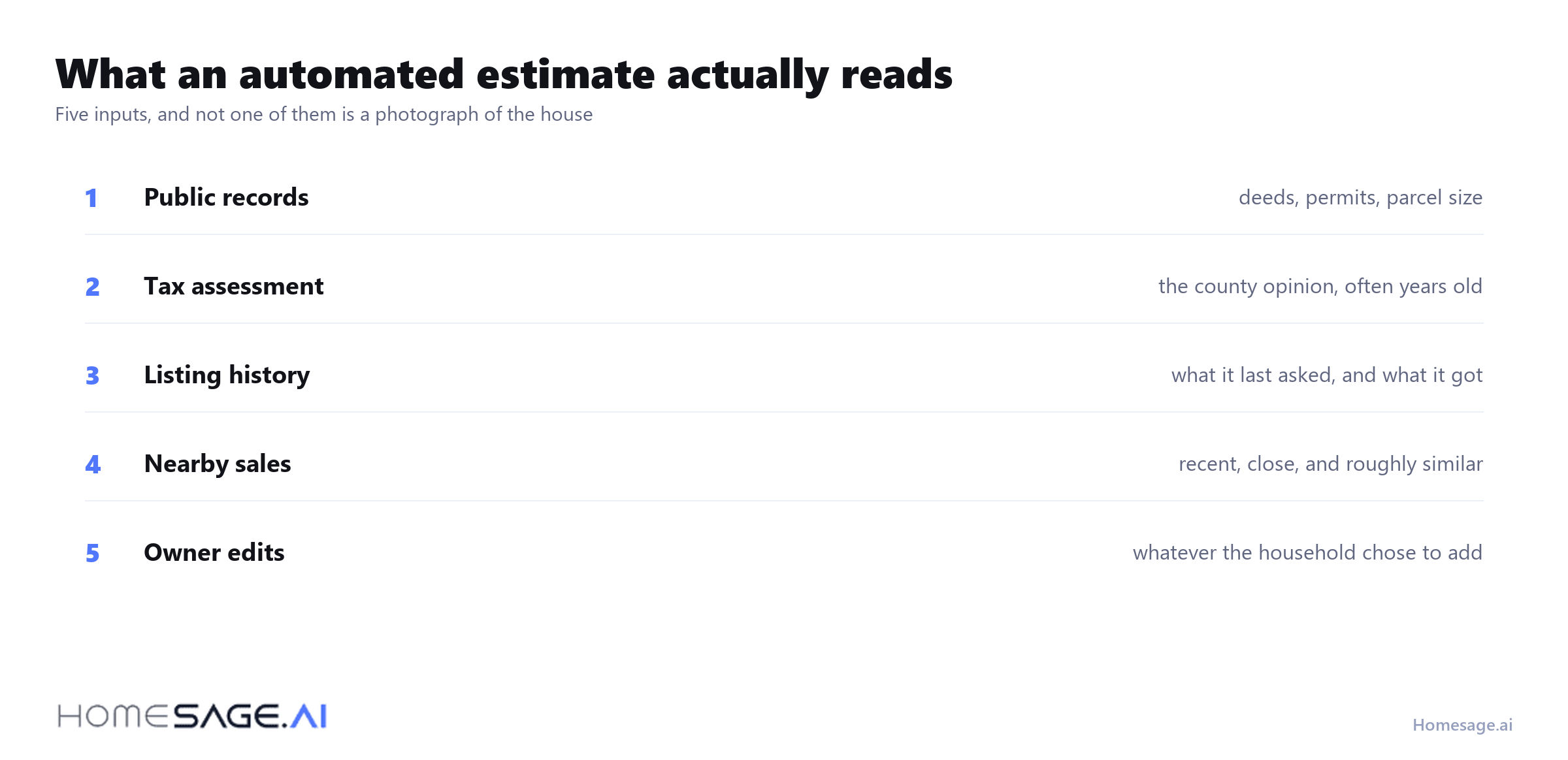
An automated valuation model is a statistical opinion built from records. It reads deeds, permits and parcel data, the county tax assessment, the listing history, recent nearby sales, and whatever the household typed into the portal.
Every one of those inputs describes the house on paper. None of them is a photograph of the kitchen.
Build with this data
Software developers can pull this kind of data straight from the Homesage.ai real estate APIs. Start with these 2 endpoints.
The question none of the free tools answer
Property condition is the gap. A model that cannot see property condition has to assume it, and the assumption it makes is average.
We screened one market to show how often that assumption is wrong. Kansas City, Missouri, active detached listings, 17 October 2026.
| Kansas City screen | Listings | Share of the market |
|---|---|---|
| All active detached listings | 1,015 | 100% |
| Graded excellent | 88 | 8.7% |
| Graded good | 451 | 44.4% |
| Graded outdated | 349 | 34.4% |
| Graded poor or worse | 50 | 4.9% |
Homesage.ai property database, Kansas City active detached listings, 17 October 2026. 938 of the 1,015 carry a property condition grade, which is 92.4%. The shares above are of all 1,015. The 77 without a grade are unassessed, not sound. Counts move daily.
399 of the 938 graded listings are outdated or worse. That is more than two houses in five where an estimate built on records alone is pricing a renovation it never saw.
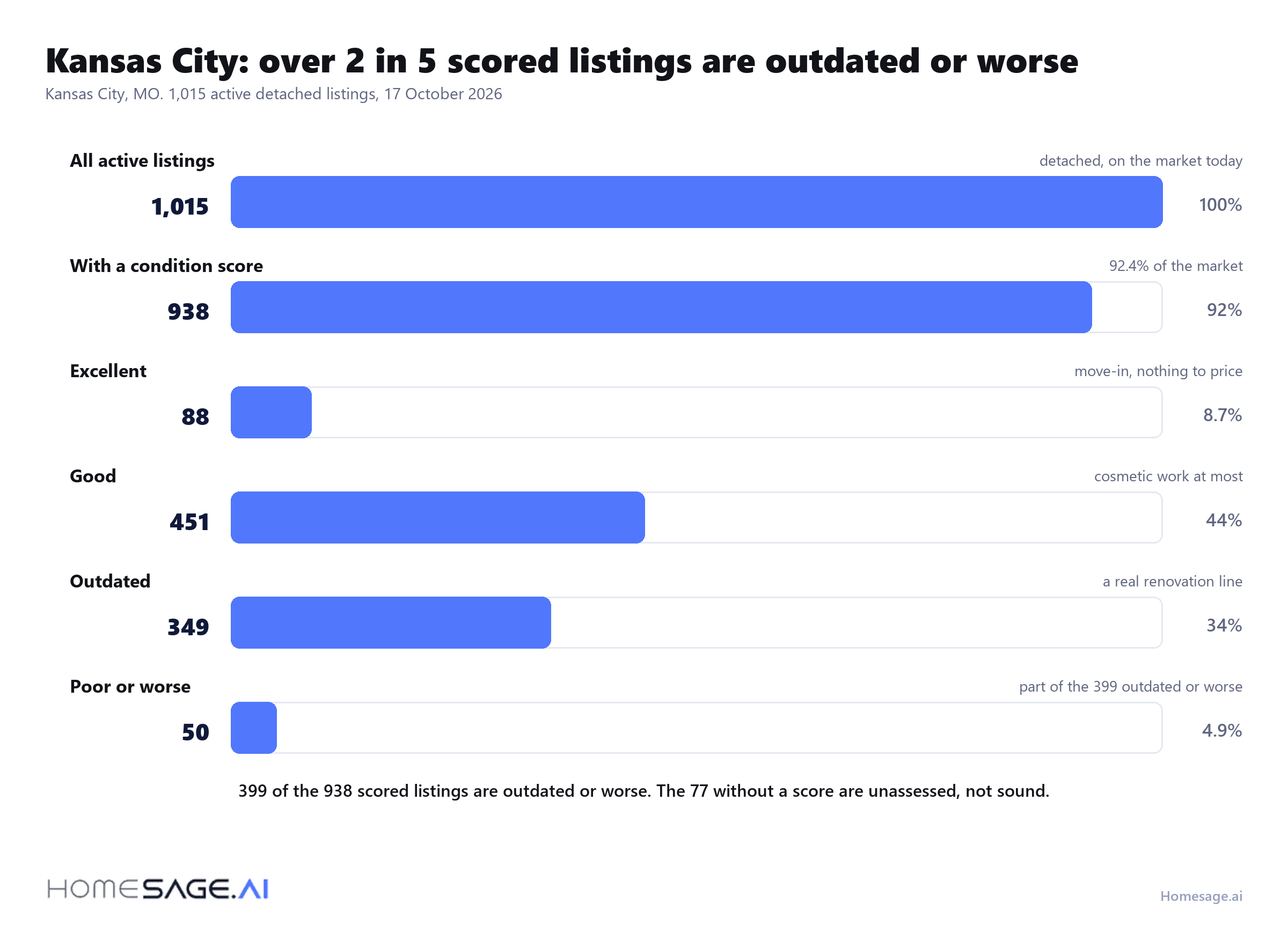
An estimate is only as honest as the worst thing it could not see. For more than two in five graded Kansas City listings on 17 October 2026, that thing was the condition.
The 5 best tools to find out home value
1. Zillow Zestimate. Best for a fast national baseline
The Zestimate is the number most buyers and sellers mean when they say they looked it up. Zillow Group reports a living database of approximately 173 million US homes behind it.
Zillow publishes its own accuracy, which is rarer than it should be. For 2025 the Zestimate carried a median error rate of 1.8% for homes listed for sale and 7.2% for off-market homes.
That second figure is the one to quote to a client. Half of off-market estimates miss by more than 7.2%, and on a $400,000 house that is a $28,800 conversation.
Best for: an instant baseline, and for knowing what your client has already seen.
Building a product on this data? Our Zillow API guide explains what developers can access.
2. Homesage.ai. Best for a value that prices the work
Our own platform starts where the records stop. It reads the listing photographs, grades the property condition, estimates what the renovation costs, and projects the after-repair value on top of the current one.
The outputs sit together on one screen rather than in five tabs. Listing price, estimated ARV, the spread between them, the Seller Motivation Score, and the property condition grade.
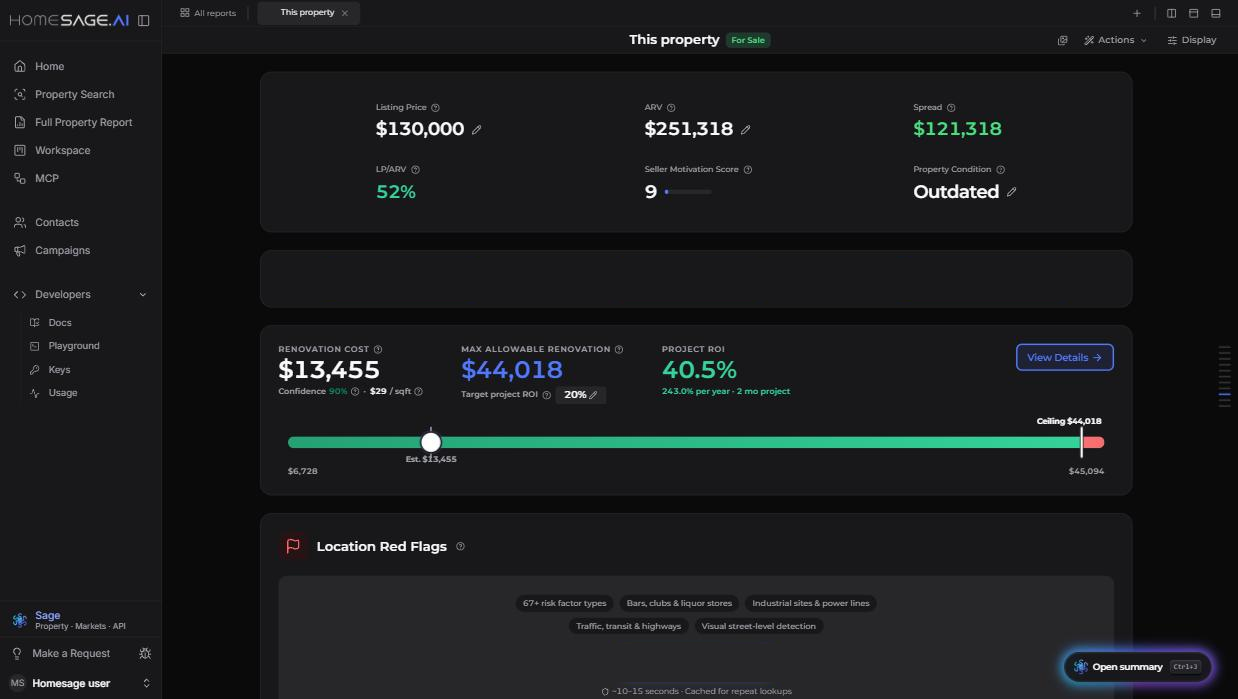
The same engine is available to brokerages and lenders through our real estate APIs, so a valuation workflow can run without anybody opening a browser.
Best for: investors, and any agent pricing a house that needs work.
3. Redfin Estimate. Best for homes already on the market
The Redfin Estimate leans on Redfin’s position as a brokerage, so its MLS data arrives early. As of 14 November 2026, Redfin publishes a median error rate of 1.94% for on-market homes and 7.66% for off-market homes, across a stated 92 million homes.
The pattern matches Zillow almost exactly. Both models are sharp on houses that are actively listed and much blunter on houses that are not.
Best for: active listings and recent sales, in the markets Redfin covers.
4. Realtor.com. Best for checking a value against live listings
Realtor.com shows more than one third-party estimate for the same address, side by side, next to the live listing. Seeing two models disagree is more useful than reading either one alone.
It is also the portal where listing data and the estimate sit in one place. That saves a step when you check a value against what is for sale nearby.
Best for: sanity-checking a number against current inventory.
5. Quantarium home value. Best for the lender’s version of the number
Quantarium home value is the estimate from the Quantarium Valuation Model (QVM), an automated valuation model. You may see it beside other providers’ estimates on Realtor.com. Like any automated estimate, it is not an appraisal.
Quantarium sells its valuation models to mortgage lenders and listing portals rather than to consumers. The outputs are built for collateral risk and loan decisions.
Agents rarely buy it directly. Knowing it exists still matters, because it is often the estimate sitting in front of the underwriter on the other side of your transaction.
Best for: understanding the lender’s view during a financed purchase.
How the five tools compare
| Tool | What it reads | Published accuracy | Reads property condition | Prices renovation |
|---|---|---|---|---|
| Zillow Zestimate | Records, tax, MLS, owner edits | 1.8% on-market, 7.2% off-market (2025 full year) | Uses photos in the model, no score shown | No |
| Homesage.ai | Records plus listing photographs | Not published | Yes | Yes |
| Redfin Estimate | MLS-led, frequently refreshed | 1.94% on-market, 7.66% off-market (as of 14 November 2026) | No condition score published | No |
| Realtor.com | MLS plus third-party models | Not published | Not shown (shows third-party AVMs) | No |
| Quantarium | Records, built for lending | Not published | Uses photos in its model | No |
Published figures, checked 15 November 2026. Zillow’s figures cover 2025, from its annual report. Redfin’s are its current rates. We do not publish a median error rate. The honest cell reads “not published” rather than a number measured a different way.
How to choose between them
Start with what the house needs. A house in good order is well served by any of the free national tools, because condition is not the issue there.
A house that needs work is a different problem. The estimate is wrong by roughly the cost of the work, and no amount of cross-checking free models will tell you what that cost is. The 6 best AI property analysis tools covers the platforms built around that gap.
If you price renovation regularly, our guide to renovation cost estimating tools covers that half of the job. For the valuation models themselves, the best real estate AVM tools go deeper on how each one is built.
Key takeaways
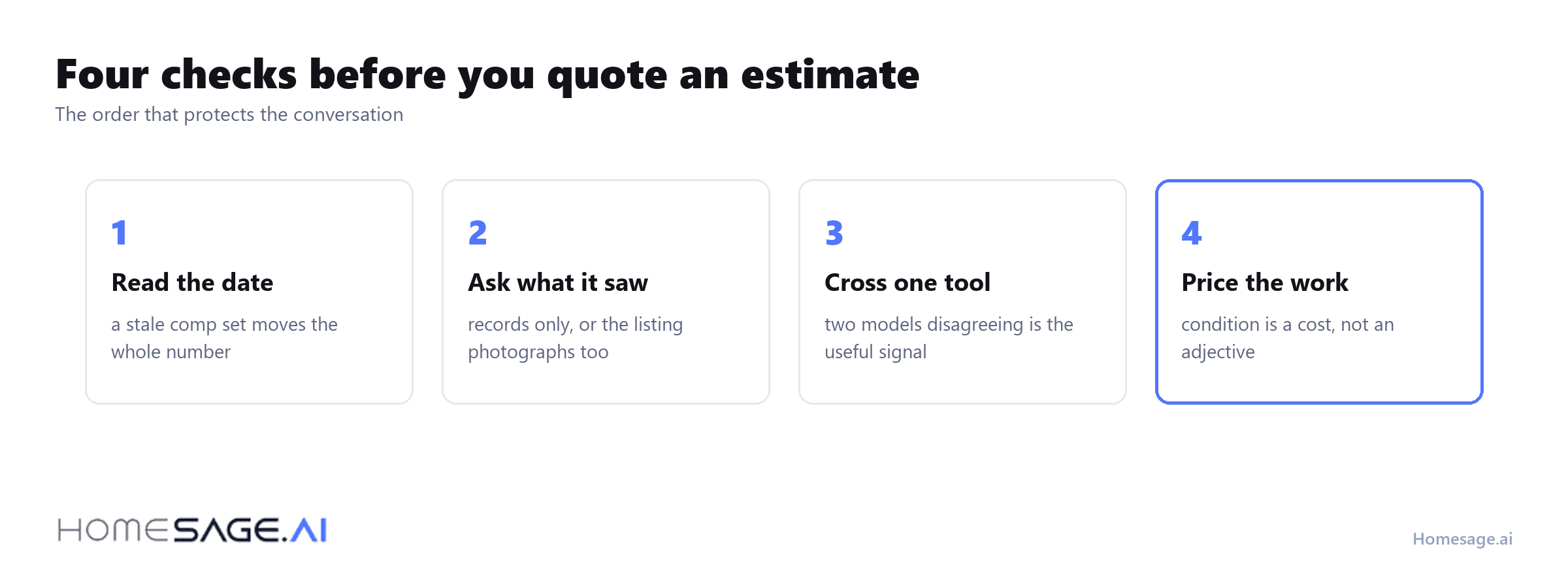
- Run two or three estimates, not one. Two models disagreeing is a signal, and a single number is only ever an opinion.
- Quote the off-market error rate, not the headline. Zillow published 7.2% for 2025 and Redfin publishes 7.66% today, and both apply to houses that are not listed.
- Automated models read records, not rooms. Property condition, renovation quality and seller motivation sit outside what any records-based model can reach.
- In Kansas City on 17 October 2026, 399 of the 938 graded listings were graded outdated or worse. That is the share of a market where the assumption of average condition fails.
- Match the tool to the house. Free national models are fine for a house in good order and misleading for one that needs work.
Conclusion
Valuation stopped being a scarce number some time ago. Anyone can produce five estimates for an address in under a minute, and they will.
What is still scarce is the explanation. Why these two models disagree, what neither of them saw, and what the repair line does to both.
That is the part a professional is paid for, and it is the part the records cannot supply.
Start now and run your next address through it.
Frequently asked questions
How accurate are automated home value tools compared with an appraisal?
Published median error rates sit near 2% for listed homes and above 7% for off-market homes. A licensed appraisal remains the standard for lending decisions, because it includes an inspection.
Can I use an automated valuation for an official transaction?
No. Lenders require a full appraisal for most conventional loans. Automated values are decision support for pricing strategy, investment screening and client conversations.
What is the biggest limitation of free home value tools?
Most do not show you a condition score. Some use listing photos inside the model, but you cannot see how condition moved the number.
How often should an agent refresh a valuation?
Weekly in an active market, and monthly for a held investment property. Refresh immediately after any material change, such as a price cut nearby or a completed renovation.
Related reading: What does a property condition API return?.
Keep reading: 4 Best Home Value Monitoring APIs in 2026.
What is the Quantarium home value?
It is the estimate from the Quantarium Valuation Model, an automated valuation model that Quantarium sells to mortgage lenders and listing portals. You may see it beside other estimates on Realtor.com. It is not an appraisal.
Sources
- Zillow Group, Annual Report on Form 10-K for the year ended 31 December 2025. Living database of approximately 173 million US homes. 2025 Zestimate median error rates.
- Redfin, Redfin Estimate accuracy, checked 15 November 2026 (page last updated 14 November 2026).
- National Association of Realtors, Real Estate in a Digital Age, published 5 October 2021.
- Homesage.ai property database, Kansas City active detached listings, 17 October 2026.
Estimated values, ARV, renovation costs and property condition grades are model-derived estimates, not investment advice or an appraisal. Property data as of 17 October 2026.