
Monitoring is not the same as valuing
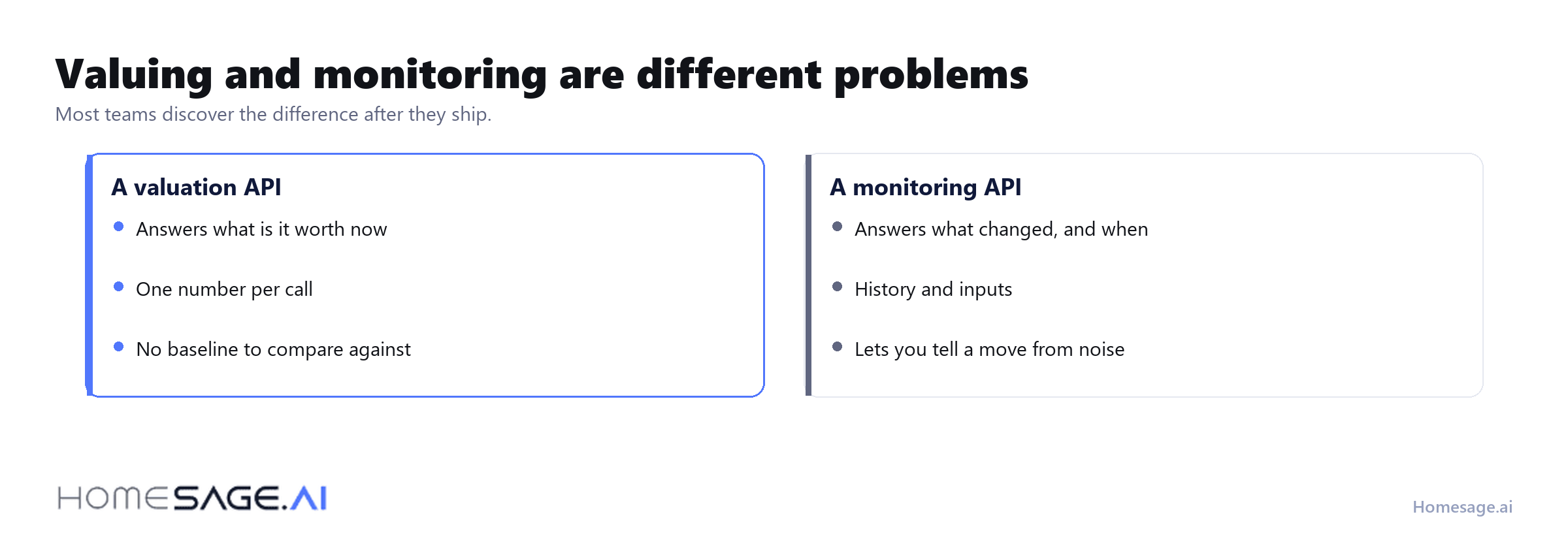
A home valuation API answers what this is worth right now. A monitoring API answers what changed, and when. The second is a harder engineering problem, because you need a baseline, a refresh cadence, and a way to tell a real move from noise.
Most teams discover this after they ship. They wire up a valuation call, run it nightly against a portfolio, and find they cannot tell whether a 2% shift is the market or the model.
So the useful comparison is not whose number is closest. It is what each provider gives you to reason about a change: history, the inputs behind the figure, and how often it is allowed to move.
Build with this data
Software developers can pull this kind of data straight from the Homesage.ai real estate APIs. Start with these 2 endpoints.
The 4 best home value monitoring APIs in 2026
1. Homesage.ai
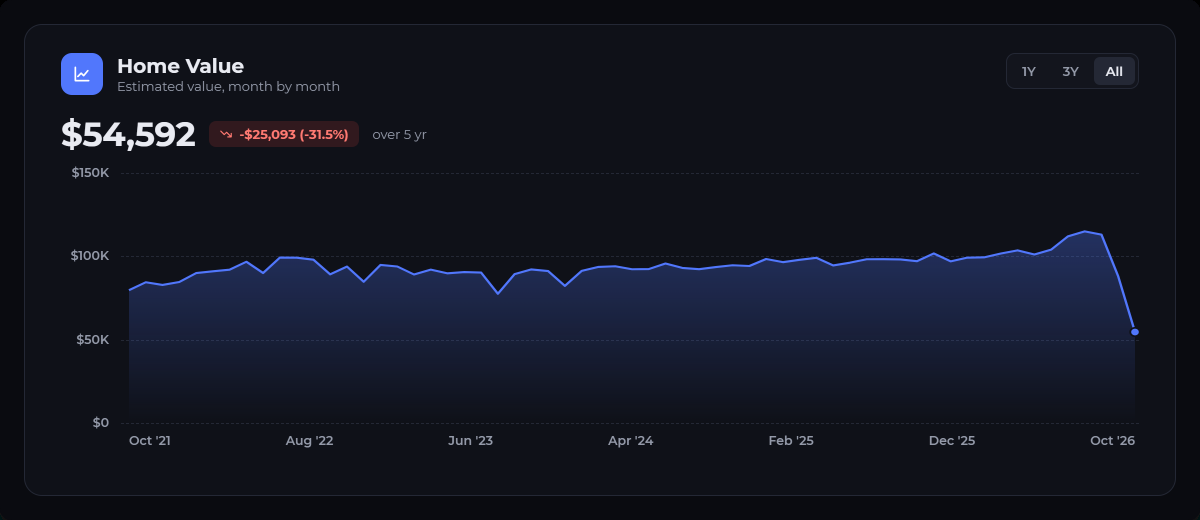
The Homesage.ai home value graph returns a value history rather than a single number, alongside the full-potential value, the spread against list price, and a property condition grade derived from listing photographs.
That combination is the point. A value that moves without a reason is noise; a value that moves alongside a property condition grade and a renovation estimate is something you can explain to an investment committee.
Best for: Teams that have to justify a number, not just display one.
2. Zillow
Zillow Group serves property and listing data through its Bridge platform. The Zestimates API covers Property, Rental, and Foreclosure Zestimates for around 100 million US homes, and Zillow describes it as being for commercial use cases by businesses.
Access is the constraint. The MLS Listings and Public Records APIs are described on Zillow’s own pages as invite-only, with data access at the discretion of individual MLS partners. The old self-service program is gone, and its documentation now returns a 404.
Best for: Consumer-facing products that can get an invitation.
3. ATTOM
ATTOM covers over 160 million US properties with REST endpoints queried by address, parcel number, ATTOM ID, or coordinates, and sells automated valuations alongside assessment and transaction history.
It is the only provider here that publishes a price. Basic Property starts at $500 a month, Premium Property is quoted on request, and it includes a 30-day trial with an API key.
Best for: Teams that want records depth and a published starting price.
4. Cotality Trestle
Trestle is the platform MLS organizations use to distribute listing data to brokers and technology providers, with RESO Web API feeds refreshed in under two minutes and, by Cotality’s own figures, 105 MLS organizations and 1,250 technology providers using it.
Cotality is the current name of the company formerly called CoreLogic. Joining costs an MLS nothing; technology providers and brokers pay a monthly connection fee that varies by connection count and feed type and is not published.
Best for: Platforms that need live MLS data across many markets.
How the four compare
| API | What it monitors | Access | Published price |
|---|---|---|---|
| Homesage.ai | Value history, spread, property condition | Self-serve | Credit-based, published |
| Zillow Bridge | Zestimates, listings, public records | Invite only | Not published |
| ATTOM | Valuations, assessment and sales history | Trial, then sales | From $500/month |
| Cotality Trestle | Live MLS listing data | MLS-gated approval | Not published |
Access terms and prices read on each vendor’s own pages, 23 October 2026. Figures widely quoted elsewhere for Zillow and Trestle do not appear on those vendors’ pages.
What the same listings actually carry
A monitoring product fails quietly when the field it depends on is missing. We measured coverage across seven cities this week on active MLS listings, using free preview calls.
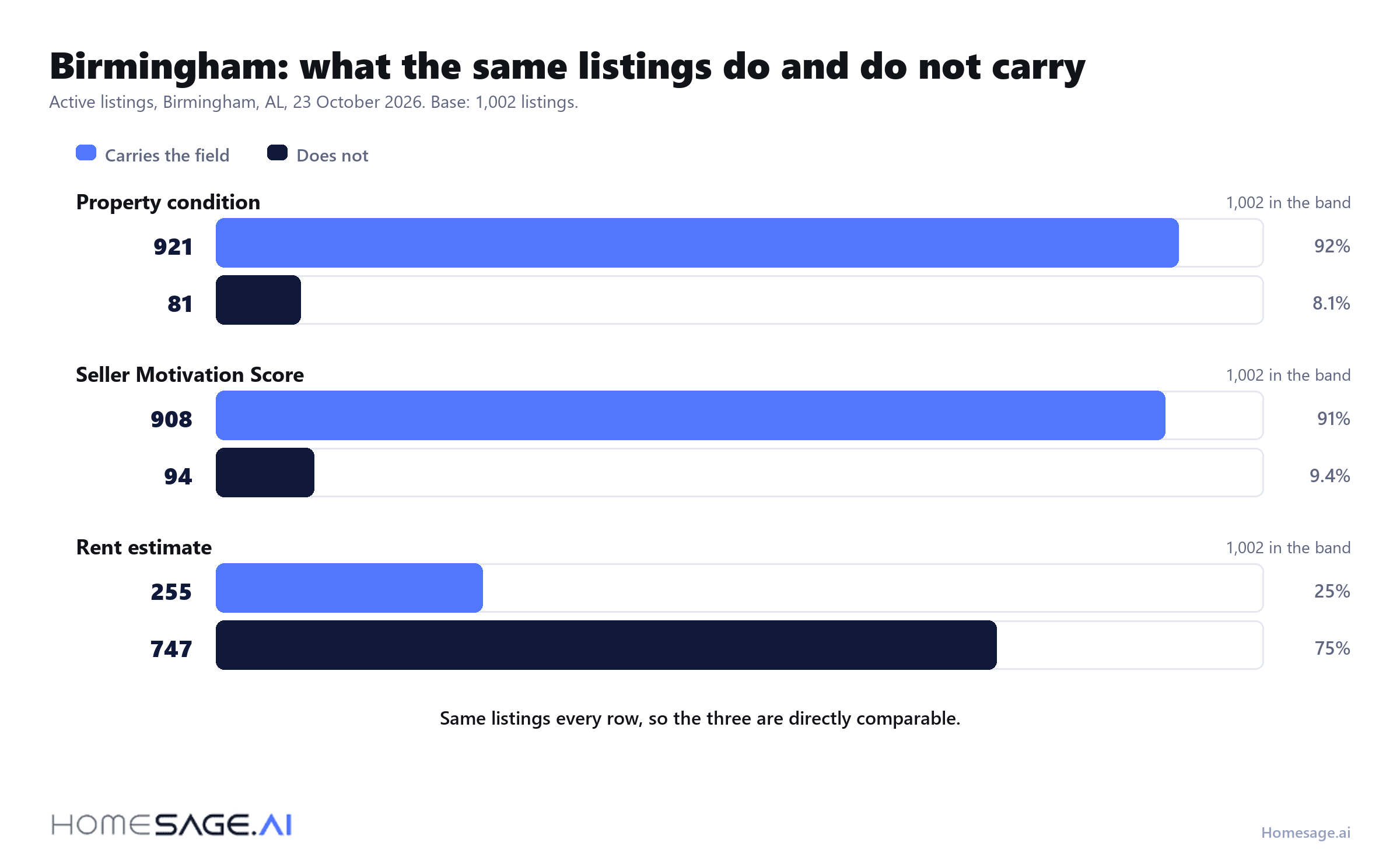
Birmingham, AL is the largest of the seven: 1,002 active listings, of which 91.9% carry a property condition grade and 90.6% carry a Seller Motivation Score. A rent estimate exists on only 25.4%.
A missing field does not look like an error. It looks like nothing changed.
The pattern held in every city we measured. Property condition ranged from 86.9% to 94.0%, and the Seller Motivation Score from 82.3% to 90.6%. Rent swung from 10.8% to 35.4%.
If your monitoring alert depends on rent, it will fire reliably in some markets and go quiet in others, and the quiet will look like stability rather than absence.
How to choose
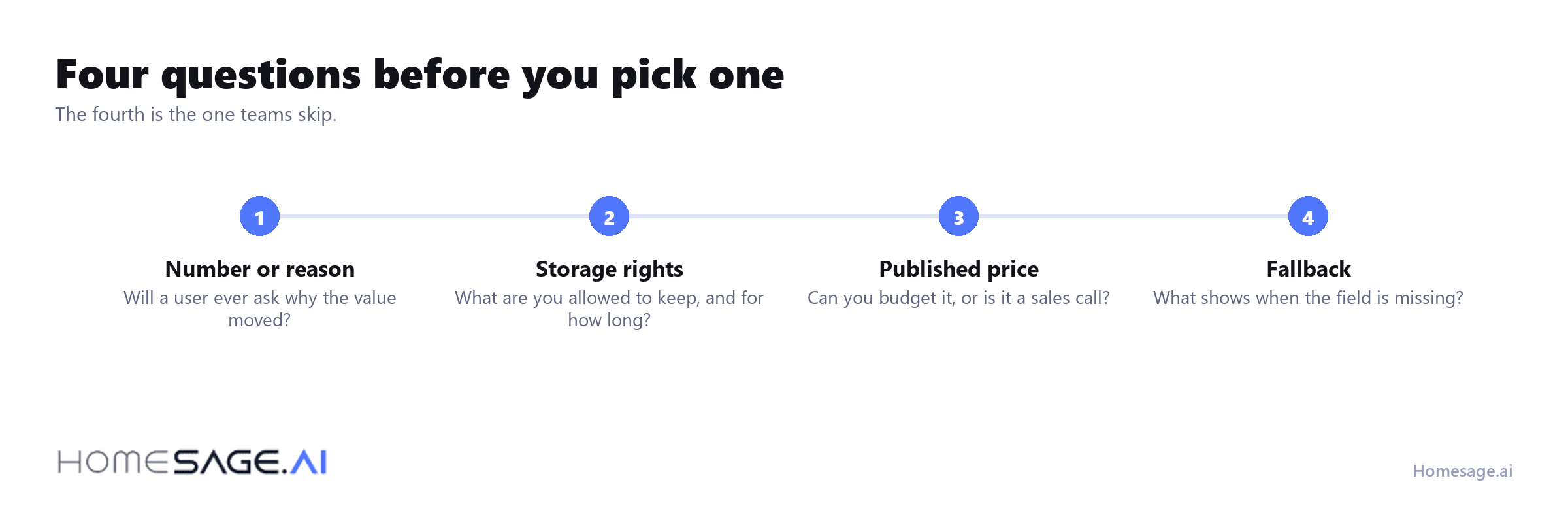
Decide first whether you need a number or an explanation. If a user will ever ask why the value moved, you need history and inputs, not just a current estimate.
Then check what you are allowed to store. Listing data carries display and retention rules that differ by MLS, and they shape your architecture more than any endpoint does.
Then price it against the field you actually need. ATTOM publishes a starting figure; the others quote on request, so budget for a conversation rather than a signup. Our comparison of property data APIs covers more providers.
Finally, build the fallback before you need it. In a market where a third of listings carry a rent estimate, a product that assumes rent will show empty states for most users.
Estimated values, after-repair values, renovation costs and returns are model-derived estimates, not investment advice. Property data as of 23 October 2026.
Key takeaways
- Monitoring needs history and inputs, not just a current valuation.
- ATTOM is the only one of the four publishing a price: Basic Property from $500/month.
- Zillow’s Bridge APIs are invite-only, and the old self-service program’s documentation now returns a 404.
- Trestle is free for an MLS to join; technology providers pay an unpublished monthly connection fee.
- Property condition and Seller Motivation Score are dependable across cities. Rent varies more than threefold.
Conclusion
All four will give you a number. Only some will give you the history and inputs that let you defend it, and only one publishes what it costs to get started. Decide which of those you actually need before you compare accuracy claims. You can start now and call the value graph on a property you know.
Frequently asked questions
What is a home value monitoring API?
An API that tracks a property’s estimated value over time and lets you detect changes, rather than returning a single valuation on request.
Is the Zillow API still open to developers?
Not as a self-service program. Zillow Group serves data through its Bridge platform, and its own pages describe the MLS Listings and Public Records APIs as invite only. The legacy API documentation now returns a 404.
What does a home value API cost?
ATTOM publishes Basic Property from $500 a month. Zillow and Cotality do not publish prices for these products. Ours is credit-based and published.
Is Cotality the same company as CoreLogic?
Yes. CoreLogic announced its rebrand to Cotality in March 2025. Trestle is the same platform under the current name.





Robin December 27, 2025
Insightful!
Peter December 28, 2025
AI-powered home value predictions are essential in modern real estate
Jose M December 30, 2025
Valuable information, thanks for sharing!