
Zillow reviews every request and asks for at least 10 business days. It publishes no API price. To build today, use a provider with a published price list.
Zillow does have APIs, but each one sits behind a request or an invitation. This guide covers what Zillow Group offers in November 2026, how to apply, what it costs, and 6 alternatives.
Four quick answers about the Zillow API
- Is Zillow’s API free? Zillow publishes no API price, and Bridge says data providers can charge fees. The no-cost route is Zillow Research data, which you download as CSV files.
- Is the Zillow API public? No. Each Zillow API requires a request form, approval, or an invitation. Only the Zillow Research downloads are open to anyone.
- Can I pull data from Zillow? Yes, in 3 allowed ways. Download Zillow Research datasets with attribution, or reuse aggregate market data from Zillow’s local pages with the line “Data Provided by Zillow Group”. The third way is an approved Bridge feed.
- How do I get a Zillow API key? Register on Bridge, request the Zillow Group datasets, and accept the Zillow Data Terms of Use. If Zillow approves you, the token appears in your Bridge dashboard.
Build with this data.
Software developers can pull this kind of data straight from the Homesage.ai real estate APIs. Start with these 2 endpoints.
What APIs Zillow Group offers in 2026
Zillow’s old API Network, a free service keyed to a ZWSID, is gone. Its archived April 2021 page shows how it worked. Today Zillow Group’s portal lists 19 entries in 7 families.
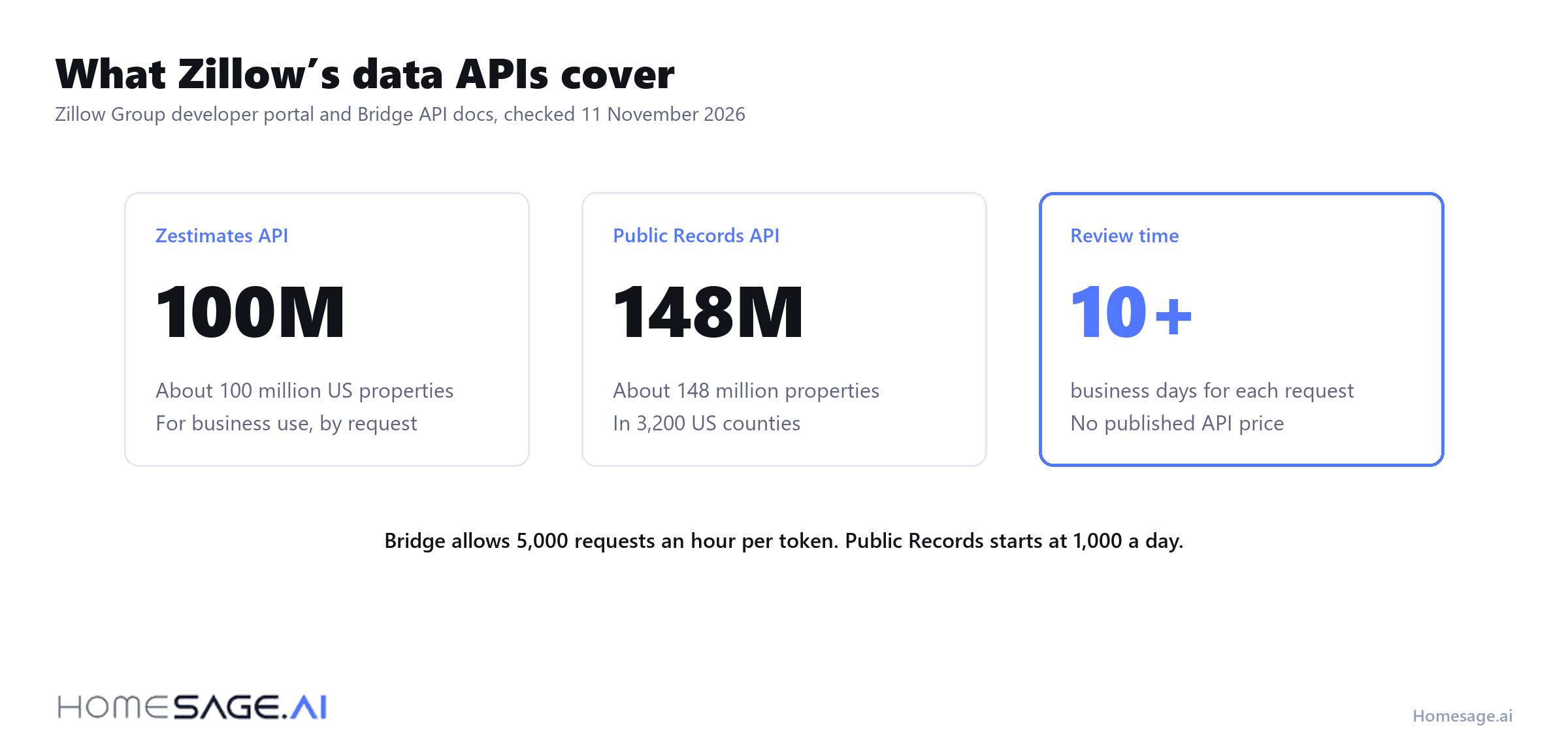
- Zestimate: The Zestimates API returns current property and rental Zestimates on about 100 million US properties. Zillow aims it at businesses for commercial use.
- Public data: The Public Records API returns parcel, assessment, and transaction records going back about 15 years. It is invite-only. Market metrics come as CSV downloads from Zillow Research.
- MLS and broker listings: Bridge Listing Output serves MLS listing data in the RESO standard, and each MLS decides who gets it.
- Agents: The Agent Reviews API is self-serve, but you still apply inside the Bridge dashboard.
- Mortgage: Seven APIs cover rates, lender reviews, and lead handoffs. The rate and review APIs need a Zillow partner ID, issued through a form.
- Rentals: A feed program sends rental listings to the Zillow Rental Network. Zillow approves each feed, and testing takes 4 to 6 weeks.
- Transactions: The dotloop API manages transaction loops and contacts for brokerages.
Source: Zillow Group developer portal and its API pages, checked 11 November 2026. Entry count rechecked 15 November 2026.
How to apply for Zillow API access
Zillow’s data APIs share one front door, the Bridge Interactive platform. Bridge’s documentation sets out these steps.
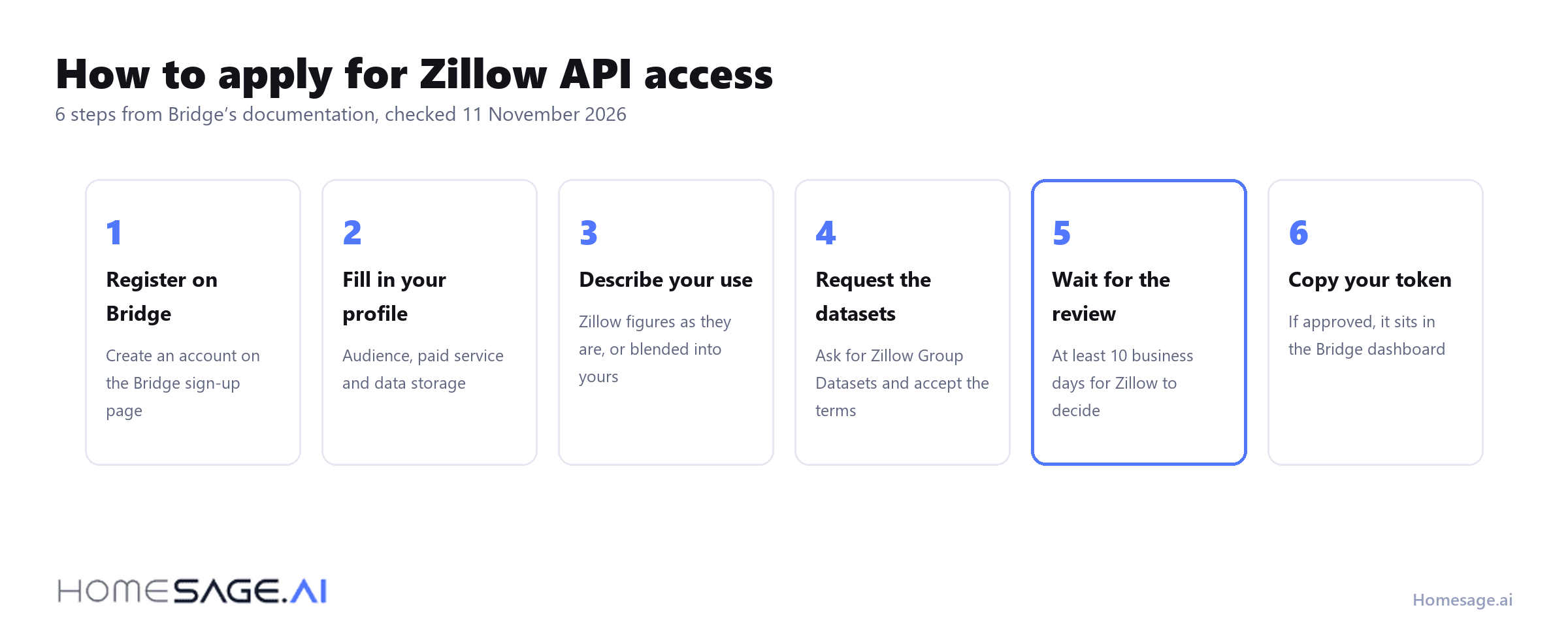
- Create an account on the Bridge registration page.
- Fill in your application profile. Zillow asks who the audience is, whether it is a paid service, and whether you will store the data.
- Say whether you will show Zillow figures as they are or blend them into your own calculation.
- Request access under Zillow Group Datasets and accept the Zillow Data Terms of Use.
- Wait at least 10 business days, the time Zillow asks for to decide eligibility.
- If approved, copy your token from the API Access Tokens page in the Bridge dashboard.
Every Bridge application gets a test dataset automatically so that you can try the API format first. Zillow’s own data stays locked until Zillow says yes.
What the Zillow API costs in 2026
Zillow publishes no API price on its developer portal or in the Bridge documentation, checked on 11 November 2026. You cannot buy access from a price list.
Every Zillow dataset on Bridge needs Zillow’s approval, and Zillow publishes no price for any of them.
The cost sits in the approval. Bridge’s documentation says a data provider can require a license agreement, fees, or compliance testing.
Zillow does give two things away. Its Zillow Research datasets on home values, rents, and inventory are open for public use if you attribute them to Zillow. Sending rental listings to Zillow through its feed program also has no fee.
Limits and terms that catch developers out
- Rate limits: Bridge allows 5,000 requests an hour per token by default. Public Records access starts at 1,000 requests a day.
- Storage and reuse: Approval covers the use you described. Zillow’s site terms bar derivative works unless a product’s own terms allow them.
- Revocation: A data provider can withdraw your access on Bridge, and you then have to reapply.
- Changing terms: Zillow last updated its terms of use on 28 October 2025. Read the current version before you build.
Unofficial Zillow APIs and scrapers
On 11 November 2026, page 1 of Google for “zillow api” showed a GitHub scraper and a scraping marketplace. These tools load zillow.com pages and parse them. None of them is a Zillow product.
Zillow’s terms of use forbid automated queries of its site, and they name scraping, robots, and crawlers. They allow copying only by hand and only for personal or professional use.
A scraper breaks the terms you accept when you use the site, and Zillow can block it at any time. Scrapers also fail whenever Zillow changes its pages. We do not recommend building on one, even for a prototype.
6 Zillow API alternatives for property data
These routes give you property data on published terms. For a wider roundup, see our 8 best property evaluation APIs.
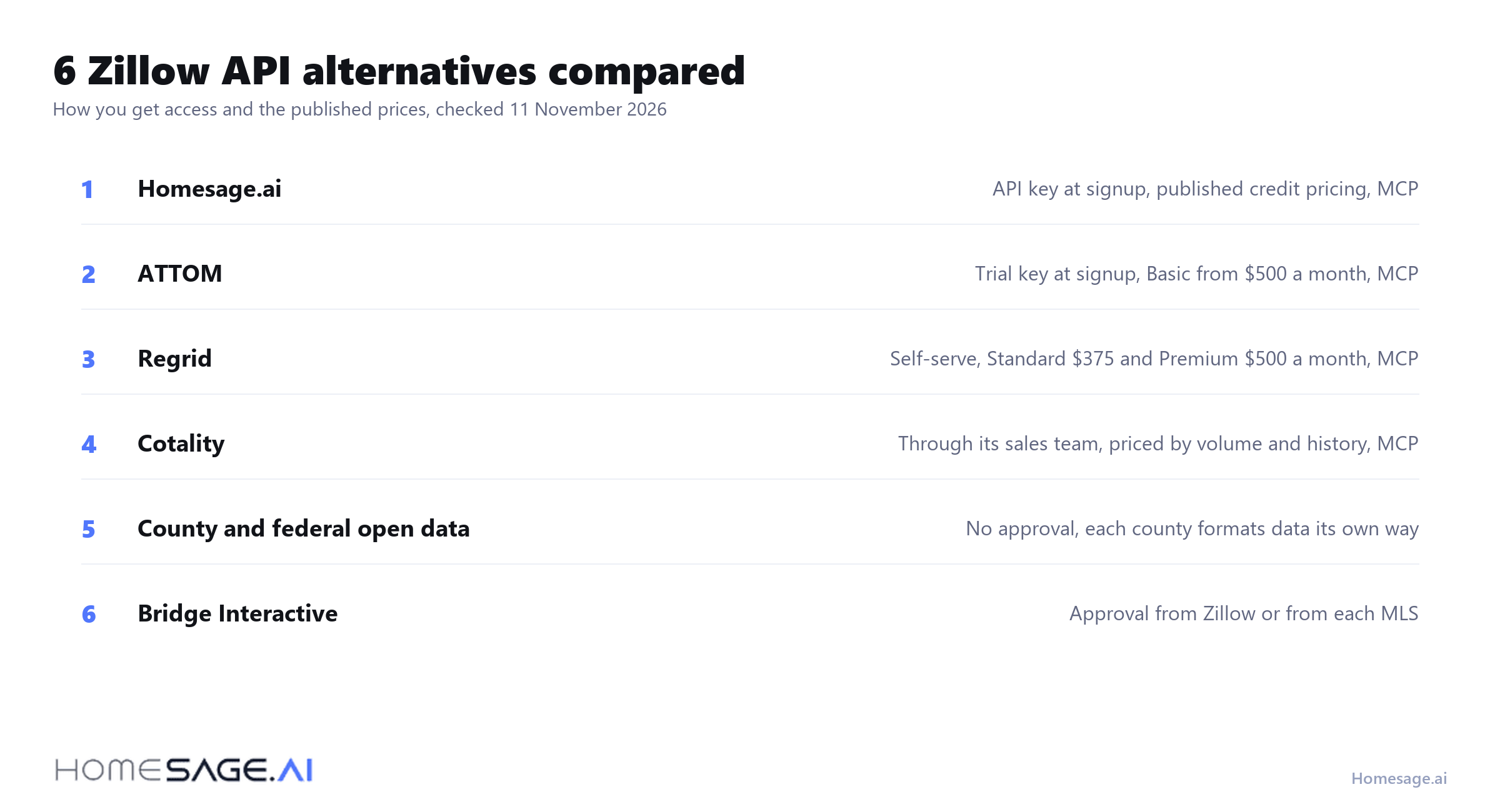
1. Homesage.ai. Best for investment data and AI agents
Our real estate APIs and MCP give insights on 160M+ US properties through 30+ REST endpoints. You create an account and get an API key at once, with no partner review.
- Published pricing: The credit cost of every endpoint is on our convenient pricing page.
- Property condition: We score property condition from property photos.
- Investment fields: Endpoints return estimated ARV, estimated renovation cost, rental estimates, and the Seller Motivation Score.
- MCP access: The same data works inside Claude, ChatGPT, Cursor, and Gemini CLI.
Sage, our assistant, runs that data inside the AI tool you already use. Ask “What is this property worth and what would it rent for?” and Sage calls our valuation and rent endpoints. See how Sage answers property questions.
You can create an account, browse the full real estate API library, or compare convenient pricing first.
2. ATTOM. Best for deep public records
ATTOM Data covers 160+ million US properties through a self-serve Property Data API. As of November 2026, it issues a trial API key at signup and lists Basic Property access from $500 a month.
Its Premium tier, which holds the ATTOM AVM and sales comparables, is priced by quote. ATTOM also offers an MCP server. See our Homesage.ai vs ATTOM comparison for when each fits.
3. Regrid. Best for parcel boundaries
Regrid sells nationwide parcel boundaries and ownership records through a self-serve API, and it now runs an MCP server. As of November 2026, Standard costs $375 a month and Premium $500, each with 2,000 parcel records.
A 30-day sandbox token covers 7 counties. Pick Regrid when your product needs the shape of the land more than a value estimate.
4. Cotality (formerly CoreLogic). Best for lenders and insurers
Cotality took its new name on 24 March 2025 and covers 154M+ residential and commercial US properties. It delivers by API, bulk file, cloud platforms such as Snowflake, or an MCP server it announced on 31 March 2026.
Cotality prices by data history, volume, geography, and delivery frequency. Access starts with its sales team.
5. County and federal open data. Best for one market at no cost
County assessor and open data portals publish parcel and tax records with no approval. Each county formats its data differently, so national coverage becomes your engineering problem.
For neighborhood statistics, the US Census Bureau Data API is open to anyone with a key you request online.
6. Bridge Interactive. Best for brokers and MLS vendors
If you qualify, the official Bridge Interactive route is the legitimate way to Zillow-hosted listing feeds. Each MLS approves its own feed.
Read our guide to MLS data integration methods for developers before you apply.
The video below walks through our real estate APIs, from your first key to your first response.
Which route to choose
- A consumer app that shows Zestimates: Apply through Bridge. Zillow’s terms bar showing its data without written approval.
- An investment tool, lending model, or agent workflow: Use a licensed real estate data API provider that issues keys at signup.
- AI agents that need property data: Use a provider with an MCP server, so the agent queries data instead of parsing web pages.
- Market trends for research: Download Zillow Research data or use the Census Data API, and credit the source.
Key takeaways
- Zillow Group lists close to 20 APIs, and each one needs a request or an invitation.
- Zillow’s data APIs run through Bridge, after a review of at least 10 business days.
- Zillow publishes no API price. Bridge says data providers can add license agreements or fees.
- Zillow Research data is open for public use with attribution, from neighborhood up to national level.
- Scraping breaks Zillow’s terms of use, which ban automated queries, robots, and crawlers.
- ATTOM, Regrid and Homesage.ai issue keys at signup and publish prices, as of November 2026.
Conclusion
A search for a Zillow API ends in one of two places. One is Bridge’s application queue, and the other is a real estate API you can call today.
Choose the Bridge route if you are building a consumer product on Zillow’s own listings and Zestimates. Apply early, describe your use exactly, and follow Zillow’s data terms to the letter.
For investing, lending, or agent work, a licensed property data API gets you to production faster. You read the terms and prices before you sign up, and no approval queue stands in the way.
Homesage.ai real estate APIs and MCP give insights on 160M+ US properties. They return valuations, comps, property condition, and estimated renovation cost. Start now, or compare plans on our pricing page.
Frequently asked questions
How much does the Zillow API cost?
Is there a free Zillow API for personal or research projects?
What is the Zillow Bridge API?
What data does the Zillow data API return?
Can I get Zestimates through an API?
Is scraping Zillow legal?
What is the best Zillow API alternative?
Ask Sage what a property is worth
Sage, our assistant, calls our valuation and rent endpoints from inside the AI tool you already use.
- Zillow Group developer portal
- Zillow Group Zestimates API
- Zillow Group Public Records API
- Zillow Group Real Estate Metrics
- Zillow Group MLS Listings
- Bridge Interactive (Bridge Data Output)
- Bridge API documentation
- Zillow terms of use
- ATTOM Property Data API pricing
- Regrid self-serve API plans
- Cotality property characteristics data
- Meet Cotality press release
- Cotality MCP server press release
Zillow Group’s API catalog, access steps and terms were checked on 11 November 2026, as were vendor prices. They can change, so verify them before you build. This is not investment advice or legal advice.





Home Valuation API: 7 Best Property Evaluation APIs (2026) October 12, 2026
[…] is partner-gated and the review takes weeks, which is the constraint teams underestimate. Our Zillow API guide for developers covers what clears the […]
6 Best Real Estate Data Providers In 2026 (Expert-Rated) October 17, 2026
[…] is partner-gated, approval takes real time, and that is the constraint most teams hit. Our guide to the Zillow API for developers covers what you can and cannot […]