
Real estate investing is no longer about gut feelings and spreadsheets. In 2026, the investors winning deals are those using predictive analytics to spot opportunities before they hit the market, forecast property appreciation with precision, and evaluate risks that traditional methods miss entirely.
The real estate market moves faster than ever. Properties with good investment potential now sell in hours. Investors who wait for complete manual analysis lose deals to competitors using AI-powered platforms that deliver comprehensive insights in seconds. The competitive advantage belongs to those who can predict market movements, not just react to them.
Predictive real estate analytics combines AI, computer vision, and massive datasets to forecast property values, identify emerging neighborhoods, and calculate investment returns with remarkable accuracy.
Platforms like Homesage.ai deliver these capabilities through developer-friendly APIs that transform raw market data into actionable intelligence Choosing one starts with the right property data API., helping investors make faster, smarter decisions backed by data rather than intuition.
This guide explores how predictive analytics revolutionizes real estate investing in 2026, the key technologies powering these platforms, and practical applications that deliver measurable returns.

What is Predictive Real Estate Analytics?
Predictive real estate analytics uses Artificial Intelligence to forecast future property values, market trends, and investment outcomes. Unlike traditional analysis that looks backward at historical data, predictive models identify patterns and relationships that indicate where markets are heading.
These systems process vast datasets, including MLS listings, public records, economic indicators These feed the best investment property APIs., demographic trends, infrastructure development, and neighborhood changes. By analyzing thousands of data points simultaneously, predictive algorithms spot correlations that human analysts can’t detect manually.
The technology leverages several AI techniques, including regression models for price forecasting, neural networks for pattern recognition, random forests for risk assessment, and ensemble methods that combine multiple algorithms. Research shows these advanced models achieve accuracy rates approaching 94% for typical residential properties in active markets.
For investors, predictive analytics answers critical questions such as which neighborhoods will appreciate the fastest over the next 12-18 months, which properties offer the best ROI potential, when to buy or sell for optimal returns, and which renovation investments generate the highest profits. This forward-looking intelligence transforms investing from reactive to proactive, giving early movers decisive advantages.
Core Technologies Powering Predictive Analytics
AI and Automated Valuation Models
At the heart of predictive analytics are AI models trained on millions of historical transactions. These models analyze actual sale prices, time on market, price reductions, and buyer behavior patterns to understand what truly drives property values in specific markets.
Automated Valuation Models represent the industry standard for property valuations. AVMs continuously learn from new data, updating predictions as market conditions change. Modern AVMs process MLS feeds, public records, and satellite imagery to deliver real-time assessments that become more precise over time.
The most sophisticated systems use ensemble methods combining multiple algorithms. A single prediction might integrate random forest models analyzing structural features, neural networks processing neighborhood characteristics, and regression models evaluating market trends. This approach reduces bias and improves accuracy across different property types.
Homesage.ai leverages these advanced techniques across its platform, delivering property valuations, investment scoring, and ROI projections with institutional-grade accuracy via simple, well-documented REST APIs.
Computer Vision for Property Assessment
Advanced predictive platforms now incorporate computer vision to analyze property images directly. These systems detect renovation needs, assess property condition, and estimate repair costs by examining photos, capabilities that traditional analysis completely lacks.
Computer vision algorithms examine listing images and identify items that need repair, such as siding and roof damage, outdated kitchens, water issues, hazardous materials, foundation issues, and deferred maintenance.
This visual analysis occurs in milliseconds, providing condition ratings that would typically require an inspector visit.
Homesage.ai‘s Property Condition API exemplifies this approach, using computer vision to categorize properties as Excellent, Good, Average, Outdated, Poor, and Very Poor based on automated visual analysis. This enables remote property evaluation across multiple markets without travel expenses, dramatically accelerating deal flow.
Natural Language Processing for Market Signals
Natural language processing scans city planning documents, zoning changes, infrastructure announcements, and news sources to identify early signals. These text analysis systems identify development projects, transit improvements, and regulatory changes that affect property values before they are known.
NLP algorithms monitor permit activity, signaling new construction; business openings, indicating gentrification; school rating improvements, attracting families; and employment growth, driving housing demand. Investors using these tools identify opportunities 12-18 months before competitors recognize emerging trends.
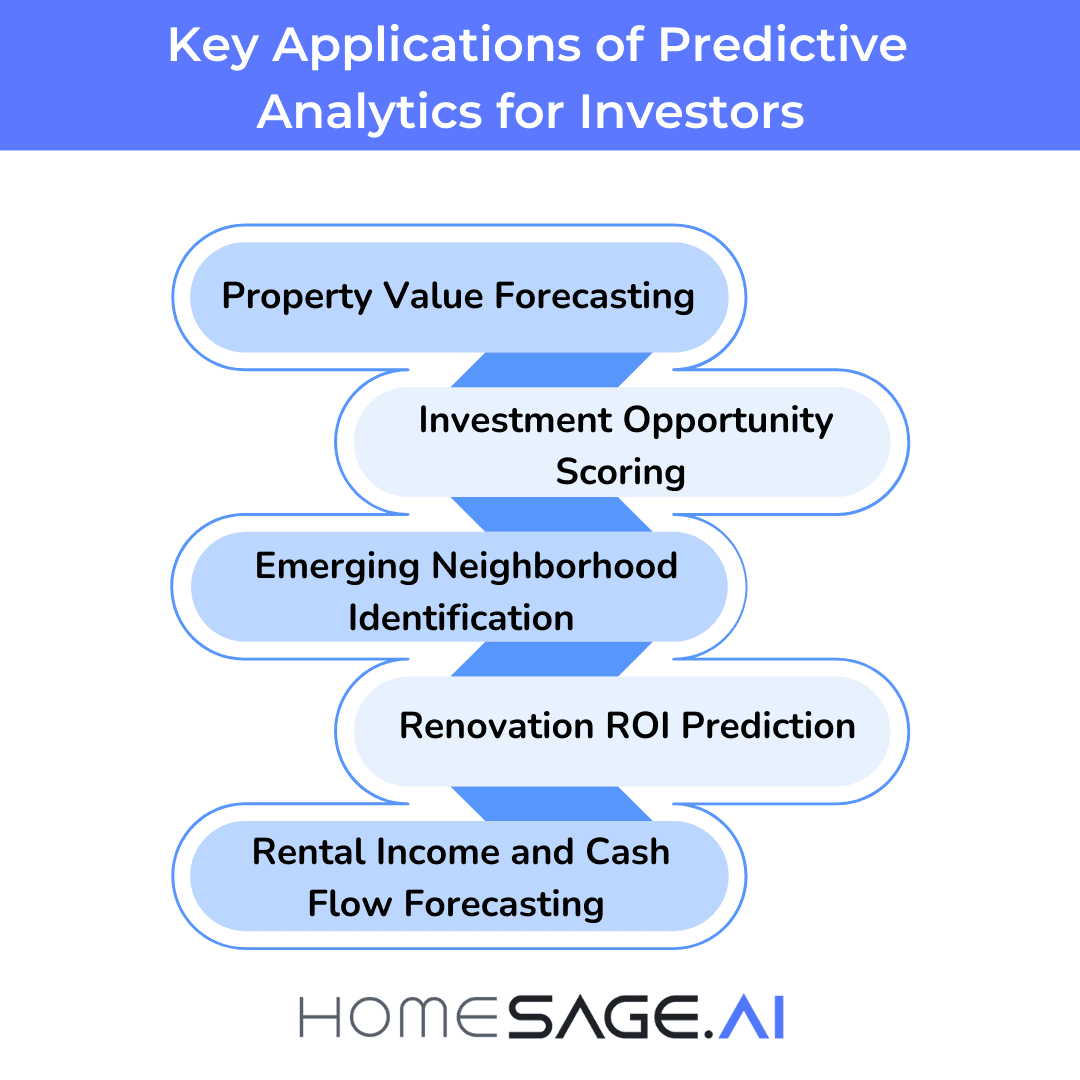
Key Applications of Predictive Analytics for Investors
Property Value Forecasting
Predictive analytics forecasts individual property appreciation by analyzing historical price trends, neighborhood trajectories, property characteristics, local economic indicators, and infrastructure investments.
AI models trained on millions of transactions predict which specific properties will appreciate the fastest over 1-5-year periods.
This capability proves especially valuable for long-term investors who need to identify properties positioned for growth rather than just immediate cash flow. Homesage.ai‘s Home Value Graph API displays historical property values and trends, providing visual insight into appreciation patterns that inform buying and holding strategies.
Accurate forecasting helps investors time acquisitions during market softness and liquidations during peak pricing. Instead of guessing optimal transaction windows, predictive models analyze market cycles and economic indicators to recommend strategic timing.
Predictive Property Valuation Methods Comparison
Forecasting Method | Time Frame | Accuracy | Data Sources | Best For |
Traditional CMA | Current value | 75-85% | Recent sales only | Listing decisions |
Basic AVM | Current value | 85-90% | Public records, MLS | Quick estimates |
Predictive ML Models | 1-5 years | 90-94% | Economic, demographic, and infrastructure | Investment strategy |
Hybrid AI-Human | Current + future | 94% + | All sources + expert adjustment | High-value decisions |
Investment Opportunity Scoring


Not all properties deserve equal attention. Predictive platforms automatically score investment potential by evaluating renovation upside, rental income potential, appreciation probability, market demand strength, and time-to-profit estimates.
Homesage.ai‘s Investment Potential API evaluates properties and categorizes them from Good to Excellent based on ROI probability, helping investors prioritize which deals deserve deeper investigation. This automated scoring process scores dozens of properties in the time required for a single manual analysis.
Investment scoring systems consider both immediate returns and long-term appreciation. A property might score well for fix-and-flip based on strong ARV projections and modest renovation costs, or rate highly for rental income based on cash flow and occupancy forecasts.
Emerging Neighborhood Identification
The most profitable real estate investments often come from buying in neighborhoods before they appreciate. Predictive analytics identifies up-and-coming areas by monitoring signals that traditional analysis misses entirely.
These intelligent systems track permit activity, signaling growth; business openings like coffee shops and restaurants; school rating improvements; transit developments increasing accessibility; employment growth; and demographic shifts, predicting demand. By analyzing these interconnected factors, algorithms forecast which neighborhoods will transform before mainstream buyers notice.
Investors using these tools gain first-mover advantages, acquiring properties 12-18 months before appreciation accelerates. This early positioning delivers outsized returns that reactive investors never capture.
Renovation ROI Prediction
Renovation costs often derail investment deals when actual expenses exceed estimates. Predictive platforms analyze property characteristics and local market conditions to provide detailed renovation cost projections based on regional labor rates, current material prices, and property-specific needs.
These systems examine property photos to identify specific improvements needed and estimate costs for kitchen updates, bathroom renovations, flooring replacement, roof repairs, and landscaping improvements. The detailed breakdowns help investors budget accurately and avoid costly surprises.
Homesage.ai‘s Renovation Cost API estimates expenses for budgeting and financial planning, while the Renovation Return API calculates potential ROI from improvements. This combination shows both the investment required and expected return, enabling data-driven renovation decisions.
Rental Income and Cash Flow Forecasting
For buy-and-hold investors, accurate income projections determine whether deals make financial sense. Predictive platforms analyze local rental markets to provide detailed cash flow forecasts for different strategies.
These systems calculate optimal rental pricing based on comparable properties, seasonal demand patterns, and neighborhood dynamics. For properties suitable for short-term rentals, predictive tools compare Airbnb income potential against traditional leasing to identify the most profitable approach.
Homesage.ai‘s Long-Term Rental API and Short-Term (Airbnb) Rental API provide estimated rental values, along with financial metrics such as monthly and annual projections, cash-on-cash returns, cap rates, and occupancy estimates. This dual analysis helps investors advise on the best monetization strategy for each property.
How Predictive Analytics Transforms Investment Workflows
Speed and Scale
Traditional property analysis requires hours of spreadsheet work researching comparable sales, calculating renovation costs, estimating rental income, and projecting returns. Predictive platforms complete this analysis in seconds by simultaneously processing thousands of market data points.
What previously required manual research now happens instantly when you enter a property address. This speed lets investors evaluate 50 properties before lunch—something impossible with traditional methods. Scale advantages compound over time as investors review more opportunities and identify more profitable deals.
Risk Reduction
Predictive analytics reduces investment risk by identifying red flags that manual analysis might miss. These systems flag properties in declining markets, overpriced listings with low negotiation potential, renovations exceeding market norms, and rental markets with declining occupancy.
By quantifying risks with data rather than intuition, investors make more objective decisions and avoid emotional mistakes. Predictive models show confidence intervals that indicate uncertainty, helping investors understand when additional due diligence is warranted.
Negotiation Intelligence
Understanding how much room exists for negotiation transforms deal-making. Predictive systems analyze listing history, days on market, price reductions, and seller motivation indicators to determine negotiation potential for specific properties.
These platforms calculate price flexibility scores that estimate the likelihood that sellers will accept offers below the asking price. Homesage.ai‘s Price Flexibility Score API determines the negotiability of listing prices, helping investors understand realistic discount potential before making offers.
Data-driven negotiation replaces guesswork with statistical analysis based on actual market behavior, strengthening buyer positions and identifying motivated sellers likely to accept aggressive offers.
Key Takeaways
- Predictive real estate analytics uses AI, computer vision, and massive datasets to forecast property values, market trends, and investment returns with close to 94% accuracy, dramatically outperforming traditional manual analysis.
- Advanced platforms identify emerging neighborhoods 12-18 months before mainstream recognition by monitoring permit activity, business openings, infrastructure development, and demographic shifts that signal transformation.
- Automated property scoring evaluates renovation potential, rental income, appreciation probability, and time-to-profit instantly, letting investors analyze 10x more properties with the same effort.
- Computer vision technology assesses property condition from photos in seconds, enabling remote evaluation across multiple markets without travel costs or preliminary inspection expenses.
- Renovation intelligence shows both costs and expected ROI for improvements, helping investors prioritize value-add strategies that maximize profits while avoiding over-improvements.
- Homesage.ai delivers comprehensive predictive intelligence through specialized APIs, including Investment Potential scoring, Property Condition assessment, Renovation Cost and Return analysis, Price Flexibility scoring, and dual Rental ROI projections for both long-term and short-term (Airbnb) strategies.
To see these ideas in action, watch this walkthrough on how AI-powered tools are transforming real estate decision-making and deal analysis in 2026.
Conclusion
The real estate investors succeeding in 2026 aren’t necessarily those with the most significant budgets or the most experience; they’re the ones leveraging predictive analytics to find opportunities faster, analyze them more effectively, and make decisions while competitors are still gathering information manually.
Predictive analytics has evolved from experimental technology to essential infrastructure for serious investors. Platforms that combine AI, computer vision, and market intelligence process information at scales impossible for individuals to handle, delivering insights that would take teams of analysts weeks to compile.
Whether you’re building rental portfolios, flipping properties, or seeking long-term appreciation plays, integrating predictive analytics into your workflow creates measurable competitive advantages. The technology transforms investing from art to science, replacing intuition with data-driven precision.
Frequently Asked Questions
Q: How accurate are predictive analytics compared to traditional property analysis?
A: Predictive analytics platforms using advanced AI achieve accuracy rates of 90-94% for typical residential properties in active markets. Hybrid approaches combining AI data processing with human expertise deliver even higher accuracy—up to 15% better than AI-only systems. Traditional manual analysis accuracy varies significantly by analyst experience and can be less consistent.
Q: Can predictive analytics really identify neighborhoods before they appreciate?
A: Yes. Predictive systems monitor dozens of early indicators, including permit activity, business openings, infrastructure investments, and demographic shifts that signal neighborhood transformation.
By analyzing these interconnected factors, algorithms forecast appreciation 12-18 months before trends become obvious to mainstream investors. This early identification creates first-mover advantages for strategic acquisitions.
Predictive analytics tells you where a market is heading. Acting on that forecast requires knowing where the market stands right now. Our guide to real-time market signals for investors covers the live data points that complement predictive models at the deal execution stage, including days-on-market trends, absorption rates, and price reduction frequency.





3 Comments
Peter January 25, 2026
Predictive property analysis can replace many manual hours per week
Gordon January 26, 2026
Protective analytics are must have for any modern investor
Joseph January 27, 2026
This is an important topic, appreciate you sharing it!