
Choosing between long-term and short-term (Airbnb) rental strategies can make the difference between steady cash flow and maximum profits.
In 2026, this decision matters more than ever as market dynamics shift, regulations tighten, and investor expectations evolve beyond simple occupancy rates.
Real estate investors face a critical fork in the road: pursue the stability of traditional long-term rentals or chase the higher revenue potential of short-term platforms like Airbnb. Both strategies offer distinct advantages, but the right choice depends on your market, property type, management capacity, and investment goals.
Modern investors use AI-powered tools like Homesage.ai‘s Long-Term Rental API and Short-Term (Airbnb) Rental API to evaluate both strategies simultaneously, comparing cash flow projections, occupancy estimates, and ROI metrics before committing capital. This data-driven approach replaces guesswork with statistical analysis based on actual market performance. 
This guide examines the critical factors that determine which rental strategy maximizes returns in 2026, helping you make informed decisions backed by market intelligence rather than assumptions.
Understanding Long-Term Rental Investment Potential
Long-term rentals involve leasing properties for extended periods, typically six months to one year or more. This traditional approach has anchored real estate investment portfolios for decades, offering predictable income and lower management demands.
Advantages of Long-Term Rentals
Long-term rental strategies deliver several compelling benefits:
- Predictable cash flow with monthly rent payments providing consistent income.
- Lower management intensity with tenant turnover occurring once annually or less.
- Reduced operating costs without frequent cleaning, restocking, or guest services.
- Simpler regulatory environment with fewer municipal restrictions compared to short-term (Airbnb) rentals.
- Easier financing, as traditional lenders readily understand and support long-term rental models.
For investors prioritizing stability over maximum returns, long-term rentals provide a straightforward path to building wealth through real estate.
Challenges of Long-Term Rentals
Despite their advantages, long-term rentals face meaningful limitations:
- Lower revenue potential compared to optimized short-term strategies in desirable markets.
- Tenant risk, including potential non-payment, property damage, or brutal evictions.
- Limited pricing flexibility, with rent increases typically restricted to lease renewal periods.
- Vacancy costs where a single month without a tenant significantly impacts annual returns.
Understanding these tradeoffs helps investors evaluate whether long-term strategies align with their risk tolerance and return expectations.
Understanding Short-Term Rental Investment Potential
Short-term rentals are properties leased for brief periods, from a single night to several months, typically through platforms like Airbnb, Vrbo and Booking. This strategy has transformed real estate investing by unlocking higher revenue potential in the right markets.
Advantages of Short-Term (Airbnb) Rentals
Short-term rental strategies offer distinct competitive advantages:
- Higher revenue potential with nightly rates often exceeding monthly long-term rents when annualized.
- Dynamic pricing flexibility, adjusting rates based on demand, seasonality, and local events.
- Personal use options allow owners to occupy properties when not rented.
- Market responsiveness with the ability to adjust pricing and strategy in real-time.
- Premium positioning in tourist destinations, business districts, and event-driven markets.
In many markets, short-term (Airbnb) rentals generate revenue per night that significantly exceeds that of long-term rentals, particularly during peak seasons.
Challenges of Short-Term (Airbnb) Rentals
Short-term strategies introduce complexities that demand careful consideration:
- Higher operating expenses, including cleaning fees, utilities, maintenance, and platform commissions.
- Management intensity requiring guest communication, check-ins, and ongoing property oversight.
- Regulatory restrictions with many cities implementing strict short-term (Airbnb) rental limitations.
- Occupancy risk where demand fluctuations directly impact revenue.
- Platform dependency, with success tied to algorithm changes and guest review systems.
The professionalism required for short-term success has increased substantially, transforming casual hosting into a sophisticated business operation.
Financial Performance: Comparing ROI and Cash Flow
Return on investment ultimately determines which strategy makes financial sense for your specific property and market conditions.
Revenue Analysis
Short-term rentals typically generate higher gross revenue in favorable markets. One analysis comparing equivalent properties showed that short – term rentals produced approximately $45,000 in annual gross income, versus $24,000 for long-term rentals.
However, another scenario showed long-term rentals achieving 5.9% ROI, compared to 5.4% for short-term strategies, after accounting for higher operating expenses.
The revenue advantage depends entirely on location, property type, and management efficiency.
Operating Expense Considerations
Short-term (Airbnb) rentals carry substantially higher operating costs:
- Cleaning fees after each guest departure.
- Utilities included in nightly rates.
- Platform commissions (typically 10-20% of gross revenue).
- Higher insurance premiums.
- More frequent maintenance and restocking.
Long-term rentals typically shift utilities and minor maintenance to tenants, resulting in lower net operating expenses as a percentage of gross income.
Cash Flow and ROI Calculation
Platforms like Homesage.ai‘s rental APIs calculate comprehensive financial projections, including monthly cash flow, annual net income, cap rates, and cash-on-cash returns for both strategies simultaneously. This side-by-side analysis reveals which approach delivers superior returns for specific properties in specific markets.
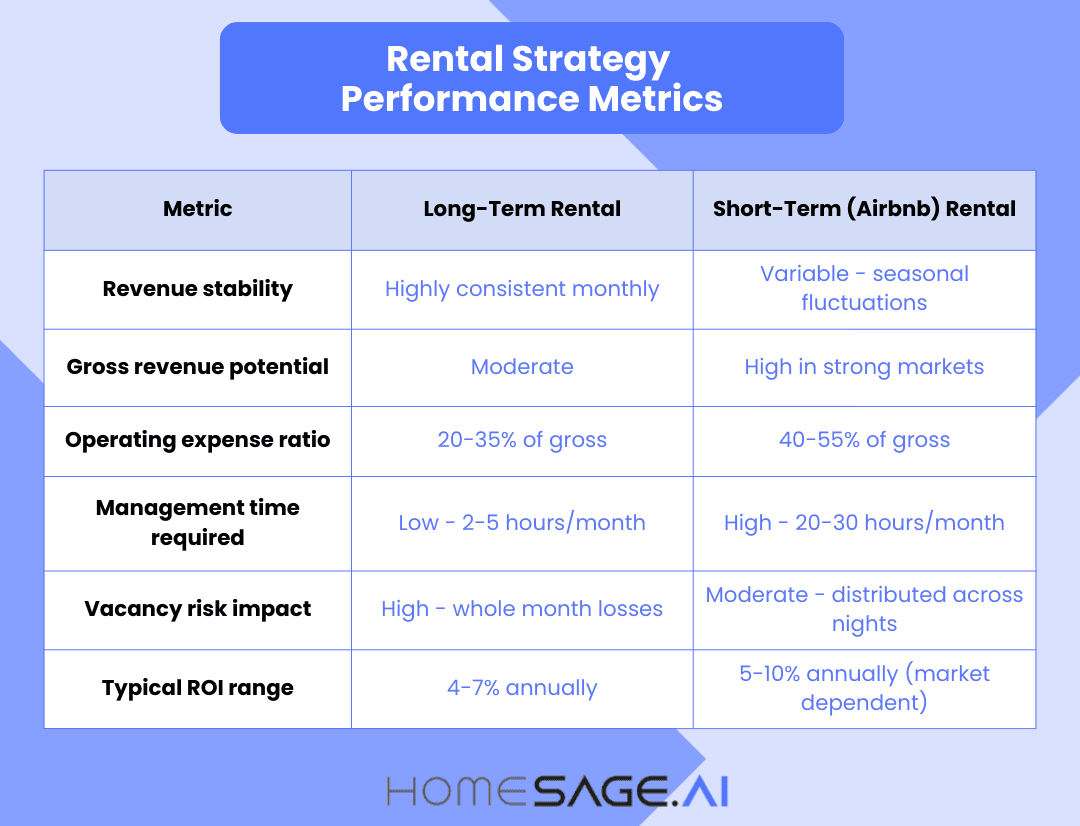
Rental Strategy Performance Metrics
Metric | Long-Term Rental | Short-Term (Airbnb) Rental |
Revenue stability | Highly consistent monthly | Variable – seasonal fluctuations |
Gross revenue potential | Moderate | High in strong markets |
Operating expense ratio | 20-35% of gross | 40-55% of gross |
Management time required | Low – 2-5 hours/month | High – 20-30 hours/month |
Vacancy risk impact | High – whole month losses | Moderate – distributed across nights |
Typical ROI range | 4-7% annually | 5-10% annually (market dependent) |
Market and Property Type Considerations
Not all properties and markets suit both strategies equally well.
Location Requirements 

Short-term rentals thrive in:
- Tourist destinations with consistent visitor demand.
- Business districts attracting corporate travelers.
- Event-driven markets near stadiums, convention centers, or universities.
- Scenic locations offering unique experiences.
Long-term rentals perform best in:
- Residential neighborhoods with stable employment.
- University towns with student demand.
- Suburban areas attracting families.
- Markets with strong local economies.
Understanding your property’s location characteristics determines which strategy aligns with natural demand patterns.
Property Type Optimization
Different property types favor different strategies:
One-bedroom properties often excel as short-term (Airbnb) rentals in urban centers, attracting business travelers and couples.
Two to three-bedroom homes perform well in both strategies, with family-friendly areas favoring long-term tenants and vacation destinations supporting short-term guests.
Unique properties with distinctive features, such as views, hot tubs, or architectural character, command premium short-term rates that long-term tenants rarely justify.
Regulatory and Management Factors
Legal compliance and operational capacity significantly affect the strategy’s viability.
Regulatory Environment
Short-term (Airbnb) rental regulations have tightened substantially across many markets. Cities implement restrictions, including:
- Permit requirements and application fees.
- Occupancy limits and noise ordinances.
- Owner-occupancy mandates.
- Total ban in specific neighborhoods.
Verifying local regulations before committing to short-term strategies prevents costly legal issues.
Long-term rentals face fewer regulatory barriers, though tenant protection laws vary significantly by jurisdiction.
Management Capacity
Short-term success demands either significant personal time investment or professional management services costing 20-55% of gross revenue. Tasks include:
- Guest communication and booking management.
- Check-in coordination and key exchange.
- Cleaning scheduling after each departure.
- Maintenance response and restocking.
- Review management and platform optimization.
Investors lacking time or local presence often find professional short-term (Airbnb) rental management essential, as it directly impacts net returns.
Long-term rentals require minimal ongoing management once tenants are established, making them suitable for passive investors or those managing multiple properties.
Market Conditions and Trends for 2026
Understanding current market dynamics helps project future performance for both strategies.
Short-Term Rental Market Outlook
The short-term (Airbnb) rental market shows signs of normalization after explosive pandemic-era growth. Demand growth is projected to moderate from 15.8% in 2021 to approximately 5.5% in 2026, reflecting market maturation.
Supply has increased as more investors entered the market, intensifying competition and requiring stronger differentiation through amenities, location, and service quality.
Successful operators in 2026 distinguish themselves through professionalism, data-driven pricing, and superior guest experiences rather than simply listing properties on platforms.
Long-Term Rental Market Stability
Long-term rental demand remains strong in many markets, supported by housing shortages, affordability challenges preventing homeownership, and demographic trends favoring rental living.
This strategy continues to offer predictable returns for investors comfortable with moderate appreciation and steady cash flow.
How AI-Powered Tools Help Investors Decide
Modern investment analysis tools eliminate guesswork from strategy selection.
Homesage.ai‘s Long-Term Rental API and Short-Term (Airbnb) Rental API provide comprehensive projections, including estimated monthly and annual rental income, occupancy rates based on comparable properties, cash flow calculations accounting for expenses, cap rates, and ROI metrics, and comparative analysis showing which strategy maximizes returns.
This data-driven approach allows investors to evaluate both strategies for specific properties before purchasing, ensuring capital allocation aligns with maximum return potential rather than assumptions about rental performance.
Want to see what this decision looks like in a real workflow? The short video below shows how to generate a property report and quickly compare long-term vs short-term rental potential, so you can sanity-check your numbers before you choose a strategy.
Key Takeaways
- Long-term rentals offer stability, predictable cash flow, and lower management demands, making them ideal for passive investors prioritizing consistency over maximum returns.
- Short-term (Airbnb) rentals deliver higher revenue potential in favorable markets but require professional management, higher operating costs, and active involvement to succeed in increasingly competitive environments.
- Financial performance varies dramatically by location and property type, with short-term strategies excelling in tourist destinations while long-term approaches suit residential markets with stable employment.
- Regulatory restrictions increasingly limit the viability of short-term (Airbnb) rentals in many cities, requiring thorough legal research before committing to this strategy.
- AI-powered analysis tools like Homesage.ai‘s rental APIs enable side-by-side comparison of both strategies, calculating ROI, cash flow, and occupancy projections that inform data-driven investment decisions.
- The most successful investors in 2026 select strategies that match their management capacity, risk tolerance, and market conditions rather than following generic advice about which approach performs better universally.
Conclusion
The choice between long-term and short-term (Airbnb) rental strategies isn’t about which is objectively better, but which aligns with your specific property, market, and investment potential. Both approaches create wealth when matched to appropriate circumstances and executed professionally.
Short-term (Airbnb) rentals reward investors willing to operate hospitality businesses in markets with strong visitor demand. Long-term rentals serve those prioritizing passive income and stability over maximum gross returns.
Understanding the financial implications, management requirements, and market dynamics of each strategy prevents costly mistakes and aligns capital with realistic expectations.
Technology has democratized access to institutional-grade analysis previously available only to large investment firms. Platforms like Homesage.ai provide the rental income projections, market intelligence, and comparative analysis that transform rental strategy selection from guesswork into data-driven decisions.
Ready to evaluate rental strategies for your investment properties? Explore Homesage.ai‘s Long-Term and Short-Term Rental APIs to access comprehensive income projections and ROI calculations that help you select the strategy maximizing returns in your specific market.
Frequently Asked Questions
Q: Which rental strategy generates higher returns in 2026?
A: Neither strategy universally outperforms the other. Short-term (Airbnb) rentals typically generate higher gross revenue in tourist destinations, business districts, and markets with strong visitor demand.
Long-term rentals often deliver superior net returns in residential areas after accounting for the higher operating expenses and management intensity of short-term strategies.
The optimal choice depends on your specific property location, type, and management capacity.
Q: Can I switch between long-term and short-term rental strategies?
A: Yes, though practical and legal considerations apply. Switching from long-term to short-term requires waiting for the lease to expire, obtaining necessary permits, furnishing the property, and establishing platform listings.
Moving from short-term to long-term involves removing listings, potentially unfurnishing the property, and finding qualified tenants. Local regulations may restrict short-term (Airbnb) rentals even if your property previously operated as long-term housing.
Q: How do Homesage.ai’s rental APIs help investors choose strategies?
A: Homesage.ai‘s Long-Term Rental API and Short-Term (Airbnb) Rental API provide side-by-side financial projections for the same property under both strategies, including monthly and annual income estimates, occupancy projections, operating expense calculations, cash flow analysis, and ROI comparisons.
This comprehensive analysis reveals which approach maximizes returns for your specific property and market, eliminating guesswork from strategy selection.
Q: What are the most prominent mistakes investors make when choosing rental strategies?
A: Common mistakes include assuming short-term (Airbnb) rentals always generate higher returns without accounting for operating expenses and management costs.
Underestimating the professional effort required for successful short-term operations and failing to research local regulations before purchasing properties for short-term use.
Additionally, many investors select strategies based on national trends rather than specific market conditions where their property is located. Data-driven analysis specific to your property and market prevents these costly errors.





Peter December 31, 2025
Very helpful
Nourhan January 1, 2026
Insightful!
Cris January 5, 2026
Good read !