Real estate investing has not become harder to understand. It has become harder to do profitably with just gut feelings.
Two things changed at once: margins compressed, and the data that used to be an edge became something everyone has.
The margin is measurable. ATTOM’s 2025 year-end analysis puts the typical US flip at a 25.5% gross return, around $65,981 before holding, financing, and selling costs the thinnest since 2008, on the fewest flips since 2020.
Rental buyers face the same squeeze from the other direction, with financing costs that have not returned to anything resembling 2021. Calculating ROI on a rental property sets out the full workings.
What follows is not a motivational guide. It is what the four strategies require in 2026, the five numbers that decide whether a deal works, and what we see across our own property records including one pattern that surprises most investors when they first see it. Rent or flip compares both strategies on the same listings.
“Quick answer Real estate investing is buying property for a financial return rent, resale profit, or appreciation rather than to live in. In 2026, that return favors data-driven buyers: mortgage rates are forecast to average around 6%, flip margins are the thinnest since 2008, and the edge has moved from access to interpretation. The four working strategies buy-and-hold rentals, fix-and-flip, BRRRR, and out-of-state ownership all reduce to one discipline: buy only when the five numbers clear.

What Real Estate Investing Means in 2026
At its simplest, real estate investing is buying property for a financial return rather than to live in. That return arrives in one of three ways: rent that exceeds the cost of holding the asset, a resale price that exceeds the total cost of acquiring and improving it, or appreciation you capture later by selling or refinancing. How much you can rent a house for covers where a defensible rent figure comes from.
Everything else the strategies, the jargon; the software is a variation on those three an investor who understands that clearly will make better decisions than one who has memorized twenty acronyms.
The practical shift in 2026 is that the analysis layer has moved. Ten years ago, the edge was access: knowing which houses were coming up and having a relationship with the listing agent. Today, most listings are visible to everyone within minutes.
The edge has moved to interpretation of reading conditions, negotiability, and true return faster and more accurately than the next buyer looking at the same listing.
What the 2026 Market Actually Looks Like
Financing is the variable that moves everything else. Fannie Mae’s forecast Has the 30-year fixed rate averaging around 6% across 2026, down from the 7% that defined early 2025. That matters more to investors than any headline about prices, because it sets both your carrying cost and your buyer’s budget at the exit.
Lower rates cut both ways. They widen the pool of buyers who can afford your finished flip, and they widen the pool of investors bidding against you for the same distressed house. Do not model the first effect without the second. Whether flipping still pays in 2026 tests that against current margins.
Analysis of NAR’s housing data puts the demand side of that equation at roughly 5.5 million additional households able to qualify for a mortgage as rates of ease.
On the flip side, ATTOM’s data shows flipping volume at its lowest since 2020. Fewer competitors chasing thinner margins reasonably describes the current market. Whether that reads as opportunity or as a warning depends entirely on how accurately you underwrite. Buying a rental in a market you do not live in covers the execution risk that adds.
How to Choose a Market
Most new investors choose a strategy first and a market second. That is backwards. The market determines which strategies are even available to you, because it sets out the two things you cannot change: what inventory exists, and what it costs to hold.
Three questions settle it.
First, does inventory support your strategy?
A flip needs a supply of houses that need work, and as the Phoenix and Cleveland figures show, that share of the market varies by more than two and a half times between two ordinary American cities.
Second, does the rent-to-price ratio work?
A $400,000 house renting for $2,000 is a very different asset from a $150,000 house renting for $1,400, whatever either one looks like.
Third, can you get there, or do you have someone who can?
A market that fails against any of those three is not a market you should be in, no matter how good the headline appreciation numbers look. Appreciation is what you hope for. Cash flow and condition are what you underwrite.
Public inputs are free: Census Bureau ACS data covers population and income trends for every county, HUD publishes Fair Market Rents for every metro, and building permits show whether supply is chasing demand. For a fuller framework, see Building a Data Driven Property Investment Strategy.
The Four Strategies, and What Each Actually Requires
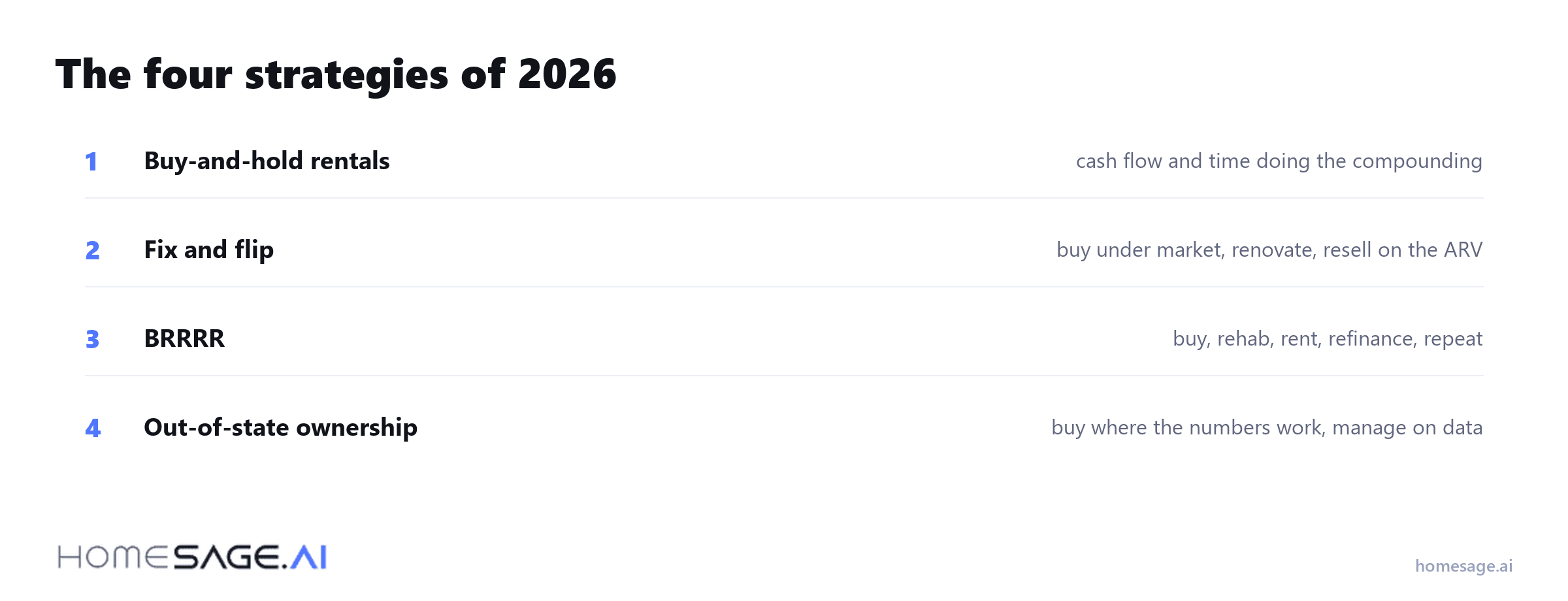
1. Buy-and-Hold Rentals
You buy a property, rent it, and hold it for cash flow and long run appreciation. It is the slowest strategy and the most forgiving of mistakes, because time covers a lot of errors. The number that matters most is cash on cash return: the annual pretax cash flow divided by the cash you put Go deeper on what counts as a good cash-on-cash return.
Buy and hold suits investors with stable income who want an asset, not a job. It suits nobody who needs the money back within three years.
2. Fix and Flip
Buy under market, renovate, resell at the after-repair value. Everything hangs on three estimates: what the house is worth today, what the renovation really costs, and what it will sell for when done. Our guide to ARV what after-repair value is and how to calculate it walks through that math in detail, and the complete guide to flipping homes with AI covers the whole workflow from sourcing to sale.
3. BRRRR
Buy, Rehab, Rent, Refinance, Repeat: a flip that you keep. Instead of selling the renovated house, you rent it, refinance at the new value to pull your capital back out and roll it into the next deal. BRRRR compounds fast when the ARV comes in as predicted, and stalls just as fast when it does not. The BRRRR method explained walks the five steps and where they stall.
Two BRRRR specific cautions: most lenders require a seasoning period before the cash out refinance, so model six months of holding costs, and always underwrite the refinance at the appraiser’s likely number rather than your most optimistic ARV. How long a flip actually takes puts a timeline on it.
4. Out-of-State Ownership
You buy where the numbers work rather than where you live. Cash flow in the Midwest and South has looked better than the coasts for several years, and remote management has become normal rather than exotic.
The cost is that you cannot walk to the property. Everything you would have judged with your own eyes on the roof, the moisture in the basement, whether the kitchen photo is flattering must come from data and from someone you trust on the ground.
Choosing a Strategy: Cash, Time and Risk
| Strategy | Cash needed | Time demand | Main risk | Core number |
|---|---|---|---|---|
| Buy-and-hold rental | Down payment + reserves | Low, ongoing | Vacancy, repairs | Cash-on-cash return |
| Fix and flip | Purchase + full renovation | Intense, 3–9 months | Renovation overruns | ARV and the 70% rule |
| BRRRR | Same as a flip, recycled | Intense, then low | Appraisal below ARV | Post refinance equity |
| Out-of-state | Down payment + reserves | Low, but remote | Unseen condition | Verified condition + local rent |
The Five Numbers That Decide a Deal
A deal is not a story about a neighborhood. It is a short list of numbers that either clear their thresholds or do not.
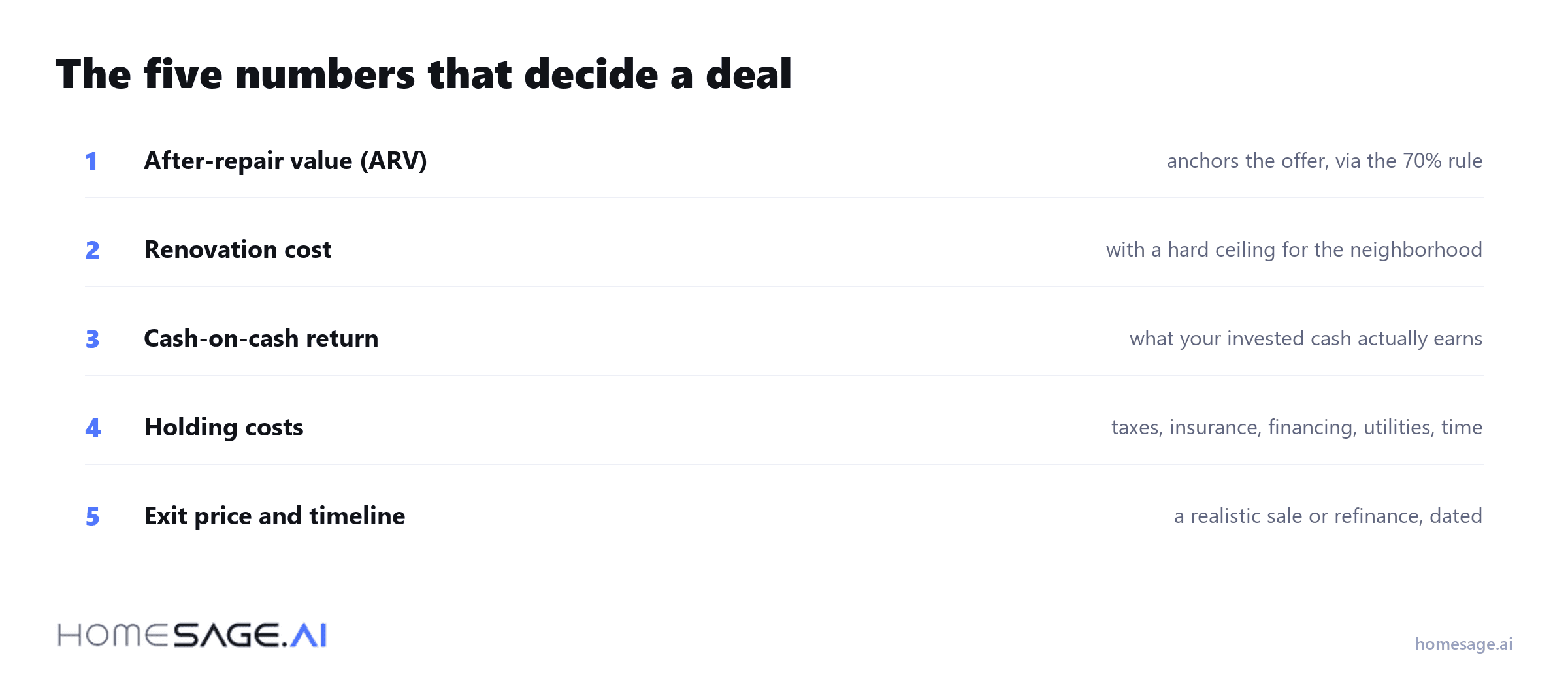
After-repair value anchors everything on a value-add deal. The widely used 70% rule says pay no more than 70% of ARV minus repair costs, so a home worth $330,000 renovated, needing $45,000 of work, supports a maximum offer of about $186,000. The full walkthrough comps, adjustments, and sensitivity cases are in the ARV meaning guide.
Renovation cost comes with a ceiling: the point where one more dollar of improvement stops adding a dollar of value. Over improving the neighborhood is one of the most common ways investors turn a good purchase into a break-even project. What it costs to flip a house itemises that budget.
Cash-on-cash return measures what your actual invested cash earns each year the number of rental investors live on. Its cousin, the cap rate, strips out financing so you can compare properties on equal terms. Go deeper on what counts as a good cap rate.
Holding costs taxes, insurance, financing, utilities, and every month the project runs long are the silent margin killer, which is why thin margin years punish slow renovations twice.
Exit price and timeline close to the loop: a realistic sale or refinance number, with a date attached. For a faster route through all five, see how to analyze residential investment deals fast.
Financing Your First Deal
Financing shapes return more than most first time investors expect, because it determines both your monthly carrying cost and how much cash you have left for the next deal.
Conventional investment mortgages typically want 20–25% down and price a point or so above owner-occupied rates. Hard money lends against the property rather than your income, funds in days rather than weeks, and costs several points plus double-digit interest which is affordable across four months and ruinous across fourteen.
DSCR loans qualify for the property’s rent rather than your salary and have become the default for investors whose tax returns understate their income.
The rule that keeps people solvent: match loan duration to strategy duration. Hard money on a flip is a reasonable trade. Hard money on a property you end up holding is how investors lose houses.
One 2026 specific note: as rates ease toward the 6% average, refinancing windows open for deals bought in 2023–2024 rates. Investors holding 7% of era debt should rerun their numbers this year.
The Data-Driven Investing Loop
Strip away the strategy differences and successful investors run the same five step loop. What has changed in 2026 is how much of it can be done from a desk, in minutes, before a single site visit.
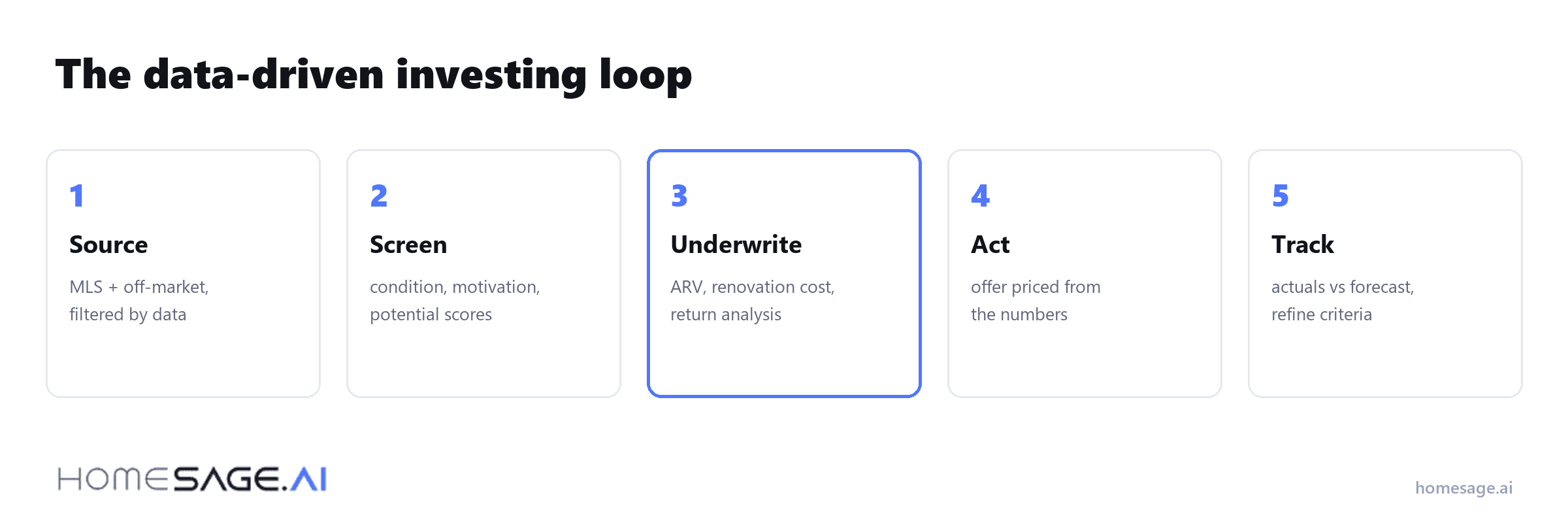
- Source from both MLS and off market channels restricting yourself to one is how real estate investment opportunities get missed. The MLS gives volume and transparency; off market gives discounts and less competition. Serious investors keep both funnels running.
- Screen each candidate on condition, investment potential, and seller motivation before spending an hour on it. Screening exists to say no quickly: of every hundred listings that match your filters, a handful deserve underwriting and one or two deserve an offer.
- Underwrite the survivors properly for the five numbers, plus your financing terms and write the assumptions down. An underwriting file you can revisit is worth more than a dozen deals remembered optimistically.
- Act at the price the numbers support, not the price the listing asks. Walking away is a result, not a failure; the investors who lose money are usually the ones who renegotiate with themselves instead of the seller.
- Then track actual results against your forecasts, renovation actuals vs. estimates, achieved rent vs. pro forma, sale price vs. ARV. The feedback loop is what turns good investors into dangerous ones.
How AI Changed Each Step
AI in real estate investment is not one tool; it is a different way of doing each step of the loop. Computer vision grades a property's condition from its photos; it is how the Phoenix and Cleveland figures above exist at all.
Machine learning models estimate renovation costs from local labor and material prices. Valuation models predict ARV from hundreds of comparables at once. Scoring models estimate how likely a seller is to accept the asking below. Should I sell or rent my house works the same decision for an owner.
Our post on how AI levels the playing field explains why this matters most for individual investors competing against institutions.
Homesage.ai is an AI real estate intelligence platform that provides insights on 155M+ US properties, scoring property conditions, seller motivation, and renovation return for every address. What a property condition report covers explains what that read does and does not establish.
For context on scale: the Census Bureau counts roughly 147 million housing units in the United States the 155M+ figure covers property records across residential and other parcel types.
The practical effect is speed. Screening that used to take a drive by and an hour of comps now takes minutes, so that an individual investor can evaluate every candidate in a metro instead of the three they had time to visit.
The platform’s Full Property Report bundles the whole screen condition grade, investment potential, renovation estimate, ARV into one report per address. The full picture of what changed, stage by stage, is in AI in real estate: from deal sourcing to closing.
This video shows what that screening looks like in practice a property condition check from listing photos in about two minutes.
Your First 90 Days as a Data-Driven Investor
Knowledge without reps stays theoretical. Here is some concrete on ramp that costs little and builds the habits everything else depends on:
- Days 1–15: Pick one strategy and one market. Write down why, in numbers inventory mix, rent-to-price, your capital and time budget. Depth beats breadth at every stage of investing.
- Days 16–45: Underwriting twenty deals on paper. No offers yet. Screen listings, estimate condition and renovation needs, run the five numbers, and record every assumption.
- Days 46–75: walk five of them. Compare what you see on site against what the data told you remotely. The gap between the two is your personal error rate to measure it, then shrink it.
- Days 76–90: make your first real offer at the price your underwriting supports, with financing terms already modeled and reserves already set aside. If it is rejected, the process not the outcome is the win. Repeat it.
Six Mistakes That Sink First-Time Investors
- Underwriting on hope: using the listing price and a guessed rent instead of comps and market rents.
- Confusing “needs work” with “is a deal”: in Cleveland’s August inventory, a third of listings needed real work and under 7% graded high investment potential.
- Over-improving: renovating past what the neighborhood pays for.
- Thin reserves: one roof or one vacancy should never threaten the deal.
- Chasing one channel: the best real estate investment opportunities rotate between MLS and off market fish in both.
- Skipping the tracking step: investors who never compare forecasts to actual repeat their errors with more zeros.
Key Takeaways
- The edge moved from access to interpretation: everyone sees the listings; returns go to whoever reads condition, negotiability, and true return fastest.
- 2026 is thin margin, low competition: rates near 6%, flip returns at 25.5% gross the thinnest since 2008 and the fewest flips since 2020.
- Condition varies enormously by market: 36% of Cleveland’s active listings needed real work in late August against 13% in Phoenix to pick up the market before the strategy.
- Needing work is not the same as being a deal: under 7% of Cleveland’s sub $300K inventory graded high or excellent for investment potential.
- Five numbers decide every deal: ARV, renovation cost, cash-on-cash return, holding costs, and a dated exit.
- Run the loop and keep score: source, screen, underwrite, act, track with AI doing the screening at market scale.
Conclusion
Real estate investing in 2026 is neither the frenzy of 2021 nor the freeze of 2023. It is a normal rate; thin margin markets the kind that historically rewards investors who buy numbers and punish investors who buy stories.
The playbook in this guide picks the market before the strategy, clears the five numbers, runs the loop, and uses AI to screen wider and faster than you could alone work at any scale, from a first duplex to a fifty-property portfolio.
Explore what Homesage.ai offers real estate investors, create an account to try it on live listings, or review pricing to get started.
This article is general information, not investment advice. Evaluate every property against your own finances and local conditions.