
Finding undervalued investment properties before other investors spot them separates wealth builders from deal chasers. Predictive analytics has changed the game for real estate investors and hard money lenders in 2026, turning property hunting from guesswork into a data-driven science.

Traditional methods like driving neighborhoods and manually comparing properties take weeks and still miss hidden opportunities. Modern investors use AI-powered predictive analytics to process thousands of market signals simultaneously, identifying undervalued properties that offer instant equity before they hit mainstream listings. Many investors also rely on AI-powered CMA tools to compare property values and identify opportunities in their target markets.
Platforms like Homesage.ai combine computer vision, AI, and real-time market data to help investors and lenders spot underpriced gems in minutes rather than months.
This guide shows you exactly how to leverage predictive analytics to find properties selling below their true market value.
What Predictive Analytics Does for Real Estate Investors
Predictive analytics uses historical data, current market conditions, and AI algorithms to forecast future property values and identify pricing anomalies. Unlike traditional appraisal methods that only look backward at comparable sales, predictive models analyze patterns across millions of transactions to spot properties priced significantly below their predicted value.
The technology trains algorithms on massive datasets, including property characteristics, neighborhood demographics, economic indicators, infrastructure development, and historical price movements. These systems identify micro-level value triggers, such as renovation quality, zoning changes, and hyper-local comparable sales, that traditional analysis completely misses.
For investors and lenders, this means finding the properties everyone else scrolls past because they lack the data to recognize true value. Predictive analytics spots houses listed at market rate that should actually be worth significantly more after minor improvements, or identifies emerging neighborhoods three to six months before prices start climbing.
How Predictive Analytics Identifies Undervalued Properties
Pattern Recognition at Scale
Predictive analytics runs mass appraisals on every listing by comparing property characteristics with those of hundreds or thousands of similar properties that recently sold. The algorithms detect when a property’s listing price falls substantially below what the data predicts based on location, size, condition, and features.
While traditional investors analyze properties one at a time, predictive systems rank entire markets by undervaluation potential in minutes. This pattern recognition works like having a team of analysts evaluating every property in your target market simultaneously.
Computer Vision for Condition Assessment
Advanced platforms use computer vision technology to analyze property photos and assess condition without site visits. Homesage.ai‘s Property Condition API categorizes properties as Excellent, Good, Outdated, Poor, and Very Poor by analyzing images, helping investors identify renovation opportunities that create instant equity.

This visual analysis catches details that human reviewers miss when scrolling through dozens of listings. The system spots outdated fixtures, deferred maintenance, and cosmetic issues that suppress listing prices but require relatively minor investment to fix.
Local Market Intelligence
Predictive models incorporate neighborhood-level data, including school ratings, crime statistics, employment trends, and planned infrastructure projects. This granular intelligence identifies micro-markets where property values lag behind surrounding areas despite similar fundamentals.
BGO, a global real estate investment manager, uses AI models built on 20 years of transaction data to prioritize local market fundamentals over national indicators. Their analysis revealed that investment success depends almost entirely on the selected local markets, validating the location-first approach enabled by predictive analytics.
Using Predictive Analytics to Find Undervalued Properties
Set Clear Investment Criteria
Start by setting clear parameters, including target markets, property types, price ranges, and minimum expected returns. For fix-and-flip investors, define acceptable renovation budgets and minimum profit margins. Buy-and-hold investors should specify cash flow requirements and target cap rates.
Access Comprehensive Property Data
Quality predictions require quality data. Homesage.ai‘s Property Information API provides comprehensive details, including listing prices, square footage, features, and location specifics across over 140 million properties. This broad coverage ensures you’re evaluating opportunities across entire markets.
Run Automated Valuations
Use AI algorithms to predict what each property should sell for based on its characteristics and recent comparable sales. The system generates an expected value and compares it with the actual listing price to identify significant discrepancies.
Properties selling for two standard deviations below their predicted price represent strong undervaluation candidates worth deeper investigation. This statistical approach removes emotion and bias from initial screening.
Evaluate Investment Potential
Homesage.ai‘s Investment Potential API categorizes properties by ROI probability, helping investors quickly distinguish excellent opportunities from marginal deals. This evaluation considers not just current underpricing but also renovation costs, neighborhood appreciation trends, and rental income potential.
Calculate Renovation Costs and Returns
AI-powered cost estimation analyzes property images to identify needed repairs and calculates expenses based on local labor rates and material costs. Homesage.ai‘s Renovation Cost API estimates repair expenses while the Renovation Return API calculates expected ROI from improvements. This dual analysis helps investors avoid properties that are cheap for good reasons.
To see this process in action, watch this short walkthrough on Homesage.ai’s AI-powered investment property search.
The video shows how to create highly targeted searches, apply advanced filters like investment potential, property condition, and price flexibility score, and instantly surface the most promising deals in your market. It’s a practical demonstration of how predictive analytics and automation turn a long manual property hunt into a repeatable system that works for both investors and hard money lenders.
Assess Price Flexibility
The Price Flexibility Score analyzes listing history, days on market, and comparable sales to determine negotiation potential. Properties with high flexibility scores indicate motivated sellers, for whom aggressive offers may succeed.
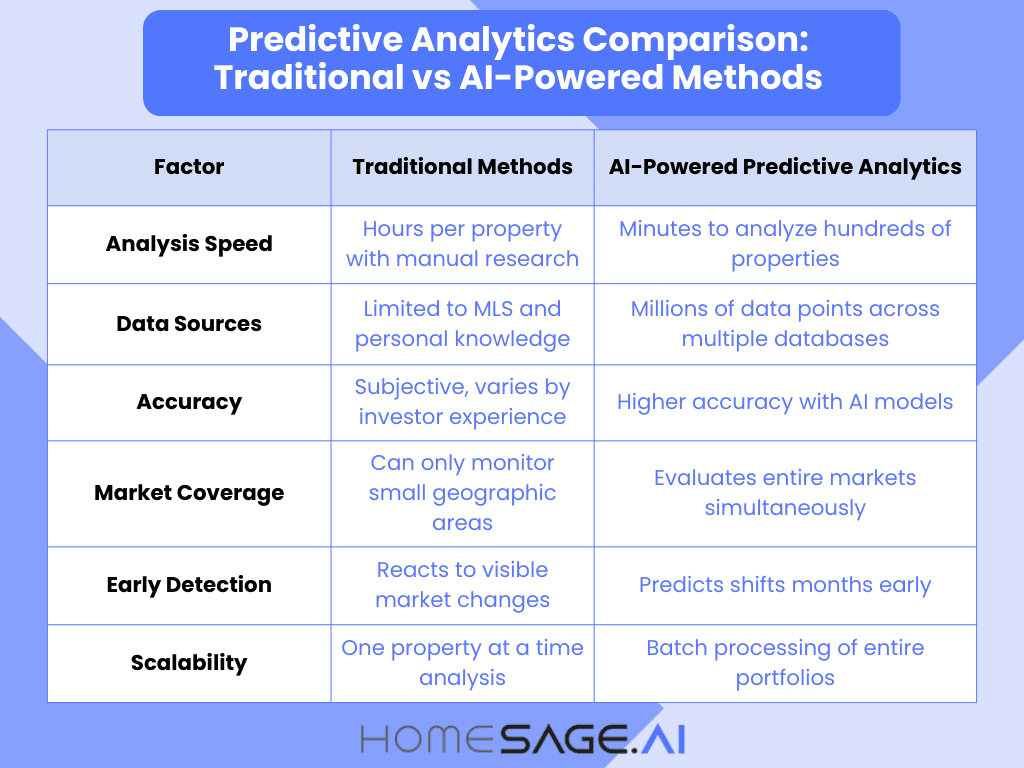
Predictive Analytics Comparison: Traditional vs AI-Powered Methods
Factor | Traditional Methods | AI-Powered Predictive Analytics |
Analysis Speed | Hours per property with manual research | Minutes to analyze hundreds of properties |
Data Sources | Limited to MLS and personal knowledge | Millions of data points across multiple databases |
Accuracy | Subjective, varies by investor experience | Higher accuracy with AI models |
Market Coverage | Can only monitor small geographic areas | Evaluates entire markets simultaneously |
Early Detection | Reacts to visible market changes | Predicts shifts months early |
Scalability | One property at a time analysis | Batch processing of entire portfolios |
Applications for Different Investment Strategies
Fix-and-Flip Analysis
Predictive analytics transforms fix-and-flip investing by identifying properties where purchase price plus renovation costs leave substantial profit margins. The Flip Return API estimates anticipated returns from buying, renovating, and selling properties, detailing all costs, expected sale price, and ROI in comprehensive reports.
Rental Property Investment
Buy-and-hold investors use predictive analytics to find undervalued properties in neighborhoods poised for appreciation while generating immediate cash flow. The Long-Term Rental API and Short-Term (Airbnb) Rental API provide estimated rental values and financial metrics, including cash flow projections, cap rates, and annual returns.
Hard Money Lending
Lenders use predictive analytics to verify that property values support requested loan amounts. Homesage.ai‘s comprehensive property reports give lenders confidence that they’re funding viable projects rather than overleveraged gambles. This intelligence reduces default risk while enabling lenders to approve more loans in strong markets.
Overcoming Common Challenges
Predictive accuracy depends entirely on data quality. Properties with incomplete listing information or limited comparable sales reduce model confidence. The best approach combines AI predictions with human expertise, creating hybrid models that deliver higher accuracy than either method alone.
Algorithms trained on typical residential properties struggle with unique homes that have custom features or limited comparables. For these properties, use predictive analytics as a starting point, but supplement with professional appraisals.
In rapidly changing markets, select platforms that continuously update data rather than rely on monthly or quarterly refreshes. Real-time integration ensures valuations reflect current market dynamics rather than outdated information.
Key Takeaways
- Predictive analytics achieves 82-91% accuracy in identifying undervalued properties by processing market data at scales impossible for manual analysis
- Computer vision technology like Homesage.ai‘s Property Condition API assesses property condition from photos, spotting renovation opportunities that create instant equity without site visits
- AI-powered platforms combine Property Condition, Investment Potential, Renovation Cost, and Price Flexibility analysis to provide comprehensive undervaluation insights in minutes
- Early market detection capabilities flag neighborhood appreciation trends three to six months before they become obvious, giving investors first-mover advantages
- Hybrid approaches combining predictive analytics with human expertise deliver superior results compared to either method alone
- Hard money lenders use predictive valuations to set appropriate loan-to-value ratios and reduce default risk on investment property loans
Conclusion
The real estate investors and lenders who consistently find undervalued properties in 2026 leverage predictive analytics to process market intelligence at scales that manual methods cannot match. They identify mispriced properties before competition recognizes their value.
Predictive analytics doesn’t replace investor judgment or local market expertise. Instead, it amplifies your capabilities by screening thousands of properties to surface the handful worth your detailed attention. This efficiency advantage lets you evaluate more opportunities, make faster decisions, and deploy capital into deals with a higher probability of success.
Whether you’re flipping houses, building rental portfolios, or underwriting investment property loans, integrating AI-powered property analysis into your workflow helps you make smarter decisions and identify opportunities others miss.
Frequently Asked Questions
Q: How accurate is predictive analytics for finding undervalued properties?
A: Advanced predictive analytics platforms achieve close to 94% accuracy rates when identifying undervalued properties and forecasting market trends. These systems use AI algorithms trained on millions of transactions to detect pricing anomalies that manual analysis misses.
The most accurate approach combines AI predictions with local market expertise, creating hybrid models that outperform either method alone.
Q: What data sources do predictive analytics platforms use?
A: Comprehensive predictive analytics platforms aggregate data from Multiple Listing Services, public property records, tax assessments, historical transaction databases, demographic information, economic indicators, school ratings, crime statistics, and infrastructure development plans.
Platforms like Homesage.ai process data across over 140 million properties, ensuring broad market coverage.
Q: Can predictive analytics help with rental property investments?
A: Yes, predictive analytics is highly effective for rental property analysis. Homesage.ai‘s Long-Term Rental API and Short-Term (Airbnb) Rental API provide estimated rental values, cash flow projections, cap rates, and ROI calculations for both rental strategies.
The technology identifies undervalued properties in neighborhoods with strong rental demand, helping investors find deals that generate immediate cash flow while appreciating over time.
Q: How often should I update my predictive analytics data?
A: In stable markets, weekly updates typically suffice for most investment strategies. However, in rapidly changing markets or highly competitive areas, daily data updates provide significant advantages by catching new listings and price reductions before other investors. The best platforms offer real-time data integration that continuously monitors market changes.





Mike February 4, 2026
Investors who adapt to the new technologies will have an dvantage in finding details
Mia February 4, 2026
Insightful!
Emma February 4, 2026
This is very helpful, thanks!
Chris February 4, 2026
Nice breakdown, thanks for sharing!