
78% of homeowners exceeded their budget on their most recent renovation project, according to research from GreatBuildz published in CCR Magazine. For real estate investors, that number isn’t a homeowner statistic; it’s a direct threat to ARV projections, hard money loan coverage, and deal profitability.
A renovation estimate that’s off by 15% on an $80,000 scope means $12,000 in unexpected costs before you’ve collected a dollar in rent or sale proceeds.
AI renovation cost calculators promise to change this, delivering fast, data-backed estimates without a contractor on-site. But in 2026, how close do these tools actually get to what a licensed contractor will bid? The answer depends on property condition, local market dynamics, and how you sequence these tools in your workflow.

If you’re evaluating specific platforms, our guide to the 4 best AI renovation cost estimators in 2026 compares tools by accuracy and feature set. For a broader look at how the underlying technology works, we’ve also covered how AI calculates renovation costs in detail.
What AI Renovation Cost Calculators Actually Measure
AI renovation cost calculators estimate project costs by analyzing large databases of historical project data, regional labor and material rates, and property-specific inputs. Most investor-grade tools generate results in minutes without anyone physically inspecting the property.
Standard inputs these tools evaluate include:
- Project type (kitchen remodel, full gut renovation, roof replacement)
- Local labor rate indexes by ZIP code
- Current material pricing benchmarks updated for market conditions
- Property condition signals: advanced tools now incorporate computer vision
- Scope complexity benchmarked against comparable past projects
The output is typically a cost range or line-item breakdown by trade category: demolition, framing, plumbing, electrical, finishes, and HVAC. Some tools also layer in ROI projections, showing investors which renovation categories are likely to recover cost at resale.
How Accurate Are AI Renovation Cost Calculators vs. Contractor Bids?
Where AI Renovation Estimators Perform Well
Research published in 2026 by construction estimating analysts found that AI-powered estimating tools can improve bid accuracy by 20.4% compared to manual estimation and achieve less than 5% variance from actual project costs when the renovation scope is clearly defined.
For real estate investors, this matters most on predictable renovation categories: flooring replacement, interior paint, kitchen cabinet refreshes, bathroom vanity upgrades, and roof repairs. A tool within 5% on a $50,000 kitchen renovation is within $2,500 of the contractor’s number, an acceptable margin for pre-offer analysis on a standard value-add deal.
Where AI Renovation Estimators Fall Short
Three scenarios consistently push AI calculator accuracy beyond acceptable thresholds for investors:
- Hidden damage and structural surprises. Water intrusion, foundation movement, and deferred maintenance can’t be detected from a database. A contractor walking the property identifies these on-site. AI estimates built from inputs alone do not.
- Local labor market volatility. In supply-constrained metros, licensed trades can run 30–40% above regional averages. AI tools calibrated to national benchmarks miss current local subcontractor pricing.
- Non-standard or severely distressed properties. AI tools are trained primarily on median-market project data. Historic homes, heavily distressed assets, and properties with atypical configurations produce estimates with significantly wider variance ranges.
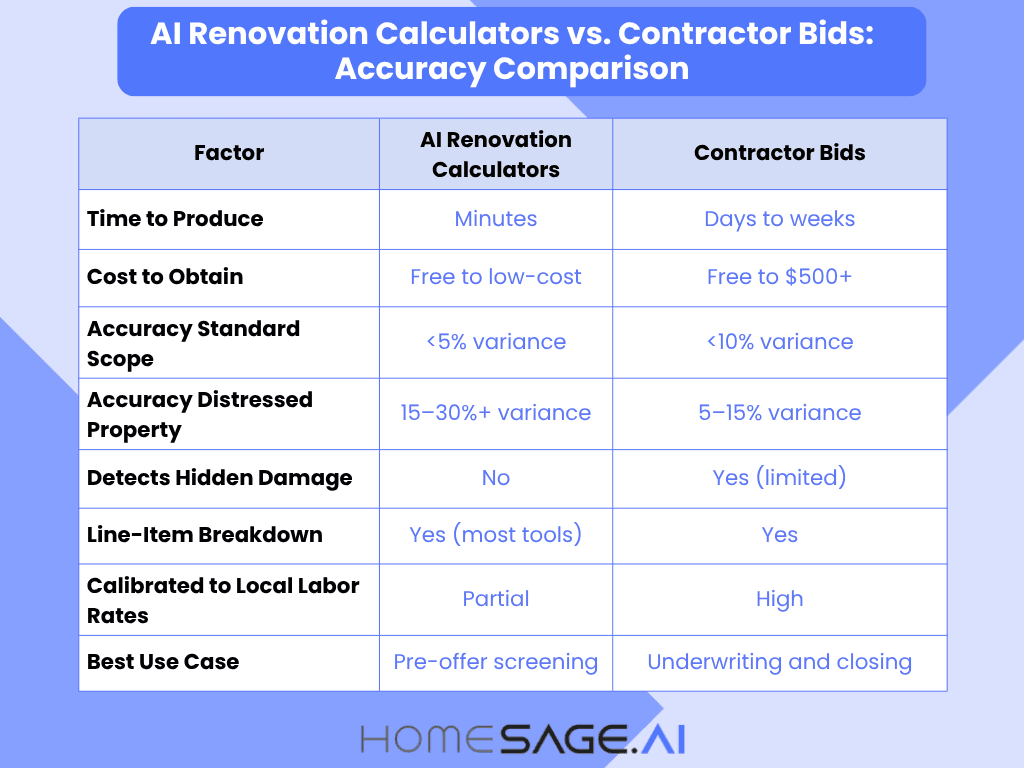
The result: AI calculators frequently underestimate costs on exactly the properties real estate investors compete for: distressed assets priced below market with deferred maintenance backlogs that only reveal themselves during a walkthrough.
AI Renovation Calculators vs. Contractor Bids: Accuracy Comparison
| Factor | AI Renovation Calculators | Contractor Bids |
|---|---|---|
| Time to Produce | Minutes | Days to weeks |
| Cost to Obtain | Free to low-cost | Free to $500+ |
| Accuracy Standard Scope | <5% variance | <10% variance |
| Accuracy Distressed Property | 15–30%+ variance | 5–15% variance |
| Detects Hidden Damage | No | Yes (limited) |
| Line-Item Breakdown | Yes (most tools) | Yes |
| Calibrated to Local Labor Rates | Partial | High |
| Best Use Case | Pre-offer screening | Underwriting and closing |
What the Data Says About Renovation Cost Accuracy in Real Estate
The 2025 Cost vs. Value Report from Zonda benchmarks 28 renovation project types across 115 U.S. markets. It shows that cost recovery and project economics vary dramatically by geography; a kitchen remodel in the Pacific region recovers at a different rate than the same project in the Midwest.

Investors relying on AI tools benchmarked to national data make pre-offer decisions on averages that may not reflect the specific submarket where the deal is located.
The 2025 NAR/NARI Remodeling Impact Report reinforces this for the most common investor renovation targets. Kitchen upgrades generate the highest demand signal from Realtors (48%), followed by new roofing (43%) and bathroom renovations (35%), but cost recovery for each varies significantly based on finish level, local buyer preferences, and market conditions.
These nuances are difficult for an AI tool to capture without local, transaction-level data.
For investors focused on ARV-driven underwriting, the renovation cost question is inseparable from valuation. Our guides on how to calculate ARV with AI and AI tools for estimating property ARV cover the valuation side of this equation in depth.
See our roundup of the best real estate AVM tools.A Three-Step Workflow for Real Estate Investors
The right approach isn’t choosing between AI estimates and contractor bids. It’s sequencing them correctly in your deal analysis process.
- Screen with AI. During initial analysis, run an AI renovation estimate to filter out deals where costs would push ARV-based returns below your target threshold. This takes minutes and prevents wasted site visits on non-viable deals before contractor availability becomes a bottleneck.
- Validate with contractors. For deals that pass your screening filter, get two to three contractor bids before going under contract. The AI estimate is your floor; the contractor bid is your real number.
- Underwrite with the blend. Weight contractor bids more heavily in your financial model. Use the AI estimate as a calibration check. A contractor bid 35% above the AI estimate may signal hidden damage or scope padding, both worth investigating before you commit.
Homesage.ai’s Full Property Reports embed renovation cost estimates directly into the deal analysis workflow, alongside ARV calculations, comparable sales, and rental projections.
The platform analyzes 155M+ US properties, giving investors renovation cost data calibrated against a depth of comparable transactions that standalone estimating tools can’t match.
For a complete guide to applying AI across the entire fix-and-flip process, from deal sourcing through ARV modeling, our complete fix-and-flip AI guide covers each stage.
Key Takeaways
- AI renovation cost calculators achieve less than 5% variance on standard, clearly-scoped projects, a useful margin for pre-offer screening
- Accuracy drops to 15–30%+ variance on distressed or non-standard properties, the category real estate investors target most
- AI estimates are most valuable at the screening stage; contractor bids remain essential for closing-stage underwriting
- AI tools calibrated to local transaction data significantly outperform tools relying on national cost averages
- The optimal investor workflow uses AI for speed and contractors for precision, not one or the other
Homesage.ai’s Full Property Reports include AI-generated renovation cost estimates alongside ARV, comps, and rental projections. Here’s a quick look at what’s inside:
Conclusion
AI renovation cost calculators have improved substantially in 2026, and for filtering deal flow before a contractor ever visits a property, they save real time. For standard renovation scopes, accuracy is solid enough to support pre-offer analysis. For distressed properties, the variance is too wide to underwrite against without a boots-on-the-ground estimate.
The investors who use these tools most effectively treat AI estimates as a pre-screening filter and contractor bids as the final input that governs deal terms. If you want renovation cost ranges integrated with ARV projections, comparable sales, and rental income data in a single property report, explore Homesage.ai’s real estate investor tools and run your next deal analysis before you make an offer.
People Also Ask
Q: How accurate are AI renovation cost calculators compared to contractor bids?
A: For standard, clearly-scoped projects, AI renovation cost calculators achieve less than 5% variance from actual costs. For distressed or complex properties, accuracy can drop to 15–30%+ variance, making contractor bids essential for final underwriting decisions.
Q: Can real estate investors use AI renovation calculators for pre-offer screening?
A: Yes. AI renovation cost calculators are well-suited for pre-offer analysis. They filter out deals where renovation costs would eliminate margins before you commit time and money to a full contractor walkthrough.
Q: What causes AI renovation cost estimates to be inaccurate?
A: The primary sources of error are hidden structural damage that can’t be detected remotely, local labor market pricing that diverges significantly from national benchmarks, and non-standard property conditions common in distressed real estate.
Q: What is the difference between an AI renovation calculator and a contractor bid?
A: An AI renovation calculator uses historical project data and regional cost indexes to produce an estimate in minutes. A contractor bid is based on an in-person site visit and reflects actual current pricing, visible site conditions, and scope specifics. Both serve different stages of the investor’s decision process.
Q: Should real estate investors get a contractor bid before buying a property?
A: For properties with visible deferred maintenance or complex renovation scope, a contractor walkthrough before going under contract is prudent. For initial deal screening, an AI estimate can eliminate non-starters without waiting on contractor availability.





Liz May 14, 2026
Very interesting article!
Emma May 14, 2026
Very informative!
Robin May 14, 2026
Incredibly helpful to investors, great read!