The official MCP site compares the protocol to a USB-C port for AI applications. That picture explains the connection. It does not tell an app builder which path to pick. The better question is who decides what gets called.
With a REST real estate API, your code decides. With an MCP server, an AI application decides. This guide compares the two on auth, control, setup effort and common risks.
How the two approaches work
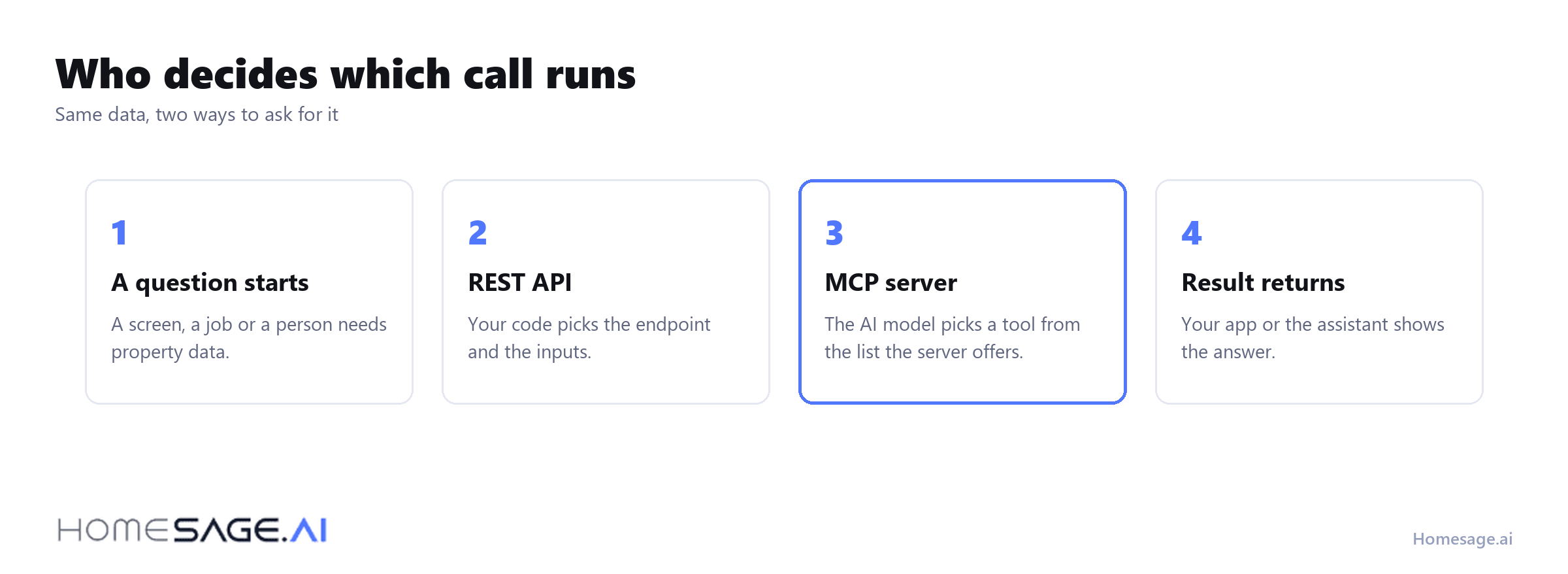
A REST real estate API exposes endpoints. Your server code picks the endpoint, sends the inputs and handles the result. Homesage.ai lists more than 30 REST endpoints and takes a Bearer key in the Authorization header of each call.
MCP uses a client-server design, described on the MCP architecture page. The host is the AI application. It creates one MCP client for each MCP server. The server is a program that provides context to those clients.
A server can offer tools, which are executable functions an AI application can invoke. It can also offer resources and prompts. The data layer uses a JSON-RPC 2.0 based protocol.
MCP supports two transports. Local servers that use stdio typically serve a single client. Remote servers that use Streamable HTTP typically serve many clients.
Decision table: REST real estate API, MCP or both
REST real estate API, MCP server or both, compared
| Factor | REST real estate API | MCP server | Both |
|---|---|---|---|
| Best for | Fixed screens, batch jobs and backend pipelines | Assistants and agents that pick data during a chat | A product with app screens and an assistant |
| Auth | Bearer key in a request header | Remote servers support bearer tokens, API keys and custom headers. MCP recommends OAuth. | Often separate credentials for the app and the assistant |
| Who calls it | Your code | The AI application, through its model | Your code for screens, the model for open questions |
| Control | Full. You choose every call, input and retry. | Shared. The model chooses tools and inputs from what the server lists. | Code owns fixed flows. The model owns open questions. |
| Setup effort | Write and test client code | Connect the server to a host that supports MCP | Both setups, plus a rule for which path owns which job |
| Common risks | Bad inputs, an expired key or unhandled errors in your code | The model picks a tool or inputs you did not expect | Duplicated logic and two sets of credentials to maintain |
As general guidance, read the table by row. If control matters most, start with the real estate API. If speed to a working assistant matters most, start with MCP.
What we checked
On 19 November 2026 we called the list_api_endpoints tool on our MCP server. It returned 33 operations that an AI application can choose from.
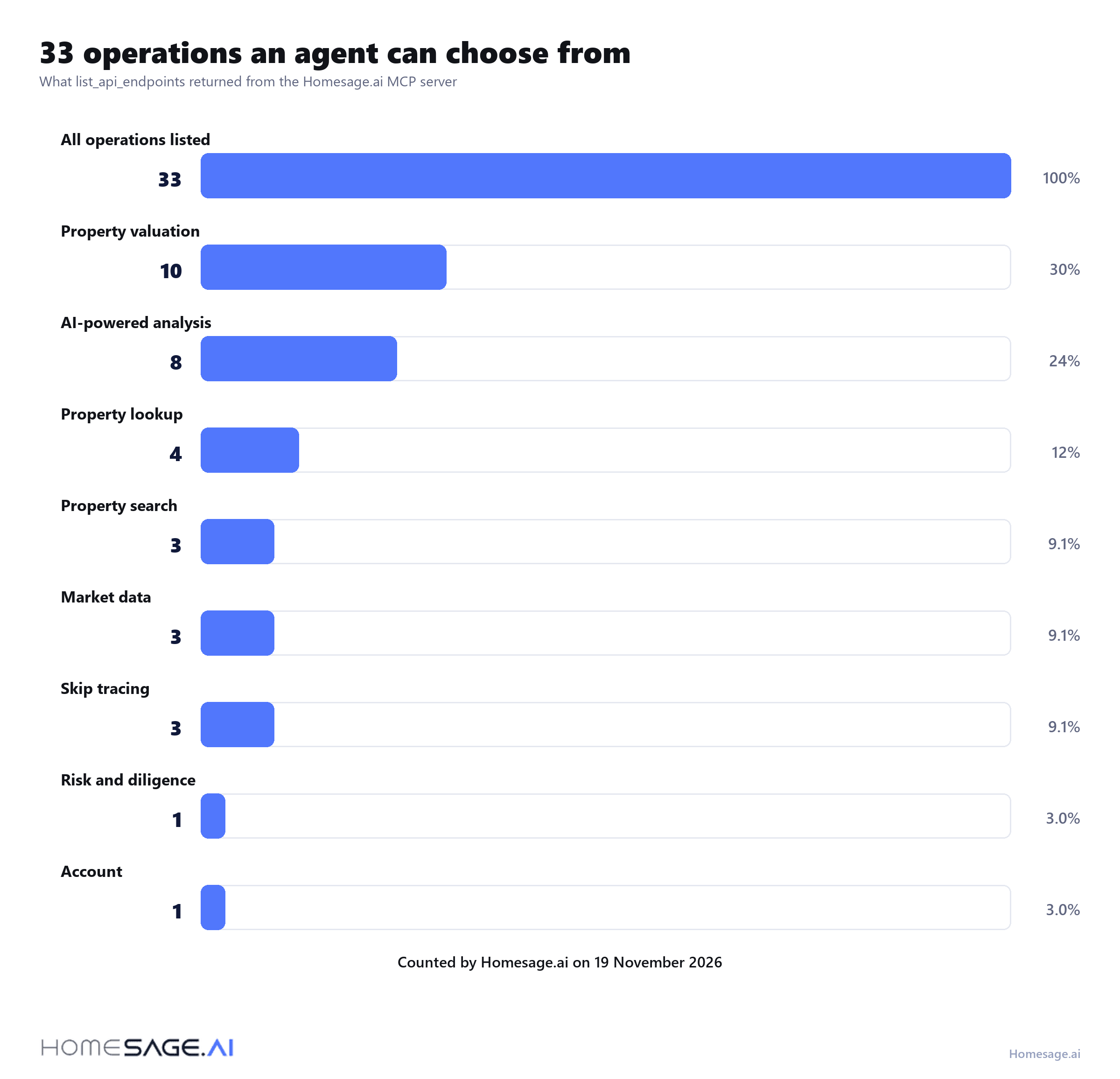
Valuation has the most, with 10, and AI-powered analysis follows with 8. For an agent, more tools means more choices to pick from. That is why the model needs clear tool names and your team needs to test its picks.
The Sage page describes more than 30 endpoints, which matches this count. Counts change as endpoints are added, so check the date.
When a real estate API is the better choice
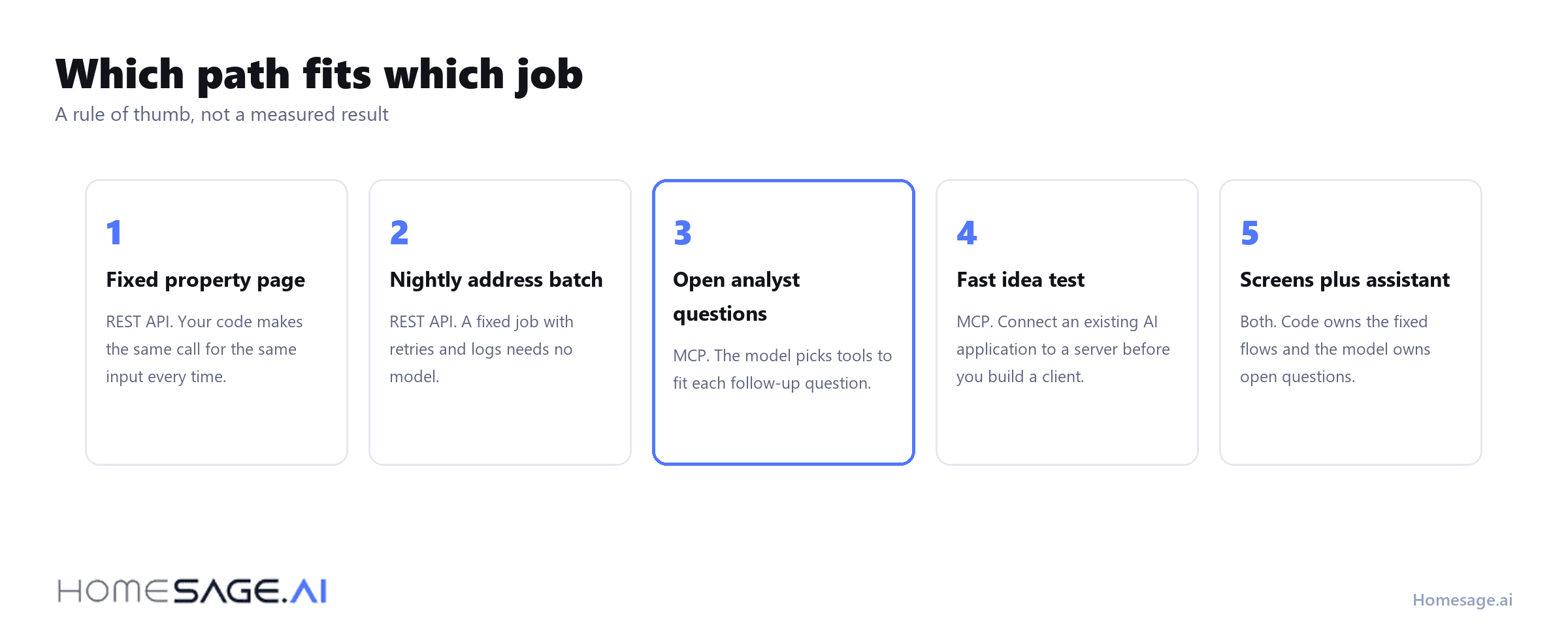
These are common rules of thumb, not measured results. Pick the REST real estate API when your app needs the same result for the same input every time. A property page that shows an estimated value is a good case. You write the call once, test it and ship it.
Pick it for batch work. A nightly job that checks a list of addresses needs fixed code, retries and logs. A model in the middle adds a step you do not need.
Pick it when cost control sits in your code. You decide each call, so you also decide when to stop. Our API also offers a search preview endpoint that you can call before the full search.
Pick it when no AI application is involved. MCP defines its host as an AI application. Without one, the real estate API is the simpler path.
The honest limit is effort. You own the client code, the error handling and every future change to your screens. If you are still choosing a provider, compare property data APIs for developers. If your product is a listing website, see how IDX and an API differ for real estate websites.
When MCP is the better choice
Another rule of thumb: pick MCP when people ask open questions. An analyst asks about one address, then follows with a question about the next step. A fixed screen cannot anticipate that sequence.
With a real estate API your code decides. With MCP the model decides, so test how it decides.
Pick it when you want to test an idea fast. A common approach is to connect an existing AI application to a server first, before you build a client. The Sage page lists MCP setup for Claude, Cursor, VS Code and Gemini CLI.
Pick it when several tools must work together. The host can connect to more than one MCP server, and the model can combine what each one offers. For a wider view, read our guide to MCP servers in real estate.
The honest limit is predictability. The model chooses the tools and the inputs, so two phrasings of one question can lead to different calls. Test the prompts your team will really use. Avoid MCP for a flow that must behave the same way every time.
A worked example in words
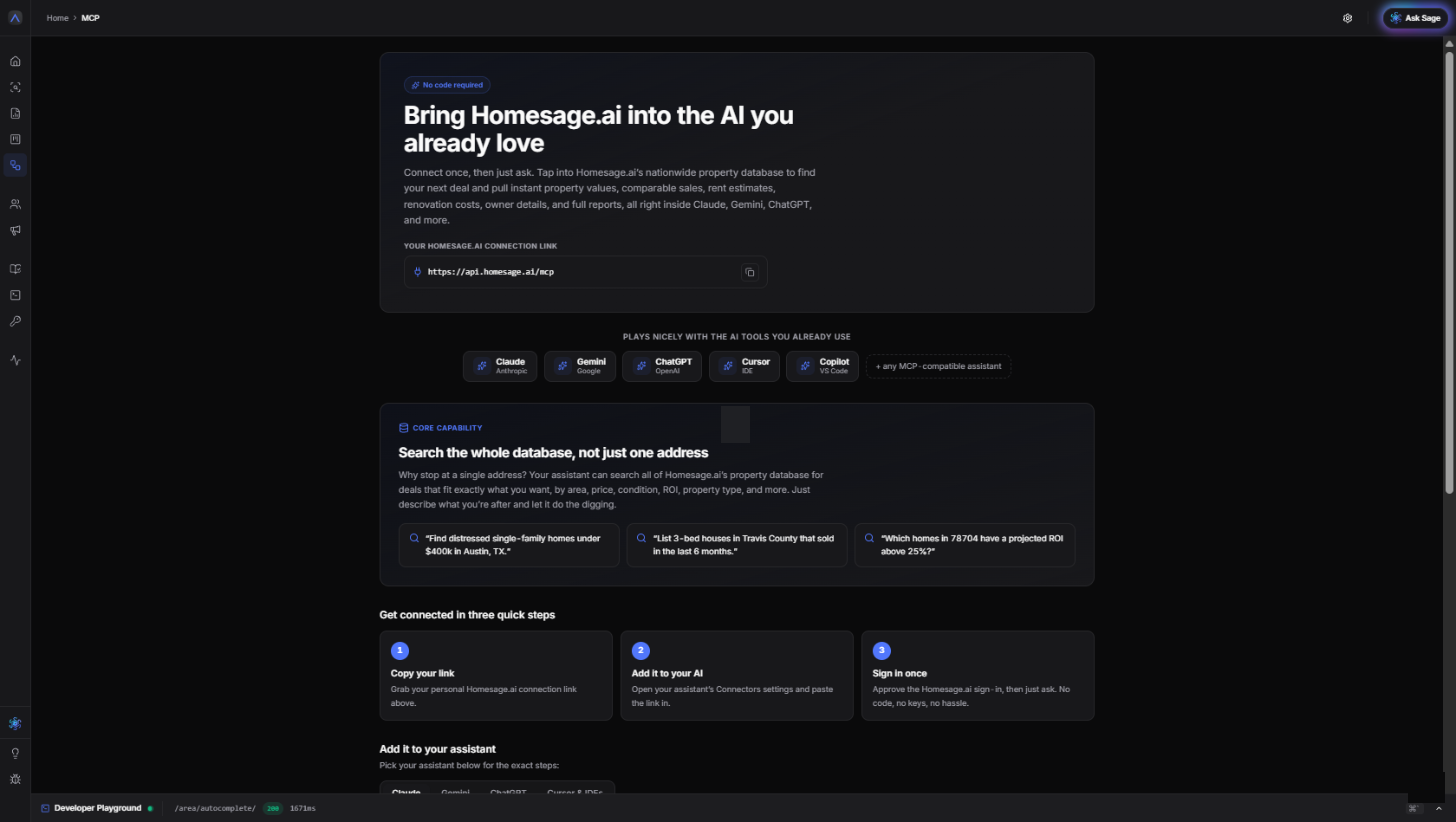
Screenshot: the MCP page in Homesage.ai, with the connection link. Select the image to enlarge.
This is a made-up scenario, not a customer story. A proptech team builds an investor portal. An investor types an address on the property page. The page needs an estimated value and an estimated rent. These are estimates, not appraisals.
The developers use the REST real estate API. They call address autocomplete as the investor types, then call the current-estimate and rental endpoints. The same input leads to the same calls, so the team writes tests and watches errors.
If an address does not match, the Homesage.ai API returns a 404 with a suggested address and no charge. The page can show that suggestion to the investor.
Next, the team’s analysts want to ask plain-English questions about a short list of addresses. Nobody wants to build a screen for each question. The team adds an MCP server to an AI application instead.
The model reads the tools the server lists and picks the ones that fit each question. An analyst reviews each answer before acting on it.
The portal does not depend on a model’s choices. The analysts do not wait for a developer. The two paths have different owners and different rules.
Security basics for both paths
A common practice is to treat every key like a password. Store it on a server, never in browser or mobile code. Give each key only the access its job needs, rotate it on a schedule and log each call.
For MCP, read the MCP security best practices before you build a server. The page lists scope minimization as a topic. It also calls token passthrough an anti-pattern. In that pattern, a server accepts tokens from a client without checking they were issued to it, then passes them to a downstream API.
The same page describes the confused deputy problem for MCP proxy servers. Read that section if your server sits in front of a third-party API.
For remote servers, the MCP authorization specification covers the flow for HTTP-based transports. It treats authorization as optional. The link points to the draft version, so confirm the current version before you build.
A common approach is to ask every vendor for its rate limits and data refresh schedule in writing. Check them in the vendor’s docs. Do not assume they match another vendor’s terms.
Key takeaways
- A REST real estate API puts your code in charge of every call. An MCP server lets an AI application choose the calls.
- MCP is an open-source standard for connecting AI applications to external systems, not a replacement for every integration.
- Choose the REST real estate API for fixed screens, batch jobs and flows that must repeat exactly.
- Choose MCP for open questions, fast tests and assistants that combine several tools.
- Use both when your product has app screens and an assistant, and give each path one clear job.
- Our check on 19 November 2026 found 33 operations on our MCP server, so test how a model picks between them.
- Limit key access, avoid token passthrough and check rate limits before launch.
Conclusion
The choice is about control. A REST real estate API gives your code full control and asks for more build effort. An MCP server gives an AI application room to choose and asks you to test how it chooses.
Many real estate products end up with both. App screens and batch jobs run on the real estate API. Analysts and agents use MCP for open questions. Give each path one job and one set of credentials.
Homesage.ai offers a real estate API and a real estate MCP server. Pick the path that matches your first use case, then add the other when a second use case appears. Start now.
Frequently asked questions
Does MCP replace a REST real estate API?
Can I use MCP without an AI application?
Which AI tools connect to the Homesage.ai MCP server?
How do I start with the Homesage.ai real estate API?
More guides in this topic ⏱ Quick reads, pick your next one
Main guide on this topicWhat is proptech? Real estate technology explained→Each page was fetched on 19 November 2026.
- Model Context Protocol, What is the Model Context Protocol (MCP)? (docs version 2026-07-28), accessed 19 November 2026
- Model Context Protocol, Architecture overview (docs version 2026-07-28), accessed 19 November 2026
- Model Context Protocol, Security best practices (docs version 2026-07-28), accessed 19 November 2026
- Model Context Protocol, Authorization specification (draft), accessed 19 November 2026
- Sage page, live product page, accessed 19 November 2026
- Our MCP server, list_api_endpoints call, run by our team on 19 November 2026
This guide is general information for app builders. It is not legal, security or investment advice. Product details are as of 19 November 2026. Check each vendor’s current docs before you build.