This guide is for a developer or product manager who is new to real estate. It explains what proptech means and its 8 main categories. It also covers who buys proptech, the data under it, and how to judge a tool before you sign.
Homesage.ai combines public records, listings and models on 160M+ US properties, so we work with all 3 data layers described in this guide.
Proptech meaning in plain words
The word joins property and technology. You will also see real estate technology, and in commercial property, CRE tech. All 3 terms mean software or data made for people who buy, rent, and lend on property.
A proptech company sells that software or data as its main product. A brokerage that uses a contact database is a proptech customer. The company that makes the database is the proptech company.
Investors put $16.7 billion into proptech and adjacent real estate technology companies worldwide in 2025. That was 67.9% more than in 2024. The figures come from the Center for Real Estate Technology & Innovation (CRETI), as reported by Multifamily Dive on 13 January 2026.
Funding kept coming in 2026. CRETI counted about $2.21 billion raised in the third quarter of 2026 alone. Both totals include debt and other financing as well as venture capital.
The 8 main categories of proptech
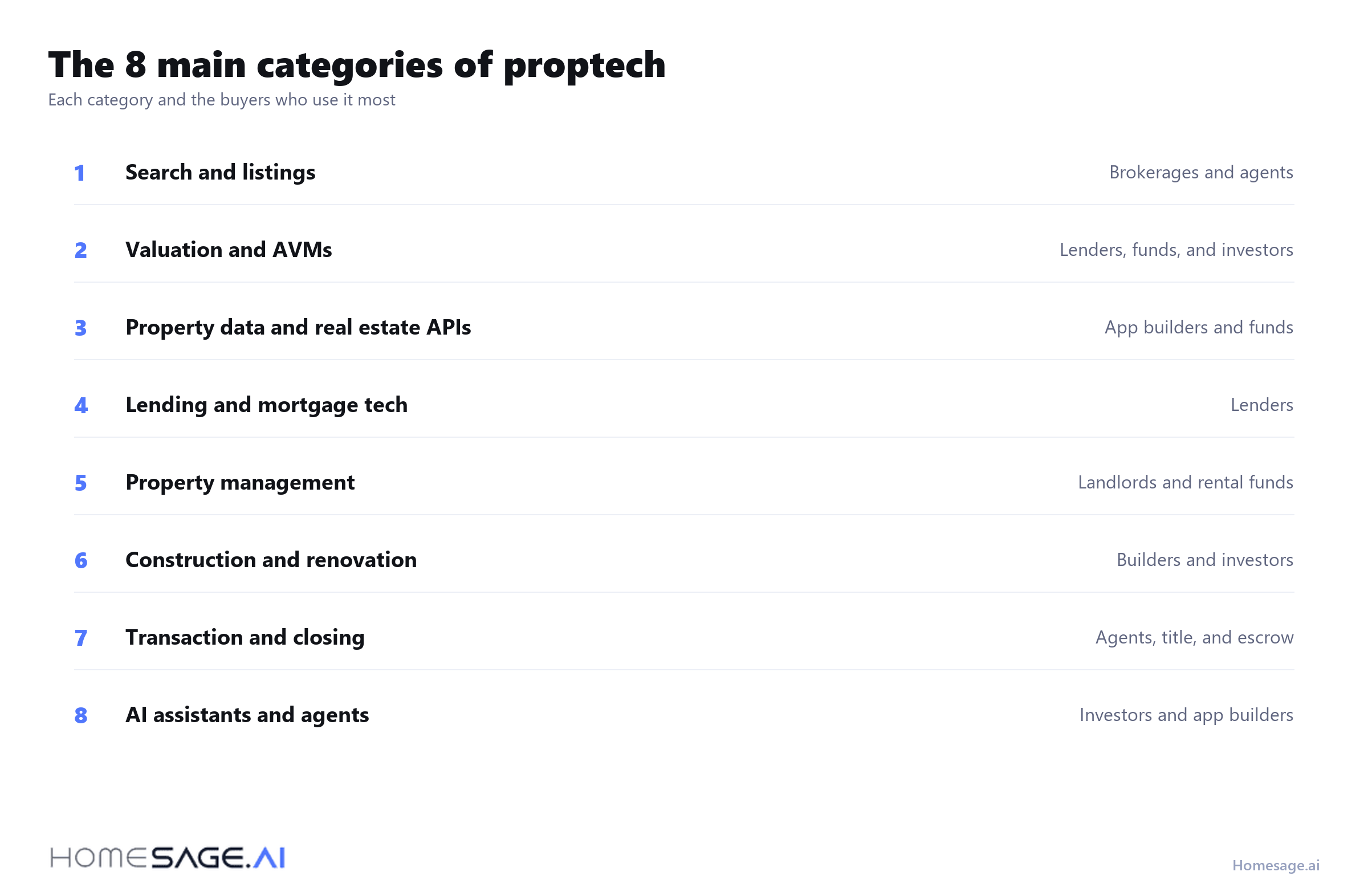
Most proptech products fit one of 8 categories, and some companies sell into more than one. The categories also lean on each other. A valuation tool needs listing data, and an AI assistant needs all of it.
1. Search and listings
Home search sites and agent tools show homes for sale or rent. Agents share listings through a multiple listing service (MLS), a database run for local brokers.
The US had 484 MLSs on 31 December 2025, 30 fewer than a year earlier. That count is from T3 Sixty’s Real Estate Almanac, per Real Estate News on 4 March 2026.
2. Valuation and AVMs
An automated valuation model (AVM) estimates a home’s value from records, past sales, and listings. Lenders, funds, and investors use AVMs to price homes in bulk.
An AVM estimate is not an appraisal. Since 1 October 2025, a federal rule has required mortgage lenders to apply quality control standards to the AVMs they use.
3. Property data and real estate APIs
Data companies gather records, sales, and listings. Then they clean the data and join it. They sell access through a real estate API, bulk files, or an MCP server for AI tools.
App builders buy these feeds so they do not have to collect county records themselves. Our guide to what a real estate API is shows how the calls work.
4. Lending and mortgage tech
Lenders buy software for loan applications, underwriting, and servicing. These tools pull credit, income, and property facts into one loan file. A lender also checks property value, liens, and condition before it funds a loan.
5. Property management
Landlords and managers use software to list rentals, collect rent, and track repairs. Single-family rental funds rely on it to run homes in different cities. Owner reports and work orders sit in the same system.
6. Construction and renovation
Builders and contractors use software to estimate costs, plan jobs, and track permits. Investors use renovation tools to price a fixer-upper before they bid. Some tools now estimate repair needs from property photos. A photo-based estimate is a starting point, and an inspection still sets the real scope.
7. Transaction and closing
This group covers e-signature, title and escrow, and online closings. E-signature is the most used technology among agents who are Realtors. The National Association of Realtors (NAR) 2025 Technology Survey found that 79% of them use it.
8. AI assistants and agents
This is the newest category. An AI assistant answers property questions in plain words. An AI agent goes further and runs tasks, such as pulling comparable sales or building a list of deals.
Both call real estate APIs and MCP servers for facts, so their answers are only as good as that data.
Who buys proptech
This guide looks at 5 groups of buyers. Each one checks different things first.
Proptech buyers and what they check first
| Buyer | What they buy | What they check first |
|---|---|---|
| Investment funds | Valuation, property data, property management | Coverage in their markets and a clear data license |
| Lenders | AVMs, loan software, property data | Quality control on every AVM they use |
| Brokerages | Search sites, contact databases, closing tools | MLS rules and whether agents will use it |
| App builders | Property data, real estate APIs, MCP servers | Documentation, cost per call, and display rights |
| Investors | Deal search, valuation, renovation estimates | Accuracy on homes they know and cost per report |
App builders sit in the middle. They buy data from the other categories and build products for the other 4 groups.
What every proptech category runs on
Under the 8 categories sit 3 layers of property data. Each tool mixes them in its own way.
Public records
Local offices record deeds, mortgages, and tax assessments. Most of this happens at the county level. The US has 3,069 county governments, per the National Association of Counties.
Formats and update schedules differ from one office to the next. A parcel number, often called an APN, is the key that joins records to one property.
MLS and listing data
Listings add the asking price, property photos, and the agent’s description. Public records do not carry these. Listings come from the 484 MLSs and from broker websites. Use rules travel with the data, so a tool that shows property photos needs the right to show them.
Models
Models turn the first 2 layers into answers. AVMs estimate value, and rent models estimate rent. Condition models grade a home from its photos. Every model output is an estimate. Good tools put a confidence score and a data date beside each one.
How proptech startups get property data gets its own guide later in this series. It compares building, buying, and licensing the data.
Test the data on addresses you know
You just saw the 3 data layers under every proptech tool. Pull one property through our API and check it against a home you know.
How AI is changing proptech
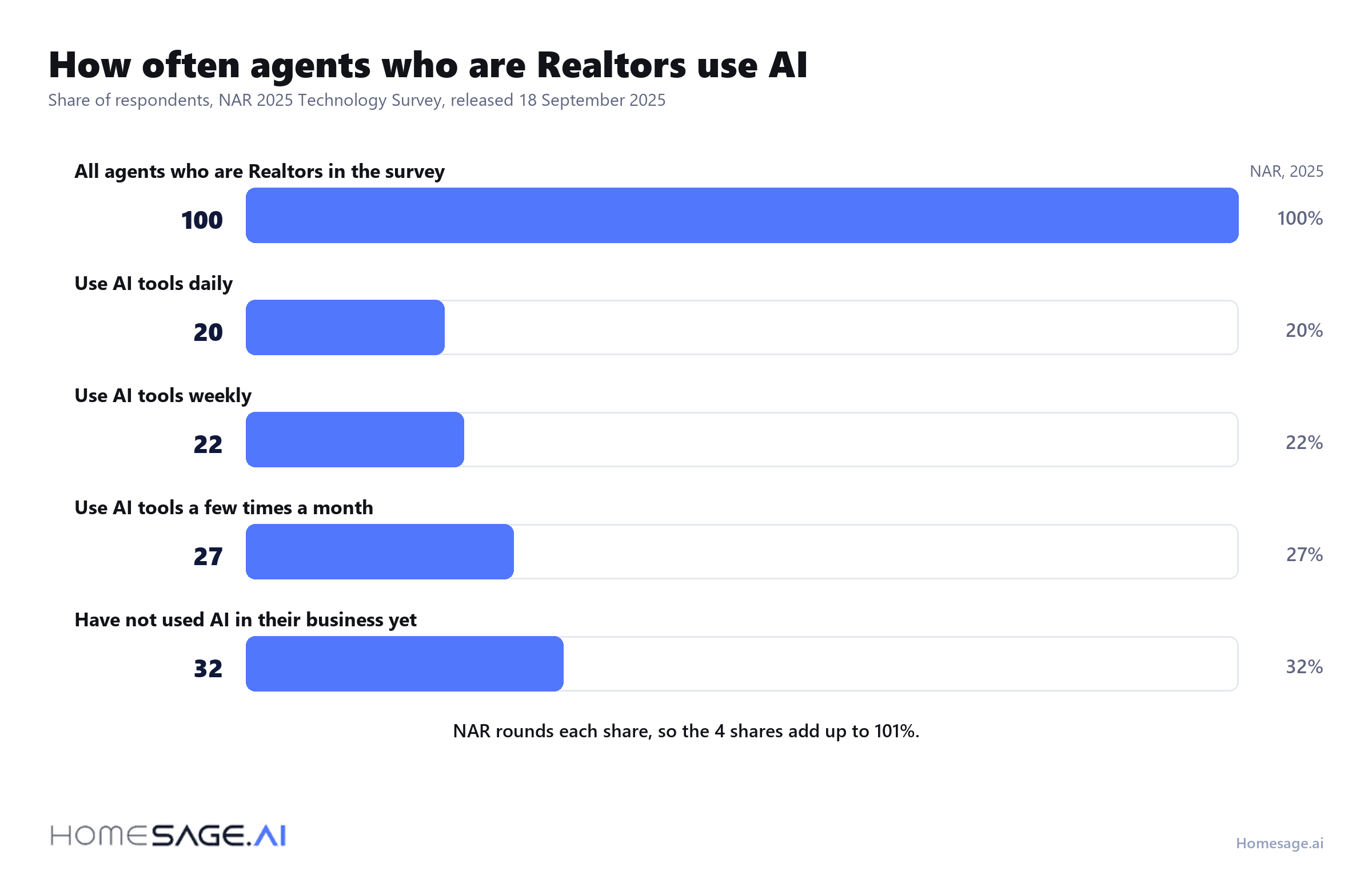
NAR’s 2025 Technology Survey found that 20% of agents who are Realtors use AI tools daily. Another 22% use them weekly and 27% a few times a month. The survey found 32% had not used AI in their business yet.
AI changes proptech work in 3 ways.
- Reading photos. Models grade property condition and flag repair needs from property photos.
- Answering questions. Assistants turn records and listings into plain answers for agents and investors.
- Running tasks. Agents call data services on their own, often through MCP.
The Model Context Protocol (MCP) is an open-source standard for connecting AI applications to outside systems. That definition comes from its official documentation. A data company that runs an MCP server lets AI assistants call its data directly.
AI does not fix bad data. A model fed stale or thin records gives confident wrong answers. Lenders must also make sure their AVMs comply with nondiscrimination laws under the federal quality control rule.
Our complete guide to AI in real estate covers uses from deal sourcing to closing. A guide to proptech trends for 2027 is coming later in this series.
How to evaluate a proptech tool
Run the same 5 checks on any proptech tool before you sign. Test it on properties you already know well.
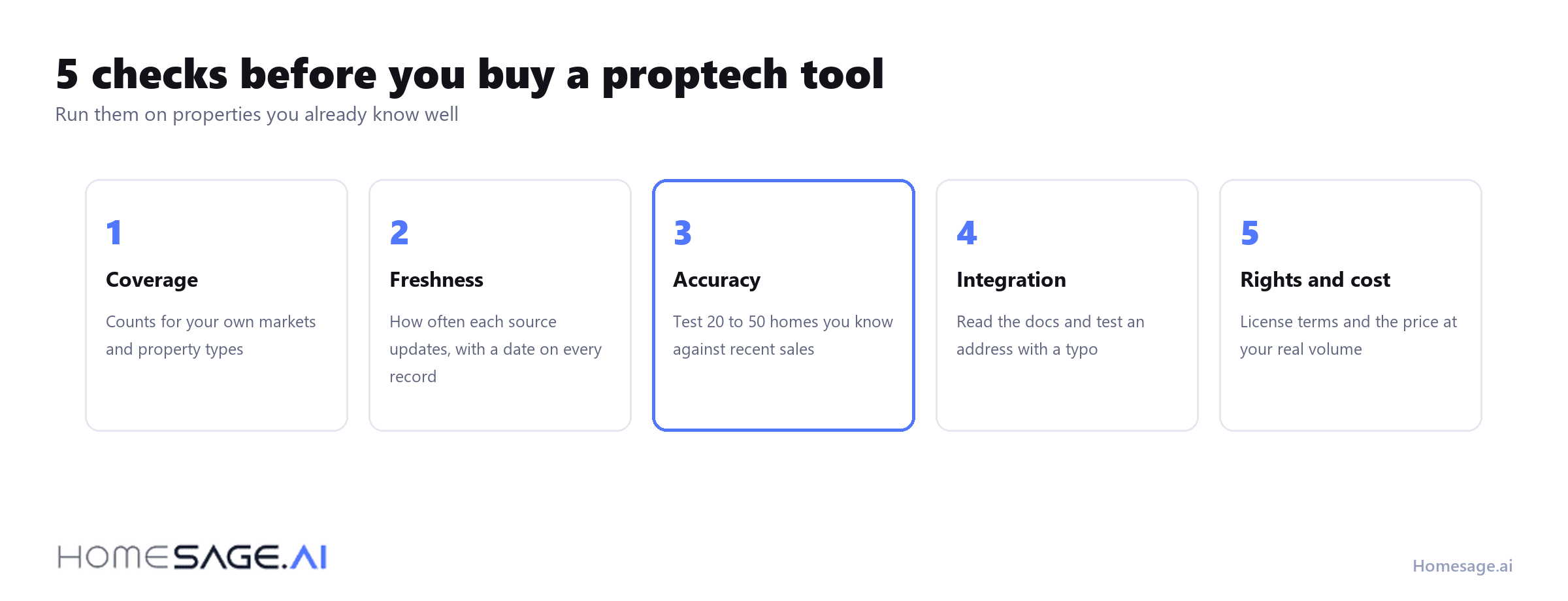
- Coverage. Ask which places and property types the tool covers. Get counts for your own markets as well as the national total.
- Freshness. Ask how often each source updates. Every record should carry a date.
- Accuracy. Run 20 to 50 homes you know and compare the estimates with recent sales. Ask for a confidence score on each estimate.
- Integration. Read the documentation before the sales call. Then test an address with a typo and see what comes back.
- Rights and cost. Read the license for display, storage, and resale. Price the tool at your real monthly volume.
Test a proptech tool on homes you know before you trust it with homes you do not.
Lenders have a sixth check. The AVM rule came from 6 federal agencies on 7 August 2024. It lists 5 quality control standards, per the Federal Housing Finance Agency (FHFA).
- A high level of confidence in the estimates
- Protection against the manipulation of data
- Steps to avoid conflicts of interest
- Random sample testing and reviews
- Compliance with nondiscrimination laws
Some teams build their own tool instead. A guide to building or buying proptech software is coming later in this series.
Proptech companies by category
A list of proptech companies is easier to use when you sort it by category. Start with the category that matches your job. Then compare 2 or 3 tools inside it. Our guide to proptech companies for investors compares 8 platforms side by side.
Where Homesage.ai fits
Homesage.ai works mainly in 2 of the 8 categories, property data and AI assistants. We provide insights on 160M+ US properties.
For app builders, our real estate API covers 33 operations, from address autocomplete to a Full Property Report. Pricing is credit-based. A current value estimate costs 2 credits, and a Full Property Report costs 15.
Our value estimates carry a confidence score from 0 to 1. When an address does not match, the API suggests the closest match and charges 0 credits.
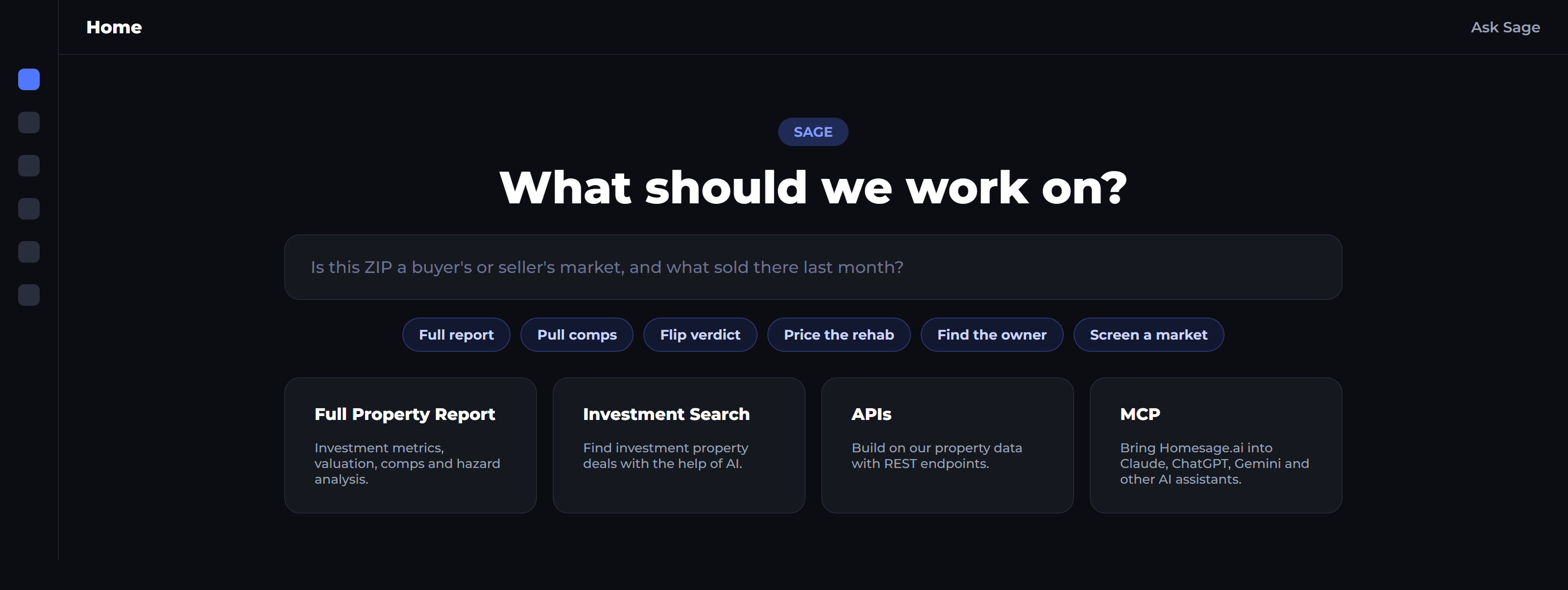
Our MCP server gives AI tools the same data. For investors, Sage is the assistant in the Homesage.ai portal and inside AI tools. It scans a whole area or analyzes one property in full.
Key takeaways
- Proptech means property technology, the software and data made for real estate.
- The 8 main categories run from search and valuation to closing tools and AI assistants.
- Every category runs on public records, listings, and the models built on them.
- Judge any tool on 5 checks, and start with accuracy on homes you know.
- An AVM estimate is not an appraisal, and lenders must apply quality control to their AVMs.
Conclusion
Proptech is a broad label, but it is easy to read once you sort tools into 8 categories. Every one of them runs on the same 3 data layers: public records, listings, and models.
Today, pick the category that matches your job. Then test 2 or 3 tools on addresses you already know, and read each license before you build on it.
Homesage.ai gives app builders insights on 160M+ US properties through a real estate API with 33 operations, plus an MCP server for AI tools. Start with one address you know well.
Ask Sage about any property
See how an AI assistant answers a property question from real data.
Frequently asked questions
What is proptech?
What is a proptech company?
What are examples of proptech?
Is an AVM estimate the same as an appraisal?
How is AI used in proptech?
What data do proptech apps use?
- Multifamily Dive on the CRETI 2025 proptech funding analysis, 13 January 2026
- CRETI, State of Proptech Venture Capital Q3 2026, 5 October 2026
- Real Estate News on the T3 Sixty MLS count, 4 March 2026
- NAR 2025 Technology Survey release, 18 September 2025
- FHFA, AVM quality control final rule, 89 Fed. Reg. 64538, 7 August 2024
- National Association of Counties, What are counties, read 14 November 2026
- Model Context Protocol documentation, read 14 November 2026
This guide describes types of software and one federal rule. It is not legal or lending advice, and it is not investment advice. A value estimate is not an appraisal.
Published 19 November 2026. Sources read 14 November 2026. Not legal, lending, or investment advice.