
Real estate platforms in 2026 face a critical decision: continue with legacy data providers that slow innovation, or switch to modern alternatives that deliver speed, accuracy, and AI-powered intelligence.

For IT developers and real estate and PropTech companies, the cost of staying with outdated providers now outweighs the friction of migration Start by choosing the right property data API..
Data quality issues, integration challenges, and a lack of intelligent analytics are pushing platforms to reevaluate provider relationships. Industry reports show that data challenges remain among the biggest impediments to PropTech innovation, with inconsistent quality, high costs, and poor interoperability driving platforms toward modern solutions.
Modern data providers like Homesage.ai are changing expectations by delivering AI-powered property intelligence, real-time updates across 140+ million properties, and developer-friendly APIs that integrate in days rather than months.
This guide explores why platforms are switching data providers, what triggers migration, and how to evaluate alternatives.
The Main Factors Driving Migration
Data Quality and Accuracy Problems
The most common trigger for switching real estate data providers is unreliable data quality. Platforms encounter missing fields, outdated information, and inconsistent formatting that require extensive cleanup before use.
Legacy providers often aggregate data from multiple sources without proper validation, leading to incorrect addresses, outdated listing statuses, or missing critical fields such as square footage or tax assessments. For platforms that promise real-time property intelligence, these gaps undermine credibility.
Modern providers solve this through AI-powered validation that automatically identifies and corrects inconsistencies.
Platforms like Homesage.ai implement multi-layer verification processes that ensure data accuracy before delivery, significantly reducing downstream errors.
Integration Complexity Creates Technical Debt
Technical integration challenges drive many migrations. Legacy providers deliver data in outdated formats, poorly documented APIs, or via file-based transfers that require custom parsing logic.
These patterns create technical debt, slowing feature development and increasing maintenance costs. Development teams spend valuable time building workarounds for API limitations rather than creating user-facing features that differentiate their platforms.
Modern providers offer RESTful APIs with comprehensive documentation, interactive testing environments, and SDKs in popular languages. This developer-first approach reduces integration time from weeks to days.
Performance Limitations at Scale
As platforms grow, legacy infrastructure often can’t keep pace. Slow response times, rate limiting, and downtime during peak hours create frustrating user experiences.
Platforms scaling to thousands of concurrent users need sub-100ms response times and 99.9% uptime guarantees. Legacy providers built on older infrastructure rarely meet these standards, forcing platforms to implement complex caching and fallback systems.
The AI Intelligence Gap
Missing AI-Powered Analytics
The most significant competitive disadvantage of legacy providers is the absence of AI-powered property intelligence.
Traditional providers offer raw property information: listing prices, square footage, sales history, but lack the analytical layer that transforms data into actionable insights Compare modern options in the best real estate data providers..
Modern PropTech users expect AI-driven features like:
- Automated property condition assessment from photos
- Investment potential scoring with ROI projections
- Price flexibility analysis for negotiation strategy
- Renovation cost estimates with local market data
- Rental income forecasting for multiple strategies
Homesage.ai delivers these capabilities through specialized and well-documented APIs that combine computer vision, AI, and real-time market analysis. This intelligence layer creates competitive differentiation that raw data alone cannot provide.
Computer Vision for Property Assessment
One of the most transformative AI capabilities is computer vision for property condition analysis. Modern providers analyze listing photos to identify renovation needs, structural issues, and maintenance requirements instantly, capabilities impossible with traditional providers.
This visual intelligence enables remote property evaluation, automated condition scoring, and renovation cost estimation without site visits. For platforms serving investors or remote buyers, this feature alone justifies migrating to a provider.
Cost Structure and Transparency Issues
Hidden Fees and Unpredictable Pricing
Legacy providers often employ complex pricing models with hidden fees, overage charges, and unclear billing structures. Platforms report discovering unexpected costs for API calls, data refreshes, or access to “premium” fields that should be standard.
This unpredictability makes budgeting difficult and creates friction between technical and finance teams. Platforms need transparent, usage-based pricing that scales predictably with growth.
Modern Usage-Based Models

Forward-thinking providers offer transparent pricing with clear per-request costs, flexible credit-based systems, and free testing tiers. This approach aligns provider incentives with platform success, and costs scale proportionally with usage rather than through arbitrary tier jumps.
Platforms like Homesage.ai offer upfront pricing calculators and generous free tiers that let development teams test integrations before making a financial commitment.
Real-Time Data Requirements
Batch Updates Fall Short
Legacy providers typically update data daily or weekly through batch processes. In fast-moving 2026 markets, this latency creates a competitive disadvantage. Properties sell within hours of listing; prices adjust rapidly; market conditions shift constantly.
Platforms need real-time or near-real-time data feeds that reflect current conditions. Users expect to see new listings within minutes, price changes to be reflected immediately, and market metrics to be updated continuously.
Event-Driven Architecture
Modern providers support webhook integrations that push updates to platforms when significant events occur, such as new listings, price reductions, status changes, or market shifts. This event-driven architecture eliminates polling, reduces API calls, and ensures platforms display current information without manual refresh.
Developer Experience Matters
Poor Documentation Slows Integration
Developer experience often determines whether integration succeeds or fails. Legacy providers frequently offer minimal documentation, limited code examples, and slow support response times.
Development teams waste days troubleshooting undocumented API behaviors or waiting for support responses. This friction extends integration timelines and frustrates technical teams.
Developer-First Approach
Modern providers prioritize developer experience through:
- Comprehensive interactive documentation
- SDKs in multiple languages
- Code examples for common use cases
- Sandbox environments for testing
- Responsive technical support
- Active developer communities
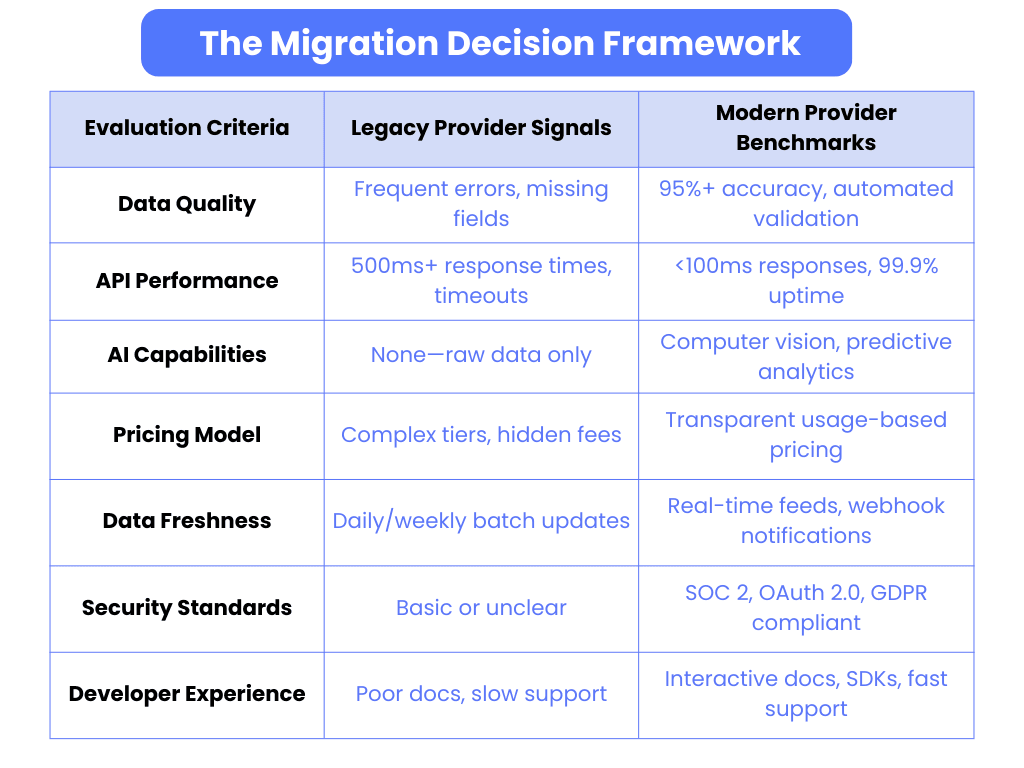
The Migration Decision Framework
Evaluation Criteria | Legacy Provider Signals | Modern Provider Benchmarks |
Data Quality | Frequent errors, missing fields | 95%+ accuracy, automated validation |
API Performance | 500ms+ response times, timeouts | <100ms responses, 99.9% uptime |
AI Capabilities | None—raw data only | Computer vision, predictive analytics |
Pricing Model | Complex tiers, hidden fees | Transparent usage-based pricing |
Data Freshness | Daily/weekly batch updates | Real-time feeds, webhook notifications |
Security Standards | Basic or unclear | SOC 2, OAuth 2.0, GDPR compliant |
Developer Experience | Poor docs, slow support | Interactive docs, SDKs, fast support |
Key Takeaways
- Real estate platforms are switching data providers due to persistent quality issues, integration complexity, and performance limitations that create competitive disadvantages in 2026’s markets.
- The AI intelligence gap drives migration, legacy providers offer raw data while modern alternatives deliver computer vision property assessment, predictive analytics, and investment intelligence that users expect.
- Pricing transparency matters; hidden fees and unpredictable costs contrast sharply with usage-based models that scale predictably with platform growth.
- Real-time data requirements exceed legacy batch-update capabilities; platforms need webhook integrations and event-driven architectures that deliver market changes instantly.
- Developer experience determines integration success: comprehensive documentation, responsive support, and modern SDKs reduce implementation time from weeks to days.
- Platforms like Homesage.ai demonstrate how AI-powered property intelligence, developer-first design, and transparent pricing create competitive advantages that justify migrating to the provider.
If you want a clear next step after these key takeaways, this walkthrough shows how to integrate Homesage.ai real estate APIs and start switching from a legacy data provider with minimal friction.
Conclusion
The landscape of real estate data providers has fundamentally changed. Platforms tolerating legacy provider limitations, inconsistent data, slow performance, and the absence of AI capabilities risk losing users to competitors offering superior intelligence and experiences.
Migration friction is real, but the opportunity cost of staying with outdated providers now exceeds switching costs. Platforms that migrate gain AI-powered features, faster performance, better developer experiences, and pricing models that support sustainable growth.
The PropTech winners in 2026 aren’t necessarily those with the largest user bases; they’re platforms making strategic infrastructure decisions that enable rapid innovation and superior user value.
Frequently Asked Questions
Q: How long does it typically take to switch real estate data providers?
A: Basic integration with modern providers takes 1-2 days using RESTful APIs and comprehensive documentation, though complete migration, including testing, typically requires 2-4 weeks depending on platform complexity. Providers offering parallel access during transition periods minimize downtime and migration risk.
Q: What are the biggest risks when switching data providers?
A: Primary risks include temporary data inconsistencies during transition, API endpoint changes requiring code updates, and differences in data structure or field naming conventions. Mitigation strategies include running providers in parallel during testing, implementing comprehensive data validation, and using abstraction layers that isolate provider-specific code.
Q: How can platforms evaluate data quality before committing to a new provider?
A: Request free trial access or sandbox environments to test data quality with your specific use cases. Compare sample data against known properties, validate completeness of required fields, test edge cases, and measure API response times under realistic load. Homesage.ai and other modern providers offer generous testing tiers for evaluation.
Q: Do AI-powered data providers cost significantly more than legacy options?
A: Not necessarily; while AI capabilities add value, transparent usage-based pricing often results in lower total costs compared to legacy providers with hidden fees and tier-based restrictions. Platforms pay for actual usage rather than pre-purchasing access tiers, creating better alignment between costs and platform growth.
In most cases, a provider switch starts with a diagnosis. Before changing vendors, engineering teams need to determine whether the root cause is the provider or the architecture itself. If your platform is showing P95 latency spikes, schema drift, or stale AI inputs, our breakdown of the underlying real estate data stack architecture identifies the failure layer and covers the 5-layer fix that enterprise PropTech teams are applying in 2026.




N February 8, 2026
Great read
Robin February 8, 2026
Insightful!
Ty February 8, 2026
Very relevant insight
Mike February 8, 2026
Data is the most important thing for good AI outputs