Introduction
The world of real estate valuation is complex, blending market dynamics, property characteristics, and expert opinion.
See our roundup of the best real estate AVM tools.In recent decades, technology has significantly streamlined this process through Automated Valuation Models (AVMs). But a crucial question lingers: do these automated tools truly understand the nuances of a property, particularly its physical condition?
Traditionally, the answer has been ‘not really,’ but advancements, particularly from innovators like Homesage.ai, are changing the landscape.
What is an AVM and Why is it Important?
An Automated Valuation Model (AVM) is a computer software program that uses mathematical modeling combined with databases of property information to calculate a real estate value estimate.
Think of it as a sophisticated algorithm designed to provide a quick, data-driven snapshot of what a property might be worth at a specific point in time.
AVMs typically rely on:
- Public Records: Tax assessments, deeds, property transfers.
- Multiple Listing Service (MLS) Data: Property characteristics (square footage, beds, baths, lot size), listing prices, days on market, and final sales prices of comparable properties (comps).
- Historical Price Trends: Analyzing market appreciation or depreciation in the area.
- Proprietary Data: Some AVM providers incorporate additional unique data sets.
The Importance of AVMs:
AVMs have become indispensable tools across the real estate and finance industries for several reasons:
- Speed and Efficiency: They deliver value estimates almost instantaneously, compared to the days or weeks required for a traditional appraisal.
- Cost-Effectiveness: AVMs are significantly cheaper than manual appraisals, allowing for broader application.
- Scalability: Lenders and investors can evaluate large portfolios of properties quickly.
- Consistency: Based on algorithms, they offer a degree of objectivity and consistency, removing subjective human bias (though algorithmic bias can exist).
The Achilles’ Heel: Property Condition
Despite their strengths, traditional AVMs have historically struggled with one critical factor: property condition.
Most standard data sources lack detailed, objective information about whether a house has a brand-new gourmet kitchen or one desperately needing a complete overhaul, a pristine roof or one nearing the end of its life.
An AVM might know the square footage, number of bathrooms, and the sale price of the house next door, but it typically wouldn’t differentiate between a meticulously maintained home and a neglected fixer-upper if their core stats (size, beds, baths, location) are similar.
This limitation can lead to significant inaccuracies, especially in markets with diverse housing stock quality. See our guide on validating AVM accuracy.
Prominent AVMs in Use:
Several AVMs are widely recognized and utilized in the industry:
- Zillow Zestimate: Perhaps the most publicly known AVM, used widely by consumers.
- Redfin Estimate: Another popular consumer-facing AVM from the brokerage Redfin.
- CoreLogic: A major provider of data and analytics, offering various AVM solutions primarily to industry professionals (lenders, servicers).
Homesage.ai: Revolutionizing AVMs with Computer Vision
Recognizing the critical gap left by traditional AVMs, Homesage.ai pioneered a groundbreaking approach.
They developed the first AVM that directly incorporates property condition by leveraging the power of computer vision and artificial intelligence.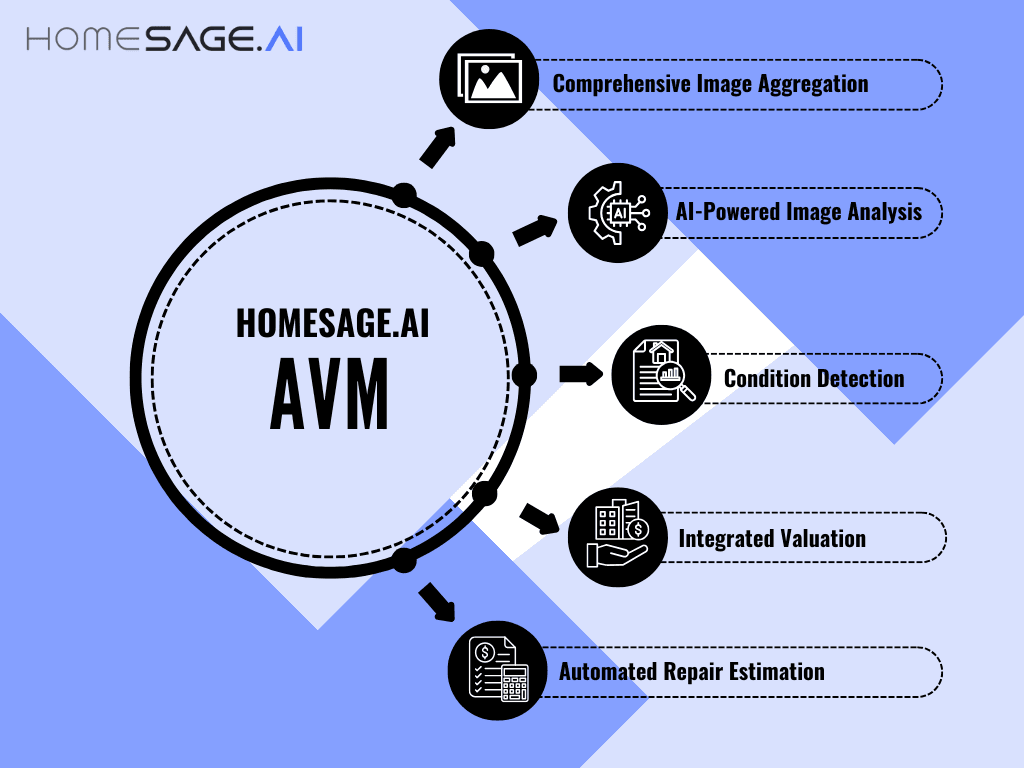
Here’s how the Homesage.ai system works:
- Comprehensive Image Aggregation: The platform gathers all available images associated with a property. This includes photos from current and historical MLS listings, assessor databases, user uploads, and potentially other sources.
- AI-Powered Image Analysis: Sophisticated computer vision algorithms analyze these images, pixel by pixel. The AI is trained to identify and classify key components of a property (e.g., kitchens, bathrooms, roofs, flooring, exteriors).
- Condition Detection: Beyond simple identification, the AI assesses the condition of these components. It can detect features indicating high quality (e.g., granite countertops, stainless steel appliances, hardwood floors, new roof shingles) or poor condition (e.g., damaged drywall, outdated fixtures, worn carpets, visible roof wear). It categorizes conditions – identifying potential issues or positive attributes.
- Automated Repair Estimation: Crucially, the Homesage.ai models don’t just spot issues; they automatically estimate the potential cost of necessary repairs or renovations based on the detected conditions.
This calculation considers the type and severity of the issue and localized repair costs. - Integrated Valuation: This detailed condition assessment and calculated repair cost are then directly integrated into the valuation model.
- Current Value: The AVM adjusts the property’s estimated current market value based on its actual, observed condition, providing a much more realistic figure than condition-blind models.
- After Repair Value (ARV): The platform also predicts the ARV – the estimated value after the identified necessary repairs are completed. This is invaluable for investors, flippers, and lenders evaluating renovation projects.
By analyzing visual data that traditional AVMs ignore, Homesage.ai provides a significantly more accurate and nuanced valuation, particularly for properties that deviate from the neighborhood average in terms of upkeep or renovation status.
This technology represents a major leap forward, making AVMs more reliable and reflective of true market value.
Industry adoption of AI-powered property condition assessment has accelerated dramatically in 2026. According to recent market analysis, AI adoption in real estate valuation is growing by 40% as firms recognize the competitive advantage of condition-aware AVMs.
Property condition assessment technologies now incorporate IoT sensors for continuous structural monitoring and predictive analytics, enabling proactive asset management that reduces long-term operational costs.
This transformation is particularly evident in investment and portfolio management, where AI platforms process massive datasets spanning market conditions, climate risk, and asset performance to help investors make faster, more accurate decisions.
Key Takeaways
- Traditional AVMs miss critical details: They rely on quantitative data like square footage and comparable sales but can’t assess a property’s actual physical condition, leading to significant valuation inaccuracies.
- Homesage.ai pioneered condition-aware AVMs: The platform was the first to directly incorporate property condition assessment using computer vision and AI technology to analyze property images from MLS listings and assessor databases.
- Visual analysis enables accurate valuations: By identifying component conditions, detecting quality indicators or issues, and estimating repair costs, Homesage.ai provides more reliable current market valuations and After Repair Value (ARV) estimates.
- Perfect for investors and real estate professionals: Condition-aware AVMs are invaluable for flippers, lenders, and agents evaluating renovation potential, especially for properties that deviate from neighborhood averages.
- Speed and scalability without sacrificing accuracy: While AVMs can’t fully replace licensed appraisals for high-stakes lending, Homesage.ai‘s condition-aware platform bridges the accuracy gap and delivers valuations that reflect true market value.
- The future is automated and intelligent: AI-powered property assessment represents a major leap forward in AVM reliability, making automated valuations faster, more cost-effective, and increasingly reflective of real-world property conditions.
Conclusion:
While traditional AVMs have often treated property condition as a black box, relying primarily on quantitative data, the answer to “Is property condition taken into consideration?” is evolving.
Standard models largely do not, or only do so indirectly through broad assumptions.
However, innovators like Homesage.ai are fundamentally changing this.
By employing advanced AI and computer vision to analyze property images, detect physical conditions, and even estimate repair costs, they are creating AVMs that offer a far more accurate, transparent, and useful valuation.
Q&A:
Q: How accurate are AVMs?
A: AVM accuracy varies widely depending on the provider, the specific model used, the geographic location, market conditions, and the availability of quality data.
While often providing a reasonable estimate (typically within a 3-7% median error rate in active markets), they can be significantly less accurate for unique properties, rapidly changing markets, or areas with few comparable sales.
By introducing property condition as an AVM factor, the error rate could be significantly improved.
Q: What data points do AVMs use?
A: AVMs primarily use quantitative data such as property characteristics (square footage, number of bedrooms/bathrooms, lot size, age), location data, public records (tax assessments, sales history), MLS data (listing information, days on market, comparable sales prices), and local market trends (price appreciation/depreciation).
Advanced AVMs, like Homesage.ai, are now incorporating qualitative data derived from image analysis to assess property condition and needed repairs.
Q: Can an AVM replace an appraisal?
A: No, an AVM cannot fully replace a traditional appraisal for many high-stakes situations, particularly complex mortgage lending decisions.
While AVMs provide quick, cost-effective estimates valuable for various purposes, a full appraisal involves a physical inspection by a licensed professional, a deeper dive into property condition, and adherence to strict regulatory standards (like USPAP in the US).