
Real estate data APIs have become an essential infrastructure for IT developers, but rising data costs can quickly erode profit margins. As property data volumes expand and API usage scales, understanding how to optimize these expenses becomes critical for maintaining competitive operations. Start by comparing the 5 best real estate APIs for 2026.
The challenge isn’t just about reducing costs; it’s about maximizing value while maintaining data quality and reliability. This guide explores seven proven strategies that real estate investors and realtors can implement immediately to reduce API costs while enhancing their data-driven decision-making capabilities. 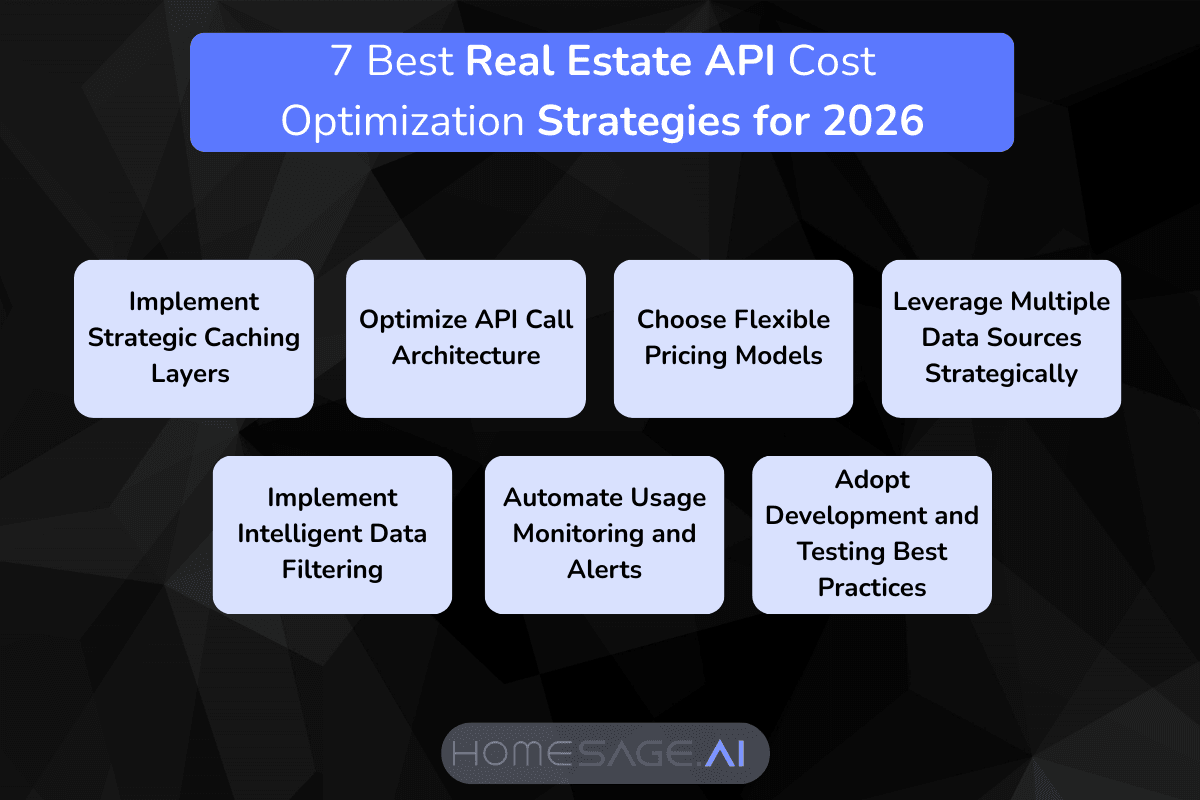
Platforms like Homesage.ai have integrated many of these optimization principles directly into their API architecture, making cost-effective property data access more accessible than ever.
1. Implement Strategic Caching Layers
Caching is one of the most effective ways to reduce costs for the real estate data API. By storing frequently accessed property data locally, you minimize redundant API calls while maintaining fast response times.
The key is understanding which data changes frequently and which remain relatively static. Property characteristics like square footage, lot size, and year built rarely change and can be cached long-term. Market trends and neighborhood statistics can be updated weekly or monthly, while active listings need daily refreshes.
Homesage.ai‘s APIs provide clear data freshness indicators and optimal refresh intervals for each endpoint, helping developers implement efficient caching without compromising accuracy. This eliminates guesswork about when to refresh cached data.
2. Optimize API Call Architecture
How you structure API requests directly impacts costs. Batching requests, using bulk endpoints, and eliminating unnecessary calls can dramatically reduce expenses.
Request batching allows you to retrieve multiple properties in a single API call rather than making individual requests. Most real estate data APIs support bulk operations that return dozens or hundreds of properties per request.
Key optimizations include:
- Batch property lookups when analyzing multiple addresses.
- Use filtered queries to retrieve only needed data fields.
- Implement request throttling to stay within rate limits.
- Design asynchronous processing for non-time-critical operations.
Real estate platforms should audit their API call patterns quarterly to identify optimization opportunities.
3. Choose Flexible Pricing Models
Real estate data API providers offer various pricing structures, and selecting the right model for your usage patterns is crucial.
Real Estate Data API Pricing Models by Usage Pattern
Pricing Model | Best For | Cost Optimization Strategy |
Pay-per-call | Variable, unpredictable usage | Implement aggressive caching and batching |
Monthly subscription | Consistent, predictable volume | Right-size tier based on actual usage data |
Tiered volume | Growing businesses | Monitor usage to upgrade/downgrade at optimal times |
Flat-rate unlimited | High-volume power users | Maximize value through comprehensive integration |
Hybrid models | Mixed use cases | Separate production and development environments |
Many providers offer volume discounts for committed usage levels. Free tiers and trial credits provide opportunities to test API functionality before committing and to measure actual usage accurately.
4. Leverage Multiple Data Sources Strategically
No single API provides everything at the best price. Strategic multi-source integration lets you optimize for both cost and data quality. The developer’s guide to real estate data covers multi-source selection.
Use premium APIs for critical, high-value data while relying on lower-cost sources for basic information. This tiered strategy balances quality and expenses:
- Tier 1 (Premium): Investment analytics, AI-powered insights, renovation cost estimates.
- Tier 2 (Standard): Property characteristics, ownership records, tax assessments.
- Tier 3 (Basic): Geographic data, neighborhood boundaries, public records.
- Tier 4 (Free): Census data, municipal information, basic mapping.
For complex investment analysis, Homesage.ai provides comprehensive, all-in-one insights, including property condition assessment via computer vision, renovation cost estimates, and rental ROI calculations, eliminating the need to integrate multiple APIs. This consolidation reduces both API costs and development complexity.
5. Implement Intelligent Data Filtering

Requesting only the data you actually need reduces both API costs and processing overhead. Many real estate data APIs charge based on the data returned, not just the number of requests.
Field-level filtering allows you to specify precisely which property attributes to retrieve. If you only need the address, price, and square footage, don’t request the full property record with hundreds of fields.
Apply geographic boundaries, property type filters, date ranges, and value thresholds to limit results. Implement client-side logic to screen properties before making expensive follow-up requests for detailed analysis.
Homesage.ai‘s APIs support granular filtering parameters and investment criteria at the API level. The platform’s Price Flexibility Score and Investment Potential endpoints allow you to screen thousands of properties using lightweight calls, then request comprehensive reports only for high-potential candidates.
6. Automate Usage Monitoring and Alerts
You can’t optimize what you don’t measure. Implementing comprehensive API usage tracking prevents cost overruns and identifies optimization opportunities.
Real-time monitoring helps you understand precisely how your application consumes API resources. Track metrics like calls per endpoint, average response size, error rates, and cost per user session.
Set up alerts for unusual usage spikes that may indicate bugs or abuse, and track costs by feature to identify expensive functionality. Monitor API response times to detect performance issues. Configure spending limits that automatically throttle usage as monthly budgets are approached.
Many real estate professionals discover that a small percentage of features account for the majority of API costs. Monthly audits should compare actual API costs against business value generated.
7. Adopt Development and Testing Best Practices
Development environments can consume significant API resources if not properly managed. Following development best practices helps protect both security and budget.
Separate development, staging, and production environments prevent testing activities from depleting production API allocations.
Use synthetic or cached data for initial development rather than making live API calls. Record actual API responses and replay them during unit tests. Use API mocking libraries to simulate responses without making requests.
Many API providers offer free or reduced-cost sandbox environments specifically for development and testing. Take advantage of these resources to validate integration without production expenses. Code reviews should specifically evaluate API usage patterns to prevent inefficient loops and redundant calls.
Key Takeaways
Real estate data API cost optimization requires a comprehensive approach that balances expenses with data quality and business value:
- Strategic caching stores frequently accessed property data locally while maintaining acceptable freshness based on data type requirements.
- Optimized API architecture through batching, filtering, and intelligent request design cuts costs substantially without reducing functionality.
- Flexible pricing models matched to your usage patterns ensure you pay only for what you need.
- Multi-source data strategies leverage premium APIs for high-value insights while using lower-cost sources for basic information.
- Intelligent filtering at the API level minimizes costs by requesting only needed fields.
- Automated monitoring prevents cost overruns while identifying optimization opportunities.
- Development best practices protect production budgets using sandbox environments.
Platforms like Homesage.ai have built these optimization principles directly into their API infrastructure, offering comprehensive property intelligence through consolidated endpoints, granular filtering options, and transparent pricing.
This walkthrough demonstrates how Homesage.ai‘s APIs are designed for efficient integration from day one.
Watch how developers access comprehensive real estate data through well-documented endpoints, use ready-to-copy code snippets in over 10 programming languages, and implement intelligent caching strategies using clear parameter guidelines.
Conclusion
Strategic cost optimization transforms real estate data APIs from a necessary expense into a competitive advantage. By implementing these seven strategies, investors and realtors can access the property intelligence they need while maintaining healthy profit margins.
The key is viewing API costs not just as expenses to minimize, but as investments to optimize. Focus on maximizing value per dollar spent rather than simply reducing spending. High-quality property data drives better investment decisions and faster deal closures.
Start by auditing your current API usage, implementing caching strategies, and exploring flexible pricing options that align with your actual usage patterns.
Explore Homesage.ai‘s property intelligence APIs to access cost-optimized real estate data, explicitly designed for investors and realtors who demand both quality and value.
Frequently Asked Questions
Q: What is the average cost of real estate API access?
A: Real estate data API pricing varies significantly based on features and usage volume. Basic property data APIs start at a few hundred dollars per month, while comprehensive platforms with AI-powered insights range from several thousand dollars for enterprise solutions.
Most providers offer tiered pricing that scales with request volume and feature access.
Q: How can I predict my monthly API costs accurately?
A: Track API usage in a development or limited production environment for days to establish baseline metrics. Calculate average requests per user session, daily active users, and peak usage periods.
Most providers offer usage calculators based on these metrics. Build in a 20-30% buffer for growth and unexpected usage spikes.
Q: Are free real estate data APIs sufficient for professional use?
A: Free APIs typically provide limited coverage, lower data freshness, and restricted request volumes that make them unsuitable for professional real estate operations.
They work well for learning and small-scale projects, but investors and realtors need the comprehensive coverage, accuracy, and reliability that premium APIs deliver.
Q: How do I choose between multiple real estate API providers?
A: Evaluate providers based on geographic coverage, data freshness, accuracy, pricing models, integration complexity, support quality, and request trials to test actual performance with your use cases.
Platforms like Homesage.ai that consolidate multiple data types into unified endpoints can reduce integration complexity while optimizing costs.





N January 7, 2026
Insightful!
Robin January 7, 2026
Great read
Mia January 7, 2026
very helpful
Richard January 7, 2026
Good one
Cami January 9, 2026
Very important to know it
Peter January 12, 2026
Nice tips on saving money with API calls!