
Real estate agents and brokers are facing unprecedented pressure to close more deals faster while managing growing client expectations.
Explore the full playbook on AI real estate investing.The industry is at a turning point: nearly 97% of real estate professionals now show active interest in artificial intelligence, and firms adopting AI tools report up to 300% increases in lead volume and 40% higher conversion rates.
AI in real estate has evolved from experimental technology to mission-critical infrastructure that transforms every stage of the transaction lifecycle, from initial property discovery to final closing.
The shift is measurable and accelerating. The global AI real estate market, valued at $2.9 billion in 2024, is projected to surge to $41.5 billion by 2033, a compound annual growth rate exceeding 30%.
For realtors looking to stay competitive, understanding how to leverage AI across the entire deal pipeline is no longer optional.
Platforms like Homesage.ai are leading this transformation by providing AI-powered property intelligence that streamlines everything from investment analysis to condition assessments, giving agents the data-driven edge clients now expect.
This guide walks through exactly how AI transforms real estate operations at every stage, the specific tools reshaping agent workflows, and actionable strategies for implementing AI to close more deals in less time.
1. AI-Powered Deal Sourcing: Finding the Right Properties Faster
Traditional property sourcing requires agents to manually cross-reference MLS listings, review offering memorandums, and analyze comparable properties, a process that can consume hours or even days per potential deal. AI eliminates this friction by automating discovery, matching, and preliminary analysis.
How AI in real estate accelerates deal sourcing
- Automated data extraction: AI systems parse offering memorandums, CIMs, and property flyers in seconds, extracting key details like price, square footage, cap rates, and property condition directly into structured databases
- Smart matching algorithms: Instead of keyword searches, AI learns buyer preferences, from architectural style to neighborhood characteristics, and surfaces properties that align with specific investment criteria
- Off-market opportunity identification: Predictive analytics identify properties likely to sell before they hit the market by analyzing ownership duration, tax records, and distress signals
- Proprietary intelligence building: Every property reviewed (whether pursued or passed) feeds into your database, creating a competitive advantage through accumulated market knowledge
Real-world impact: Portugal’s Porta da Frente Christie’s closed $100 million in sales in early 2025 using AI assistants that handle lead qualification and property matching around the clock, allowing human agents to focus exclusively on negotiations and relationship-building.
2. Precision Property Valuation: Eliminating Guesswork with Data
Accurate pricing is the foundation of successful transactions. Overpricing loses buyers; underpricing upsets sellers.
AI-powered automated valuation models (AVMs) now achieve median error rates as low as 2.8%, dramatically outperforming traditional appraisal methods that contain significant errors in over 33% of cases.
What makes AI valuations more accurate
- Multi-dimensional data analysis: AI processes historical sales, neighborhood trends, school ratings, crime statistics, walkability scores, and even social media sentiment to determine precise market value
- Real-time market signals: Unlike quarterly CMA reports, AI valuations incorporate current market dynamics, including inventory levels, days-on-market trends, and recent comparable sales
- Computer vision property assessment: Advanced systems analyze listing photos to assess property condition, renovation quality, and desirability factors that impact price
- Bias reduction: Algorithmic models minimize the subjective judgments that lead to appraisal inconsistencies and fair housing violations
Homesage.ai‘s Full Property Report combines computer vision and machine learning to deliver valuations that account for property condition, renovation costs, and investment potential factors traditional AVMs often miss.
The Property Condition API uses advanced computer vision to assess and categorize property conditions as Excellent, Good, Average, Outdated, Poor, Very Poor, providing clear, objective snapshots for buyers, sellers, and investors.
3. Predictive Analytics: Timing the Market with Confidence
Knowing what a property is worth today matters less than understanding where the market is headed. Predictive analytics use historical patterns, economic indicators, and local development data to forecast price trends, rental demand, and optimal transaction timing.
Key predictive capabilities realtors are using
- Price appreciation forecasting: Identify neighborhoods positioned for growth before prices surge, allowing clients to maximize ROI
- Inventory prediction: Anticipate supply crunches or market floods that impact negotiating leverage
- Rental demand modeling: For investment properties, AI predicts occupancy rates, rental price ceilings, and vacancy risk by analyzing employment data, migration patterns, and development pipelines
- Optimal listing timing: Determine the best week or month to list based on seasonal patterns, local market cycles, and current inventory levels
Investors using predictive tools reduce exposure to market volatility by 40% and make capital-deployment decisions 70% faster than with manual methods.
Homesage.ai‘s Investment Potential API leverages neural networks to evaluate every new US property listing daily, including off-market and MLS listings, scoring investment potential and surfacing hidden opportunities that traditional analysis might miss

4. Automated Workflows: Streamlining Transaction Management
Real estate closings involve dozens of stakeholders, hundreds of documents, and strict compliance requirements. A single missed deadline or misplaced signature page can delay closings and damage client trust.
Transaction tasks AI automates
- Document processing: AI extracts key terms from contracts, inspection reports, and title documents, organizing everything in searchable, centralized repositories
- Deadline tracking: Automated systems send reminders for financing contingencies, inspection periods, appraisal deadlines, and closing dates to all parties simultaneously
- Compliance enforcement: Workflows ensure required disclosures, forms, and approvals happen in the correct sequence with complete audit trails
- Multi-party coordination: AI manages file delivery, approval routing, and status updates across company boundaries
- Digital signatures: E-signature integration eliminates the delays of physical document circulation
Transaction coordinators using automation report 30% increases in productivity, 40% fewer errors, and significantly faster closing timelines.
Homesage.ai‘s API suite integrates directly with existing workflows via developer-friendly REST APIs with JSON responses and over 20 endpoints, providing property condition assessments, renovation cost estimates, and investment calculations that automatically populate into transaction management systems.
5. Enhanced Client Engagement: 24/7 Availability and Personalization
Client expectations have shifted dramatically. Buyers now expect instant responses, personalized recommendations, and proactive communication regardless of time zone or business hours.
How AI in real estate transforms client interactions
- Intelligent chatbots: Handle property inquiries, schedule showings, and answer questions instantly, even at 2 AM
- Automated follow-ups: AI tracks lead engagement and sends personalized touchpoints at optimal intervals
- Behavioral analysis: Systems learn from client interactions to refine property recommendations
- Lead qualification: AI scores lead based on engagement patterns, budget indicators, and timeline signals
- Multi-channel nurturing: Coordinates communication across email, text, phone, and social media
Agents using AI engagement tools report over 20% improvement in lead recovery rates, translating to $50,000+ in additional annual revenue.

6. Data-Driven Decision Making: From Intuition to Intelligence
The most successful agents aren’t relying on gut feelings; they’re leveraging comprehensive data analysis to guide every recommendation.
Strategic advantages of AI-driven insights
- Portfolio optimization: AI identifies the ideal property mix to balance cash flow, appreciation, and risk
- Neighborhood analysis: Understand block-level dynamics, including school quality, crime patterns, and infrastructure development
- Competitive positioning: Understand how listings compare to active inventory
- Client profiling: Identify patterns in successful transactions to refine targeting and marketing
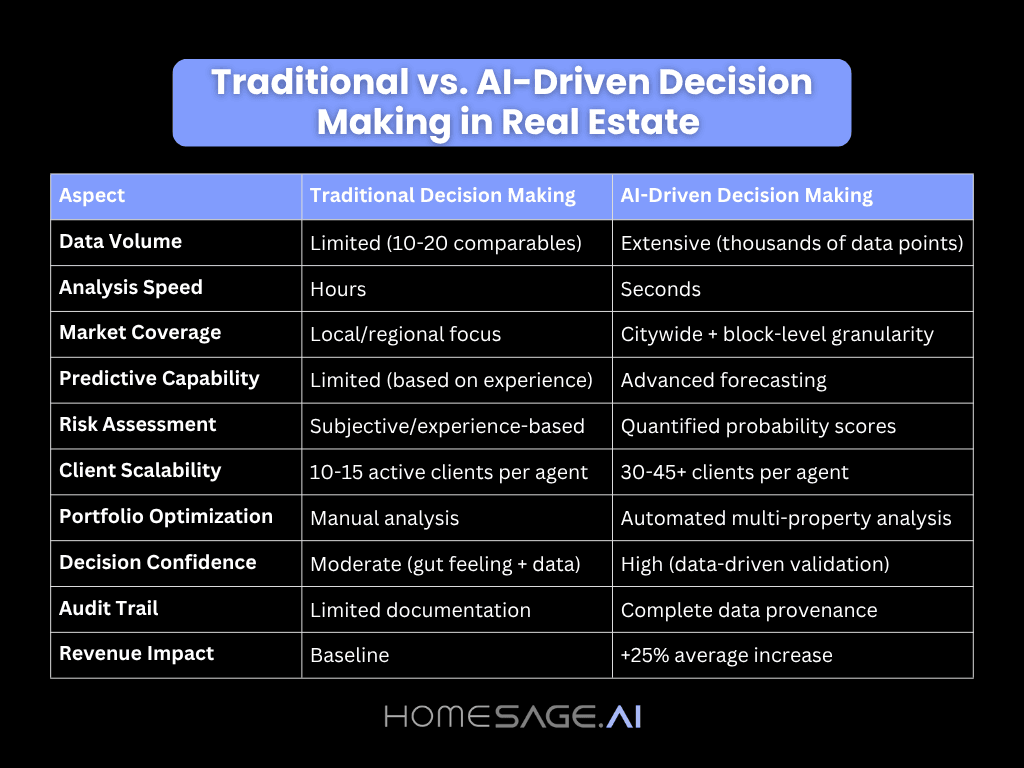
Traditional vs. AI-Driven Decision Making in Real Estate
Aspect | Traditional Decision Making | AI-Driven Decision Making |
Data Volume | Limited (10-20 comparables) | Extensive (thousands of data points) |
Analysis Speed | Hours | Seconds |
Market Coverage | Local/regional focus | Citywide + block-level granularity |
Predictive Capability | Limited (based on experience) | Advanced forecasting (appreciation, demand, timing) |
Risk Assessment | Subjective/experience-based | Quantified probability scores |
Client Scalability | 10-15 active clients per agent | 30-45+ clients per agent |
Portfolio Optimization | Manual analysis | Automated multi-property analysis |
Decision Confidence | Moderate (gut feeling + data) | High (data-driven validation) |
Audit Trail | Limited documentation | Complete data provenance |
Revenue Impact | Baseline | +25% average increase |
Key Takeaways
- AI adoption in real estate has evolved from experimental to essential, with 97% of professionals showing active interest.
- Deal sourcing is 300% faster with AI automation handling property discovery, matching, and preliminary analysis.
- Homesage.ai provides specialized APIs for Property Condition Analysis (Excellent to Very Poor grading), investment potential scoring, renovation cost estimation, ROI calculation, rental analysis, TLC identification, price flexibility scoring, and comparable sales.
- Transaction automation cuts errors by 40% and saves hundreds of hours through intelligent document processing, deadline tracking, and compliance enforcement.
- Client engagement scales to 24/7 availability with AI chatbots and automated nurturing, driving conversion rates 40% higher.
- Market growth is explosive, with the global AI real estate market projected to surge from $2.9 billion (2024) to $41.5 billion by 2033.

Conclusion
The real estate industry is experiencing a fundamental shift. AI isn’t replacing agents; it’s amplifying their capabilities.
Firms leveraging AI tools report 300% increases in leads, over 40% improvements in conversion rates, and measurable gains in revenue and agent satisfaction.
For agents and brokers looking to thrive rather than merely survive, the path forward involves strategic technology adoption that enhances human expertise.
Homesage.ai provides this foundation through its suite of AI-powered tools—from instant property intelligence to workflow-integrated APIs.
Frequently Asked Questions
Q: How accurate are AI property valuations compared to traditional appraisals?
A: Leading AI valuation platforms now achieve median error rates between 2.8% and 3%, significantly outperforming traditional methods that contain substantial errors in over 33% of cases.
Q: Will AI replace real estate agents?
A: No, AI augments agent capabilities rather than replacing them.
Q: What’s the ROI of implementing AI tools in a real estate business?
A: ROI varies, but documented returns are substantial agents using AI calling systems to report 14x returns, 25% revenue increases, and 40% conversion improvements.
Q: How do I get started with AI in my real estate practice?
A: Start small with AI-powered property search and valuation tools like Homesage.ai, then expand to client communication and transaction workflow automation.





Kevin November 13, 2025
Very nice guide!
Hamza November 13, 2025
Great Insight!
binance Register March 16, 2026
Thanks for sharing. I read many of your blog posts, cool, your blog is very good.
Real Estate API For Apps: 10 Best Options (2026) October 12, 2026
[…] access to recent comparable sales data, providing essential information for property valuation and deal analysis across real estate […]