Real estate software and AI solutions both promise to save you time, but they work in fundamentally different ways - and in 2026 the gap between them is widening.
The AI-in-real-estate market is projected to climb from roughly $303 billion in 2025 to nearly $989 billion by 2029, a 34.4% compound growth rate, according to Research and Markets.
Adoption on the ground is real but uneven. NAR's Technology Survey found 59% of Realtors use some emerging technology but are still learning it, while 21% have heard of these tools and never used them.
“Quick answer“Real estate software solutions are rules-based tools - CRMs, listing managers, transaction and accounting systems - that store and organize the data you enter. AI solutions add machine learning that analyzes data and produces decisions: valuations, deal scores, and forecasts. Software manages your workflow, while an AI layer like Homesage.ai generates insight inside it.”
What Counts as Real Estate Software Solutions
These are the systems that run the operational side of a real estate business: CRMs, transaction management, listing tools, marketing platforms, and accounting.
They are excellent at structure, repeatability, and never forgetting a follow-up. Their limit is built in - they only know what you put into them.
A CRM will remind you to call a lead. It will not tell you whether the property that lead asked about is a good deal.
What Counts as AI Solutions
AI solutions analyze data to produce outputs a human would otherwise calculate by hand: property valuations, after-repair value, rental forecasts, deal rankings, and condition scoring from photos.
They convert raw property data into a recommendation, which removes the analysis bottleneck rather than just the admin.
It helps to see where this sits in the arc. The first wave of real estate technology digitized paperwork and contacts, the second wave connected data and put listings online, and the current wave interprets that data instead of simply storing it.
If you are weighing vendors in this space, our guide to choosing the best AI provider for real estate covers what to look for.
Automation Versus AI Is Not the Same Distinction
These two get blended together, and the difference matters when you shop.
Automation follows fixed rules you set: if a lead comes in, send this email; if a task is due, remind me. It is fast and reliable, but it does not think.
AI produces judgments from data - it estimates a value, ranks a deal, predicts a rent. Most real estate software is really automation with a good interface, which is useful but limited.
When a vendor says AI, ask what decision the model actually makes. If the answer is moving data around on rules, that is automation.
Software Solutions vs AI Solutions, Side by Side
| Dimension | Traditional software | AI solutions |
|---|---|---|
| Core job | Store and organize your data | Analyze data and produce insight |
| Input | What you manually enter | Large external and internal datasets |
| Output | Records, reminders, reports | Valuations, forecasts, deal scores |
| Best at | Workflow and consistency | Speed, scale, and prediction |
| Weak spot | Only knows what you enter | Needs human verification on edge cases |
| Who benefits | Every team, for organization | Teams making data-heavy decisions |
| Example | CRM, transaction manager | AI valuation, ARV, Seller Motivation Score |
This table compares categories rather than specific vendors, so you can map it to whatever tools you already run.
The two categories solve different problems and are strongest together
How the Two Differ Across Everyday Tasks
Client Management
Software wins here outright, because a CRM is the right tool to track leads and follow-ups. AI adds a layer on top by surfacing which leads to prioritize, but the CRM is the foundation.
Pricing and Valuation
This is where AI pulls decisively ahead. A traditional CMA still relies on you picking comps by hand, while an AI valuation reads hundreds of data points and condition signals in seconds.
If you spend hours pricing listings or analyzing deals, this is the highest-return place to add AI.
Marketing
Software runs your campaigns; AI increasingly writes and targets them. NAR's survey found social media is the top lead-generating technology at 39%, ahead of CRMs at 23%.
Deal Analysis and Forecasting
This is pure AI territory. Forecasting rent, ROI, ARV, and risk is exactly what machine learning does well and what spreadsheets do slowly.
What This Looks Like in Practice
Picture two agents chasing the same investor client.
The first has a great CRM but prices the client's target property with a manual CMA. It takes a day, and the estimate ignores that the home needs a new roof.
The second runs the address through an AI tool, gets a condition-aware value and ARV in minutes, and calls back the same afternoon with numbers and a clear recommendation.
Same market, same available data, different stack - and the second agent wins the client.
The strongest teams add an AI layer on top of the software they already run.
The short video below shows what that analytical layer looks like when it runs on live property data.
Do You Need One or Both?
Almost always both. Software runs the business; AI makes faster, better-informed decisions inside it.
A realtor with a CRM but no AI still spends hours pricing a listing. A realtor with AI but no CRM makes sharp calls and then loses the client to a missed follow-up.
Use these three tests to work out which gap you actually have.
- If work is falling through the cracks - missed follow-ups, lost paperwork - you have a software gap, so fix that first.
- If work gets done but decisions are slow or guesswork - pricing, deal analysis, ARV - you have an AI gap.
- If you have both and they do not talk to each other, your next win is integration, not another subscription.
That end-to-end picture is exactly what we map in AI in real estate, from deal sourcing to closing.
What the Analytical Layer Actually Computes
The clearest way to see the difference is to list what each layer produces from the same address.
Software returns what you stored: the contact, the listing record, the task history. The analytical layer returns judgments that were never typed in by anyone.
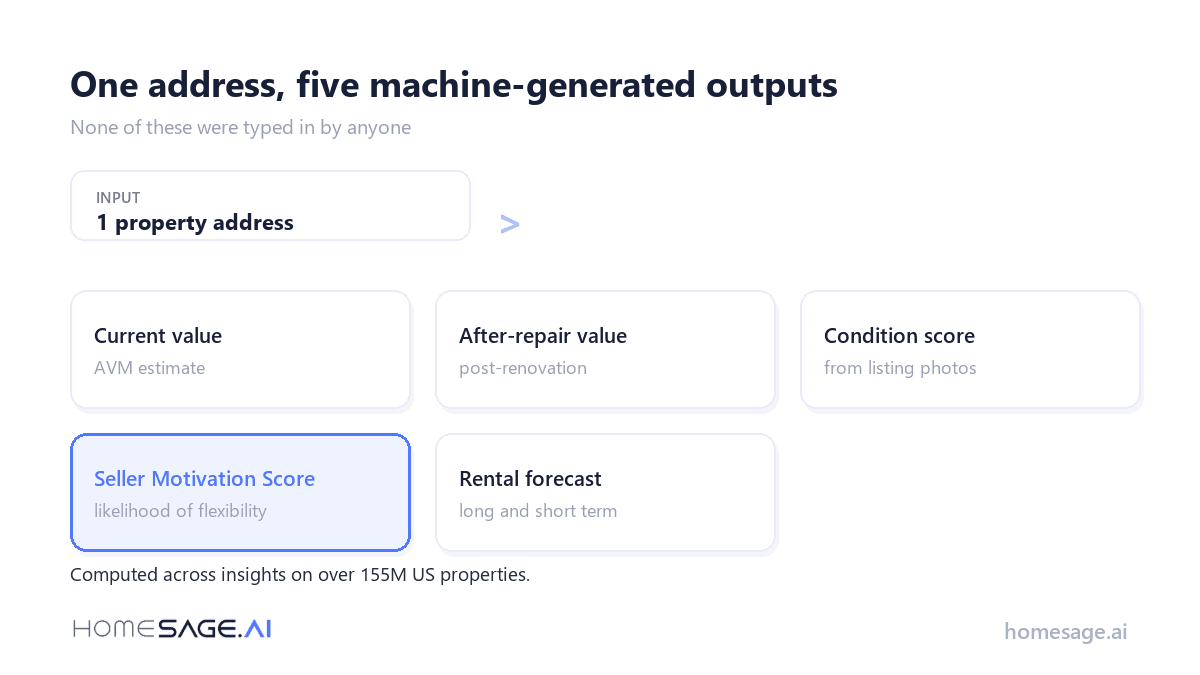
Homesage.ai runs that layer across insights on over 155M US properties, covering current value, after-repair value, computer-vision condition scoring, the Seller Motivation Score, and rental forecasting.
Signs Your Business Has Outgrown Traditional Software
- You spend hours a week on manual comps, CMAs, or deal analysis.
- Deals slip because you cannot answer a value or ROI question fast enough.
- Your team makes pricing calls on gut feel because the data takes too long to assemble.
- You have clean data in your CRM but no way to turn it into a recommendation.
If two or more sound familiar, your next investment is an AI layer rather than another organizational tool.
Adding it works best in stages. Pick the one decision that costs you the most time, test a tool against real deals for two weeks, feed its output into the software you already use, then measure the hours saved before expanding.
What About the Cost?
Traditional software is usually a predictable per-seat subscription, while AI tools range from free general chatbots to purpose-built platforms priced on usage.
The right way to think about return is time. If a tool saves each person several hours a week on analysis they currently do by hand, it pays for itself quickly.
Start by pricing the hours you lose to manual valuation and deal analysis, and see our convenient pricing for what a purpose-built layer costs.
Where Analytics and Custom AI Fit
Between basic software and full custom AI sits an analytics layer - dashboards that turn your data into trends.
Our roundup of the best real estate analytics tools and our look at the top real estate technology companies show where those fit.
Teams with specific workflows - a lender with a unique underwriting model, a contractor network scoring renovation return - often need AI shaped to their own data. That is what Custom AI Solutions and our support for contractors are built for.
Key Takeaways
- Software organizes your work and AI makes decisions inside it, so most teams need both.
- The AI-in-real-estate market is forecast to grow from about $303 billion in 2025 to nearly $989 billion by 2029.
- The highest-return place to add AI is valuation and deal analysis, where manual work costs the most time.
- Most Realtors are still learning these tools, so a considered rollout is still a competitive advantage.
- The winning move is connecting the two, so AI insight lands inside the tools you already use.
Conclusion
Software organizes your business and AI decides what to do next, which is why the strongest teams run both rather than choosing between them.
Keep the systems that manage your workflow, then layer AI where the highest-value decisions live: valuation, after-repair value, and deal ranking.
Consider a lender's stack. A loan-origination system handles the workflow, an AI valuation engine reads condition and ARV to price risk, and the two are wired together so an underwriter sees a condition-aware value inside the system they already use.
That lender replaced neither their software nor their people - they added the analytical layer that was missing. Whatever your role in real estate, keep what organizes, add what decides, and connect them. Start now to test that layer on your own addresses.