

Why a CMA drifts, and what fixes it
A comparative market analysis is only as good as the set it compares against. Pick the wrong comparables and no amount of adjustment rescues the number.
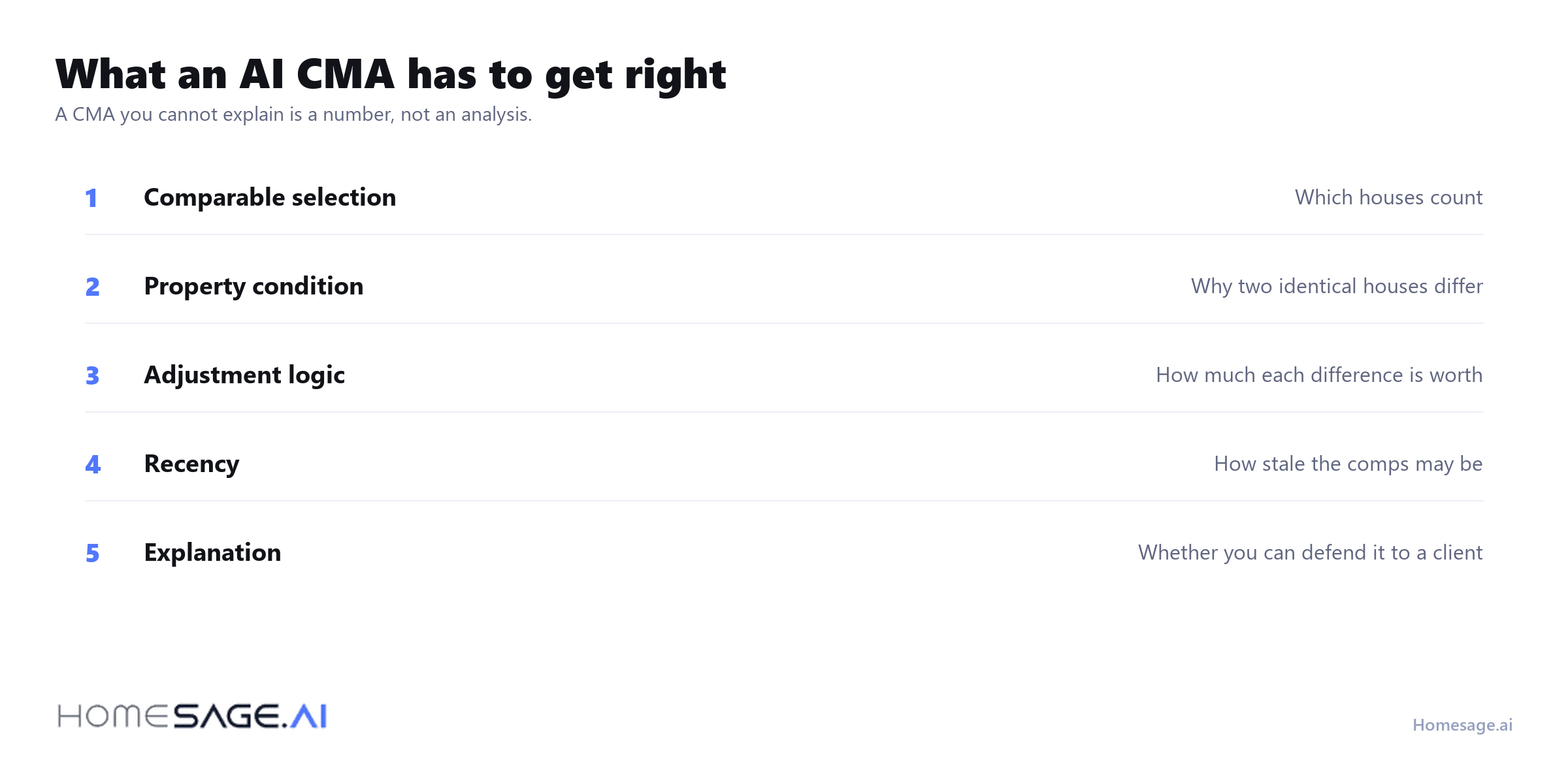
The usual failure is quiet. A tool adjusts for bedrooms, bathrooms and square footage, then stops. Two houses on the same street with the same floor plan can still be worlds apart, and the difference is condition.
That is not a rounding error. When we graded a whole city below, the comparable set split almost evenly between move-in ready and needing work. A CMA blind to that is not making a small mistake. It is making none of the adjustment that matters most.
The 3 best AI-powered CMA tools in 2026
1. Homesage.ai
Homesage.ai grades condition from listing photos, then prices the work and the return in the same pass. A comparative view therefore carries an explicit condition grade alongside price and size, so the adjustment that usually gets skipped is visible. The same fields are available through the API.
For an investor-facing analysis that matters, because the adjustment is quantified rather than argued. You can show a client why a comparable two streets away sold for more, pointing at a condition grade rather than an opinion about kitchens.
Best for: Investor underwriting, where the question is what a house is worth after work rather than as it stands.
2. Cloud CMA
Cloud CMA is built around the document a client receives. It produces polished listing presentations, buyer tours and property reports, and it integrates with the MLS systems most agents already work in. The analysis is solid and the presentation is the point.
That focus is a genuine strength when a seller is choosing between agents. A clear, branded document that explains a price wins listings. Condition adjustments remain yours to make and defend, so the quality of the analysis tracks the person using it.
Best for: Agents who need a client-ready document quickly and consistently.
3. RPR
RPR, the Realtors Property Resource, is provided to members of the National Association of Realtors. It combines public records, tax assessments and MLS data, with reports that carry the association’s credibility behind them.
Its depth on public record data is the draw. Tax history, ownership changes and parcel detail are all there without a separate subscription. Like Cloud CMA it leaves condition to your judgement, which is fine on a house you have walked and thin on one you have not.
Best for: NAR members who want depth of public record data without a separate subscription.
How the three compare
| Tool | Built for | Condition handling | Output |
|---|---|---|---|
| Homesage.ai | Investor underwriting | Graded from listing photos | Analysis and API |
| Cloud CMA | Client presentations | Manual adjustment | Polished client document |
| RPR | NAR members | Manual adjustment | Association-backed report |
The split is between a tool that measures condition and tools that leave it to your judgement. Neither is wrong, but only one of them scales.
The comparable set is not uniform
On 19 October 2026, Wichita, Kansas had 788 active listings. 707 of them, or 89.7%, carried a property condition grade.
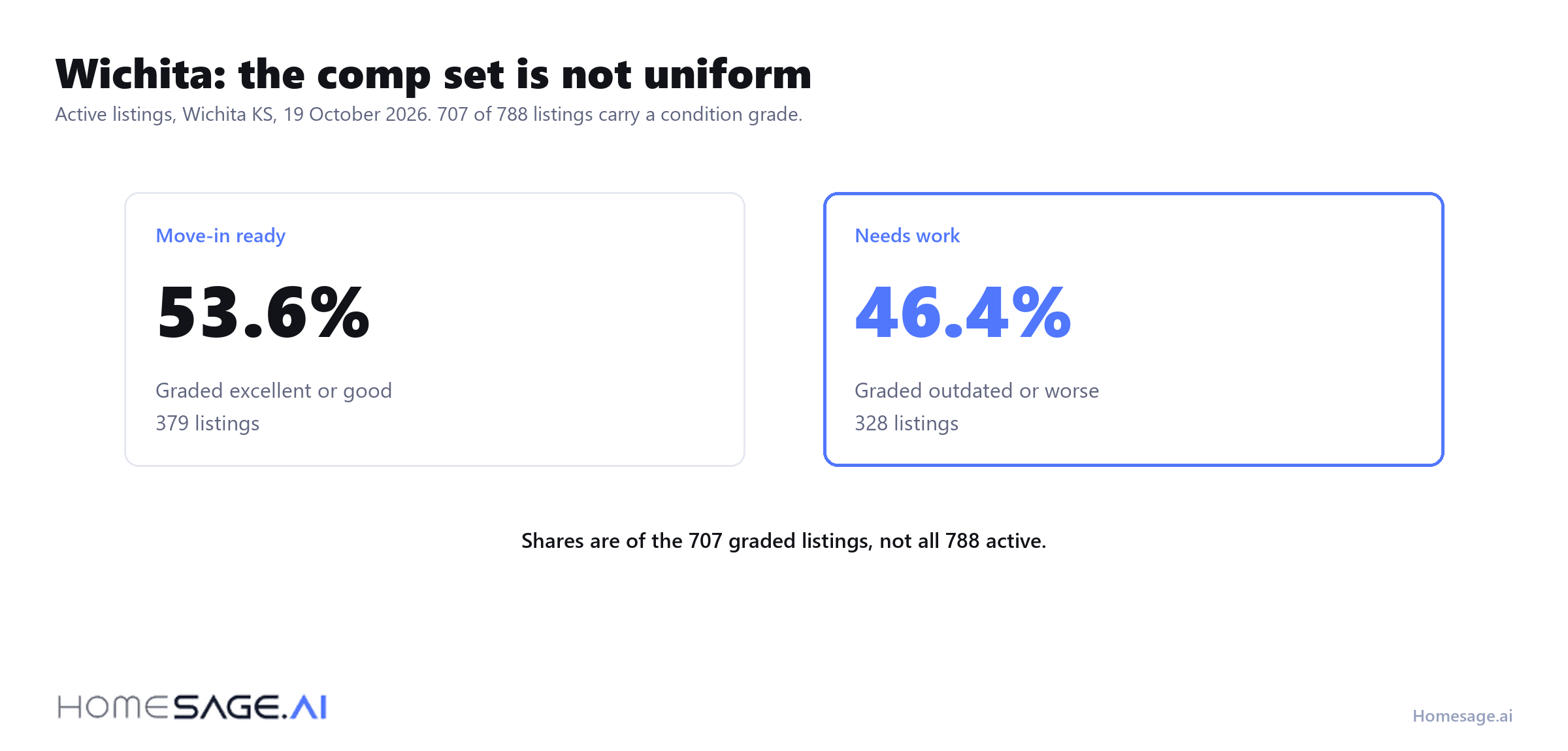
Of those 707 graded listings, 379 were graded excellent or good and 328 were graded outdated or worse. That is a split of 53.6% to 46.4%.
Roughly half the comparable set is in materially different condition from the other half.
So in a typical comparable set, close to half the houses are in materially different condition from the other half. Adjusting for size and bedroom count alone cannot reconcile that. It is how two defensible-looking analyses of the same house end up thousands of dollars apart.
Both shares above are of the 707 graded listings, not of all 788 active ones. The 81 listings with no grade are absent from the split rather than assigned to either side.
What a defensible adjustment looks like
An adjustment is a stated reason a comparable differs from the subject, with a number attached. The number matters less than your ability to say where it came from. That is the test a client, a lender or a seller will apply.
Work in a fixed order and the analysis stays defensible. Location first, because a street cannot be renovated. Then size, then condition, then time. Running condition before location is how a cheap street looks like a bargain house.
Condition is where most analyses go quiet. A property graded outdated against a comparable graded good is not a small deduction. It is the renovation budget plus the holding cost plus the discount a buyer demands for doing the work themselves. Stating that as one lump sum is fine. Leaving it out is not.
Time adjustments need a vintage. A comparable that sold five months ago in a moving market is not a comparable at today’s price. An index has to be applied, and named in the report rather than assumed.
Then show your discards. The comparables you rejected, and why, tell a reader more about the quality of an analysis than the three you kept. Any tool that will not let you record that is making the presentation easier and the argument weaker.
How to choose between them
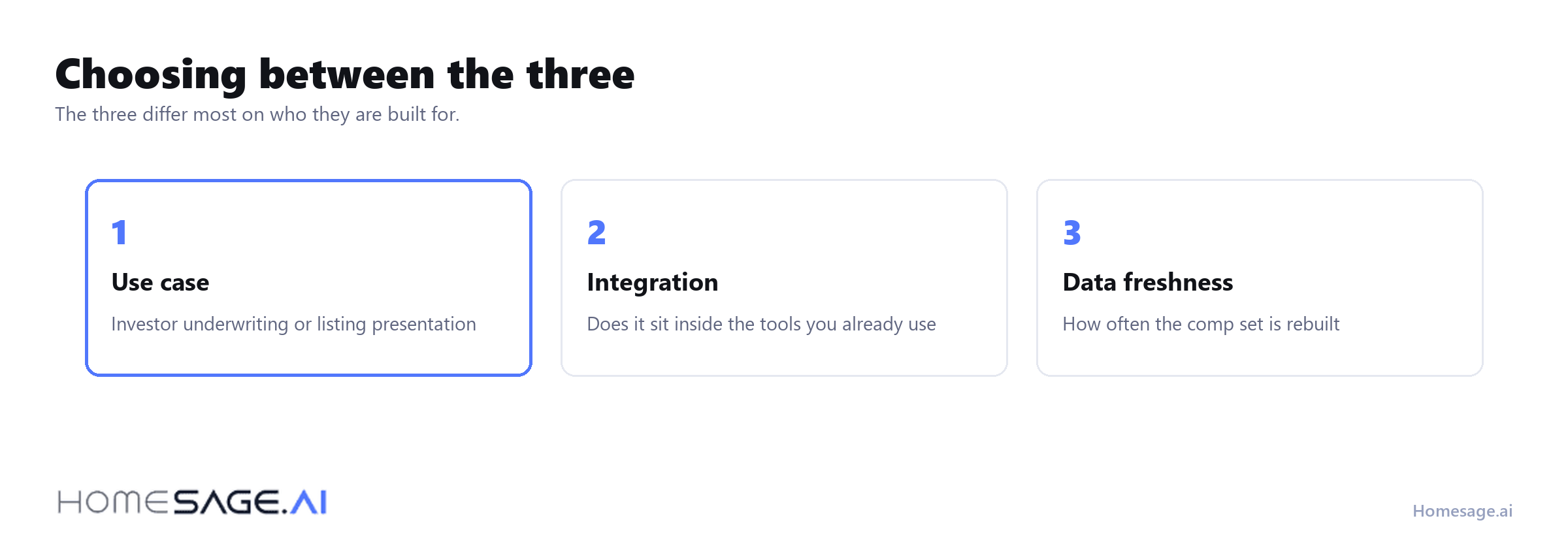
Start with who reads the output. If it is a seller, presentation quality is the product and Cloud CMA is built for exactly that. If it is you, deciding an offer, then condition and return matter more than layout.
Then check where it sits in your day. A tool outside your existing workflow gets used twice and abandoned, however good the analysis is.
Last, ask how often the comparable set is rebuilt. A weekly refresh is fine for a presentation and too slow for a moving market.
If the real question is value rather than presentation, our guide to the best tools to find out home value covers that side. For underwriting, investment property analysis tools goes further.
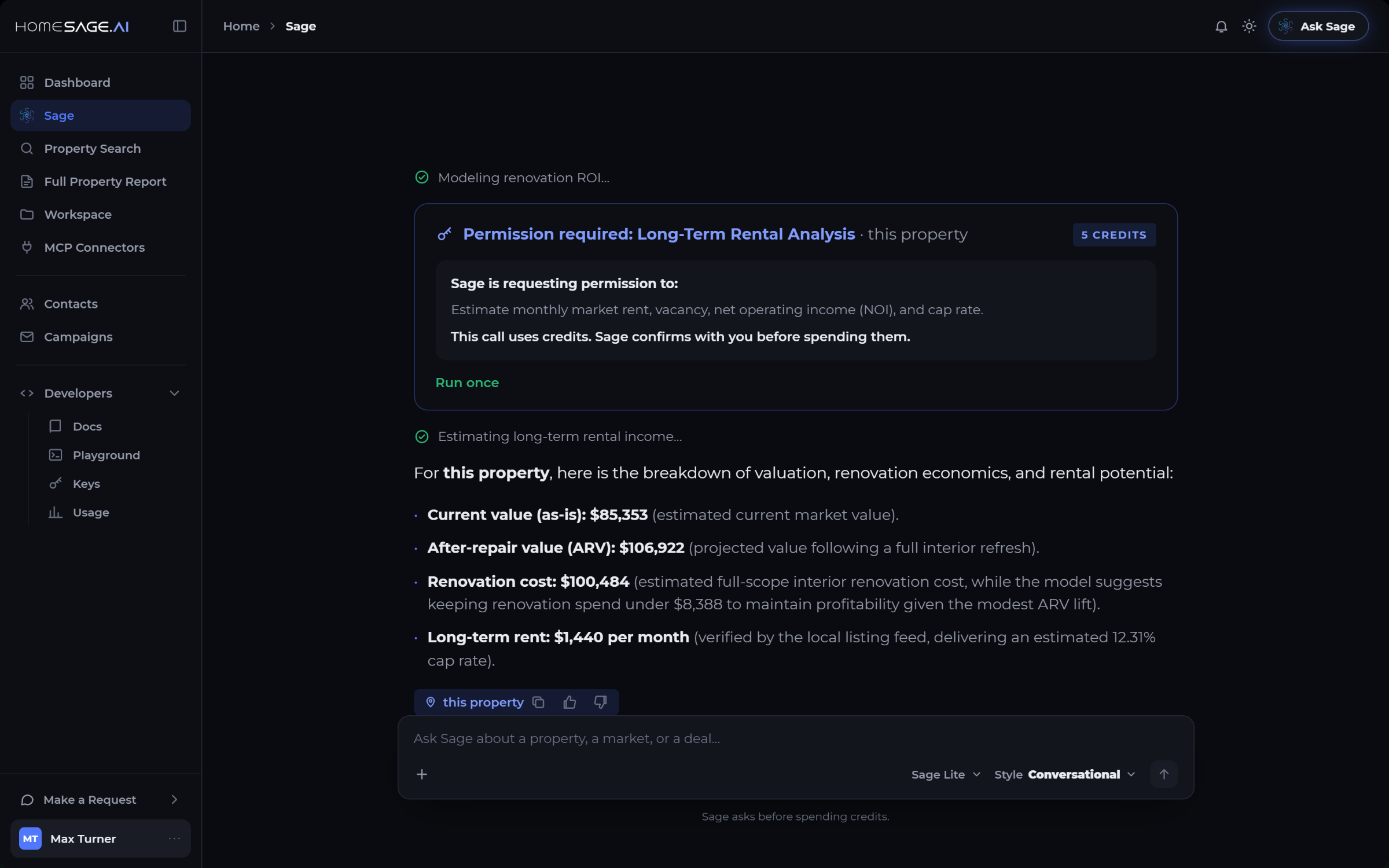
Estimated values, after-repair values, renovation costs and returns are model-derived estimates, not investment advice. Property data as of 19 October 2026.
Key takeaways
- Choose for the reader. A seller presentation and an investor underwrite are different products.
- Condition is the adjustment most CMAs skip, and it is the one that moves the number most.
- In Wichita, 46.4% of graded listings needed work. That is close to half the comparable set.
- A CMA you cannot explain to a client is a number, not an analysis.
- Check how often the comparable set refreshes before trusting it in a fast market.
Conclusion
All three tools here produce a defensible comparative analysis. They differ on who they were built for, and on whether condition is measured or left to you. Pick for the reader of the output. Confirm the tool sits inside the workflow you already use. And treat any analysis that ignores condition as unfinished rather than wrong.
Frequently asked questions
How accurate is an AI CMA compared with a manual one?
On ordinary homes in active markets they land close together, and the automated version is far faster. The gap opens on unusual properties and on homes in poor condition, where a human who has walked the property still has the advantage.
What is the difference between an AI CMA and an AVM?
An AVM returns a single value from records and comparable sales. A CMA shows the comparables and the adjustments, so you can argue with the reasoning. For a client conversation the second is far more useful.
Which of the three suits an agent working with investors?
Homesage.ai, because investor questions are about condition, renovation cost and return rather than presentation. Many agents run it alongside Cloud CMA and use each for its own audience.
Do I still need an appraisal?
For financing, yes. A CMA is a pricing and positioning tool. A lender needs a licensed appraiser, and no automated analysis replaces that.





Cami December 12, 2025
Very insightful!
Robin December 13, 2025
Insightful!
Mia December 13, 2025
Great read
Hamza December 22, 2025
Helpful guide!
Find Undervalued Investment Properties With AI | Homesage.ai October 10, 2026
[…] that offer instant equity before they hit mainstream listings. Many investors also rely on AI-powered CMA tools to compare property values and identify opportunities in their target […]
Can AI Find Investment Properties? 4 Tools That Work October 10, 2026
[…] networking connections, and often a considerable amount of luck. Investors increasingly rely on specialized CMA tools to assess property values and market conditions with greater […]
DealFinder: AI Chrome Extension For Investors | Homesage.ai October 12, 2026
[…] and sold listings on Redfin, pull DealFinder reports inline, and walk into your meeting with AI-powered CMA data your competitors are unlikely to have on […]