
Building a real estate app today means delivering innovative features, instant data, and personalized experiences.
Modern real estate apps combine AI-powered property intelligence, real-time data integration, and user-friendly interfaces that help people make confident decisions faster.
Platforms like Homesage.ai help you turn your real estate app into a powerful real estate investment tool that delivers comprehensive results in seconds.
This guide walks you through the essential steps, technologies, and best practices for building a competitive real estate app in 2026.

Choosing the Right App Architecture
Architecture decisions made early determine how easily your app scales and adapts to future changes. Compare the 10 best real estate APIs for apps.
Cross-platform frameworks like React Native or Flutter let you write once and deploy everywhere, reducing development time while maintaining near-native performance—the best balance for most PropTech applications in 2026.
Implement clean architecture patterns, such as MVVM, that separate your UI layer (display and interaction), business logic layer (property calculations), and data layer (API calls and storage).
This separation makes code easier to test, simpler to understand, and more flexible when requirements change.
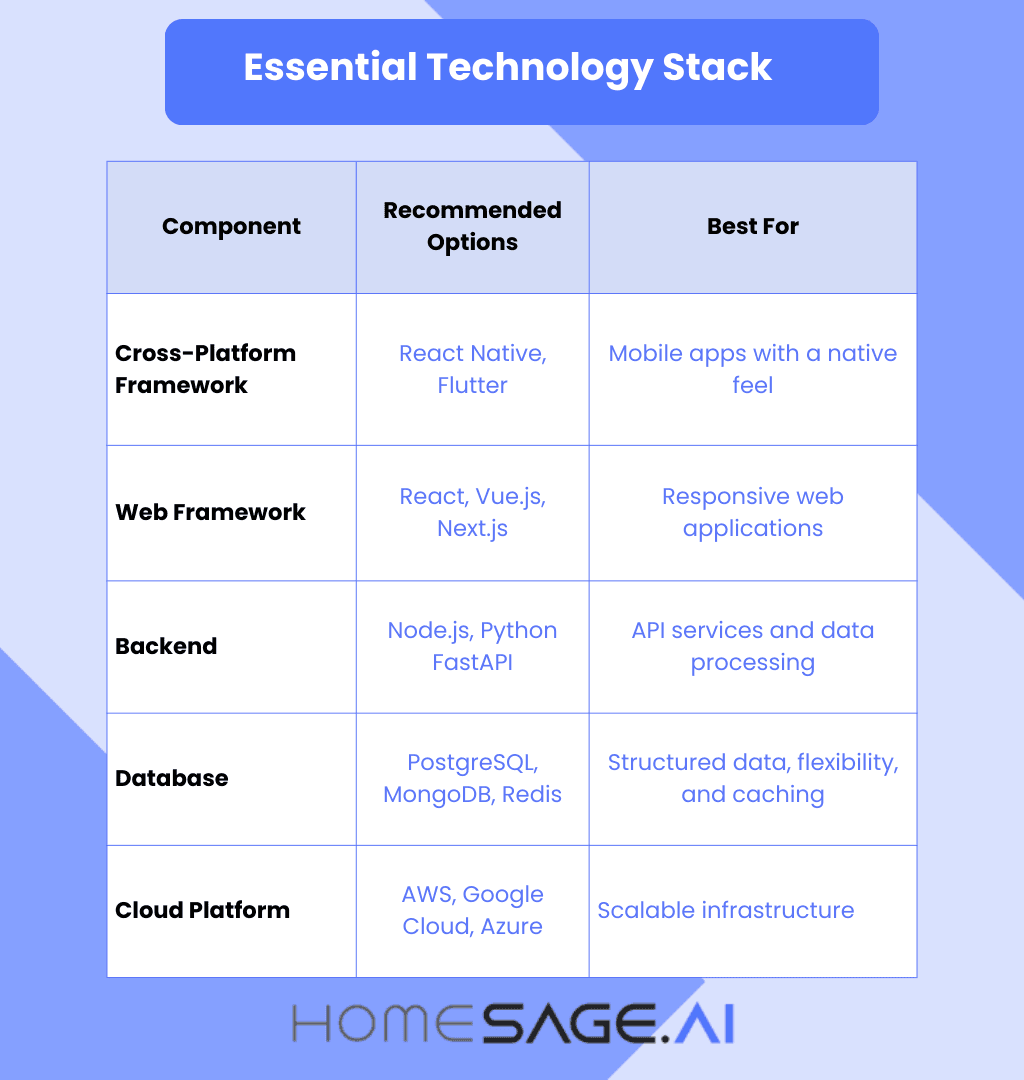
Essential Technology Stack
Component | Recommended Options | Best For |
Cross-Platform Framework | React Native, Flutter | Mobile apps with a native feel |
Web Framework | React, Vue.js, Next.js | Responsive web applications |
Backend | Node.js, Python FastAPI | API services and data processing |
Database | PostgreSQL, MongoDB, Redis | Structured data, flexibility, and caching |
Cloud Platform | AWS, Google Cloud, Azure | Scalable infrastructure |
Flutter offers exceptional performance and a rich set of widgets. For backends, Node.js provides fast development with JavaScript consistency, while Python excels at complex data processing and AI integration.
Use PostgreSQL for structured property data, MongoDB for flexible property attributes, and Redis for caching frequently accessed data, such as popular searches.
Most production applications use a combination that leverages each database’s strengths.
Integrating Real Estate APIs
APIs transform your app from a basic listing platform into an intelligent property analysis tool.
Homesage.ai offers specialized endpoints designed for PropTech developers, including Property Condition using computer vision, Investment Potential scoring with ROI probability, Price Flexibility Score for negotiation strategy, and Renovation Cost Estimates with local market data.
Authentication and Security
Most real estate APIs use API key authentication with tokens included in request headers. Review the real estate API documentation.
For production applications, implement secure key storage using environment variables, regular key rotation policies, and monitoring for unusual usage patterns. Never expose API keys in client-side code or commit them to version control.
Handling API Responses
Real estate API responses typically include property valuations with confidence intervals, detailed characteristics, comparable sales data, market metrics, and investment calculations.
Implement caching strategies that balance data freshness with performance, typically storing property valuations for 24-48 hours in stable markets.
If you prefer to see things in action, this short walkthrough shows exactly how to get started using Homesage.ai‘s real estate APIs in a modern app. You’ll see how to grab your API key, explore the docs, and make your first request for property data and analytics—all in just a few minutes.
This is a practical companion to the concepts in this guide and a helpful reference for any PropTech developer wiring APIs into their stack.
Building Core Features with AI
Intelligent Property Search
Modern search goes beyond basic filters, incorporating AI that learns user preferences, natural language processing for conversational queries, location-based recommendations, and saved searches with instant notifications.
Implement a search that understands context, recognizing that users searching for “investment properties” want different information than those searching for “family homes”.
Property Analytics & Virtual Tours
Investors expect comprehensive analytics: historical value trends, neighborhood comparisons, rental income projections, and renovation ROI calculations. Homesage.ai‘s Full Report API aggregates multiple data layers into a unified view of property intelligence.
Integrate AR/VR functionality for immersive viewing experiences that let users explore properties remotely and visualize renovations.
AI-Powered Intelligence

AI transforms apps from information displays into intelligent advisors. Track which properties users view, save, and share to refine personalized recommendations over time.
AI-powered valuation models achieve 94% accuracy for typical residential properties by processing historical transactions, neighborhood trends, and market conditions in milliseconds.
Computer vision automatically assesses Property Condition from photos, categorizing properties as Excellent, Good, Average, Outdated, Poor, or Very Poor without site visits.
Performance and Scalability
Implement multi-layer caching to reduce API calls and improve responsiveness: cache property data at the application level using Redis or Memcached, implement CDN caching for images and static content, and use client-side caching for frequently accessed data.
Property valuations change slowly, making them ideal for caching with refresh cycles of 24-48 hours.
Complex operations, such as generating comprehensive investment reports, should be processed asynchronously.
Submit requests and return job IDs immediately, then notify users when processing completes. This keeps interfaces responsive even for computationally intensive operations.
Security and Compliance
Real estate apps handle sensitive information, which requires robust security measures. Implement clear privacy policies that explain data collection and use.
For European users, ensure GDPR compliance by allowing data deletion requests. Store sensitive data encrypted both in transit and at rest.
Use environment variables and secrets management systems, such as AWS Secrets Manager, for production deployments. Monitor API usage for anomalous patterns indicating compromised credentials.
Testing and Deployment
Quality API providers offer sandbox environments with test data for development. Use these to test edge cases such as invalid addresses, properties not in the database, and rate-limiting scenarios.
Before launch, simulate production traffic patterns using tools like Apache JMeter or Locust to verify your app handles peak loads.
Modern development workflows use CI/CD pipelines that automate testing and deployment. Set up automated builds triggered by code commits, run comprehensive test suites before deployment, and use staging environments that mirror production.
Deploy backend services to cloud platforms that provide auto-scaling, load balancing, and monitoring.
Key Takeaways
- Modern real estate apps require a clean architecture, using patterns like MVVM to separate the UI, business logic, and data layers for maintainability and testing.
- Cross-platform frameworks like React Native and Flutter offer the best balance of development speed and performance for PropTech applications in 2026.
- Integrating specialized APIs, such as Homesage.ai’s property intelligence endpoints, transforms basic listing apps into powerful investment analysis tools without building complex infrastructure.
- AI delivers tangible value through personalized recommendations, predictive valuations, achieving close to 94% accuracy, and computer vision property assessment.
- Performance optimization through multi-layer caching, asynchronous processing, and 24-48 hour refresh cycles ensures apps remain responsive under high traffic.
- Security measures, including API key management, data encryption, SOC 2 compliance, and GDPR adherence, protect sensitive user information and meet enterprise requirements.

Conclusion
Building a competitive real estate app in 2026 requires combining modern architecture, intelligent APIs, and features that solve real user problems.
Success comes from making wise technology choices early, focusing on clean architecture that scales, and integrating specialized APIs that deliver institutional-grade capabilities without years of development.
Platforms like Homesage.ai demonstrate how developer-friendly APIs can accelerate time-to-market while providing the property intelligence users expect.
Apps that combine excellent user experience with powerful data intelligence will dominate the market.
Ready to build your real estate app with AI-powered property intelligence? Explore Homesage.ai‘s comprehensive API suite explicitly designed for PropTech developers, with interactive documentation, sandbox testing, and specialized endpoints for property analysis, investment scoring, and renovation intelligence.
Frequently Asked Questions
Q: What’s the best framework for building a real estate app in 2026?
A: React Native and Flutter are the top choices for cross-platform mobile apps, offering near-native performance while letting you maintain one codebase for iOS and Android.
React Native benefits from a massive community and extensive libraries, while Flutter offers exceptional UI performance and a rich widget library.
For web applications, React with Next.js or Vue.js provides the responsiveness users expect from modern property search interfaces.
Q: How long does it take to integrate real estate APIs into an app?
A: With well-documented APIs, developers typically complete basic integration in 30 minutes to 2 hours. This includes setting up authentication, making test requests, and displaying property data.
More complex integrations involving multiple endpoints and custom business logic may take several days, but getting your first working API call should happen quickly with quality documentation





3 Comments
Peter January 23, 2026
AI will be the main factor in building modern real estate apps
Nourhan M. January 23, 2026
Very helpful!
Jess January 26, 2026
This is worth paying attention to