
CoreLogic vs Homesage.ai is a fair question for any lender, investor, or realtor choosing a property-data and valuation partner in 2026 - and it is a bigger decision than it first looks, because automated valuation now sits inside real money workflows. Both platforms deliver automated valuations and property records.
They differ most in three places: condition awareness, after-repair value, and how you pay. This neutral, side-by-side breakdown will help you match the tool to your workflow rather than a sales pitch.
“Quick answer“CoreLogic is a long-established, enterprise-focused property-data and AVM provider with deep historical records. Our platform is AI-powered, covering 155M+ U.S. properties, and adds computer-vision condition analysis, after-repair value (ARV), and the Seller Motivation Score through transparent, usage-based access. Choose CoreLogic for legacy enterprise data warehousing; choose us for condition-aware valuation and developer-friendly pricing.”

Why This Comparison Matters More in 2026
Valuation used to be a back-office function. Now it is embedded in lending decisions, investment platforms, insurance pricing, and consumer apps - which means the accuracy and freshness of your data provider directly affects your risk and your margins. With AVMs now embedded in mainstream underwriting, choosing between an established data warehouse and an AI-native platform is a strategic decision, not a procurement checkbox.
How Accurate Are AVMs in 2026?
So how close do these models actually get? In data-rich urban markets, leading AVMs now land within about 3.8% to 5.5% of the actual sale price - and when a model flags a property as high-confidence, a 3-7% window is realistic.
But here is the part most vendors skip: that accuracy comes with conditions. Hand the same model a property with thin data or unusual features - a rural home, a half-finished renovation - and the error can quietly stretch past 15-20%. Those are usually the exact properties where you need the number most.
Even Zillow's published Zestimate accuracy illustrates the gap - a median error of roughly 1.9% when a home is listed on the market, versus about 7% when it is not.
If you want the deeper methodology behind trusting or rejecting a valuation, our guide to validating AVM accuracy lays out how to test any model against your own sales data before you rely on it.
CoreLogic vs Homesage.ai at a Glance
| Criteria | CoreLogic | Homesage.ai |
|---|---|---|
| Coverage | Broad U.S. property records | 155M+ U.S. properties |
| AVM approach | Established statistical AVM | AI AVM: current value and ARV |
| Condition analysis | Limited | Yes - computer vision |
| Negotiability signal | No | Seller Motivation Score |
| Pricing model | Custom quote - talk to sales first | Credit-based - clear usage pricing, start small |
| Onboarding | Enterprise procurement | Developer-friendly, self-serve |
| Best for | Big institutions with legacy systems already in place | Lenders, investors, IT developers & PropTech teams that price on today's condition |
CoreLogic is named here for comparison only; we do not link to competitor sites, and figures reflect publicly understood positioning rather than a claim about internal accuracy.
Here is what that looks like in practice - a short video on assembling a ranked property investment list with our data APIs.
Where CoreLogic Is Strong
A fair comparison starts with the current strengths. CoreLogic has spent decades building one of the deepest historical property databases in the country, and that depth is genuinely valuable for institutions that need long time-series data, regulatory-grade records, and established enterprise integrations. If your workflow is a large lender or analytics firm already wired into legacy systems, that continuity has real weight.
Where Homesage.ai Is Different
1. Condition - the blind spot that moves valuations
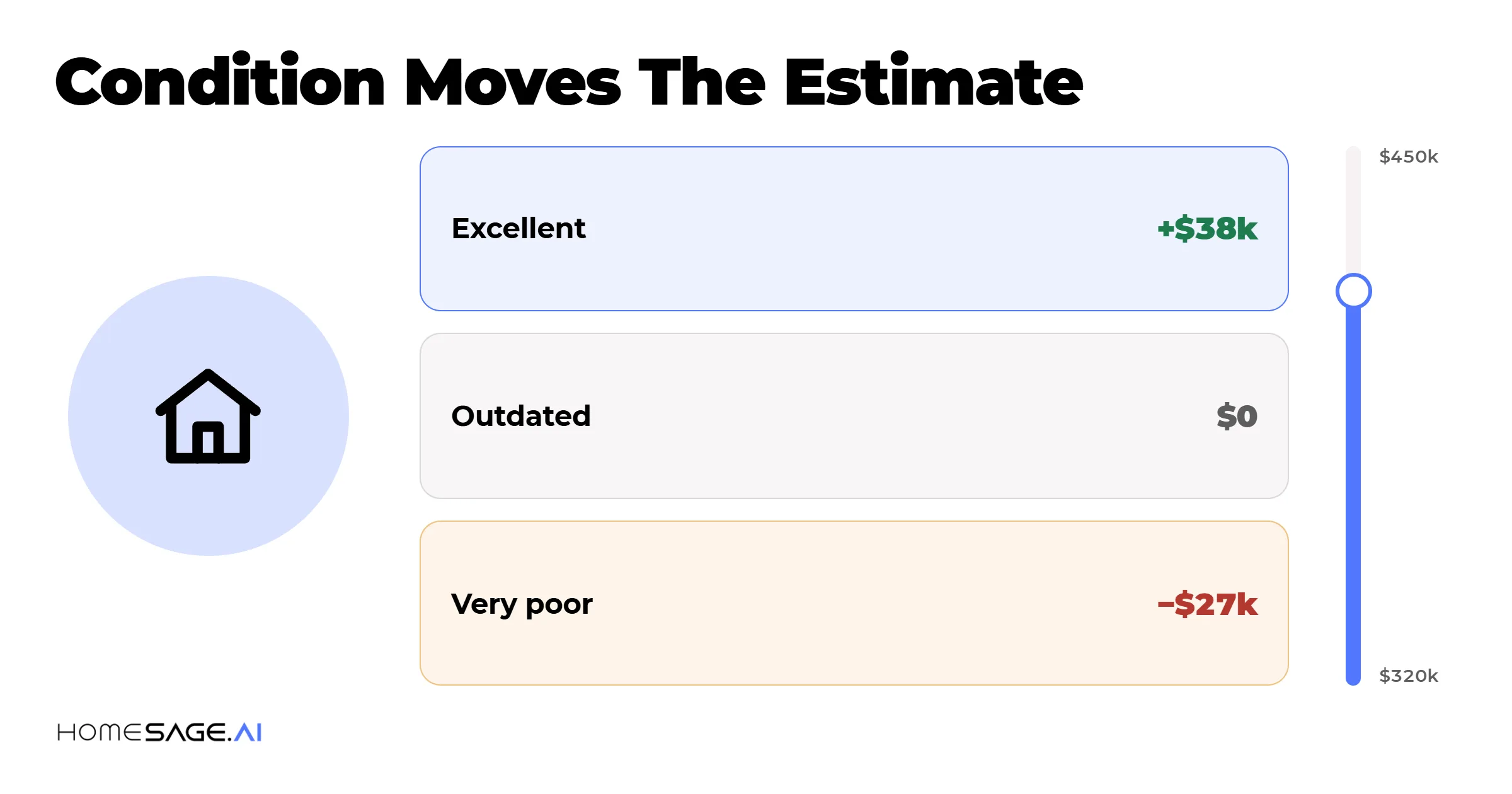
The gap most AVMs leave is condition. A model that values every home as average will misprice the one that needs a roof - and the one that was just renovated.
That blind spot is exactly where valuations drift, especially on the distressed and value-add properties investors and specialty lenders care about most. Our model reads visible condition with computer vision and returns both current value and ARV through the Full Property Reports, so you see what a property is worth now and after the work.
The industry has been slow to catch up here - we cover that shift in how AVMs are finally seeing property condition.
2. Negotiability - will the seller actually move?
Traditional valuation data tells you what a property is worth. It does not tell you whether the seller will budge.
The Seller Motivation Score estimates exactly that - and it changes which deals you prioritize. For an investor, or a lender pricing risk, knowing the seller is likely flexible is as useful as the valuation itself.
3. How you buy - test first, commit later
Enterprise data contracts often ask for a long commitment and a custom quote before you can even touch the data.
We work the other way around: transparent, usage-based pricing means a startup or a lending team can validate the data on its own properties first - and scale spend with usage, not with a signature.
Which Should You Choose?
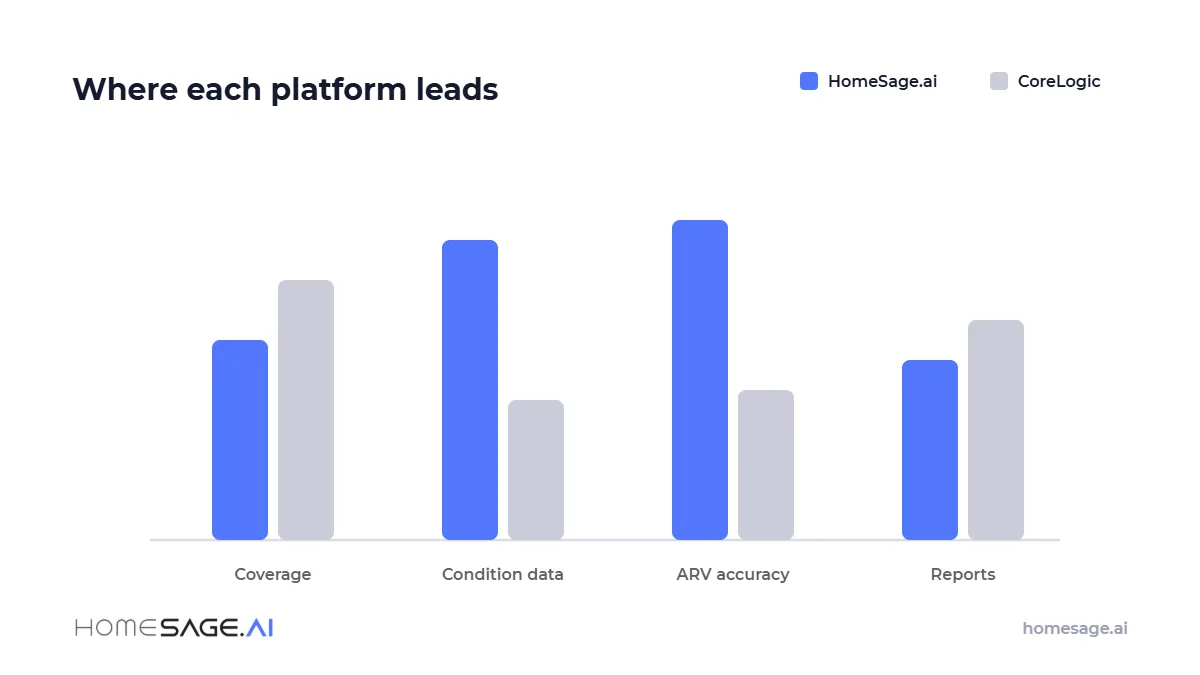
Choose CoreLogic if...
- You need a long-established enterprise data warehouse with decades of historical records.
- You already run legacy integrations and enterprise procurement is not a blocker.
- Your primary need is breadth of historical data rather than condition-aware, forward-looking valuation.
Choose Homesage.ai if...
- You want valuations that reflect what the property actually looks like - condition and ARV, not just square footage and ZIP code.
- You would rather see pricing up front and pay for what you use than negotiate an enterprise contract before touching the data.
- You are building on a modern API and want the seller-motivation signal built in, not bolted on.
And if you underwrite or invest in value-add or distressed property - where condition is the value - this is the stronger fit, full stop.
How to Run Your Own Head-to-Head Test
Do not take anyone's accuracy claim - including ours - on faith. Run a structured test before you commit:
- Pull 50-100 of your own properties with known recent sale prices.
- Run each through both providers and record the estimate and confidence score.
- Calculate the median absolute percentage error for each, weighted toward the property types you actually work.
- Pay special attention to distressed or renovated homes, where condition awareness shows up.
- Check how each handles low-confidence properties - a model that flags uncertainty is safer than one that sounds certain and is wrong.
For a broader field of valuation options beyond these two, our roundup of 7 best property evaluation APIs compares the tools developers actually integrate, and 3 best real estate AVMs gives a focused AVM comparison.
What to Know Before Switching
If you are moving off an incumbent, plan for the practical details: map the data fields you depend on to the new API, run both in parallel for a cycle so you can compare live, and confirm coverage in your specific markets. A usage-based model makes this easier because you can ramp gradually rather than flip a switch. The goal is a migration that improves accuracy without disrupting the workflows your team already trusts.
The Hidden Cost of an Inaccurate Valuation
It is tempting to treat a couple of percentage points of AVM error as a rounding issue. In practice it is the difference between a profitable decision and a loss.
Multiply that across a portfolio or a lending book and accuracy stops being a technical detail and becomes a risk-management line item. This is why the condition question matters so much: the properties most likely to be mispriced by an average-condition model are exactly the ones where the stakes are highest.
On a $400,000 property, a 7% error is $28,000 - enough to turn a sound loan into an over-advance, or a good flip into a break-even.
How Condition-Aware Valuation Actually Works
A traditional AVM predicts value from structured data - square footage, beds and baths, lot size, location, and recent sales. It has no idea whether the kitchen was renovated last year or the roof is failing. Condition-aware valuation adds a layer of computer vision that reads visible signals from imagery and permits, then adjusts the estimate accordingly.
The result is two numbers instead of one: current value in the property's actual state, and after-repair value if the work is done. For anyone underwriting or investing in value-add property, that second number is the whole game, and it is the single biggest reason teams move from a legacy AVM to an AI-native one.
What Our Own Market Data Shows
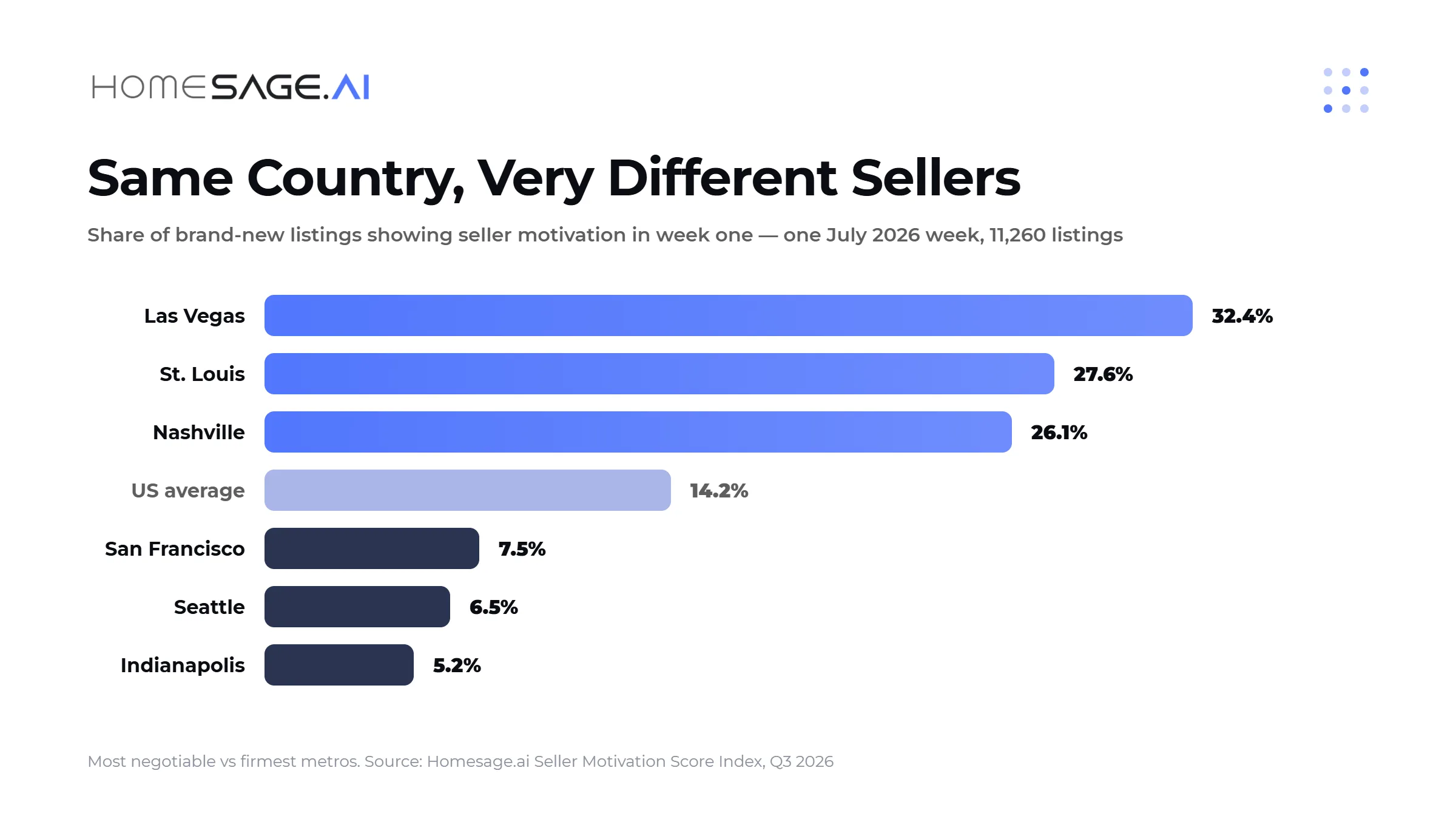
Here is a question no data warehouse can answer: which of this week's new sellers would actually take less? We put our own model on it - in a single July 2026 week, it scored 11,260 brand-new listings across 33 metros.
The headline: about 1 in 7 sellers (14.2%) showed motivation signals within days of listing. Before a single offer was made.
But the number that matters for this comparison is the spread. Las Vegas: 32.4% of new listings. Indianapolis: 5.2% - same week, same country, a six-fold difference that no valuation record, however deep its history, will ever surface.
That is the gap between knowing what a home is worth and knowing what its seller will do next. We publish the full metro breakdown every quarter in our Seller Motivation Score Index.
How the Choice Plays Out by Team Type
1. Mortgage and specialty lenders
Lenders need defensible valuations and clear confidence scores. CoreLogic's historical depth suits large, established lending operations; our condition-aware AVM is a strong fit for lenders working with renovation, bridge, or non-QM products where property condition drives risk.
2. Real estate investors
Investors care about ARV and negotiability, not decades of tax history. Our current-plus-ARV valuation and Seller Motivation Score map directly to how investors actually decide, which is why it tends to win this segment.
3. PropTech and platforms
If you are building a product, the data is only half the decision - you also live with the API every day. Docs, endpoints, and pricing you can read without booking a sales call decide how fast you ship.
That is where an AI-native provider has a structural edge: usage-based pricing means you can prototype this week, launch next quarter, and let spend grow with your users - not with a procurement cycle.
Beyond Valuation: What Else This Data Powers
Choosing a property-data partner is not only about a single value estimate. The same data feeds portfolio monitoring, lead prioritization, risk models, and consumer-facing features, so the decision compounds across your whole product. A provider that returns condition, ARV, and negotiability alongside the core record lets you build features a plain AVM cannot support - a renovation-ROI calculator, an off-market targeting tool, a seller-outreach ranking.
The accuracy question is table stakes - every serious provider clears it. The better question is which data still fits what you plan to be building a year from now.
For teams heading toward AI-driven products, data that understands condition and seller behavior opens more doors than another decade of historical records. That is the real difference hiding inside what looks like a simple accuracy comparison.
How Often Should You Refresh a Valuation?
A valuation has a shelf life. The number that was right in April can be quietly wrong by July - markets move, and they move locally.
So match the refresh to the stakes. If money is about to move - a loan in underwriting, an offer going out tomorrow - pull the freshest estimate you can get. If you are just watching a portfolio, a monthly or quarterly refresh catches the drift without burying you in noise.
The advantage of an API-based, condition-aware provider like ours is that refreshing is a single call, so keeping values current across a whole book is cheap and automatic rather than a manual re-order. Build the refresh cadence into your workflow up front, and you avoid the quiet risk of acting on a stale number.
Key Takeaways
- CoreLogic offers deep historical data and enterprise integrations; we offer condition-aware AI valuation with the decision signals attached.
- Modern AVMs report median errors around 3.8-5.5% in data-rich markets, but accuracy collapses on properties the model cannot see the condition of.
- We add after-repair value and a Seller Motivation Score - signals a legacy data warehouse does not provide.
- Pricing differs sharply: enterprise custom quotes versus transparent, usage-based access you can test first.
- Run your own head-to-head test on 50-100 known sales before committing to either.
Conclusion
CoreLogic and Homesage.ai solve different problems. If you need a long-established enterprise data warehouse, CoreLogic fits; if you want condition-aware AI valuation, ARV, and transparent usage-based pricing, ours is built for how teams work in 2026.
For most lenders and investors the deciding factor is whether the model can see property condition - because that is where inaccurate valuations quietly cost money. Run both on ten of your own properties and compare.
Frequently Asked Questions
Is Homesage.ai a CoreLogic alternative?
What does the platform do that CoreLogic does not?
How accurate are AVMs?
How is pricing different?
Can an AVM replace an appraisal?
Which is better for distressed or value-add property?
How do I test which AVM is more accurate for my market?
Disclaimer: This comparison is informational and not financial or legal advice. Automated valuations are estimates, not appraisals. Positioning and third-party figures reflect publicly available information as of 2026.





Emma July 24, 2026
Great read!
Emma July 24, 2026
Very helpful!
Nourhan August 8, 2026
Insightful!