
“Quick answerSkip tracing is cheap per record and expensive per list. Homesage.ai traces inside an investment workflow. BatchData serves enterprise volume, REISkip serves investor lists, and SkipGenie suits one-off lookups. The bigger saving is upstream. In Kansas City on 6 October 2026, screening 1,037 active listings down to 39 cut the owner lookups by 96%. That happened before a single trace ran.”
Skip tracing turns an address into an owner and a way to reach them. Investors use it to contact owners of properties that never reach the open market.
Every provider charges per record. That makes the size of your list the thing that decides the bill.
Screen before you trace
The expensive mistake is tracing a whole city. We ran Kansas City through our property database on 6 October 2026.
| Filter | What it keeps | Owners left to trace |
|---|---|---|
| Kansas City, active listings | Every home for sale in the city | 1,037 |
| Outdated, poor or very poor condition | The houses that need work | 122 |
| Under $150,000 | What a first-deal budget can fund | 39 |
Our property database, Kansas City active listings, 6 October 2026. Counts move daily.
Our owner lookup costs 4 credits per property. Tracing all 1,037 would cost 4,148 credits. Tracing the 39 that survive costs 156.
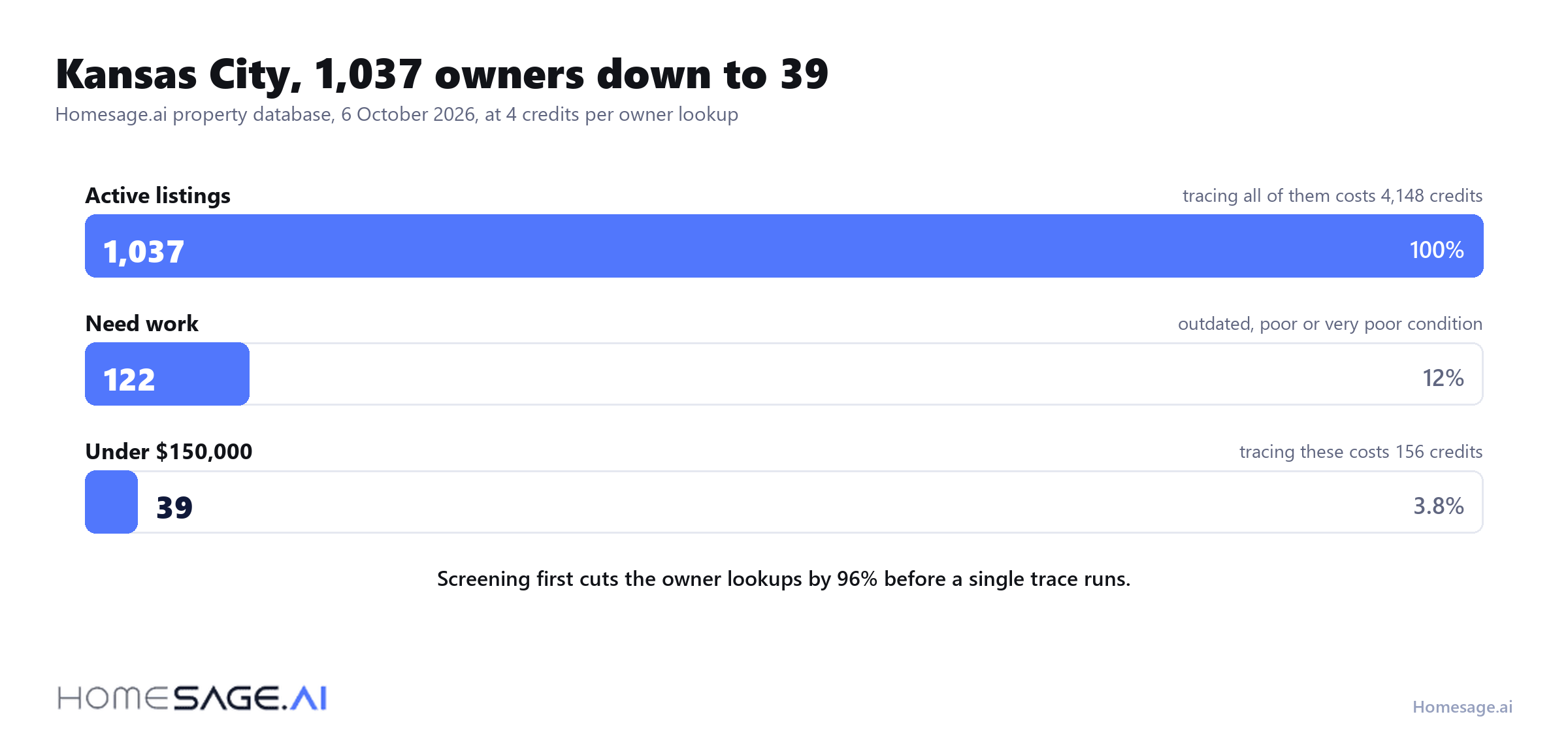
The cheapest skip trace is the one you never run. Narrow the list first, then pay per record.
What to look for in a provider
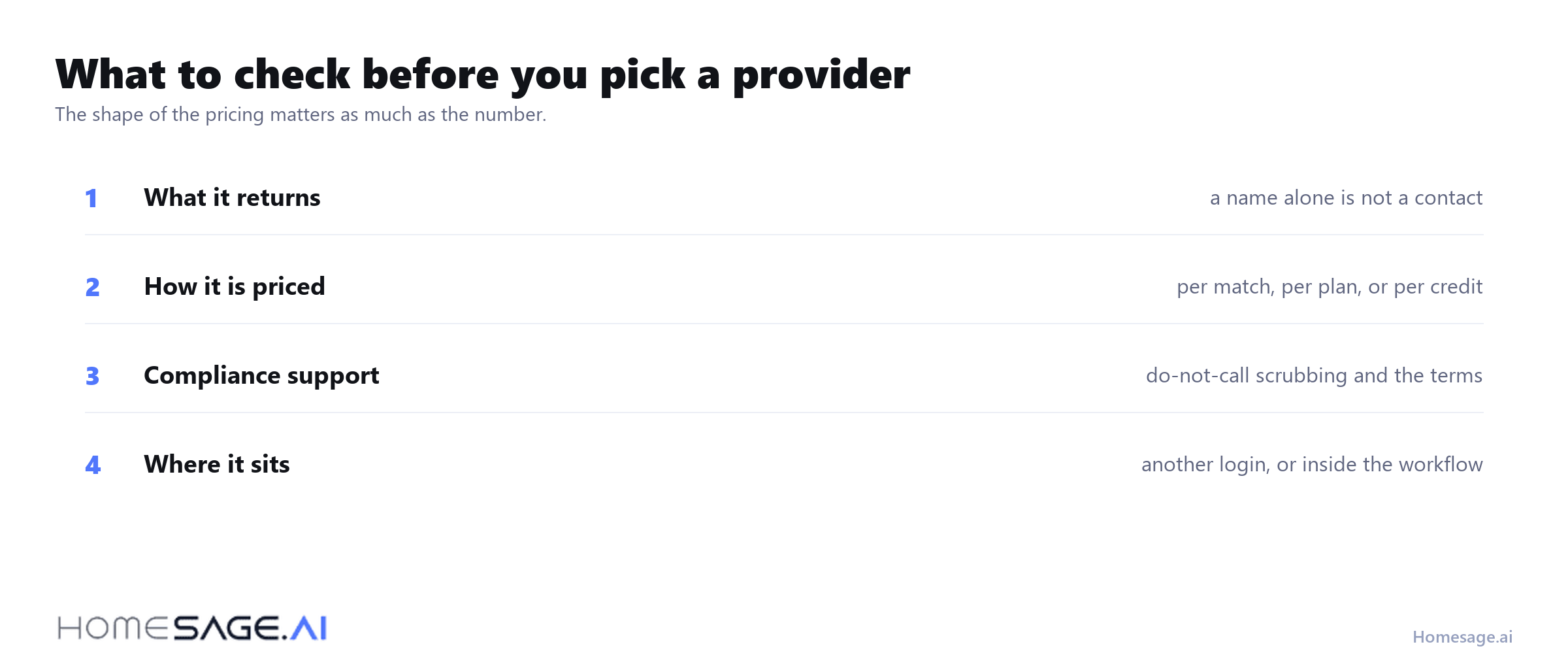
- What it returns. A name alone is not a contact. Check whether phones, emails and associated people come back in the same call.
- How it is priced. Per property match, per subscription, or per API credit. Compare on the shape, because a per-match price and a monthly plan are not the same purchase.
- Compliance support. Do-not-call scrubbing and the terms covering how you may use the data.
- Where it sits. A standalone tool means another login. An API means the trace runs inside the workflow that found the property.
The best skip tracing data providers
1. Homesage.ai skip tracing API
Best for investors who want the trace to run where the property research already happens.
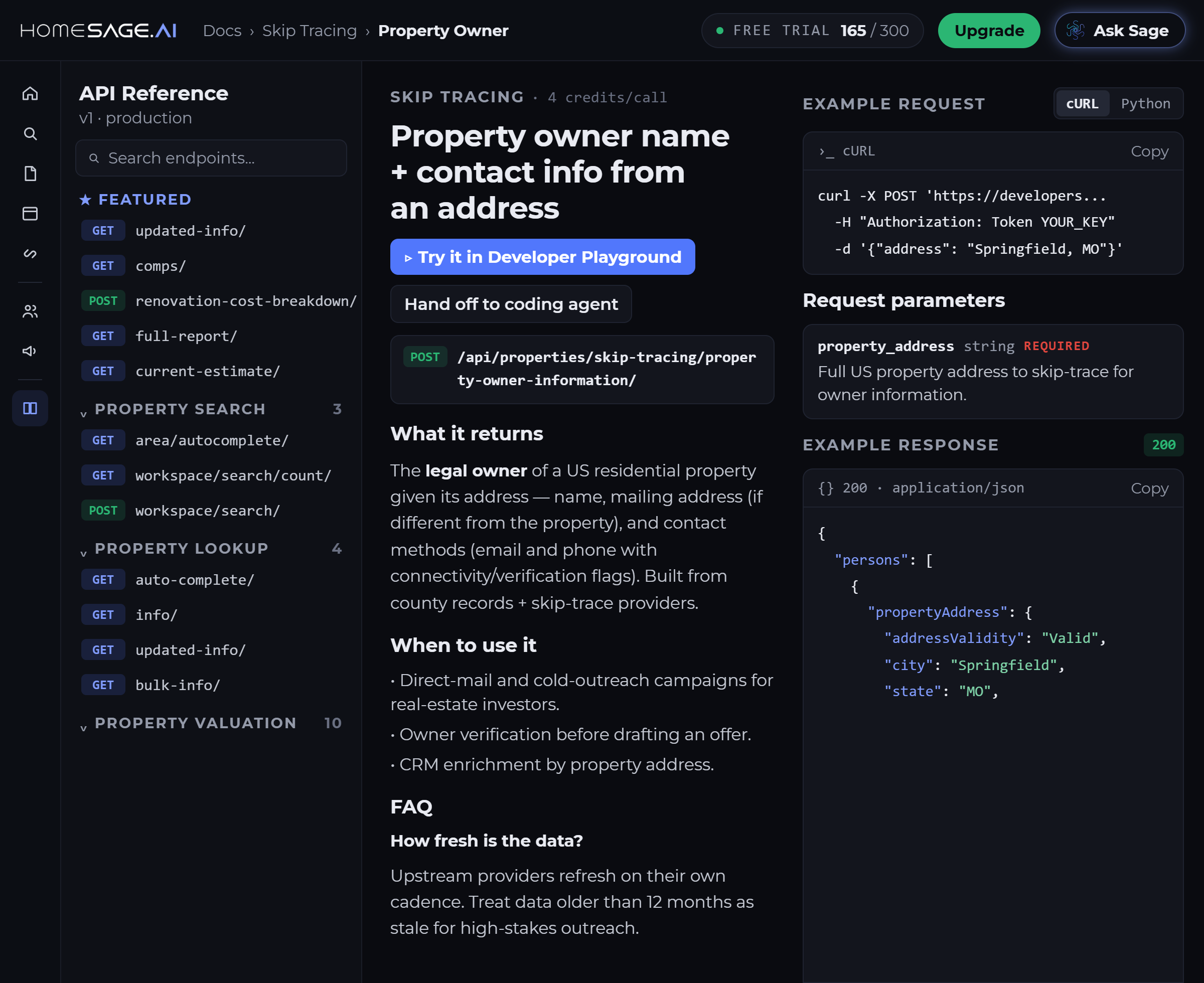
Three endpoints cover the job. Owner information from an address at 4 credits, associated people at 1 credit, and a full person record at 1 credit.
The advantage is sequence. The same account that scored the property on condition and return also returns the owner. The list you trace is already the list worth tracing.
The cost sits on the endpoint itself, so the price of a trace is known before the call is written.
2. BatchData
Best for teams tracing at volume through an API, with enterprise contracts and bulk delivery.
Its terms restrict use to the customer’s own purposes, which matters if you were planning to resell or republish what comes back.
3. REISkip
Best for investor and wholesaler lists, with pricing built around per-match volume rather than a platform subscription.
4. SkipGenie
Best for occasional lookups where a subscription is hard to justify.
How the 4 providers compare
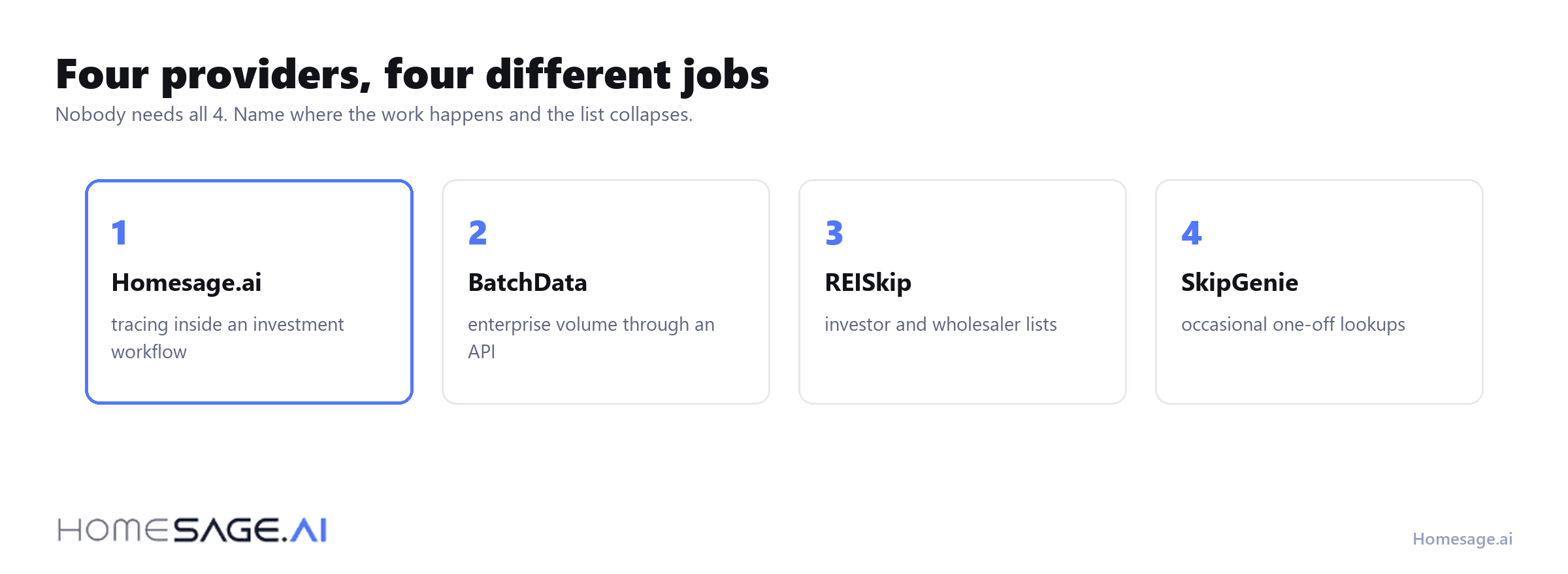
None of them is best in general. Each is built for a different place in the work, so the real question is where your tracing happens.
| Provider | Best for | How it is priced | Where it runs |
|---|---|---|---|
| Homesage.ai skip tracing API | Tracing inside an investment workflow | Per API credit, 4 credits an owner lookup | The same account that scored the property |
| BatchData | Teams tracing at volume | Enterprise contracts and bulk delivery | A standalone API |
| REISkip | Investor and wholesaler lists | Per match, by volume | A standalone platform |
| SkipGenie | Occasional lookups | Per lookup | A standalone platform |
Credit cost is our published API price. Third-party pricing shapes are the vendors’ own published descriptions, checked 6 October 2026.
Here is a short video on what a single property report returns.
What a trace actually returns
A provider that hands back a name has done a tenth of the job. Our owner lookup returns the owner of record plus the fields that decide if the call is worth making.
- The owner of record. One or two people, with the mailing address when it differs from the property.
- Phone numbers with a history. Each number carries its type, whether the provider tested it, whether it was reachable, the date it was last reported, and a confidence score.
- Email addresses with a verification flag. Verified means the provider checked the mailbox. It does not mean the owner reads it.
- Do-not-call, litigator and deceased flags. 3 fields that stop a campaign before it starts.
Those flags matter more than a headline match rate. A reachable mobile number sitting on a do-not-call registration is not a lead, and dialling it anyway is how outreach becomes a legal problem.
2 limits travel with the data. Skip-trace records are research-grade aggregation of public records and are not certified for legal proceedings. Treat anything older than 12 months as stale for high-stakes outreach.
List first, then drill down
3 endpoints do the job, and running them in order is what keeps the bill small.
- Owner lookup, 4 credits. The legal owner, built from county records. Most addresses stop here.
- Associated people, 1 credit. Everyone the address links to, including residents, relatives and former owners. Each person comes back with an ID.
- Person details, 1 credit. Pass one of those IDs and get the full record. Current and previous addresses with first-seen and last-seen dates, phones with connectivity, emails with verification, relatives and associates.
The second step earns its place when the owner of record cannot be reached. The documented case is a deceased owner. The people worth contacting are the family linked to the address, not the name on the deed.
Repeat calls on an ID you have already pulled are free within your own history. Building a record over several sessions does not cost a credit each time.
What skip tracing does not solve
A phone number is not a motivated seller. Contact data tells you how to reach an owner, never whether reaching them is worth your time.
The property side decides that. Property condition, the estimated renovation cost and the return are what separate 39 calls from 1,037.
Using the data lawfully
Owner contact data carries terms. Most providers restrict it to your own business purposes, and do-not-call rules apply to the numbers you get back.
Scrub against do-not-call lists before any campaign, keep records of consent where you rely on it, and never republish owner data.
The data itself carries 3 of those checks. A do-not-call flag sits on the record and on individual numbers, and a litigator flag marks people with a history of suing over unwanted contact. Read both before a number reaches a dialler.
The deceased flag is a courtesy as much as a compliance control. Calling the owner of record at a house whose owner died last spring ends a relationship. That family might otherwise have sold to you.
When a trace comes back empty
No provider matches every address, and the gaps are predictable rather than random.
- No current address on file. The provider has nothing recent for the person. This is common for anyone who moves often, and for an owner who died recently.
- Commercial property. Residential is the primary use case. Expect thinner coverage on anything else.
- A stale record that still matches. Worse than a miss, because it looks like a result. The last reported date on the phone number is the field that tells you.
Plan for the misses in the budget rather than in the moment. On a 39-property list, a provider matching 8 in 10 leaves 8 addresses with no owner, and those 8 are not refunded by anyone.
One case we will not give you a number for is an owner held in an entity. Where a house sits in a company or a trust, what comes back is the owner as the county recorded it. We do not publish a claim about resolving the people behind an entity, because we have no measured rate to publish.
Ask Sage before you buy a list
Sage is our AI assistant, and it runs the property screen from a plain-language question inside the AI tool you already use.
Connect Homesage.ai to Claude, ChatGPT, Gemini or Perplexity through our Real Estate MCP and narrow the market before you spend anything on contacts.
“How many active listings in this city need work and sit under my budget?”
Setting this up in ChatGPT takes 3 steps. Connect to ChatGPT in the MCP portal, then ask in plain language.
Key takeaways
- Skip tracing is priced per record, so the size of your list sets the bill.
- In Kansas City on 6 October 2026, 1,037 active listings narrowed to 122 needing work, then 39 under $150,000.
- At 4 credits per owner lookup that is 156 credits instead of 4,148.
- Choose on what comes back, how it is priced, the compliance support, and whether it runs inside your workflow.
- Contact data never tells you whether a property is worth buying. Screen first.
Conclusion
Pick the provider that fits where the work already happens. A standalone platform suits a team whose tracing is its own task. An API earns its place when the trace runs beside property research.
Then spend it on the short list rather than the city. Kansas City ran 1,037 active listings down to 39 worth tracing, which is 156 credits instead of 4,148.
Read the flags before you dial. A do-not-call registration, a litigator marker or a deceased owner turns a reachable number into a mistake.
Treat what comes back as research. Skip-trace records are not certified for legal proceedings, and anything older than 12 months is stale for high-stakes outreach.
Start with an account and screen a market before you buy a single contact record.
Frequently asked questions
What is skip tracing in real estate?
How much does skip tracing cost?
Which skip tracing provider is best?
Is skip tracing legal?
How accurate is skip tracing data?
Not investment advice. Data as of 2026-10-06. Counts come from the Homesage.ai property database and change daily. Credit costs are our published API prices and may change. Third-party product capabilities are the vendors’ own published descriptions. Owner contact data is subject to provider terms and to do-not-call rules. Check both before any outreach.





Val May 18, 2026
This is a very useful API
Emma May 18, 2026
Great breakdown!
Robin May 18, 2026
good read