
According to Postman’s 2025 State of the API Report, 82% of organizations have adopted some level of an API-first approach, up from 74% in 2024, and in real estate, that dependency runs even deeper. PropTech platforms live or die by the quality of the property data flowing through their systems. Bad data means broken valuations, unreliable search results, and user churn.
Choosing the right property data APIs for developers is not just a technical decision; it shapes what your platform can do, how fast you can ship features, and whether your data holds up under real professional use. This guide breaks down the seven best property data APIs for building PropTech platforms in 2026, with a focus on data depth, coverage, developer experience, and integration flexibility. See our guide on when to use each property data API.

Why Property Data APIs Are the Foundation of Every PropTech Platform
The global PropTech market is projected to reach $44.59 billion in 2026, with software accounting for 74.6% of that spend. Behind nearly every competitive PropTech product, investment analysis tools, AVM engines, lending dashboards, and rental platforms, is a property data API doing the heavy lifting.
The best real estate data APIs for developers deliver more than basic property records. Modern platforms need structured data across several dimensions: property characteristics, ownership history, valuation models, condition assessments, renovation cost estimates, rental projections, and neighborhood context. APIs that only serve listing data leave major capability gaps.
What separates a usable property data API from a great one comes down to four factors:
- Coverage depth: how many data points per property, and how far back the history goes
- Update frequency: how often values, statuses, and market data are refreshed
- Schema consistency: whether data is normalized across geographies and sources
- Developer experience: quality of documentation, sandbox availability, and response formats
As PropTech innovators increasingly layer multiple data types into a single platform, API selection becomes a strategic decision, not just an infrastructure one.
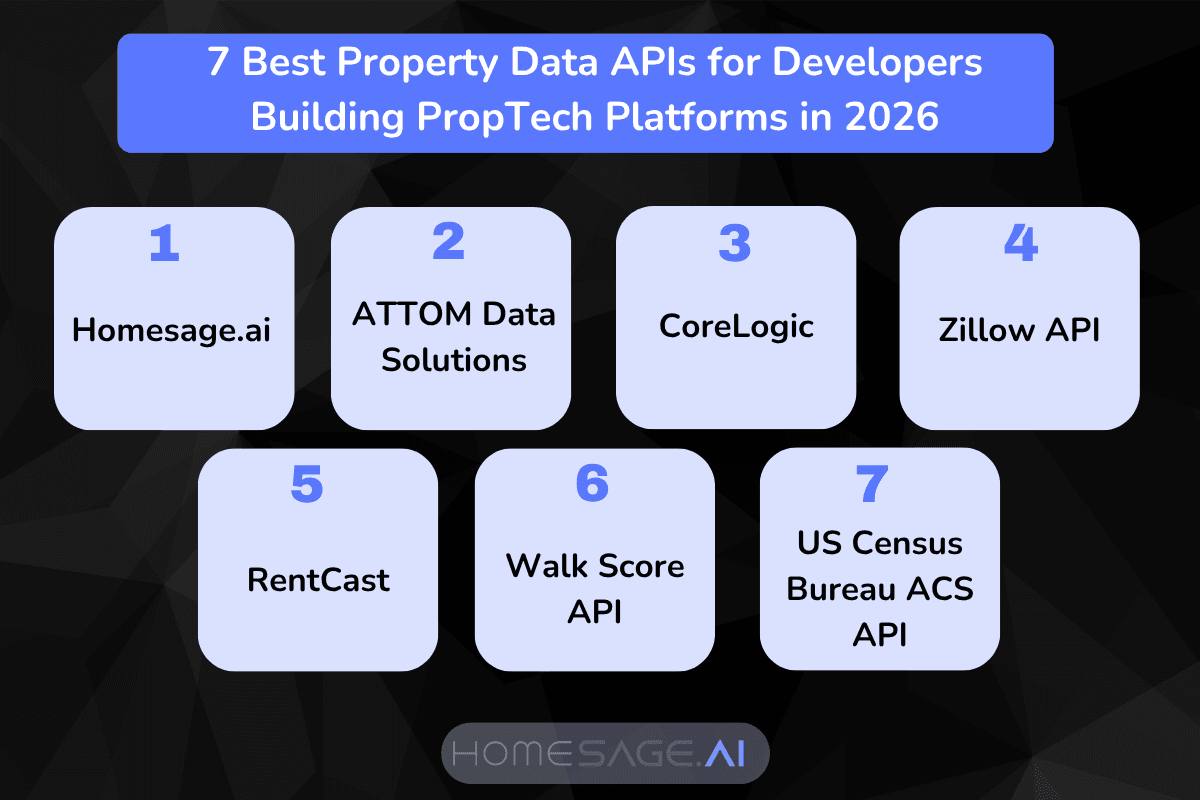
The 7 Best Property Data APIs for PropTech Developers in 2026
1. Homesage.ai. Best for AI-Powered Property Intelligence
Homesage.ai is an AI-powered real estate data platform that analyzes 150M+ US residential properties using machine learning models incorporating over 50 data points per property. For developers building platforms that need analytical depth beyond raw property records, the Homesage.ai real estate APIs offer a distinct advantage: AI-derived outputs that competitors don’t have.
The API suite includes six specialized endpoints:
- Property Condition API: computer vision analysis of property images to assess condition across five levels (Very Poor to Excellent)
- Renovation Cost API: itemized renovation cost estimates with recommended budgets
- Investment Potential API: proprietary scoring for ROI potential and deal quality
- Price Flexibility Score API: predicts the likelihood that a seller will accept below-asking offers
- Rental ROI API: short-term (Airbnb) and long-term rental projections
- AVM/Data API: automated valuations, comps, and structured property data
Best for: Investment platforms, lending dashboards, deal analysis tools, and any PropTech product that needs decision-support data rather than just property records. Explore Full Property Reports and AI Investment Property Search for platform integration examples.
Pricing: Credit-based subscription. Small (1,250 credits/mo), Medium (5,000 credits/mo), Large (20,000 credits/mo).
2. ATTOM Data Solutions. Best for Enterprise Coverage
ATTOM delivers property intelligence for 158M+ US properties, aggregating data from county assessors, recorder offices, MLS feeds, and third-party providers. Its Enterprise Data Management Program (EDMP) normalizes and validates data across sources, making it particularly reliable for financial-grade use cases.
ATTOM is a good choice for lenders, insurers, and large PropTech platforms that need consistent, nationwide data at scale. The RESTful API returns JSON and XML, and the documentation covers property attributes, tax records, valuations, ownership history, and neighborhood data. Coverage depth and normalization are ATTOM’s strongest differentiators.
Best for: Enterprise platforms, mortgage underwriting tools, insurance applications, and risk assessment systems requiring validated, multi-source data.

3. CoreLogic. Best for Mortgage and Risk Data
CoreLogic is the industry standard for mortgage-adjacent data. Its API suite covers property valuations, lien data, flood risk, climate risk, and market analytics, making it a dependable choice for platforms operating in lending, title, or insurance workflows where financial accuracy and compliance matter. Data refresh rates and cross-source validation are CoreLogic’s strongest operational differentiators.
Best for: Mortgage platforms, title companies, risk modeling applications, and financial services PropTech.
4. Zillow API. Best for Listing and Zestimate Data
Zillow’s API provides listing data, historical sales, neighborhood demographics, and the Zestimate AVM for 150M+ US properties. Developers should note: Zillow restricts commercial API use, so it typically functions as a supplementary layer rather than a primary data source for commercial PropTech. For condition-adjusted or AI-enhanced valuations, additional APIs are needed on top.
Best for: Consumer-facing property search and baseline valuation displays where commercial use restrictions don’t apply.
5. RentCast. Best for Rental Market Data
RentCast specializes in rental market data, long-term rent estimates, rental comps, vacancy rates, and neighborhood rent distributions. It fills a gap that broad-coverage APIs often leave open for rental-focused builds. The API returns clean JSON responses and offers a free tier for early-stage prototyping. Pairing it with a core property data API gives rental platforms both transaction history and live rental market context.
Best for: Rental investment platforms, property management tools, landlord dashboards, and rental analytics features within broader platforms.
6. Walk Score API. Best for Location Intelligence
Walk Score provides walkability, transit, and bike scores for any US address, adding location context that property records alone can’t supply. The API is lightweight and easy to embed into property cards, search results, or investment scoring views, making it a natural complement to any core property data layer.
Best for: Buyer-facing search platforms, neighborhood intelligence features, and investment scoring tools where location quality affects property value.
7. US Census Bureau ACS API. Best for Neighborhood Demographic Data
The Census Bureau’s American Community Survey API is a free, authoritative source for neighborhood-level data: population, income, employment, and housing tenure. It updates annually, so it works best as a background context layer rather than a live feed. Combined with a property data API, the ACS API rounds out neighborhood intelligence without adding to API costs.
Best for: Market research tools, neighborhood comparison features, and data-driven buyer or investor platforms.
How to Choose the Right Property Data API Combination
No single API covers every use case for a full PropTech platform. Most production-grade platforms combine two or three APIs. One for core property data, one for specialized analytics, and one for location or neighborhood context. Architect it with the right real estate data stack.
| Platform Type | Primary API | Supplementary APIs |
|---|---|---|
| Investment Analysis Tool | Homesage.ai | ATTOM, Walk Score |
| Mortgage Underwriting Platform | CoreLogic | ATTOM, Census ACS |
| Rental Investment Platform | HomeSage.ai | RentCast, Walk Score |
| Buyer Search Portal | Zillow | Walk Score, Census ACS |
| Hard Money Lending Dashboard | HomeSage.ai | CoreLogic, ATTOM |
| Market Analytics SaaS | ATTOM | CoreLogic, Census ACS |
Before committing to a data contract, review real estate API integration practices covering rate limits, caching strategies, and fallback handling. For a broader comparison of real estate APIs for developers, that pillar guide covers pricing and endpoint comparisons in depth.
Key Takeaways
- Data depth beats data breadth. A platform built on 50+ data points per property will outperform one relying on basic listing records. The right property data APIs for developers provide analytical outputs, not just raw fields.
- AI-derived data is the new differentiator. Condition scores, renovation estimates, and price flexibility predictions separate modern PropTech from legacy property search tools.
- Layer your APIs strategically. A core property data API, a location intelligence layer, and a specialty analytics API cover most PropTech use cases without redundancy.
- Developer experience matters at scale. Clean documentation, consistent schemas, and reliable uptime reduce integration debt and long-term maintenance costs.
- Homesage.ai’s API suite gives PropTech developers access to computer vision-based condition assessments, AI investment scoring, and Rental ROI projections, capabilities most providers don’t offer. See IT developer tools for integration options.
Conclusion
Choosing the right property data APIs is one of the most consequential architecture decisions a PropTech developer makes. The API you select shapes your platform’s data quality, feature ceiling, and scalability for years. Platforms built on surface-level listing data will lose ground to those integrating AI-powered intelligence, condition assessments, investment scoring, price flexibility predictions, and renovation estimates. This is why many platforms are switching data providers.
If you’re building a PropTech platform that needs to deliver real analytical value to investors, lenders, or agents, review what the best real estate APIs for apps can do for your architecture, then layer in the specialized data your use case demands.
In the video below, Homesage.ai walks IT developers through how the real estate API suite works in practice. From pulling property condition scores and renovation cost estimates to running investment potential analysis across 150M+ properties.
People Also Ask
Q: What is a property data API?
A: A property data API is a programmatic interface that allows developers to retrieve structured property information, including characteristics, valuations, ownership history, condition assessments, and market data, directly into their applications via authenticated HTTPS requests that return JSON-formatted responses.
Q: Which property data API has the best coverage for US residential properties?
A: Homesage.ai, ATTOM, and Zillow each cover 150M+ US residential properties. The key differentiator is data depth per property: Homesage.ai provides 50+ data points including AI-derived metrics like condition scores and investment potential, while others focus primarily on public records and listing data.
Q: How many APIs does a PropTech platform typically need?
A: Most production PropTech platforms use two to three APIs: one core property data API, one for specialized analytics (rental data, risk scores, or AI insights), and one for location context such as walkability or neighborhood demographics. Over-relying on a single provider is a common architecture risk.
Q: What should developers look for when evaluating property data APIs?
A: Prioritize data coverage depth, update frequency, schema consistency across geographies, documentation quality, sandbox access, and rate limit policies. For AI-powered platforms, look for providers that offer derived analytics, not just raw property attributes.





3 Comments
Mike April 10, 2026
Solid APS is a very important component of every modern application
Julie April 10, 2026
Really helpful to see these APIs compared
N April 11, 2026
Great Read!