“Quick answer: AI comps are comparable sales that software finds, ranks and adjusts. You get a list of recent nearby sales and an estimated value. Homesage.ai ranks sales by size, rooms, distance and sale date. It adjusts for property condition when both homes have a score (comps endpoint documentation). Check each sold date before you trust the number. Redfin reports a median error of 1.95% on homes for sale and 7.70% off market (About the Redfin Estimate, read 21 November 2026).

A comp is a recently sold home that looks like the one you are pricing. Investors and agents start almost every valuation from them.
This guide shows what an AI comp is and how the model picks each sale. It also covers what to check before the value goes into a deal. For the full deal math, see how to analyze a deal fast.
What AI comps are and what they return
The sales comparison approach compares a property with similar properties that sold recently. Doing that by hand means searching sales, dropping weak matches and adjusting each price for the differences.
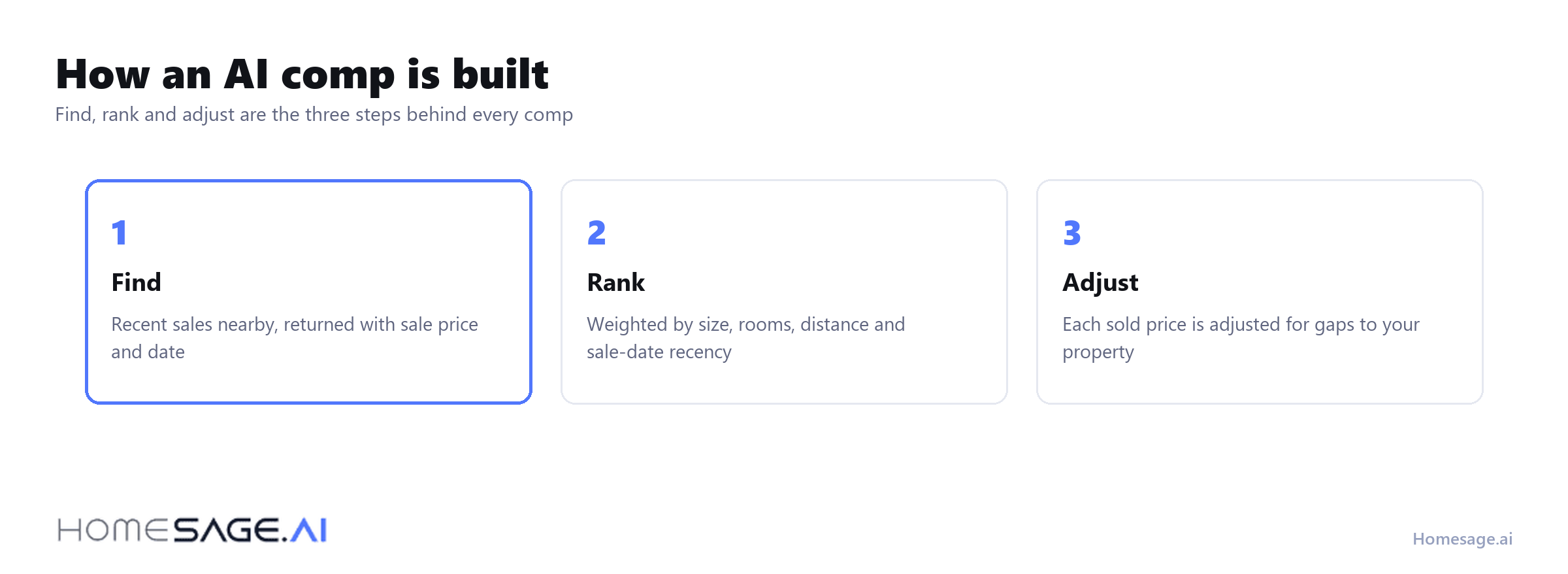
AI comps run the same steps in software. You give an address. The tool returns a ranked list of sold homes with a sale price, a sale date and an adjusted price, plus an estimated value.
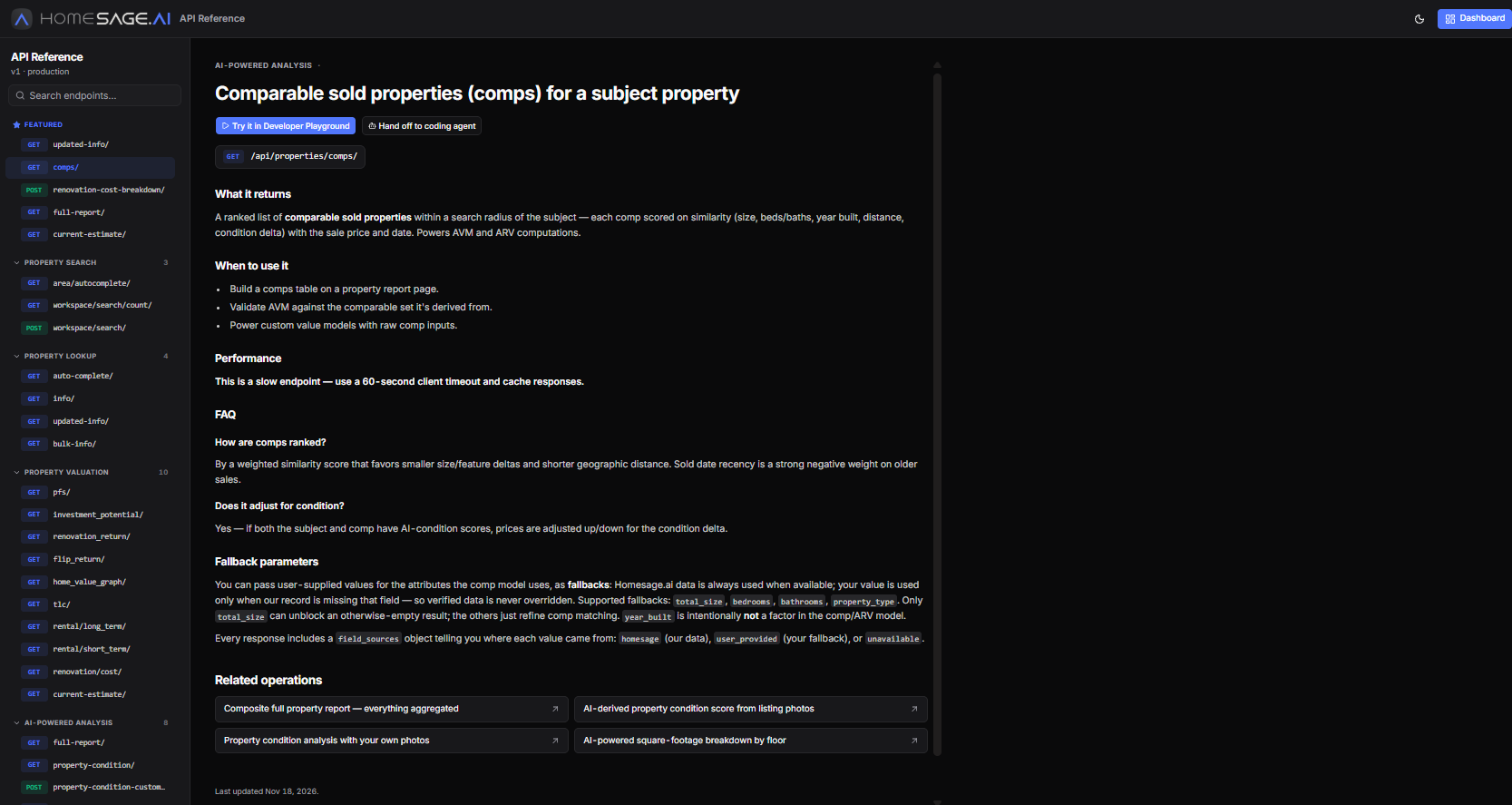
Our comps endpoint documentation returns each comp with distance, size, beds, baths, sold price, adjusted price, sold date, property condition and a confidence score. It also returns an estimated after-repair value (ARV) and a confidence level for that value.
How the model ranks and adjusts each sale
According to our documentation, comps are ranked by a weighted similarity score. Smaller gaps in size and features score higher, and so do shorter distances. Sale-date recency is a strong negative weight on older sales.
A sold price only becomes a comp once it is adjusted to the subject property.
Condition matters too. If both the subject home and the comp have an AI condition score, the price is adjusted up or down for the gap. The score is read from property photos, so it is a screening signal and not an inspection.
You can also send your own square footage, bedrooms, bathrooms or property type as fallbacks. Our data is used first. Your value is used only when our record is missing that field, and each response says where every value came from.
Check every comp before you trust the value
An estimated value is only as good as the sales behind it. Read the comp list line by line, and drop any sale that does not fit your deal.
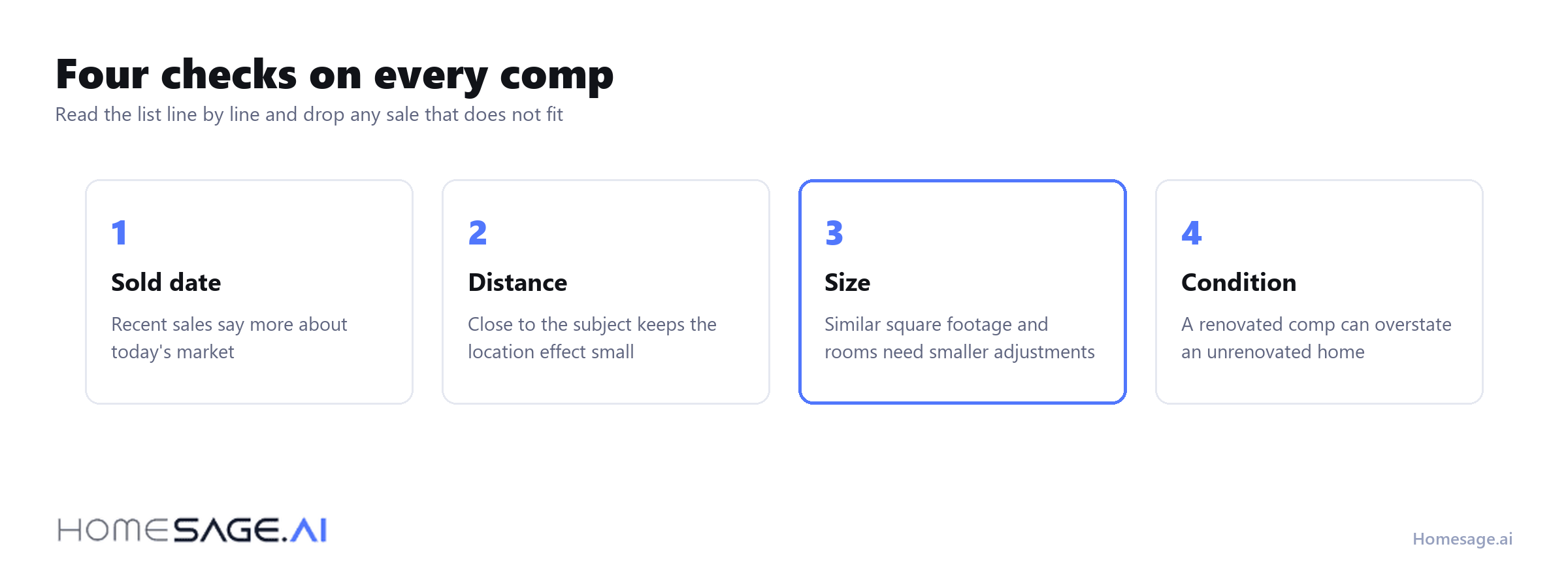
Four checks on each comp.
| Check | What to look for | Why it matters |
|---|---|---|
| Sold date | Sales from the recent past | Older sales say less about today’s market. |
| Distance | Close to the subject home | A short distance keeps the location effect small. |
| Size | Similar square footage and rooms | Large gaps force big price adjustments. |
| Condition | A similar state of repair | A renovated comp can overstate an unrenovated home. |
For a flip, the last check carries the most weight. A fully renovated comp is a fair guide to your exit value. It is a poor guide to your purchase value. To turn comps into a resale figure, read how to calculate the after-repair value with AI.
A worked example with invented numbers
Take a 1,500 square foot house. The three comps below use invented round figures. Each sold price is adjusted for the gap to the subject home.
Three invented comps and their adjusted prices.
| Comp | Sold price | Adjustment | Adjusted price |
|---|---|---|---|
| Comp A, 1,400 sq ft | 300 thousand dollars | Plus 10 thousand for size | 310 thousand dollars |
| Comp B, renovated | 330 thousand dollars | Minus 15 thousand for condition | 315 thousand dollars |
| Comp C, similar | 320 thousand dollars | No change | 320 thousand dollars |
The adjusted prices run from 310 thousand to 320 thousand dollars. Show that as a range, and build your exit math on the low end. If the deal only works at the high end, it is too thin.
Then stress-test it. Lower the value by 5%, raise the repair bill by 20%, and add a few extra months of holding cost. For the other numbers in the deal, see the market indicators that matter to investors.
Where AI comps break
Comps are a starting point. These are the cases where they miss.
Thin data: Few recent sales nearby means a weaker estimate. Our comps response warns when comp data is limited.
Non-disclosure states: Some states do not record sale prices publicly. There, our documented example returns no estimated ARV and a confidence of insufficient.
Condition: A score read from photos cannot see wiring, a roof leak or a bad foundation. Get an inspection and a contractor bid.
Not an appraisal: Lenders order their own. Redfin says its estimate is not an appraisal. It reports a median error of 1.95% on homes for sale and 7.70% off market (page read 21 November 2026). Off-market homes are the harder case, and many investor targets sit there.
What our own test shows
A comps adjustment leans on property condition, and your exit math leans on rent. We tested how often each field exists on homes already for sale. The test covered 5,061 active for-sale listings in seven US cities (Homesage.ai test, 26 and 29 October 2026).
Listings with each field, seven US cities, 26 and 29 October 2026.
| Field | Share of 5,061 listings | What it means for your analysis |
|---|---|---|
| Property condition grade | 94.4% | Present on nearly every listing, so a condition adjustment is usually possible. |
| Verified rent | 17.7% | Missing on most listings, so show rent as an estimate. |
| Verified rent by city | 5.1% to 38.1% | Coverage varies widely, so check your own market. |
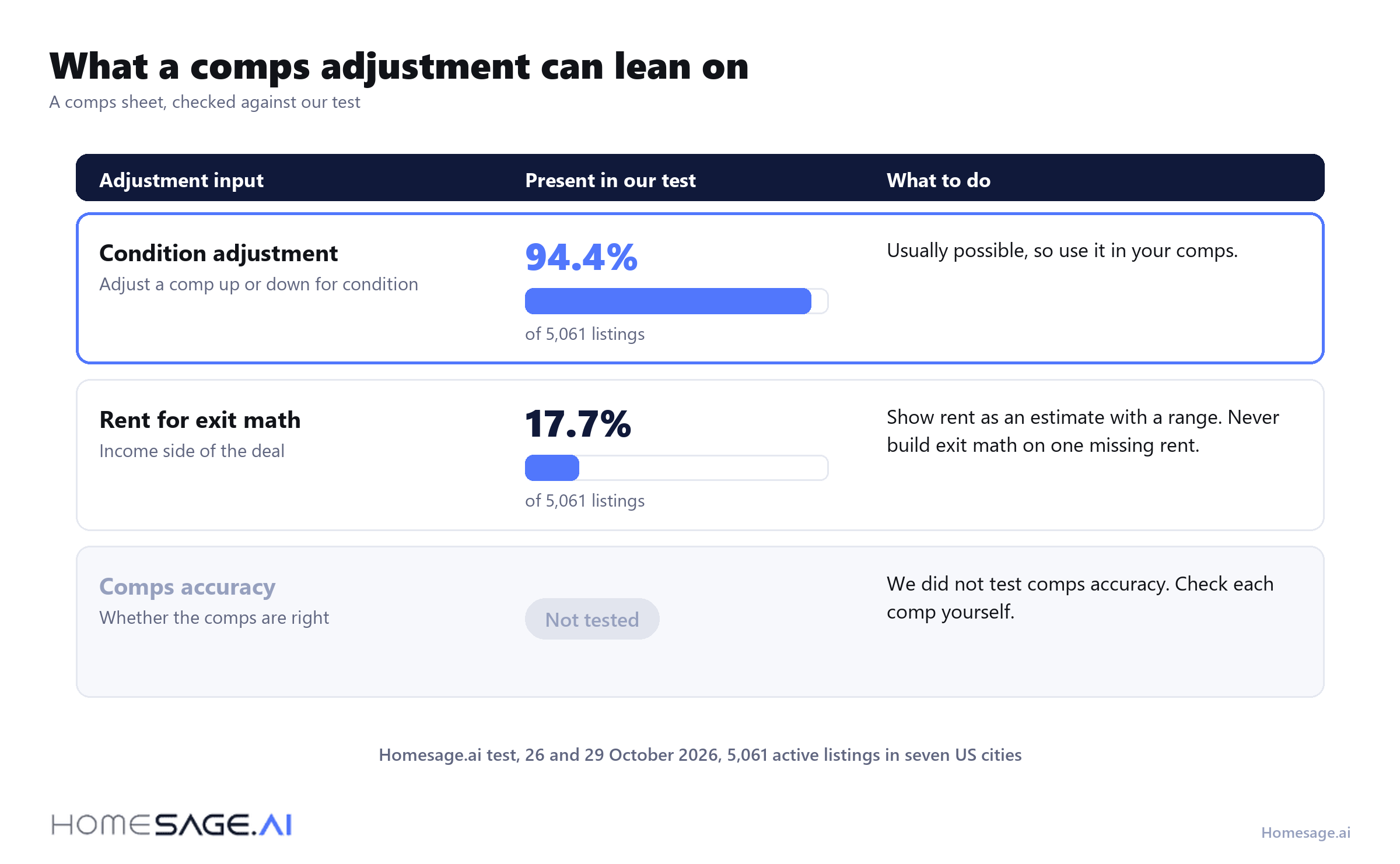
For an investor, the habit is clear. Condition is usually there, so use it in your comps. Rent is optional, so show it as an estimate with a range. Never build exit math on one missing rent.
Limits: the test covers active for-sale listings in seven cities. It measures whether a field is present, not whether it is accurate. We did not test comps accuracy. Counts move daily.
Pull recent sales for a whole ZIP code
Sometimes you want the market and not one address. Our sold-by-ZIP endpoint lists residential properties sold in a ZIP code over the last 365 days by default. Each row has a sale date, a sale price and basic property characteristics.
Use it to see how many homes sold, how prices moved and which sales look like your subject home. Then run the comps endpoint on the address you care about.
Ask Sage to run the comps
Sage is our AI assistant. It runs these analyses from inside the AI tool you already use. See our MCP connector for how it connects (page read 21 November 2026).
Try a prompt such as: show me the comps for this address and flag any that sold long ago. Give me the value as a range. Then read each comp yourself.
Related reading: AI Chrome Extension for Real Estate Investors.
Key takeaways
- AI comps find, rank and adjust recent sales, then return an estimated value.
- Our comps endpoint ranks sales by similarity and sale date, and adjusts for condition when both homes have a score.
- Check sold date, distance, size and condition on every comp.
- Show the value as a range and build exit math on the low end.
- Redfin reports a median error of 1.95% on-market and 7.70% off-market, so off-market values need wider margins.
- Our test found a condition grade on 94.4% of 5,061 listings and verified rent on 17.7%.
Conclusion
AI comps remove the slowest part of valuation, the search. They do not remove the judgment. You still decide which sales are fair matches for your deal.
Read the sold dates first. Then check distance, size and condition, and show the value as a range. A deal that survives the low end of that range is a deal you can defend.
Run one address you are already considering and read the comps behind the number. Start now.
Disclaimer: This guide is general information, not financial or investment advice. Estimated values, ARV and returns are model-derived estimates, not appraisals. Example figures are invented. Third-party figures come from the pages named in Sources, read on 21 November 2026.
Frequently asked questions
What are AI comps in real estate?
How many comps do I need to value a deal?
Are AI comps the same as an appraisal?
Why would a comps tool return no value?
Can I use comps to set my maximum offer?
- Homesage.ai, Comparable sold properties (comps) endpoint documentation, read 21 November 2026.
- Homesage.ai, Sold properties by ZIP endpoint documentation, read 21 November 2026.
- Redfin, About the Redfin Estimate (median error 1.95% on-market and 7.70% off-market), read 21 November 2026.
- Wikipedia, Real estate appraisal, sales comparison approach, read 21 November 2026.
- Homesage.ai, Real estate MCP page, read 21 November 2026.
- Our own test, 26 and 29 October 2026, 5,061 active for-sale listings in seven US cities.