
“Quick answer A Seller Motivation Score is a 0–100 reading of how much negotiating room a listing likely has, computed by AI from four public signals: days on market, price-change history, comparable activity, and seasonal demand. Higher scores mean a more movable asking price. High readings are rare in live inventory: across 23 Cleveland listings we deep screened on 6 September 2026, the median score was 5.8, and exactly one listing cleared 30, after three price cuts and 43 days on market.

What Listing Price Flexibility Means
Price flexibility is the gap between what a seller asks and what they would accept. Seller’s motivation in real estate is what creates that gap: a motivated seller is priced, or becomes priced, to move, while an unmotivated one will hold firm for months.
Knowing which is which you offer is the difference between a deal and a wasted week.
The asking price is an opening statement. Motivation decides how the conversation ends.
Traditionally, gauging flexibility took intuition, an agent’s read, or time-consuming research into each listing’s history. The signals were always public; they were just scattered. Now AI can read them together, at a market scale, and turn them into a single comparable number.
What Is a Seller Motivation Score?
Homesage.ai’s Seller Motivation Score is that number: a 0–100 estimate of how likely a listing price is to move, computed by AI models for active listings across the platform’s 155M+ US property records.
A score near zero describes a seller holding firm; a rising score describes a listing whose own history says the ask is softening. For IT developers, the same field ships in the real estate API under the name of PFS.
The score doesn’t read minds, and it doesn’t claim to. It reads behavior. A seller’s circumstances are private, but their listing leaves a public trail, and that trail is measurable.
How Does the Seller Motivation Score Work?
The score works by reading four families of public signal together, each one checkable by hand if you have the patience:
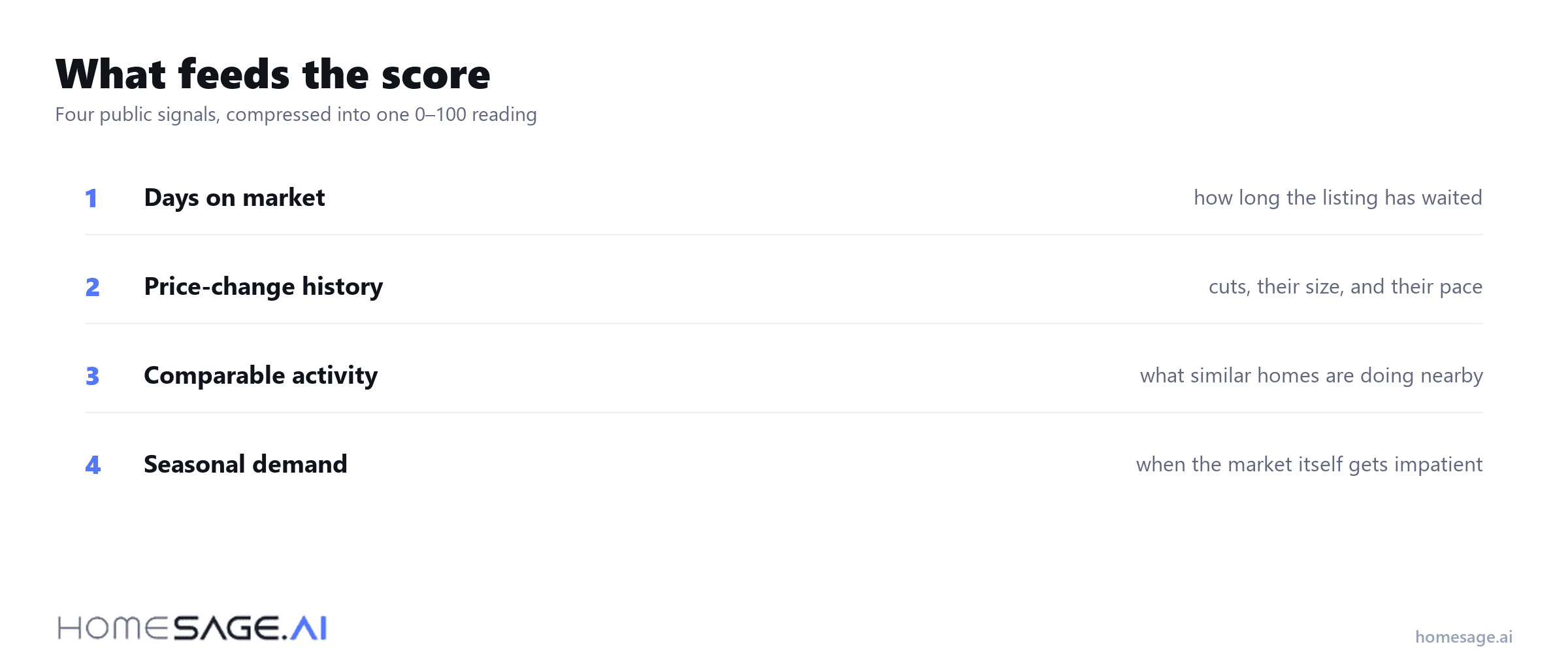
- Days on market: The longer a listing waits past its market norm, the more the ask tends to soften.
- Price-change history: Cuts, their size, and their pace. Three cuts in four weeks say more than any listing description.
- Comparable activity: What similar homes nearby are asking and closing at, and how fast they are moving.
- Seasonal demand: The same listing carries different leverages in March than in November.
Weighing those signals against each other used to take experience, and it is the part AI models do consistently. The output is deliberately simple: one number you can compare across every listing in a market.
What a Motivated Seller Looks Like in Live Data
Here is the score on real inventory, from our 6 September 2026 deep screen of 23 active single-family listings in one Cleveland ZIP code. The median Seller Motivation Score was 5.8, and most listings scored under 10. Exactly one listing cleared 30: a three-bedroom bungalow that cut its price three times in four weeks, from $174,900 to $149,000, and sat on the market for 43 days.
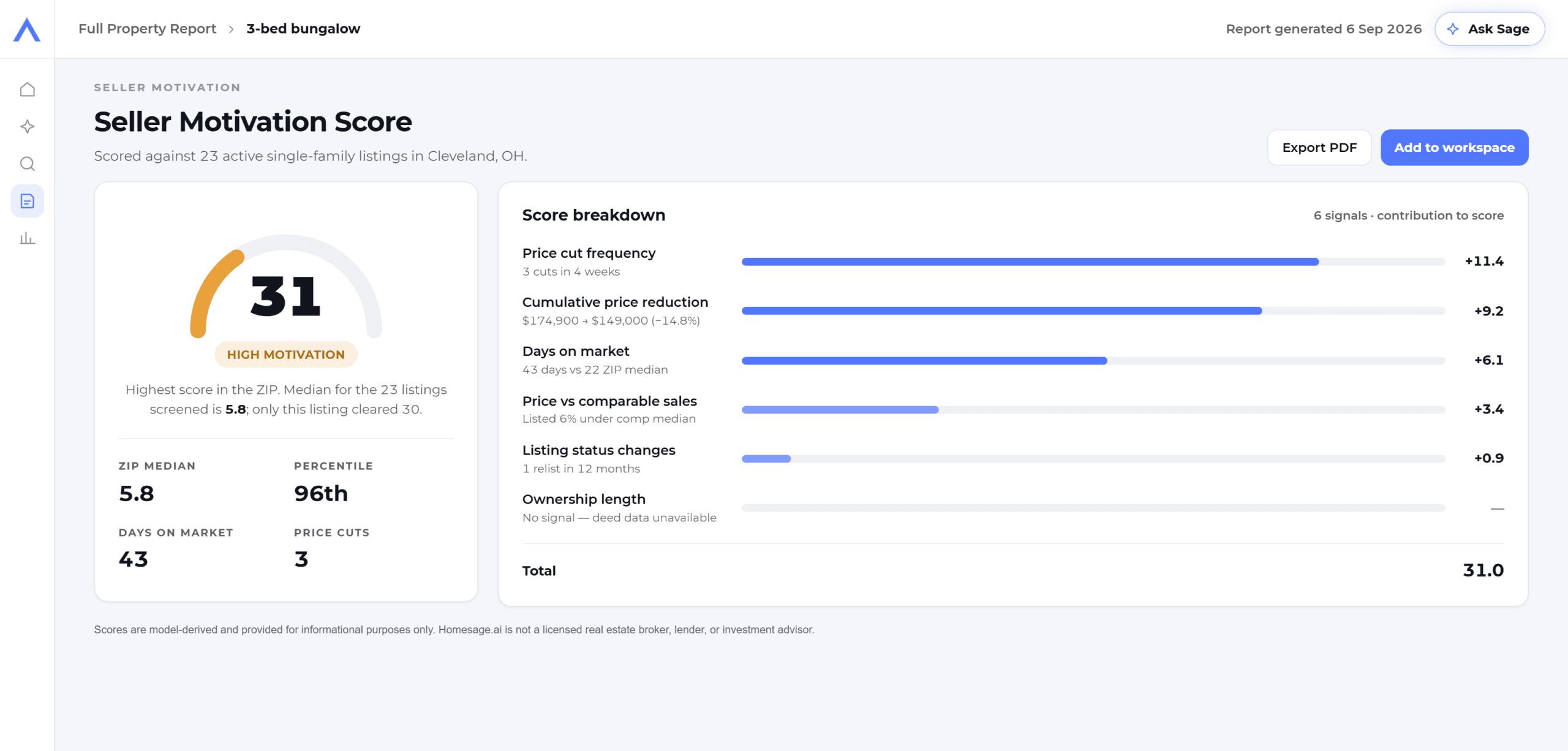
The trail behind that 30 is exactly the kind of record the models read: each price reduction on a real estate listing is a dated, public event, and their pace tells the story. Here is, verbatim from the listing history.
| Date | Event | Asking price |
|---|---|---|
| 25 July 2026 | Listed | $174,900 |
| 3 August 2026 | Price cut | $169,000 |
| 10 August 2026 | Price cut | $159,000 |
| 17 August 2026 | Price cut | $149,000 |
| 6 September 2026 | Still active, day 43 | Score: 30 |
That distribution is the point. Motivation is rare, so a high score is a genuine signal rather than decoration, and it is why the score works best as a ranking tool: sort a market by it, and the listings worth a negotiation float to the top.
The same example carries an honest caveat. That 30-score bungalow still failed to flip underwriting, because it’s realistic renovation scope dwarfed what the deal could absorb at any nearby price. A motivated seller makes a price movable; it does not make a property good.
The data-driven guide to real estate investing covers the full underwriting discipline the score fits into.
How to Find Motivated Sellers with the Score
Finding motivated sellers used to mean driving for dollars and cold-calling stale listings. With a score attached to every active listing, it becomes a sort. In practice, the score has three jobs, in order:
- Shortlisting: Sort a market’s active listings by motivation and start where the negotiating room is. It is one of several AI-powered metrics investors use to spot good deals, alongside condition grades and value-gap readings.
- Offer strategy: A high score with a stale, thrice-cut listing supports a materially lower opening offer; a low score suggests bidding close to ask or waiting.
- Timing: Watching a score rise on a shortlisted property tells you when a seller’s position is softening, without calling anyone.
The score appears in listing results in Investment Property Search, where it can rank a whole market, and in each Full Property Report next to the valuation, condition, and return analysis.
Here is a short look at the platform where the score lives in.
Reading the Score Honestly
Like every estimate on the platform, the score deserves to be read with its limits in view. It measures the listing of public behavior, so it cannot see private circumstances: a divorce, a relocation deadline, an estate sale that has not yet shown up as a price cut.
Sellers like that sometimes negotiate hard from a listing that still looks firm on paper.
It is also weakest where its inputs are thinnest. A listing in its first week has almost no trail to read, and a rural property with few comparables gives the models less to weigh, so a young or thinly compared listing deserves more of your own judgment.
The score updates as the trail grows, which is why watching it move is often more informative than any single reading.
And it is a negotiation signal, never a valuation. Two listings can carry the same score while one is priced $40,000 over its renovated ceiling and the other under it. The score tells you the ask can move; the underwrite tells you where it must move to.
Our guide to analyzing residential investment deals fast shows where the score slots into that ten-minute discipline.
Who Uses the Score
Investors: Rank whole markets by motivation to find motivated sellers first, then aim to underwrite time at listings with real negotiating room.
Realtors and agents: Justify an offer number to clients with a data-backed reading instead of a hunch and set listing-side expectations honestly.
Lenders: Add negotiation context to underwriting files alongside valuation and condition, for a fuller picture of the deal being financed.
IT developers and proptech teams: Pull the same score into their own apps through the real estate API library, where it ships as the PFS field beside condition, valuation, and return endpoints.
Here is the score’s place on the platform briefly.
| Feature | What you get |
|---|---|
| AI-powered analysis | Machine learning over listing behavior, comparables, and seasonality |
| One comparable number | A 0–100 score you can rank an entire market by |
| In every Full Property Report | Beside condition, valuation, renovation, and return analysis |
| Real estate API access | The PFS field, ready to integrate into apps and websites |
| Coverage | Insights on 155M+ US properties |
How to Get Started
Test it at a live address: Create an account and open a report on any listing you are watching.
- Rank a market: Run an Investment Property Search and sort by motivation to see your area’s outliers.
- Set alerts on your schedule: Save the search and let new high-scoring listings come to you at the cadence you choose.
- Going deeper: Review pricing for report volume and real estate API access when you are ready to build it into your workflow.
Key Takeaways
- A Seller Motivation Score is a 0–100 AI reading of how movable an asking price likely is, built from days on market, price-change history, comparable activity, and seasonal demand.
- High scores are rare in live inventory: the median across our 23-listing Cleveland deep screen was 5.8, and only one listing cleared 30.
- The score measures behavior, not private circumstances. It reads the public trail for a listing leaf, which is also why you can sanity-check it by hand.
- Use it to rank and time negotiations, not to skip underwriting. The highest-scoring listing on our screen was still a bad flip at every realistic price.
- Motivation is one signal of seven. It makes the other numbers negotiable; it does not replace them.
Conclusion
Negotiation has always run on information asymmetry. The seller knows their urgency; the buyer guesses. What a Seller Motivation Score changes is not the game but the guess: the public half of the seller’s position, the waiting, the cuts, the season, the neighbors, is now read systematically instead of anecdotally.
The honest way to use it is context, not prophecy. A 30 in a market of fives tells you where negotiating attention belongs today, and the trail of signals behind it tells you why. What it never tells you is whether the property deserves an offer at all; that remains the underwriter’s job.
The practical advice is simple. Stop treating every asking price as equally serious, because the data says they are not. Rank the market by motivation, underwrite the shortlist properly, and let the sellers who are already moving toward you meet you first.
This article is general information, not investment advice. Evaluate every property against your own finances, local costs, and professional inspection.





AI Tools For Estimating Property ARV: Investor Insights 2026 October 10, 2026
[…] to generate accurate valuations. The platform provides comprehensive property details, including listing prices, square footage, features, and location specifics, all essential for precise ARV calculations. This […]
Can AI Calculate Renovation Costs? | Homesage.ai October 10, 2026
[…] Insights: Get a “Price Flexibility Score” to understand how much room there is for negotiation on a […]
Flip Or Rental? Ask AI To Help | Homesage.ai October 17, 2026
[…] the negotiation edge, see how AI reads listing price flexibility, and 4 ways AI helps real estate […]