
What software does real estate agents use to win listings, stay organized, and close faster in 2026? According to the National Association of Realtors' 2025 Technology Survey the everyday stack is clear: eSignature tools lead at 79% adoption, social media at 75%, and, with only 32% of agents saying they have not yet used AI, roughly 68% now use it in some form. Yet the CRM remains underused, and many agents still lean on spreadsheets and manual follow-up. In other words, the modern agent stack has five layers - and the newest one, AI deal analysis, is exactly where agents are pulling ahead. This guide breaks down all five, what to look for in each, and how to build a stack that wins business.
“Quick answer“Real estate agents use software across five categories: a CRM to manage clients, listing and MLS tools to find and post properties, transaction management to handle paperwork, marketing tools for outreach, and AI analysis tools like the Homesage.ai DealFinder Browser Extension to evaluate any property instantly across 155M+ records. Per NAR's 2025 survey, eSignature (79%) and social media (75%) are the most-used tools, and roughly 68% of Realtors now use AI, since NAR reports 32% have not yet used it.”
The 5 Categories of Software Real Estate Agents Use
1. CRM (Customer Relation Management)
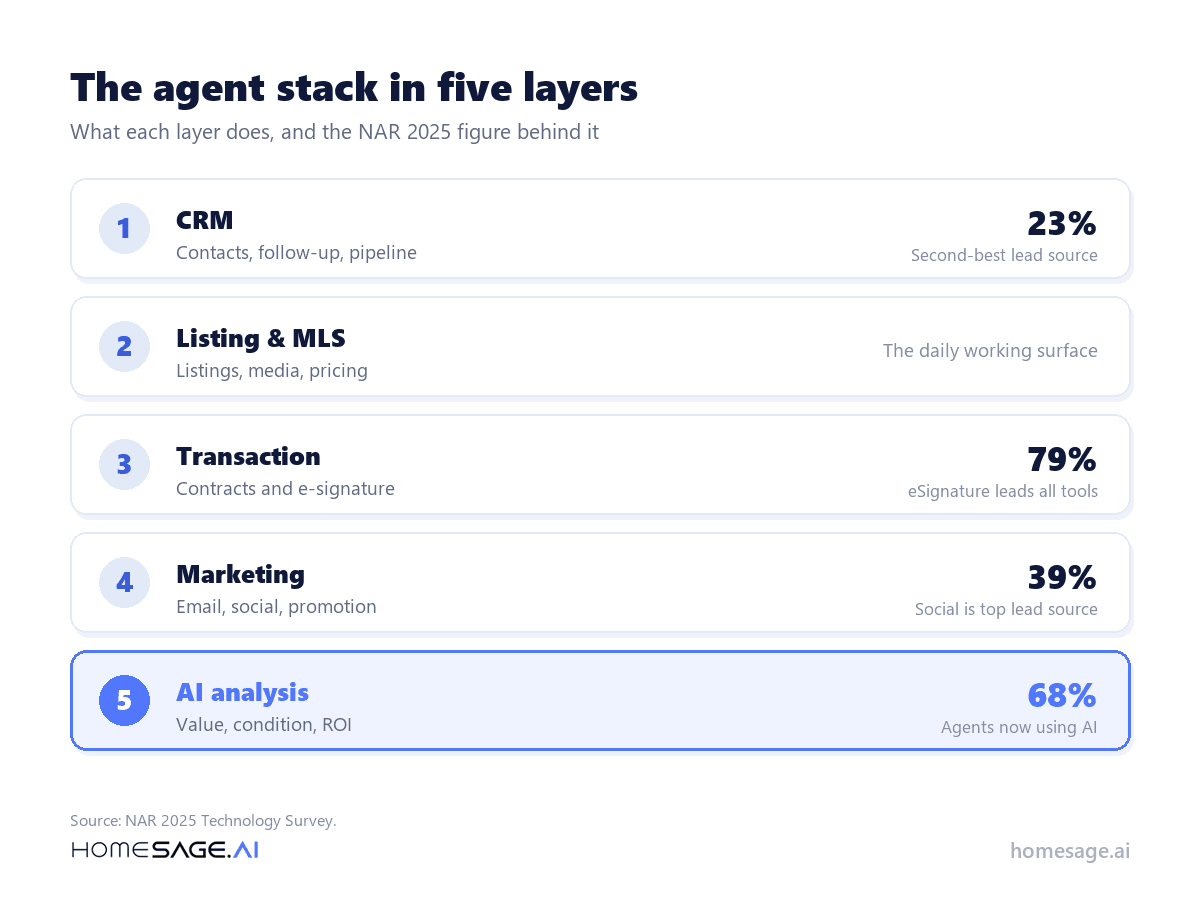
The backbone of the business: tracking leads, follow-ups, and past clients so nothing slips. NAR found CRM to be the second most effective lead-generating technology at 23%, behind social media at 39%.
That's the single biggest fixable gap in most agents' stacks. Look for a CRM with automated follow-up, mobile access, and, increasingly, AI-powered insights. If you're choosing where to get organized first, this is it, because every other tool eventually feeds into your CRM.
2. Listing and MLS tools
How agents search inventory, post listings, and pull comparable sales. This is the daily workspace for finding and pricing property, and it's where most agents already spend their screen time.
The agents who stand out here pair MLS data with automated, data-backed comps rather than eyeballing three recent sales. When you evaluate these tools, prioritize accurate comps, fast search, and clean photo and status management.
3. Transaction management
Handles contracts, disclosures, and e-signatures. It's no surprise eSignature tops NAR's usage list at 79% - it's the one piece of technology nearly every closing now touches, and clients now expect it.
Good transaction software reduces errors, keeps compliance tidy, and moves a deal from accepted offer to close without a paperwork bottleneck.
4. Marketing tools
Email, social, and listing-promotion tools that keep an agent visible and generate leads. Social media's 75% adoption and its top spot for lead generation (39%) show how central this layer has become.
NAR also found 46% of agents using AI-generated content, often for listing descriptions. The winning approach is consistency: a steady cadence of listings, market updates, and helpful content beats occasional bursts, and AI drafting makes that cadence sustainable.
5. AI analysis tools
The newest and fastest-growing layer. NAR's survey puts AI adoption at roughly 68%, with ChatGPT the most common tool (58%), followed by Gemini (20%) and Copilot (15%). But general chatbots don't analyze a specific property - they can draft a listing description, not tell you whether 123 Main Street is a good deal.
That's where purpose-built tools come in: the Homesage.ai DealFinder Browser Extension analyzes any listing from the browser across 155M+ properties, so an agent can answer an investor client's value, condition, and rental questions on the spot. For a wider view, see our roundup of real estate technology tools for agents.
The Agent Stack in One View
- CRM - Manage clients and follow-ups. Nothing falls through the cracks (still underused by many agents).
- Listing / MLS - Search, list, and price property. Daily deal-finding workspace.
- Transaction - Contracts and e-signature. eSignature is the #1 tool at 79% adoption.
- Marketing - Email, social, promotion. Social is the top lead source (39%).
- AI analysis - Instant value, condition, ROI. Advise clients on the spot (DealFinder).
This maps software categories, not specific brands, so you can slot in the tools you already use.
How Much Do Agents Spend on Technology?
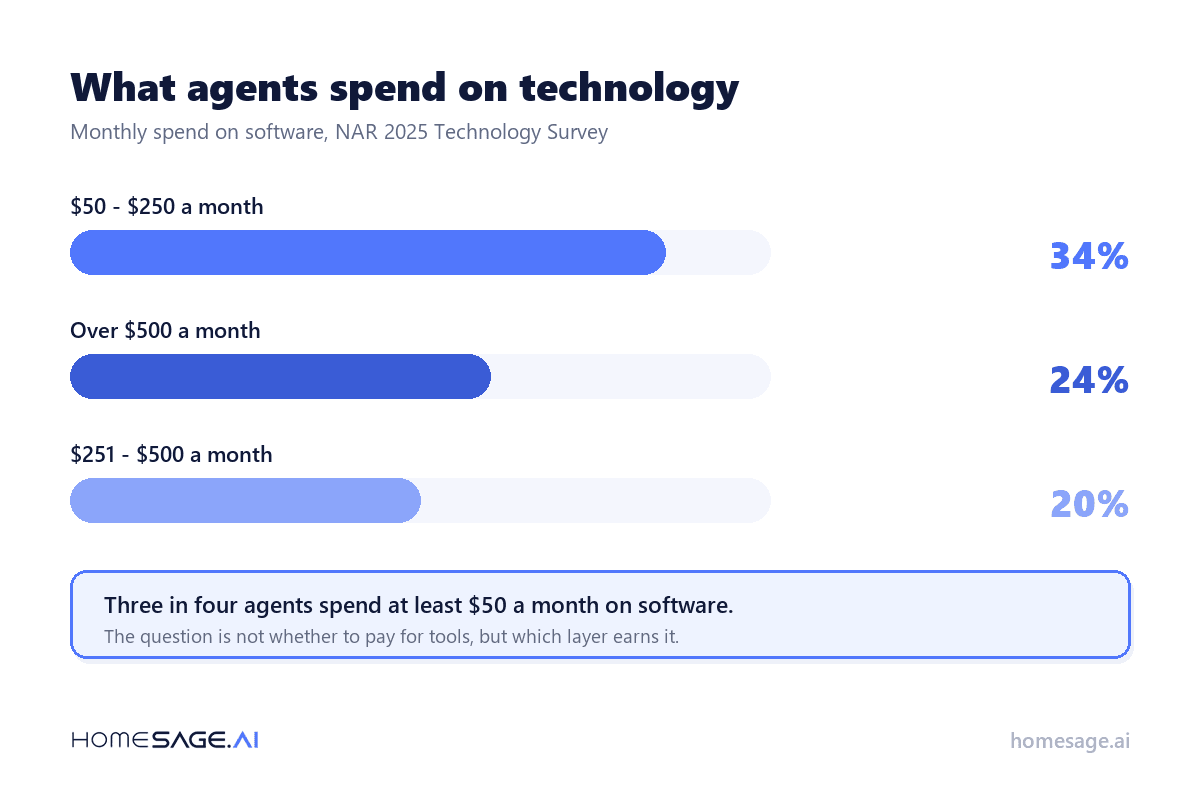
More than you might expect, and it's rising. NAR found roughly 34% of agents spend $50-$250 a month on technology, 20% spend $251-$500, and 24% spend more than $500 a month.
The spending is moving toward tools that produce answers, not just store data - which is why AI analysis is the layer to add if you already have the basics covered. The goal isn't to buy the most software; it's to cover the five categories without paying for five overlapping tools.
How to Build Your Stack, by Experience Level
New agent
Start lean: a CRM (even a simple one), your brokerage's MLS access, an eSignature tool, and one social channel you post to consistently. Add an AI analysis tool early - it makes you sound like a veteran when a client asks about a property's real value.
Established agent
You likely have the basics. The gap is usually integration and AI: connect your CRM to your marketing and add a property-analysis tool so you can respond to client questions in minutes, not days.
Investor-focused agent
Your edge is analysis. Lean hard into AI valuation, ARV, and rental forecasting so you can bring investor clients data-backed recommendations they can't get from a generalist agent.
Common Mistakes Agents Make with Software
- Buying tools, they never fully adopt - CRM only works if you keep it updated.
- Stacking overlapping subscriptions instead of covering the five categories cleanly.
- Relying on general AI chatbots for property analysis they're not built to do.
- Ignoring the AI analysis layer entirely and losing investor clients to agents who use it.
What Separates a Modern Agent Stack in 2026
The difference isn't more tools - it's the AI layer working on real property data. An agent who can pull an instant, data-backed read on any property wins investor clients and prices listings with confidence, while competitors are still waiting on a manual CMA.
To go deeper on the client-facing side, our guides to the best APIs realtors can use to increase sales and AI-powered CMA tools are good next reads. Pair an AI analysis tool with a CRM you keep updated, and you have covered the two layers most agents get wrong.
It also pays to keep a pulse on what is emerging, so your stack doesn't fall a year behind the market - see our real estate technology news roundup of platforms to find off-market deals.
The CRM Problem: The Most Underused Tool in the Stack
Here is the gap that costs agents the most money. NAR ranks CRM as the second most effective lead-generating technology at 23%, behind only social media at 39% - and yet it's the layer agents most often buy and then abandon.
The reasons are familiar: you're too busy to set it up properly, or you subscribe and never keep it current. But math is unforgiving. A lead you forget to follow up on is a commission you gave away. If you do one thing after reading this, adopt a CRM you'll maintain, even a simple one. It's the layer with the clearest return for the least effort.
How AI Is Changing Each Category
AI isn't a sixth silo bolted onto the stack - it's quietly upgrading the other four. CRMs now score and prioritize leads. Listing tools generate descriptions and suggest pricing. Marketing tools draft and target content, which is why 46% of agents already use AI-generated content.
Transaction tools flag missing documents. The agents who benefit most are not the ones chasing a single magic app; they're the ones choosing tools in each category that have AI built in, so the whole stack gets smarter at once.
Free Versus Paid Tools for Agents
You don't need an expensive stack to start. Free general AI chatbots handle content drafting, your brokerage often provides MLS access, and many CRMs have free tiers.
Where paying is worth it's property analysis: a purpose-built tool that reads value, condition, and ROI across 155M+ records does something free chatbots simply can't.
The smart budget spends little on the categories where free is fine and invests in the AI analysis layer that wins investor clients.
A Recommended Starter Stack
If you're assembling or auditing your tools, here is a clean five-part stack that covers everything without overlapping: one CRM you commit to keeping updated; your brokerage or MLS listing access; a reliable eSignature and transaction tool
one marketing channel you post to consistently, with AI drafting to keep the cadence; and one AI analysis tool for instant, data-backed property reads.
That last layer is the differentiator in 2026 - it's what lets you answer a client's value, condition, or ROI question on the spot instead of promising to get back to them. Cover those five, keep them connected, and you have the stack that most top-producing agents run.
More tools rarely help; the agents who win are the ones who use these five well, not the ones with the longest list of subscriptions.
What Is Coming Next for Agent Software
The direction of travel is clear from NAR's own numbers: AI usage now sits at roughly 68% of agents, and the fastest growth is in tools that analyze rather than just store.
Expect the five categories to keep merging - CRMs that score leads, listing tools that price automatically, marketing that targets itself - with property analysis becoming standard expectation rather than an edge.
For agents, the practical implication is simple: the baseline is rising. A data-backed answer to a client's property question, delivered in minutes, is quickly moving from a differentiator to a requirement. The agents who adopt the AI analysis layer now will be fluent in it when clients start assuming everyone has it.
Key Takeaways
- The modern agent stack has five layers: CRM, listing/MLS, transaction, marketing, and AI analysis.
- Per NAR 2025, eSignature (79%) and social (75%) lead, AI adoption is roughly 68%, and the CRM remains the most underused high-value tool.
- General chatbots draft content; purpose-built tools like the Homesage.ai DealFinder analyzes a specific property.
- Most agents spend $50-$500/month - invest in the AI analysis layer once the basics are covered.
- A clean five-part stack beats a long list of overlapping subscriptions.
Conclusion
The modern agent stack isn't about adding more tools — it's about the AI layer on top of them. Your CRM, MLS, transaction software, and marketing platforms aren't going anywhere. What changes is what sits above them: instant, data-backed property intelligence that lets you advise clients on the spot, with confidence, without having to run back to the office or wait for a report.
The agents who win in today's market aren't the ones with the most tools — they're the ones who can answer the hard questions in real time. What's this property worth? What would it rent for? What condition is it really in? How flexible is the seller?
The Homesage.ai Deal Finder brings value, condition, rental potential, and Seller Motivation Score into the tools agents already use — no new workflow, no steep learning curve. It works wherever you're already working.
The market is moving toward AI-first advisors. The agents who adopt that layer first will out-advise, out-close, and out-earn the ones who wait. The question isn't whether to add AI to your stack — it's whether you add it before or after your competition does





Emma August 12, 2026
great read
Nourhan August 12, 2026
Useful breakdown. The CRM point hits hardest — adoption beats features every time.