
What the gross rent multiplier means
The gross rent multiplier, or GRM, compares what a rental property costs with the rent it brings in. Gross rent is the rent before vacancy, repairs, or any other cost comes out.
GRM = price ÷ (monthly rent × 12). A lower GRM means each dollar of price buys more rent. Stessa's guide to the gross rent multiplier says a GRM below similar properties in the same market makes an investment more attractive.
- Price: use the list price, or your offer once you have one.
- Gross rent: 12 months of rent before any cost comes out.
- Market: compare only with similar properties in the same ZIP code.
- Use: a fast screen to sort a list before you run the full numbers.
A real example from 4 Homesage.ai reports
We ran a Full Property Report on 4 single-family properties listed for sale on 14 October 2026. Each report shows a rent estimate and the GRM at the list price.
| Property | List price | Rent estimate | GRM |
|---|---|---|---|
| Detroit, MI 48214 | $165,000 | $1,726 a month | 8.0 |
| Detroit, MI 48206 | $160,000 | $1,609 a month | 8.3 |
| Phoenix, AZ 85015 | $395,000 | $2,525 a month | 13.0 |
| Atlanta, GA 30318 | $449,900 | $2,050 a month | 18.3 |
The Detroit property in 48214 costs 8.0 years of rent. The Atlanta property costs 18.3 years. For each dollar of yearly rent, the Atlanta buyer pays more than twice as much.
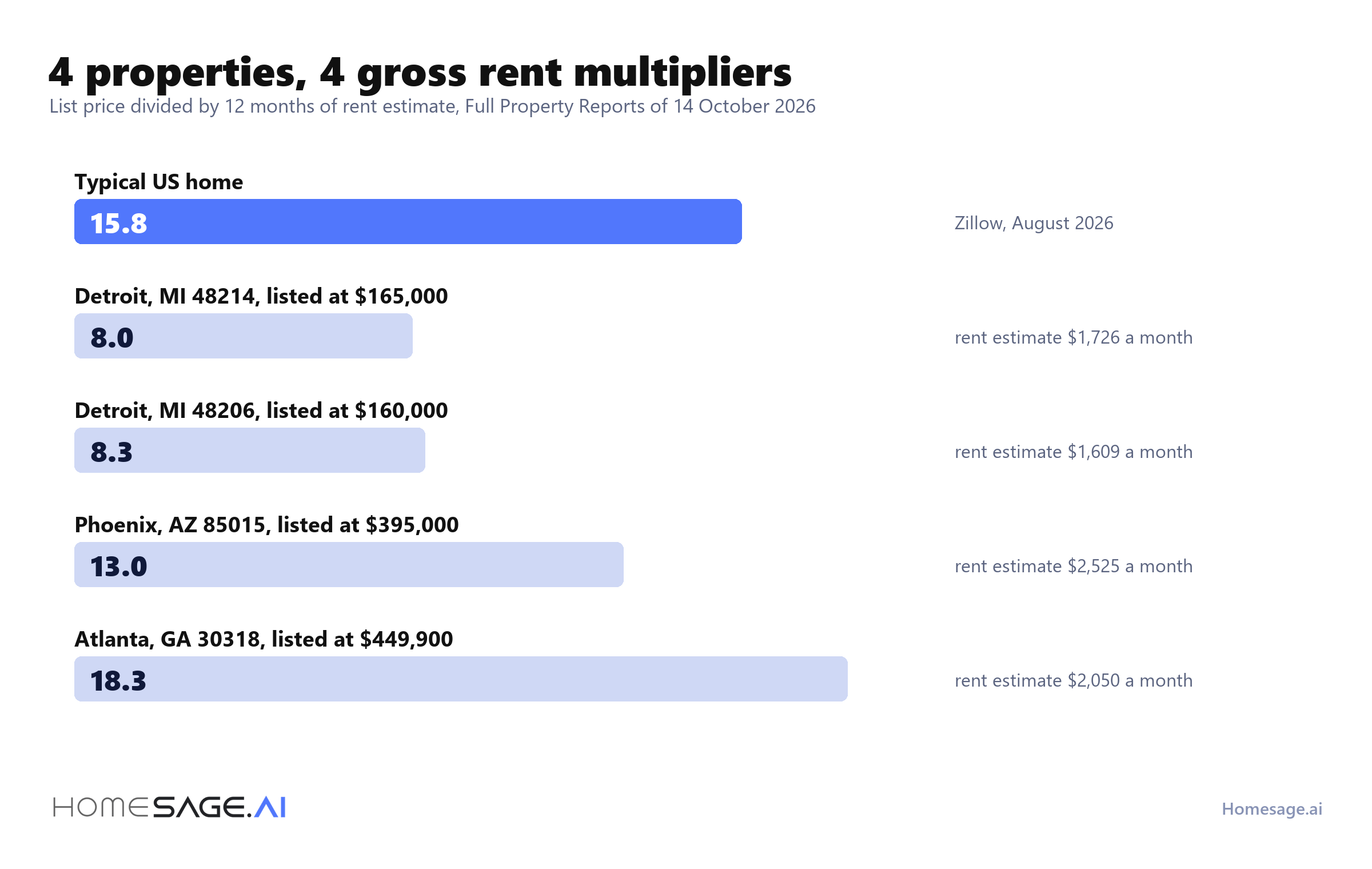
For a national benchmark, Zillow's August 2026 figures put the typical US home value at $369,678 and the typical rent at $1,948 a month. That works out to a GRM of about 15.8 for the typical home.
The Detroit property earns back its price in 8 years of rent. The Atlanta property takes 18.
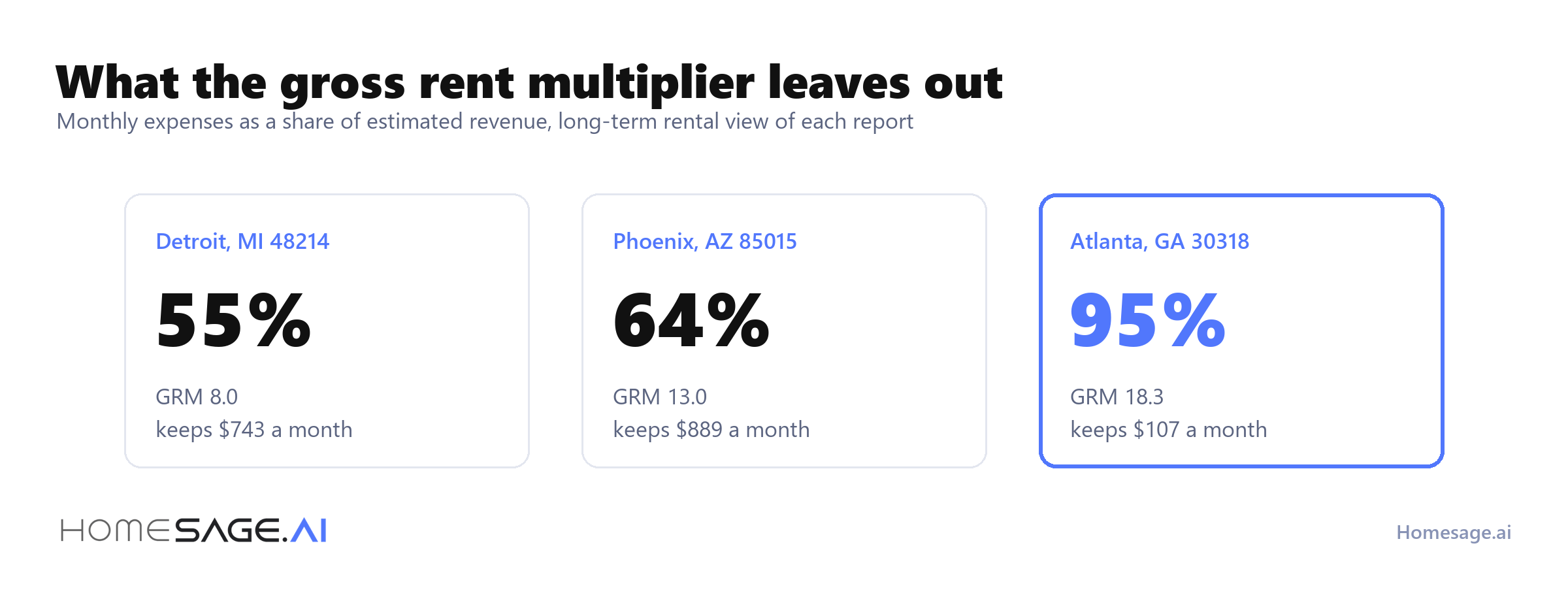
GRM skips every cost. The long-term rental view in each report sets monthly expenses against the estimated monthly revenue. Expenses take 55% of revenue on the Detroit 48214 property and 95% on the Atlanta property. The Atlanta property keeps an estimated $107 a month before any loan payment, against $743 for the Detroit 48214 property.
How to work out the gross rent multiplier
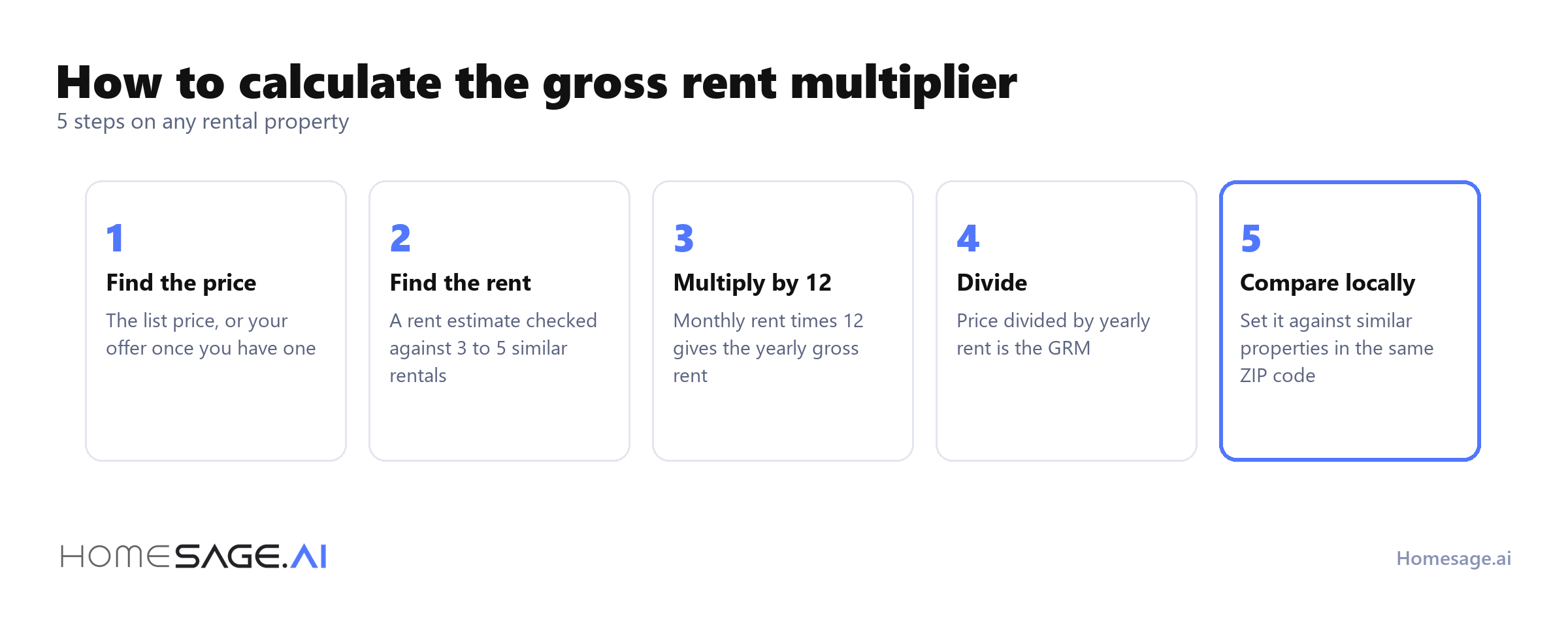
- Find the price. Use the list price, or your offer once you have one.
- Find the monthly rent. Start from a rent estimate for the exact address, then check it against 3 to 5 similar rentals nearby. Our guide on how much you can rent a property for walks through that check.
- Multiply the monthly rent by 12. For the Phoenix property, $2,525 × 12 = $30,300 a year.
- Divide the price by the yearly rent. For the Phoenix property, $395,000 ÷ $30,300 = 13.0.
- Compare the result with similar properties in the same ZIP code.
What moves the gross rent multiplier up or down
Price moves faster than rent. Zillow puts US rent growth at 2.5% for the year to August 2026, so a price cut changes the GRM the same day. The Phoenix property's list price fell from $435,000 on 7 August to $395,000 on 13 October. At the same rent estimate, its GRM dropped from 14.4 to 13.0.
Location sets the range. The 2 Detroit properties sit at 8.0 and 8.3, and the Phoenix and Atlanta properties sit at 13.0 and 18.3. A GRM only means something next to sales and rents in the same ZIP code.
Common gross rent multiplier mistakes to avoid
- Comparing GRMs across cities: An 8.0 in Detroit and a 13.0 in Phoenix come from 2 different markets. Compare each one with its own ZIP code.
- Reading a low GRM as profit: GRM skips costs. The Atlanta report puts expenses at 95% of revenue.
- Using the short-term rental figure: The Atlanta report estimates $2,908 a month as a short-term rental, against a $2,050 rent estimate. That figure comes before cleaning and platform fees, so it flatters the GRM.
- Leaving out repairs: If a property needs work before a tenant moves in, add the estimated renovation cost to the price before you divide.
Frequently asked questions
What is a good gross rent multiplier?
Is a lower gross rent multiplier better?
How is the gross rent multiplier different from cap rate?
Can I use the gross rent multiplier on a single-family rental?
Does the gross rent multiplier include repairs?
Ask Sage what a property rents for
Sage, our assistant, returns a rent estimate for any US address from inside the AI tool you already use.
- Homesage.ai Full Property Reports for 4 single-family properties in Detroit (48214 and 48206), Phoenix (85015), and Atlanta (30318), generated 2026-10-14.
- Zillow August 2026 Market Report, published 2026-09-08.
- Stessa, gross rent multiplier guide, updated 2024-12-23.