
Traditional appraisals take 1–3 weeks and cost $300–$600 per property, according to HUD appraisal cost data. For hard money lenders closing deals in days, that timeline is a deal-killer. Automated property valuation systems for lenders have become the operational backbone of modern hard money underwriting, delivering collateral intelligence in seconds, not weeks.
This guide covers what hard money lenders need to evaluate, select, and deploy AVM systems at scale.

What Is Automated Property Valuation for Lenders?
An automated valuation model (AVM) is a software system that estimates a property’s market value using algorithms, comparable sales data, public records, and AI, without requiring a physical inspection. For hard money lenders, AVMs serve one specific function: delivering a rapid, data-backed view of collateral value so you can make faster underwriting decisions on fix-and-flip loans, bridge loans, and BRRRR acquisitions.
Modern enterprise AVMs output far more than a price estimate:
- Market value estimates with confidence scores indicating data reliability
- After Repair Value (ARV) projections based on comparable renovated sales
- Renovation cost estimates derived from property condition analysis
- LTV validation flags when a property falls outside acceptable risk thresholds
The confidence score is especially critical for hard money use cases. A low-confidence output, common in rural markets or properties with few comparables, signals escalation to a hybrid appraisal, not a green light to proceed on the AVM alone. For a broader look at how lenders are using predictive analytics tools across their underwriting stack, that comparison covers the full landscape.
Why Hard Money Lenders Depend on AVMs More Than Anyone
Hard money lending operates on a fundamentally different timeline than conventional mortgage lending. Borrowers come to you because banks are too slow. Your edge is speed, and speed requires eliminating manual bottlenecks from collateral review.
According to the Mortgage Bankers Association’s 2025 Home Equity Lending Study, 47% of total HELOC and home equity loan originations in 2024 were subject to an AVM, the highest adoption rate on record and more than double the share seen in 2019 and 2020.
For hard money lenders, valuation accuracy carries higher stakes than for conventional lenders. Your loans are asset-backed at 65–75% LTV, which means collateral value is your primary risk control. A mis-valued property at origination compounds across the loan lifecycle, especially on fix-and-flip deals where the exit depends entirely on ARV accuracy. Understanding how to estimate ARV with AI is one of the highest-leverage skills a hard money operation can build.
Hard money lenders using hybrid AI valuation systems consistently report significant reductions in appraisal cycle time, turning what was a week-long bottleneck into a same-day or next-day output.

The 4 Core Components of an Enterprise AVM System
Not all AVMs are suited to hard money workflows. When evaluating a system, you need four components working together; any system missing one of them is likely a consumer-facing home value tool repurposed for lending, not built for it.
| Component | What It Does | Why It Matters for Hard Money Lenders |
|---|---|---|
| Property Condition Assessment | Analyzes physical condition via computer vision or data proxies | Prevents over-lending on distressed assets with hidden repair needs |
| ARV Engine | Projects post-renovation value from comparable renovated sales | Core to fix-and-flip and BRRRR underwriting; the exit depends on this |
| Renovation Cost Estimator | Estimates repair costs from condition data | Validates borrower rehab budgets before you commit capital |
| Confidence / FSD Score | Rates the reliability of the estimate based on data availability | Tells you when to escalate to a hybrid appraisal instead of relying on the AVM |
The top-rated AVM platforms in 2026 for hard money use cases all include these four components, though the depth of property condition assessment varies significantly across providers.
For teams building AVM governance from scratch, our breakdown of the essential AVM quality checks maps directly to FFIEC examiner expectations.
How to Select and Integrate an AVM Into Your Lending Workflow
Selecting an AVM for high-volume use requires evaluating it against your specific deal mix, not just abstract accuracy benchmarks.
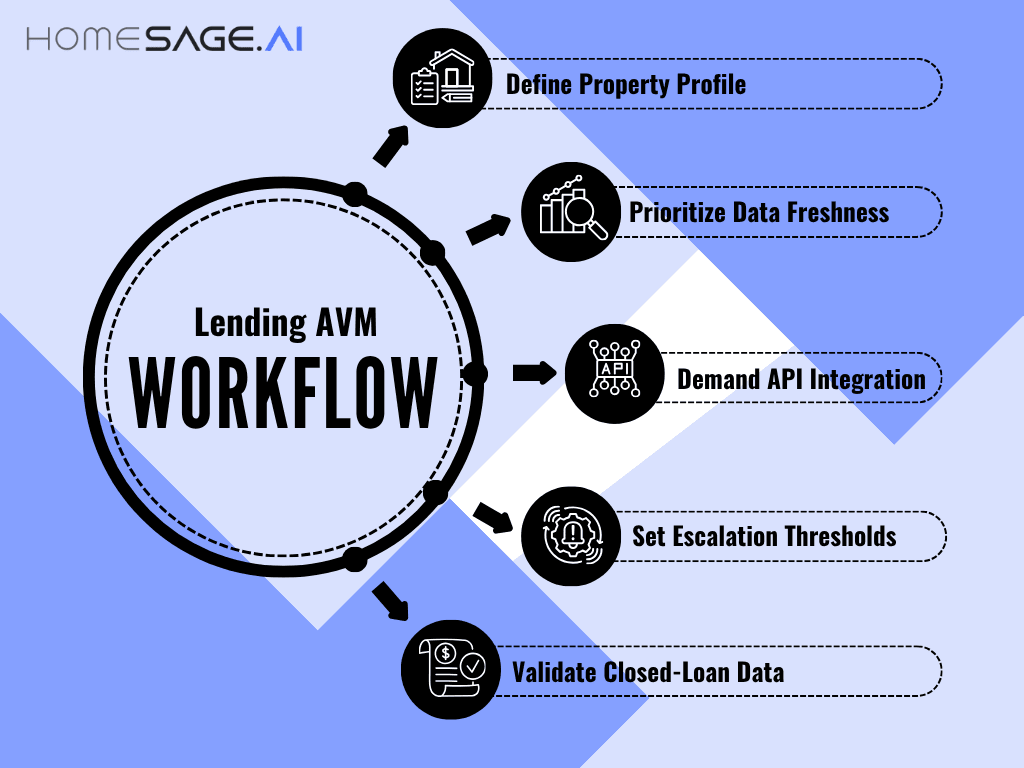
Define your property profile first. AVMs perform best on standard single-family homes in suburban markets with active comparable sales. If you lend heavily in rural areas or thin-data markets, prioritize providers with explicit confidence flagging and deep data coverage outside major metros.
Prioritize data freshness. A valuation built on six-month-old comparables in a shifting market is a liability. Enterprise systems for active lenders should reflect new sales as they close, not quarterly data refreshes.
Demand API integration, not just a web portal. The most efficient hard money operations embed AVM outputs directly into their loan origination system. A provider offering a documented real estate data API lets you pull valuations automatically at the point of application. The APIs built for hard money lenders cover the specific endpoints that matter for underwriting. See also how lenders use real estate data APIs to speed up due diligence end-to-end.
Establish escalation thresholds before you go live. Define internal rules: if the confidence score falls below a set level, or the borrower’s ARV claim exceeds the AVM output by more than a defined percentage, require a hybrid appraisal before proceeding.
Validate against your own closed-loan data. Pull 50–100 closed loans, compare AVM estimates at origination to actual sale prices, and measure the error rate for your specific deal mix. No external benchmark tells you more than your own portfolio history.
Where AI-Powered Valuation Separates from Basic AVMs
Standard AVMs produce price estimates. AI-enhanced systems layer on computer vision property condition scoring, neighborhood trend forecasting, renovation cost breakdowns, and real-time risk flags, the full picture a lender needs before committing capital.
Homesage.ai is an AI-powered real estate data platform that analyzes 155M+ US properties using machine learning models incorporating over 50 data points per property, including property condition assessments, renovation cost estimates, ARV projections, and investment potential scoring built for lenders working at speed. Homesage.ai for lenders describes how the platform fits active lending workflows.
Full Property Reports deliver the data depth needed to accelerate due diligence without sacrificing accuracy. For context on how AI is reshaping throughput across the industry, the full guide to AI workflows for hard money lenders covers the broader operational picture.
Regarding compliance: the CFPB’s AVM quality control standards, finalized in 2024 and effective October 2025, require mortgage originators to implement policies ensuring AVM outputs are accurate and free of demographic bias, a key reason to use enterprise-grade systems with documented validation rather than consumer-facing tools. Independent research published by the Urban Institute found AVMs can produce valuation errors that vary by neighborhood demographics, precisely the kind of bias the CFPB rule targets. For a lender-focused breakdown of how AVM usage is reshaping appraisal fee structures, see Bankrate’s 2026 home equity closing cost analysis.
Key Takeaways
- AVM adoption in lending is accelerating sharply: Usage on home equity loans jumped 20 percentage points year-over-year in 2024, with adoption expected to exceed 50% of alternative valuation products by late 2026.
- Hard money lenders carry higher valuation risk than conventional lenders. Collateral value is your primary underwriting control, which means AVM accuracy directly affects portfolio performance.
- Enterprise AVM systems for hard money use must include four components: property condition assessment, ARV engine, renovation cost estimator, and confidence/FSD scoring; a system missing any of these isn’t built for your use case.
- API integration is the force multiplier: embedding AVM outputs into your LOS eliminates manual lookup bottlenecks and lets you evaluate more applications per day without adding underwriting headcount.
- AI-powered platforms like Homesage.ai deliver instant access to property condition scoring, renovation cost estimates, and ARV projections across 155M+ US properties, with the data depth and speed to meet high-volume hard money underwriting demands.
Conclusion
Automated property valuation for lenders is no longer a technology experiment; it’s a current competitive baseline. Hard money lenders still relying on manual comps and full appraisals for every application are operating at a structural speed disadvantage against competitors who have embedded AVM intelligence into their underwriting pipeline.
The lenders gaining ground in 2026 aren’t just using AVMs to reduce appraisal costs. They’re using them to evaluate more deals, build consistent collateral risk frameworks, and create a data layer that compounds decision quality over time. That starts with selecting a system built for hard money workflows, integrating it at the API level, and setting clear escalation rules for assets where automation needs a human check.
Want to see how lenders are putting AI and real estate data APIs to work beyond valuation? This video walks through how hard money lenders and mortgage professionals are using Homesage.ai‘s API-driven data to sharpen their marketing targeting and portfolio analytics. A practical extension of the AVM workflow covered in this guide.
Explore Homesage.ai’s real estate APIs to see how Automated Property Valuation integrates into your lending workflow or book a demo to walk through how hard money lenders are using it today.
People Also Ask
Q: Can hard money lenders use AVMs instead of traditional appraisals?
A: Hard money lenders can use AVMs for initial screening on standard residential properties, but most high-volume operations use a hybrid approach. AVMs for rapid risk flagging, with full or hybrid appraisals reserved for complex assets or low-confidence outputs. Federal regulations finalized in 2024 require quality control standards and bias testing for AVM use in formal lending, effective October 2025.
Q: What is the best automated property valuation system for hard money lenders in 2026?
A: The best AVM for hard money operations combines property condition assessment, ARV projection, renovation cost estimation, and a confidence score. AI-powered platforms covering 155M+ US properties with real-time data and API integration capability are best suited to high-volume underwriting where both speed and collateral accuracy matter.
Q: How accurate is automated property valuation for lenders?
A: Leading enterprise providers report accuracy within 5–10% of full appraisal values for 85–90% of properties in active suburban and urban markets. Accuracy drops for rural properties and thin-data markets, which is why confidence scoring and escalation thresholds are essential components of any enterprise AVM deployment.
Q: How do I integrate an AVM into my loan origination system?
A: Most enterprise AVM providers offer a real estate data API that connects directly to your LOS or underwriting platform, allowing automated valuation pulls at the point of application. Define escalation rules before going live; your team needs to know when the AVM output is sufficient and when a hybrid appraisal is required.





Sally April 8, 2026
An excellent guide for lenders!
N April 8, 2026
Great Read!
Peter April 8, 2026
Very helpful for lenders!
Nourhan May 3, 2026
Very helpful!